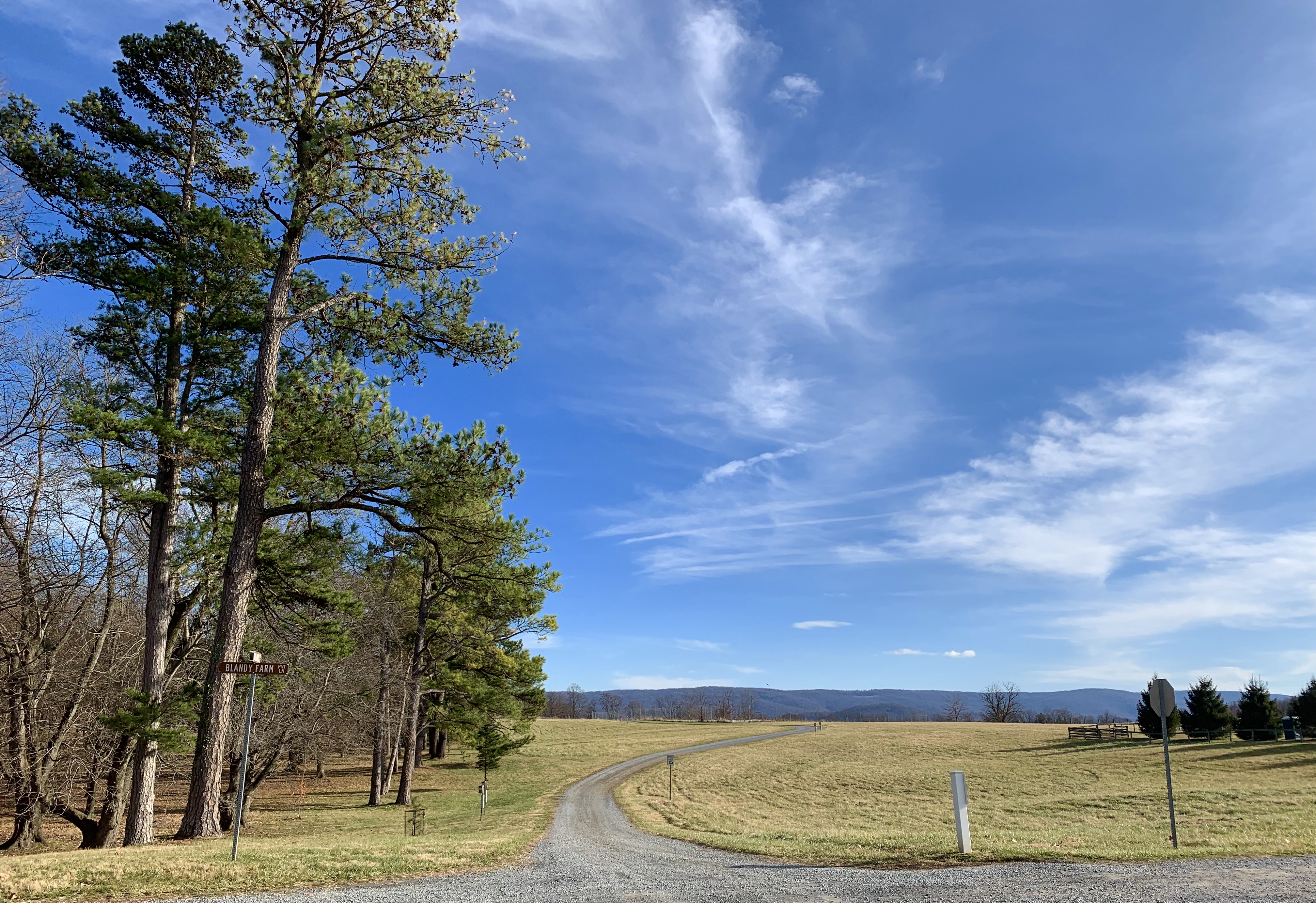
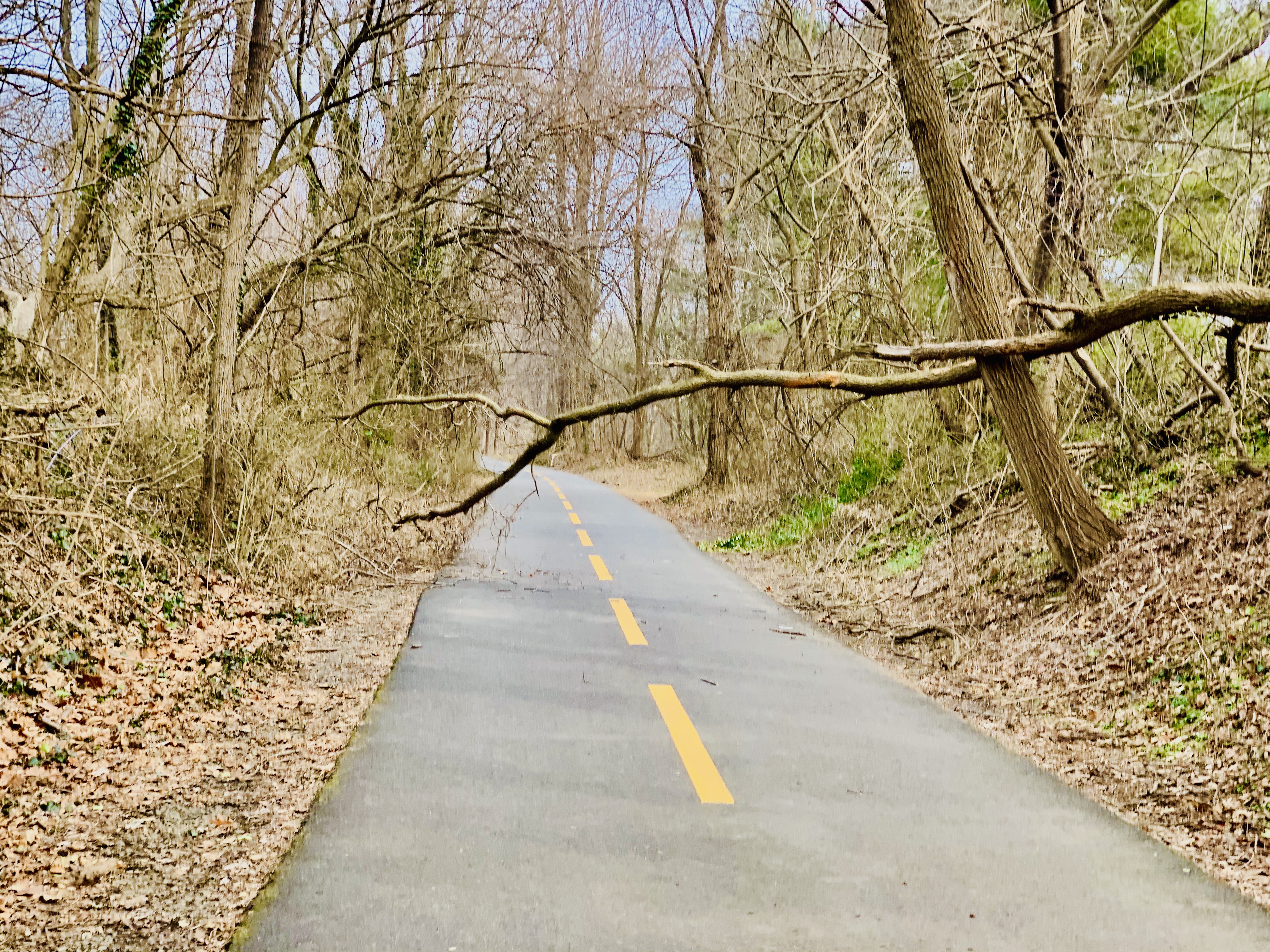
With every step, I grow closer to seeing my friends. My friends are trees that I have grown to love during the miles of walks that my two dogs and I have taken.
To be outdoors, surrounded by nature, in the company of my dogs is what I love so. Let it rain. The wind can blow. The temperatures can drop. We walk. We have discovered magical secret places and mystery in the ordinary.
Had I known that I would fall for trees with bare branches and walk, even run to greet them, I would have laughed. Trees? Really? Yes. Trees. Until this year, I only liked trees bedecked with lush green foliage and my heart would plunge into despair as the last leaves drifted to the ground.
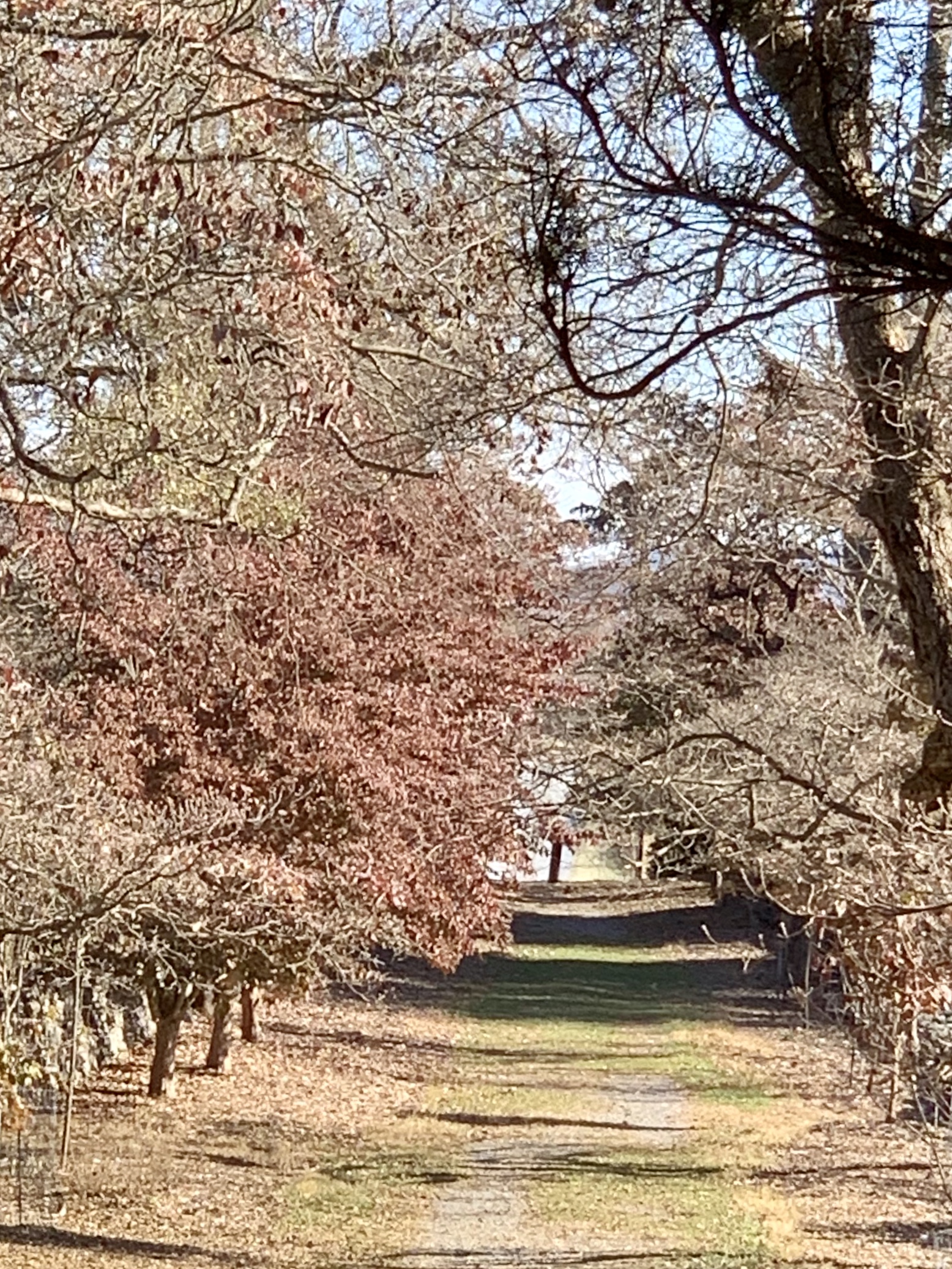
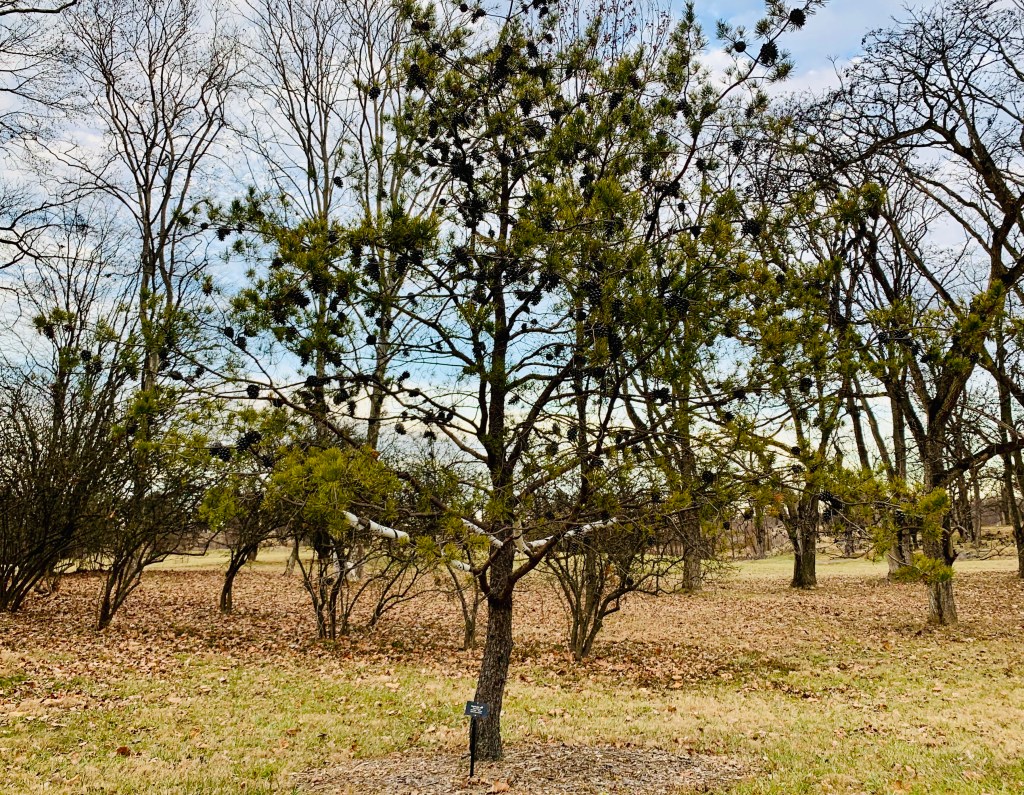
Last fall, something happened. It was a gift. My eyes were opened to the textures, colors, shapes, decorations, and outlines of bare branches against brilliant skies. From the ordinary cedar to the oak, to the sweet gum tree with its spiny fruit, to the many varieties of holly, to sycamores with pin cushion fruit, and magnificent evergreens of unexpected shapes – I love them all.
Our walks have taken us to arboretums, parks, and paths. My choice is to take the road less traveled. I smile when I reflect upon poem, “The Road Not Taken”
“…Two roads diverged in a wood, and I- I took the one less traveled by, And that has made all the difference.” Robert Frost
Walking with my sweet dogs at my side, with my ear pods secured by ear warmers, poetic music streaming through my iPhone, my mind wanders through stanzas and Sonnets. People who pass us must find me strange smiling at a tree.
“When lofty trees I see barren of leaves, Which erst from heat did canopy the herd, And summer’s green all girded up in sheaves, Borne on the bier with white and bristly beard, Then of thy beauty do I question make,” Shakespeare Sonnet XII
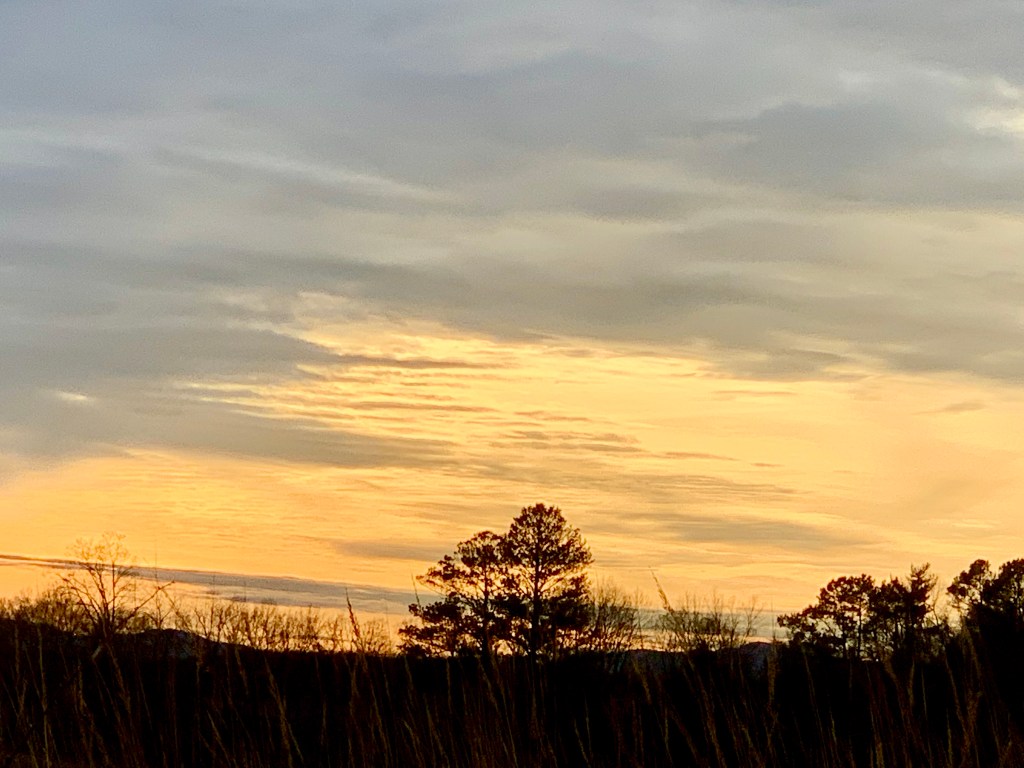
This season I experience something different and have tried to understand that difference. Simply focusing upon the shapes and movements of the grasses and tree limbs has transformed my dreary winter existence into flourishing friendships with unexpected flora!
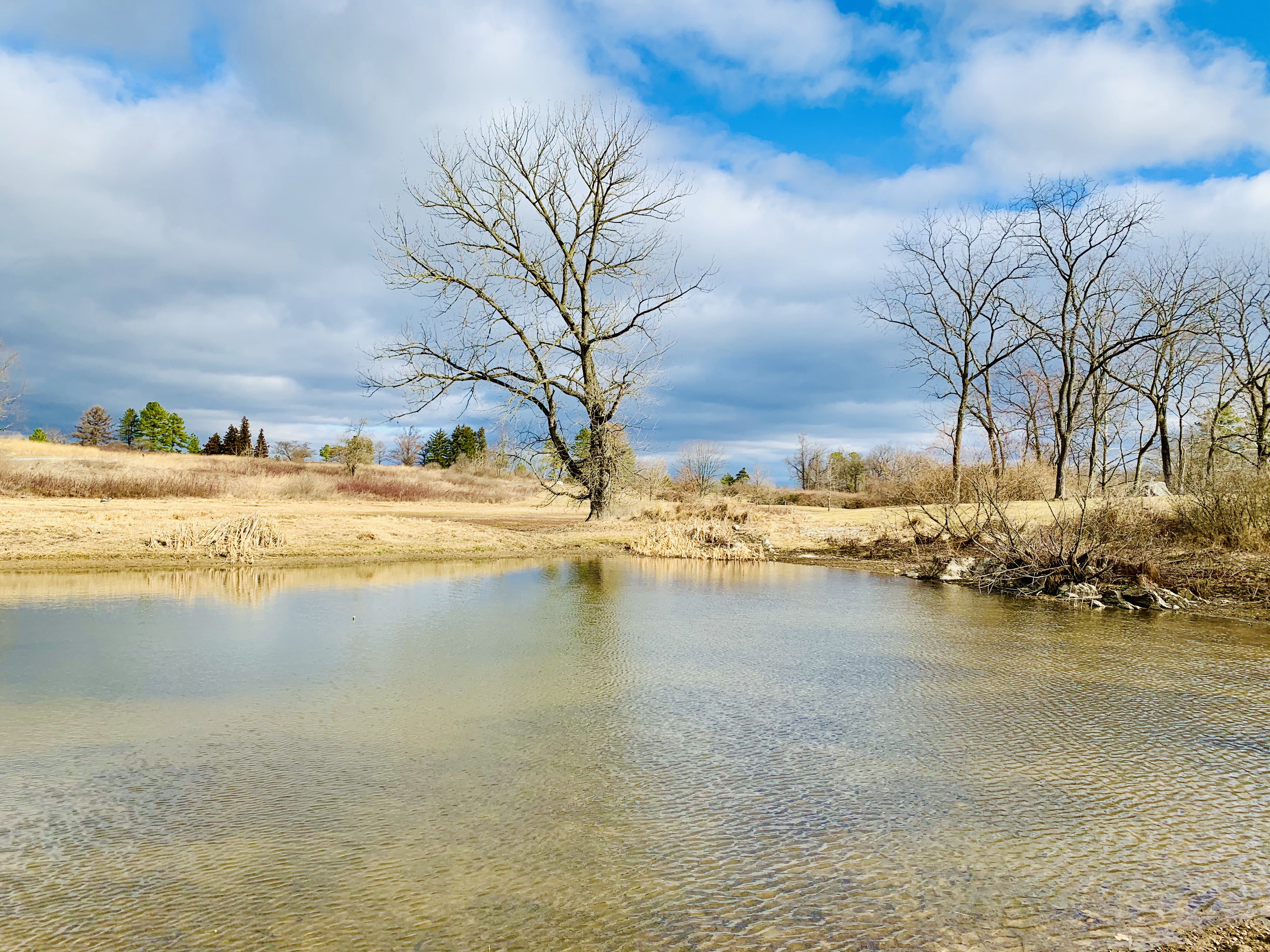
There are trees and then there are TREES! All I had to do was see. I saw a whole world of bare trees of incredible grace. There are outlines of branches against the sky and shadows on the ground. I laughed out loud at trees in shapes that would have delighted Dr. Seuss and caught my breath at the majesty of enormous trunks and sturdy limbs. Trees form canopies above meandering paths, and dot bucolic landscapes of resting fields.
Exploring secluded horse trails or traversing paved paths, there is always something new to spy. “And above all, watch with glittering eyes the whole world around you because the greatest secrets are always hidden in the most unlikely places. Those who don’t believe in magic will never find it.” – Roald Dahl
Ending our walks take much discipline –
“…The woods are lovely, dark and deep, But I have promises to keep, And miles to go before I sleep, And miles to go before I sleep.” From “Stopping By Woods on a Snowy Evening” by Robert Frost
Just before Christmas, I stopped in one of my favorite tack and feed stores, Tri-County Feeds, Fashions, and Finds in Marshall, Virginia, for a little last minute shopping. On the counter I saw a notice of a book signing by a horsewoman I have known for quite some time. Her resume was enticing and the book looked like a great gift idea. The next day, I returned with my pen and notepad ready to learn about the book and the author. When our interview ended, I purchased a dozen books which author, Joyce D’Auqila, carefully autographed for each of my friends.
Breaches is a relatable, warm story about Kate, a horse-crazy girl willing to do anything for the opportunity to be with and near horses. A woman with a dream and a plan, “She remained relentless in her thirst to know more and do better.”
A well-written, intelligent story about hearts and horses, Joyce capably describes the “unseeable” – how does one rider get performance from a horse that another rider cannot? In one case, it was, “Stronger seat and legs, a more demanding attitude…” Only an experienced rider and horseperson can delve so elegantly into that subject. Her description of a rider managing a difficult ride with a difficult horse, “Quiet persistence of patience – just being cool – … [the horse] not going to draw him into her drama . . . [the horse] changed her mind and began . . . to agree…” It is refreshing that a book about horses and riders is written by an experienced horsewoman. My need to cringe and shake my head never arose.
Those of us who ride or have ridden can so easily relate to the trials and tribulations, the emotions, the joys and the terrors of the heroine, Kate. Anyone who has seriously ridden a horse has had a rough landing at one time or another. Sometimes, those landings determine a rider’s future. This book emphasizes the need to get back on.
Joyce D’Aquila began her horse riding odyssey as a ten-year-old. She told me, “I was the hardest of the hardcore horse girls. I think that my first word was ‘horse.’ I slept with a plastic model horse of Trigger. It had hard stiff legs and often my mother would have to move it away from me if it was sticking into my side while I slept.”
“My parents were not terribly encouraging or supportive of my riding. I played the violin. It was very scary to have to tell them that I would be stopping violin but would continue with the horses,” recalled Joyce. Graduating with a degree in veterinary science, she worked for a veterinarian for a decade. She realized that while she worked very hard to maintain her horses, she was not seeing or riding them, “That is when I made the decision to go into horses professionally. I rode the tough ones, the ones that nobody wanted. You know, horses have a unique way of bonding and it has been determined that horses are very therapeutic. I have a good eye and can bring the best out of them. I can think like a horse and read their body language.”
“Are you Kate,” I asked. “No, not exactly, but my parents kept waiting for me to outgrow my horse passion,” she replied. ”The events and relationships, are fictional. The characters are composites of experiences and students that I taught. Some were students in private schools and others were in Pony Clubs,” she said. “Like Kate, I went against all odds and got on with it. I taught a ” Kate, “ who was a breath of fresh air. She was sharp and cool and so enthusiastic. Her hair would be flying around all the time. She was a little bit lacking in confidence because she was a little bit plump in school. Later, she became a beautiful woman.” Joyce told me.
D’Aquila is an experienced upper level “event” rider. Eventing is a riding discipline with three phases – dressage (obedience), cross country (galloping and jumping large “natural” obstacles in the open), and stadium jumping (jumping in an arena on a prepared surface). At the upper levels, this discipline, perhaps over others, takes enormous bravery on both the riders’ and horses’ parts. “There are so many horse-crazy girls and I wanted to capture the serious side, the commitment, the ethics as well as the personalities,” said Joyce. A key factor for Joyce is that the welfare of the horse always comes first, which is so aptly described in the story.
Breaches addresses trust and betrayal, love and pain, and pride and fear. These are thoughts and emotions that every horseperson experiences on some level most of the time. Yet, Like Kate, we persevere at all cost. Very engaging, this book has me waiting for the next volume. To purchase books, email Joyce at moedaq1@aol.com .
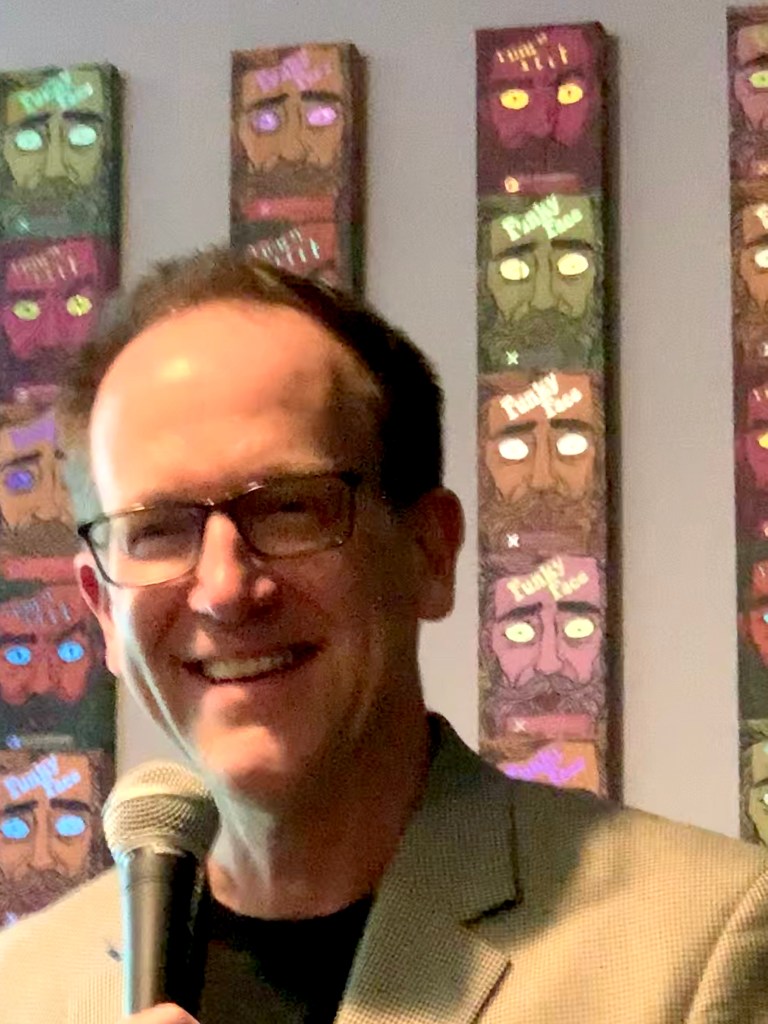
“Try to get the window seat on the right side of the aircraft when you are flying into Venice. You will see the ‘Big Fish” or Two Kissing Fish’, so fly during the day, ” said art historian, fifth grade teacher and travel enthusiast, John Daum. “It is a dream come true to stand here and know that we have this incredible brewery and all of these wonderful people in our community who have come out on a Thursday night, here, in this place that we all love, called Middleburg,” continued Daum. The January 9th talk was hosted by the Loudoun County Public Library at the Old Ox Brewery, Middelburg.
John Daum
Having seen this event promoted on Facebook, I was not sure that a library event was something I wanted to attend. I saw the promotion repeatedly and until an hour before the start, I was vacillating. Finally, I googled John Daum. What I discovered was a man who is passionate about art, travel, and his students. He is a teacher at the Hill School in Middleburg, his fortunate students learn about art history from this art-loving, traveling, enthusiastic man! OK! May I please be a fifth grader for his class? Needless to say, I picked up my notepad and pen and headed for Middleburg.
We were treated to a virtual tour of the mystical and magical city of Venice. No packing, No TSA, No connecting flights. Just a cold craft beer, some time with friends, and listened and watched as John delighted us with abundant images of well-known and many not-so-well known aspects of Venice.
The Windged Lion of Venice – the symbol of Venice
No streets no cars
Peaceful canals in out-of-the-way places
Images curtesy of John Daum
“Venice is one of my favorite places in the world…”, said Daum. He stressed that there are countless, “cool and unusual things about this city.” “It shouldn’t be there. But it is. This is a Disneyland and should have never happened. But it did happen and it was a world superpower for hundreds of years and a cultural hotspot even today. If you get lost in Venice – it’s ok because you are in Venice and it is an island. So get lost,” Daum told us.
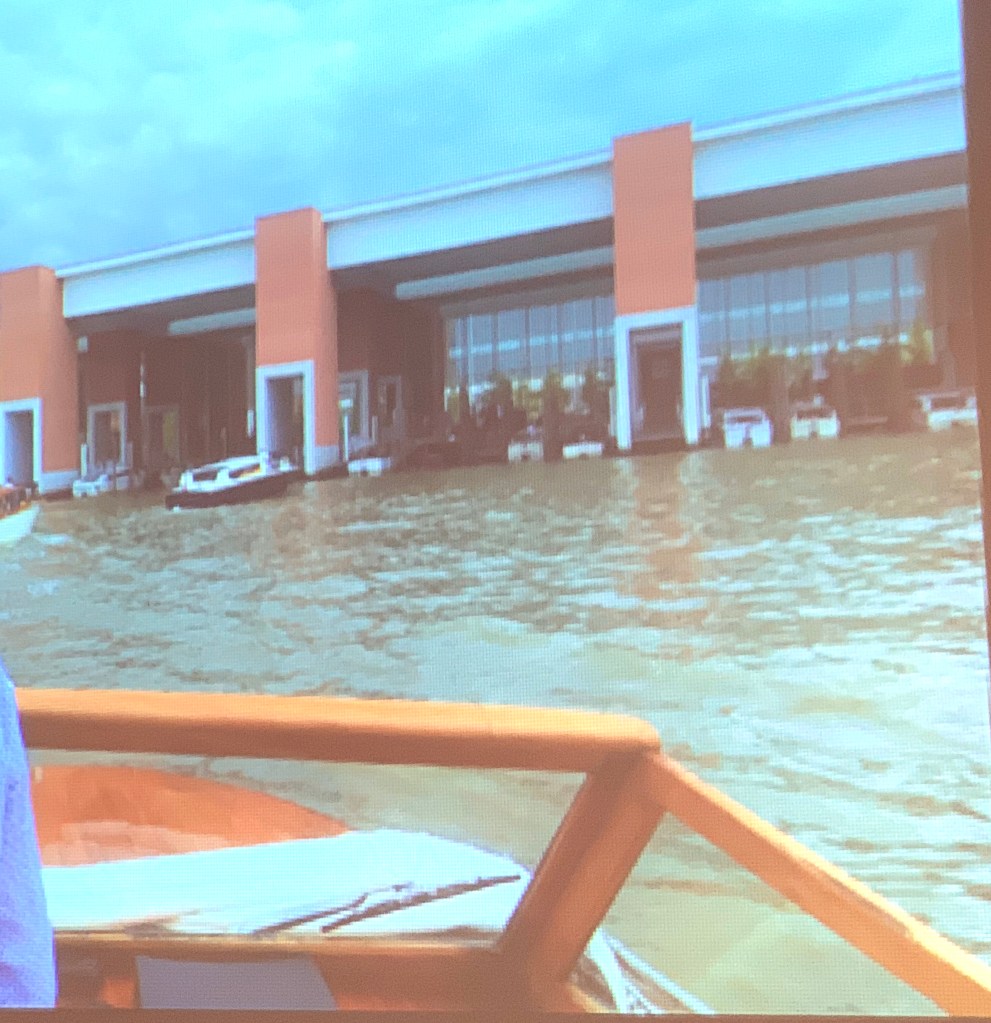
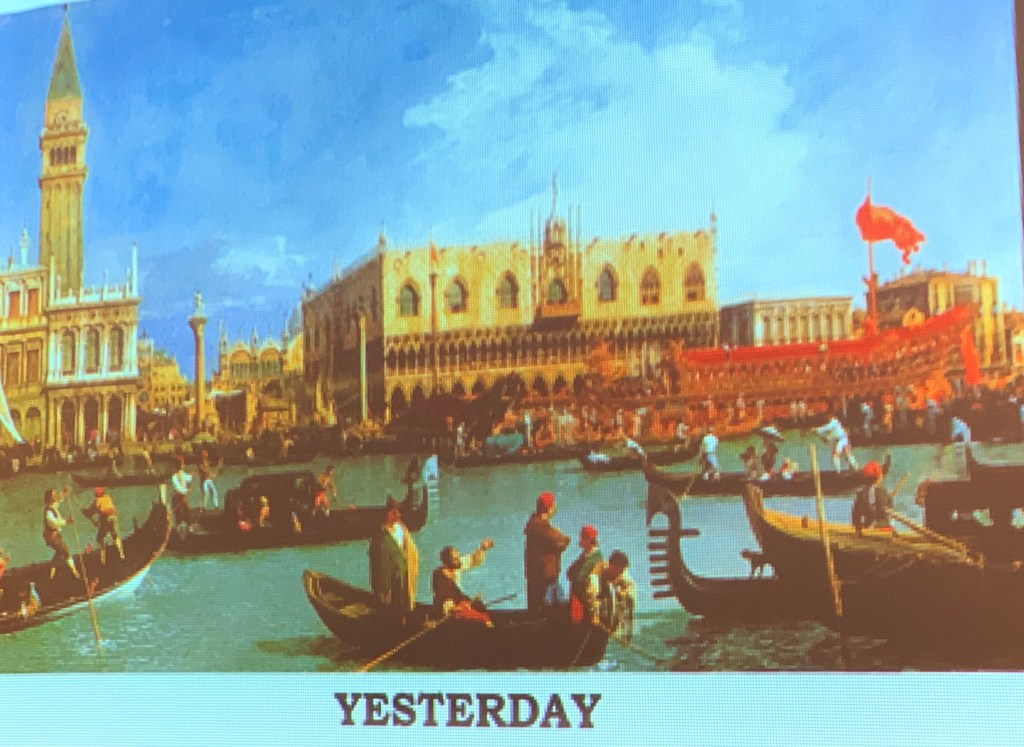
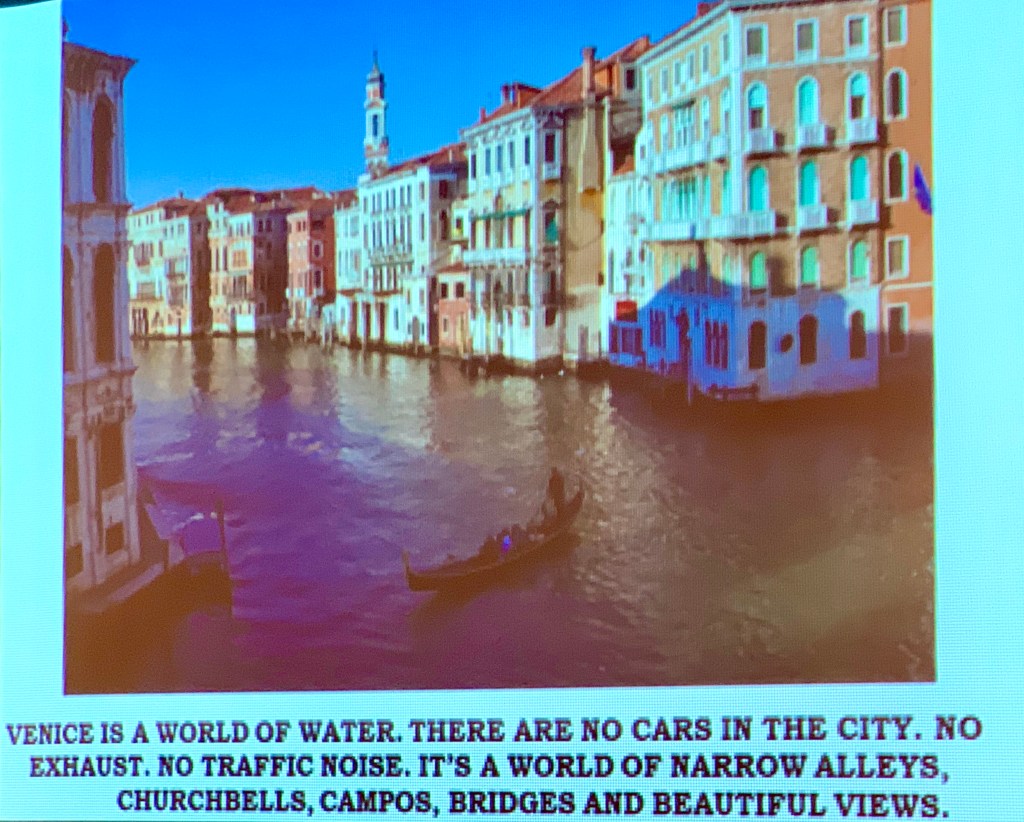
“Upon arriving in Venice by plane or train, a boat will pick you up and whisk you into Venice in about 30 minutes. There are no streets, no cars – all water and beautiful buildings. All of these buildings would be a marvel in other cities but in Venice, there are so many, they can appear ordinary. Most of the buildings are original,” continued, Daum after sipping his favorite beer (#11 on the menu, I believe). He compared Canaletto’s painting of Venice with a current photo of the city – little or no change is evident. “Nothing makes sense in Venice – maps do not help. You can find yourself down an alleyway – you can see ‘laundry day,’” John joked.
Water taxi at the airport
No cars – just boats
Images curtesy of John Daum
“Anything that you have heard about Venice that is negative, is ‘complete BS,’” according to John. He continued, “If you have been there and did not like it, you did something wrong. Going in on a cruise ship or just for the day is shortchanging the experience. Hanging out in St. Mark’s Square is not actually being in Venice. It is the equivalent to going to NY and just going to Times Square. A lot of what makes Venice special is outside of the tourist area. 85% of the people who visit Venice come in for the day, not spend the night and leave. The economy of Venice is surviving on just 15% of the visitors who really engage with the city. If you go – be the good tourist who spends some time there, book a hotel room, spend some money and enjoy these areas that are beautiful and that are waiting for you. It is really a time capsule of a different era.”
Painting by Canaletto
Today
Images curtesy of John Daum
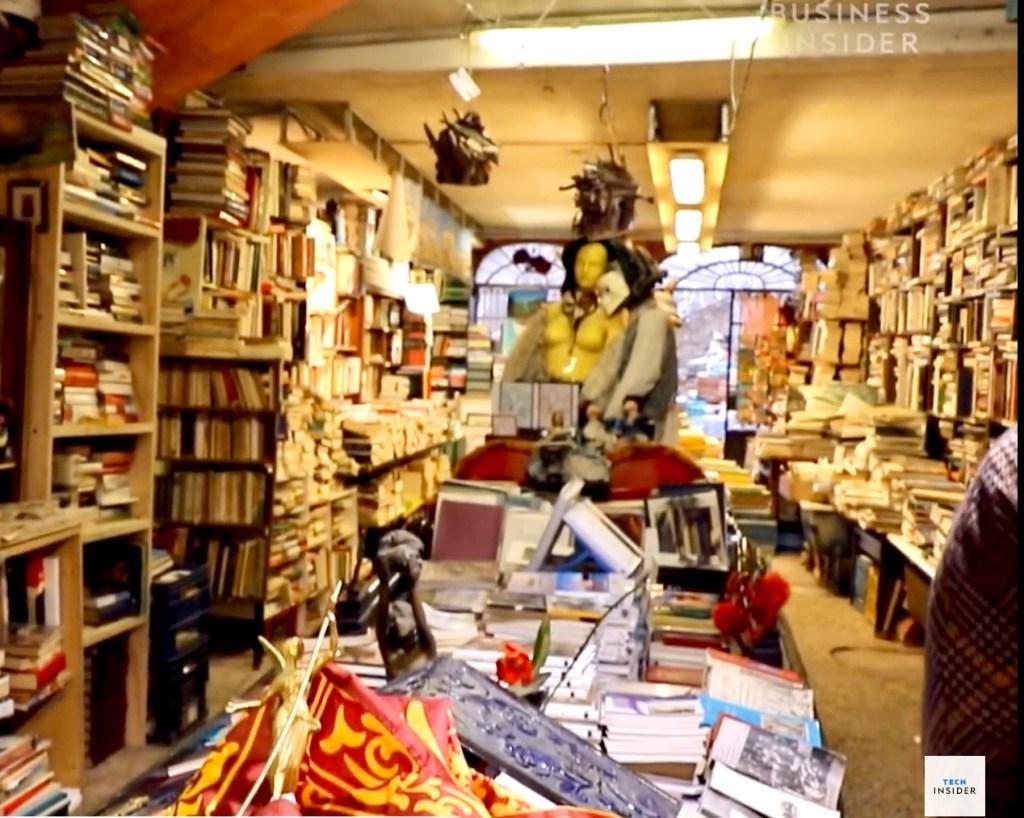
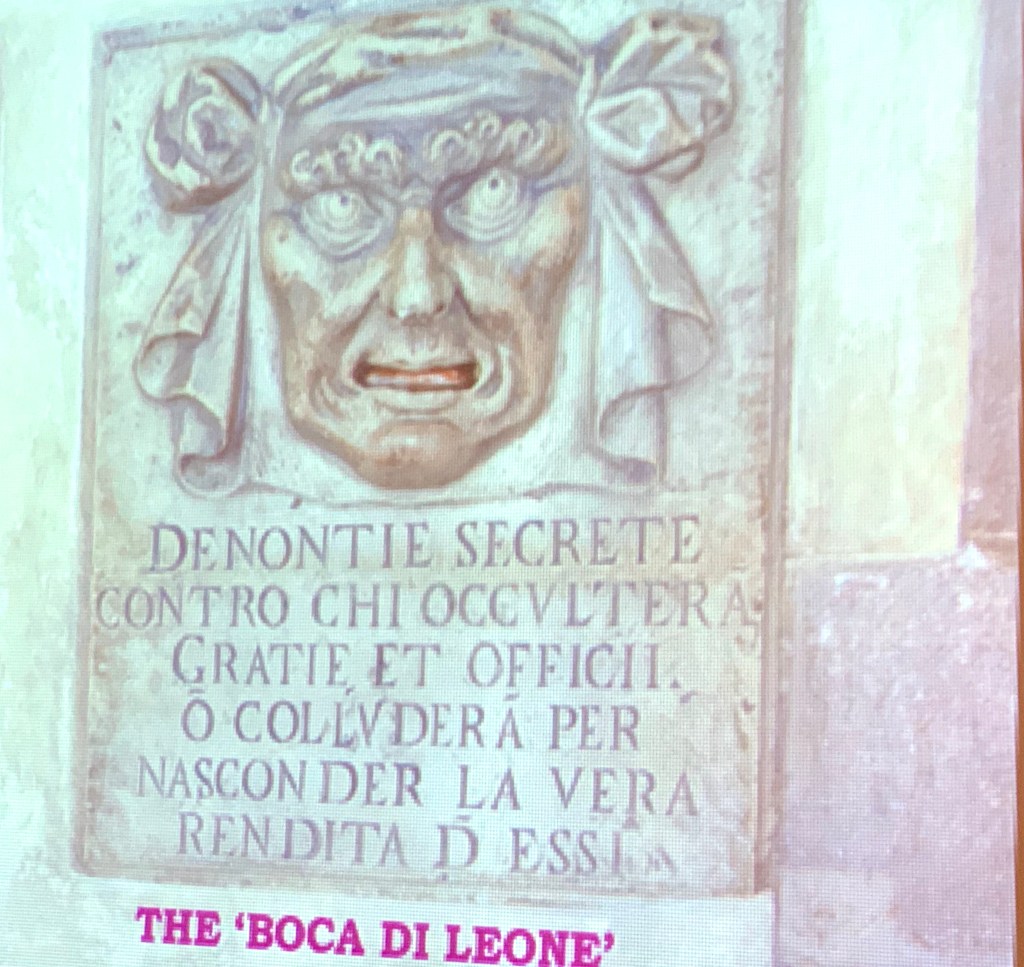
“Venice is a place that expects you to be lost and welcomes you. Go treasure hunting for unique items like the Aqua Alta bookstore where there are books in a gondola and a bathtub filled with comic books. It is ready to go if the floods come. See if you can find the only bridge without railing. Find the few remaining ‘informant boxes.’ Wander, enjoy the atmosphere. Slow down, there is a lot of enjoying the atmosphere. Early mornings and on weekend it is very quiet – nobody is out. Stroll,” suggested Daum.
Aqua Alta Bookstore
Slow Down and get lost in the city. Discover the Aqua Alta bookstore, the bridge without railings, find the remaining “informant boxes,” and meander back alleyways
Venice has rediscovered their spirits, Grapa. Italy, particularly Venice, is enjoying a renaissance of Grapa. There is such a thing as high end grapa. “You should try Venetian grapa – smooth powerful and very tasty. There are also a lot of handcrafted beers. They are fantastic! Ask for the local beer and the locals will love you,” recommended Daum.
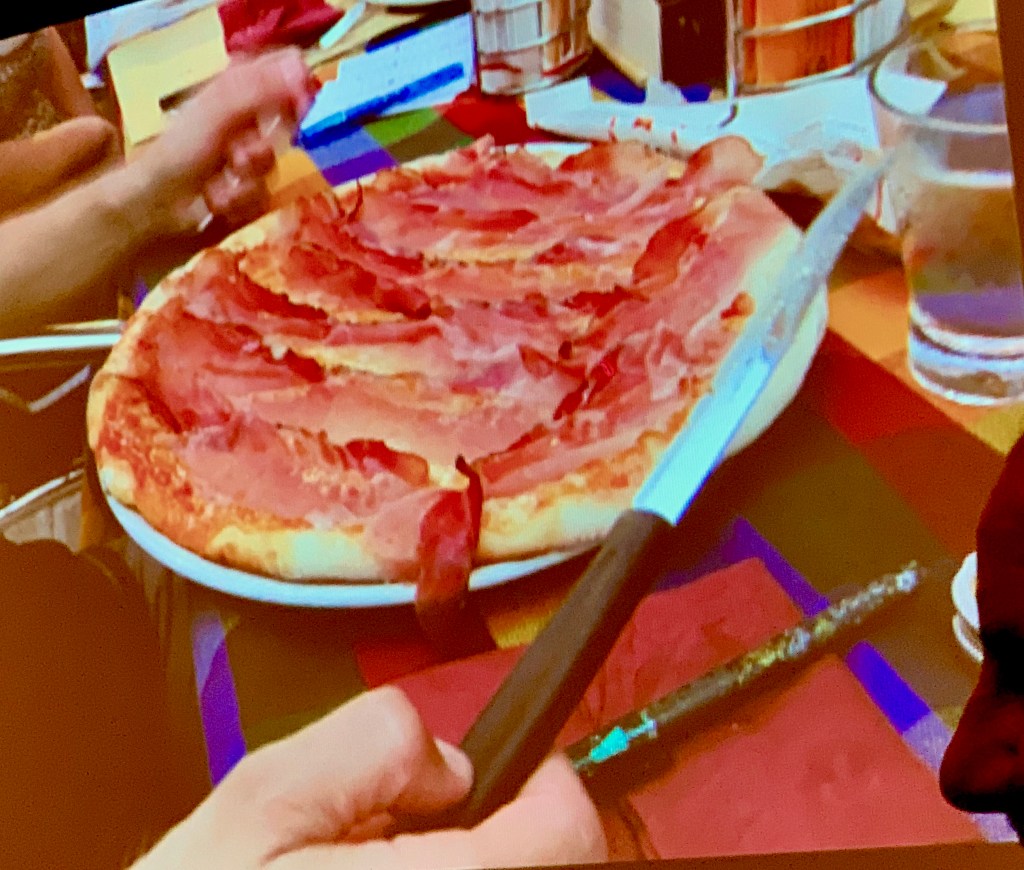
John’s descriptions of restaurants, the food (gourmet pizza, gnocchi, and more), the beverages, and atmosphere were beguiling. I was mentally packing my carry-on suitcase.
Pop-up wine bars
Pizza!
Images curtesy of John Daum
John discussed that gondola rides are popular and can be fun. He told us that the front of the gondola has a “ferro” and the “teeth” represent the 6 neighborhoods of Venice. A Gondola cost about $80K. Gondolier licenses are difficult to get and are typically kept in families. A 20 minute gondola ride will cost about $120. “Do it away from St. Marks in order to avoid the ‘It’s a small world’ experience. There are now women gondoliers. For a different experience – you can learn how to row your own boat. A great way to see a different side of Venice,” suggested Daum.
Gondola with ferro at head and the map of Venice showing the 6 neighborhoods Images curtesy of John Daum
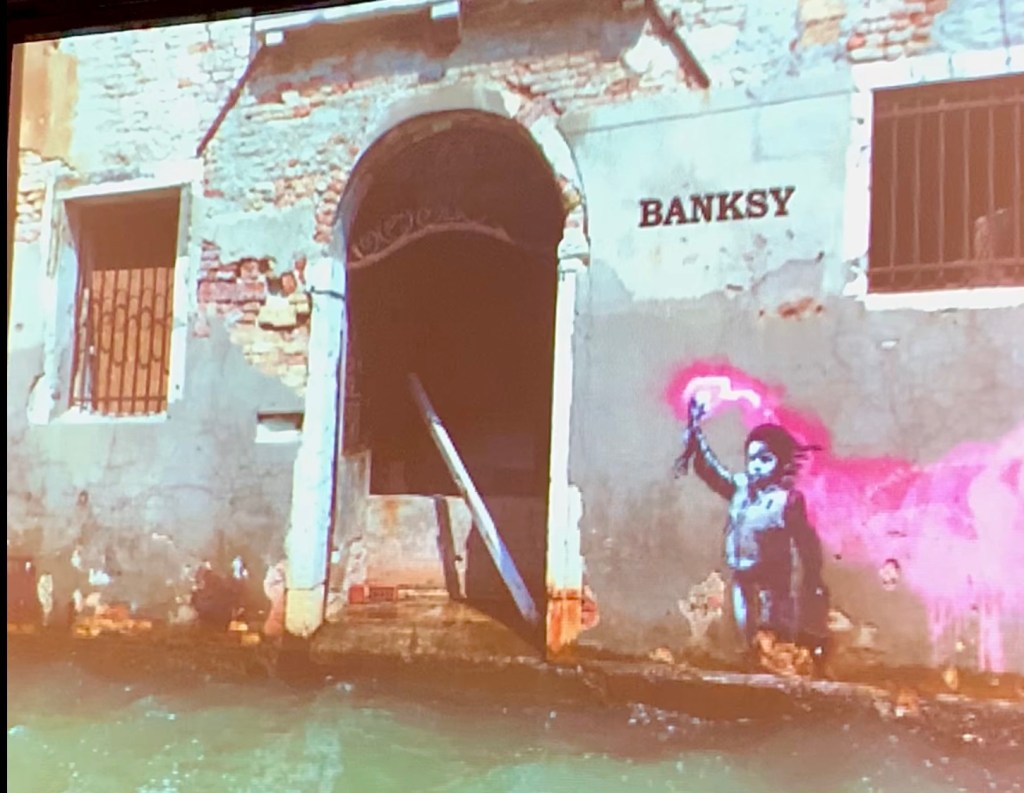
As old as Venice is, it attracts a lot of modern art. Last summer Banksy was there. Festivals and exhibitions attract artists and travelers throughout the season.
Venice is home to tremendous arts and artisans. Make your own mask, learn to blow glass, visit the fabric shop, have local gelato, enjoy great pop-up wineries. “You can get some of the best wine for 3 bucks,” said Daum.
Make a mask
Modern Art is welcomed
Images curtesy of John Daum
No visit to Venice would be complete without experiencing the unique Venetian specialties –
Gelato. There is much to be known about this amazing delicacy. There are great and amazing gelato places. Did you know that Gelato should be made fresh every day? It should be made and displayed in small containers. Who knew?
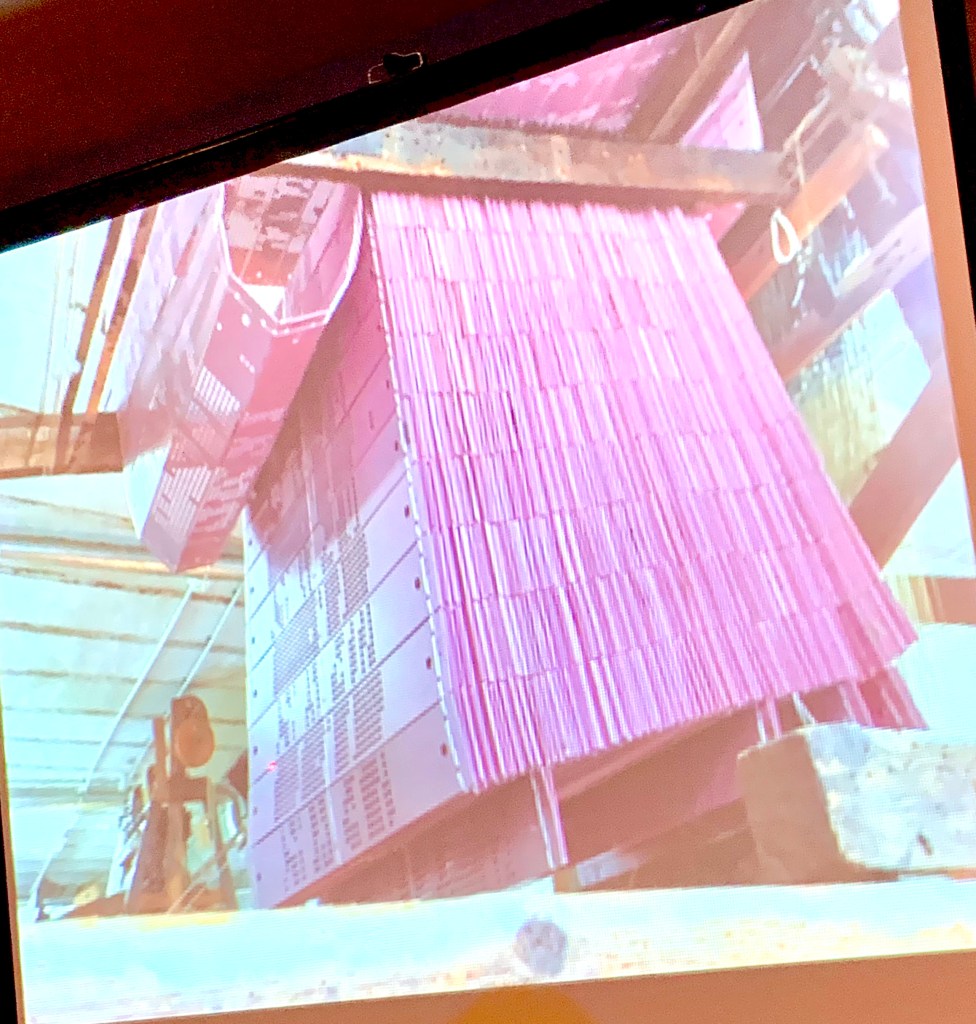
Fabrics. There is one textile handmade plant that makes some of the finest fabrics – silk velvets. They say that they are the ones who invented velvet. You can watch it being made on old machines using punch cards. Purchases of fabric or artifacts support the local economy.
Glass. Murano glass is made on its own island. It was kept away from the main city to prevent fires. John shared a little-known story, “Two artisans from Murano were bribed by the King of France and they made the mirrors for the Hall of Mirrors in Versailles.”
Colors. .John told us about an island named, Burano, a “technicolor island” where they make lovely lace. “It is hard to take a bad photo of this island. The locals are very pleasant and happy for tourists,” said Daum.
SIlk Velvet
Punch Cards for Silk Velvet Design
“Technicolor” Island
Images curtesy of John Daum
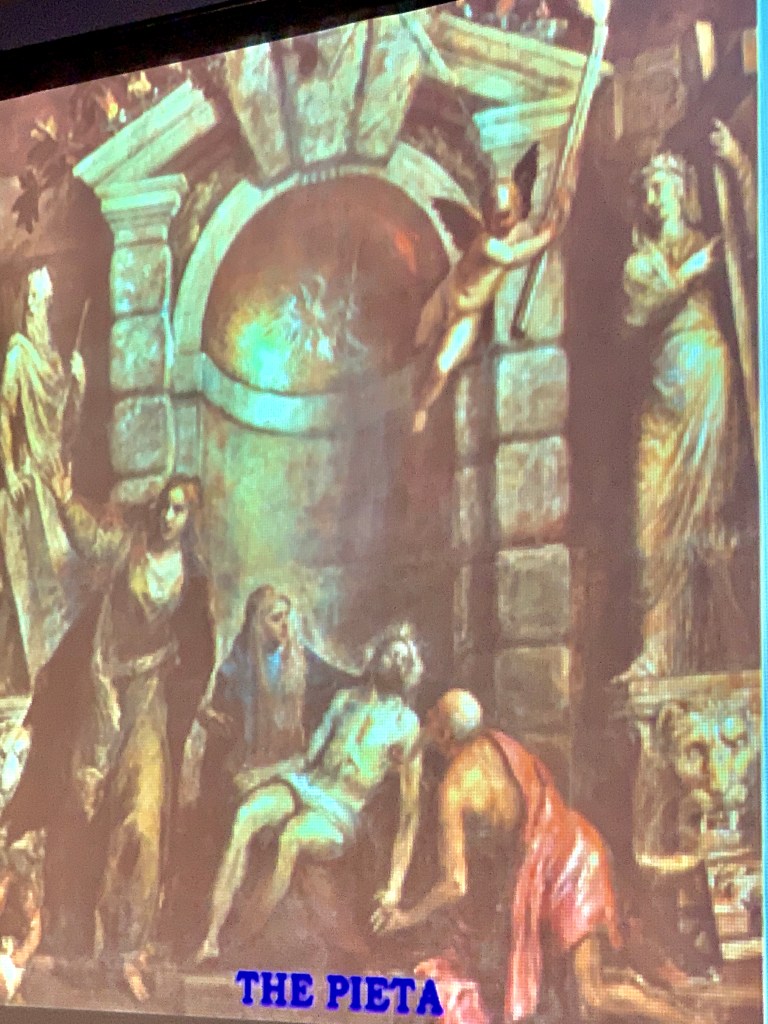
Art. That the art in Venice is amazing, is a well-known fact. John touched upon just a couple of artists – Bellini and Titian. John focused primarily on Titian’s The Pieta. It has been recently restored. It was painted around 1575 during the plague. Titian’s son died of plague while he was painting The Pieta. Not long after, Titian himself succumbed to the deadly disease leaving the painting unfinished. Because it is in a local museum, it is possible to get up close and see “the brushstrokes and even his fingerprints,” John told us. He continued, “Titian was painting in the impressionist style long before the French movement. In his advanced years, he drained his palette of the bright colors and he kept growing and challenging himself to do something new.”
Painting – the Pieta by Titian Images curtesy of John Daum
Our whirlwind tour of Venice concluded with a round of enthusiastic applause. The event continued with the tasting of more interesting beers and fascinating conversation. John Daum will present future lectures on Rome as well as the architecture of New York City, all hosted by the Library.
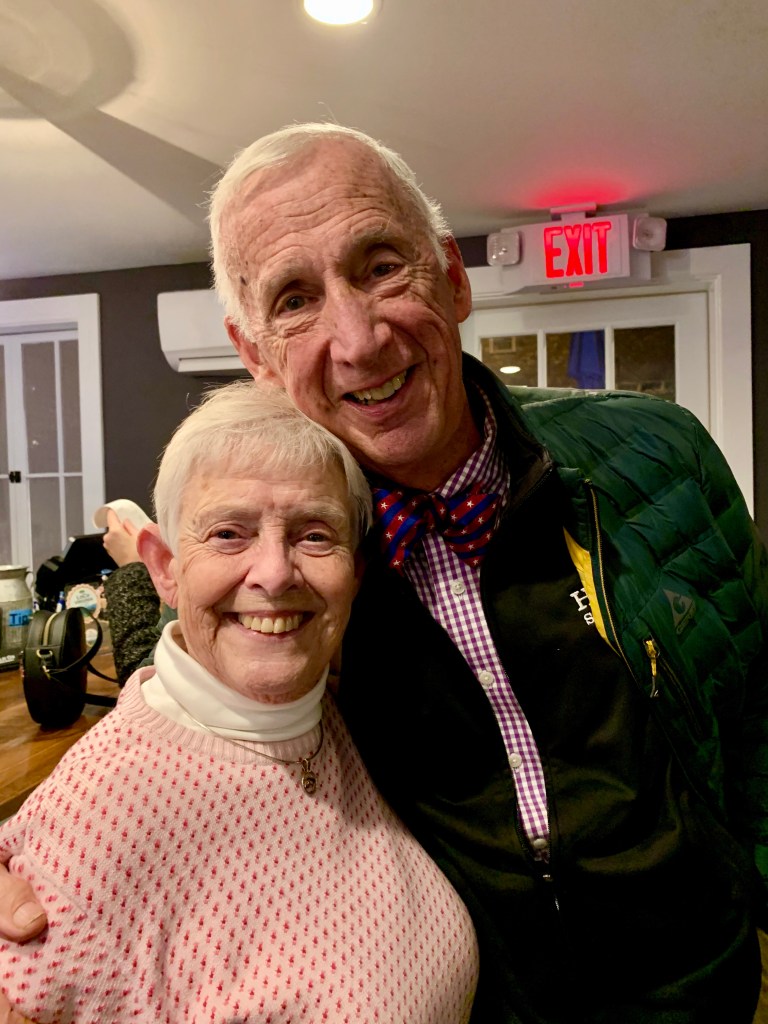
Mary and Don Woodruff of the Hill School
John Daum and Krasi Henkel
A delightful tour of Venice stimulated our appetites for a real visit
Thomas Stearns Eliot was a poet who lived between 1888 and 1965. He wrote a series of poems about cats for his godchild. In 1939, he published a collection of some of those poems as Old Possum’s Book of Practical Cats. He called himself Old Possum.
In 1981 Andrew Lloyd Webber produced the hit musical, CATS. That musical opened in London’s West End then came to Broadway. For 18 years, Cats played at the Winter Garden Theater. According to Amanda Harding of the Showbiz CheatSheet, CATS is the “tenth most popular Broadway musicals of all time.” The play is the fourth longest running play and grossed over $342 million.
A Cat’s Plot: Food
On Christmas Day 2019, the film, CATS, directed by Tom Hopper opened to negative reviews. “How was this possible?” I have seen the musical on Broadway several times; in Washington, D.C., I saw it every time it came to town (including last fall at the Kennedy Center); I saw the 1998 film; and helped coach the dancing segments for my daughter’s middle school production where she was Jennyanydots – the Old Gumbie Cat. I love and know the musical. I am also a big T.S. Eliot fan for which I earned scathing looks in a college lit course.
Now, with the stellar cast including some of my Royal Ballet favorites – Steven McRea and Francesca Hayward (I saw her perform Juliet in London in May ’19); and other celebrity favorites – Jennifer Hudson, Ian McKellen, Jason Derulo, and Judy Dench, how can it go wrong?
I was certain that there must have been some sort of political rift between the movie creators and the critics. The reviews have been scathing and some outrightly inaccurate. So, I went to watch my favorite musical in hopes of proving the critics wrong.
The critics, in general, seem to miss the point that the compilation of poems was written to a child about Eliot’s observation of cats’ behaviors and attitudes. There was no plot intended. I have read and studied the works of T.S. Eliot and like his work. Was there a plot in the crazy successful Broadway production? Not really. By adding the Grizabella character (Eliot had considered her too sad for children and therefore omitted her from the initial book), the vying for “another life,” created a tension and climax that was necessary to keep audiences engaged.
In the original CATS production, the actors performed, moved, and behaved like cats. They were sleek, flexible, and mobile. In the current film, with small exceptions, cats costumes covered people as cat caricatures. I was left with the feeling that the film tried to be all things to all people and address today’s concerns of feminizing characters over male characters. Well, fine, but in the poem by Eliot, Deuteronomy is most certainly male, “ He’s a Cat who has lived many lives in succession. He was famous in proverb and famous in rhyme….Old Deuteronomy’s buried nine wives and more–I am tempted to say, ninety-nine; . . . his numerous progeny prospers and thrives . . .the village is proud of him in his decline.” So, how will this become a female? Poor Judy Dench did what she could with it, but her character was neither faithful to the spirit nor the letter of the poem.
Steven McRea, principle dancer with London’s Royal Ballet, is my favorite current male dancer (my all-time favorite is Baryshnikov). McRea danced his heart out. Beautifully. He was a credible Skimbleshanks, the Railway Cat. I fully enjoyed his stellar tap performance. His costume was refreshing as he was not a hairy human.
When I first learned that Francesca Hayward, also of the Royal Ballet, was cast as Victoria, the White Cat, I couldn’t wait to watch her dance. What happened? First, this Victoria is NOT a white cat. While her face was angelic, her body was not lithe. She looked bulky with oversized thighs and what happened to her feet? She’s a ballerina! The dancing she performed in the film, I could have done myself. Her talent was completely wasted. Victoria in the original production only danced. In this production, they went out of their way to teach a non-singer to sing and took away her dancing. Why? The role and the production did not showcase this amazing ballerina in the slightest. Ok, yes, this is about good news, so the good news is that I enjoyed seeing her just because.
The two stand out performers of the film are Jennifer Hudson and Ian McKellen. They both gave 100 percent heart and talent and brought forth a recognizable poignant character. They were easy to love – still.
For the name and stature of Taylor Swift, she too, was underutilized. I had to look twice to be sure it was her. She sort of showed up, sang looking overweight, not fluffy, then vanished.
Director, Tom Hopper, in a pre-release interview, claimed that he had seen the play as an eight-year-old child and had fallen in love with it. Well, I am certainly glad he hadn’t hated it. Imagine what might have turned up. He tried too hard to use technology and today’s political correctness to create, as Eliot describes Rum Tum Tugger’s actions, “A horrible muddle.”
To my beloved ballet dancers, Francesca and Steven; Jennifer Hudson and Ian McKellen; I thank you for giving us your best under difficult circumstances. I regret that for the Royal Ballet dancers, who took time from their professional pursuits to try to make a beautiful addition to a beloved show, they have been subjected to horrible reviews. They deserve better.
To the critics, my suggestion is to read, and perhaps, study T.S. Elliot’s poetry and stop looking for plots and points that don’t exist. How about enjoying the poetry for what it is – descriptions of alley cats’ distinctions and similarities. This is not rocket science.
Ultimately, I loved the music; a little bit of the dancing; Gus; Grizabella; and Skimbleshanks. In a play with so much to love, this is not great news, but it’s my best attempt of being positive.
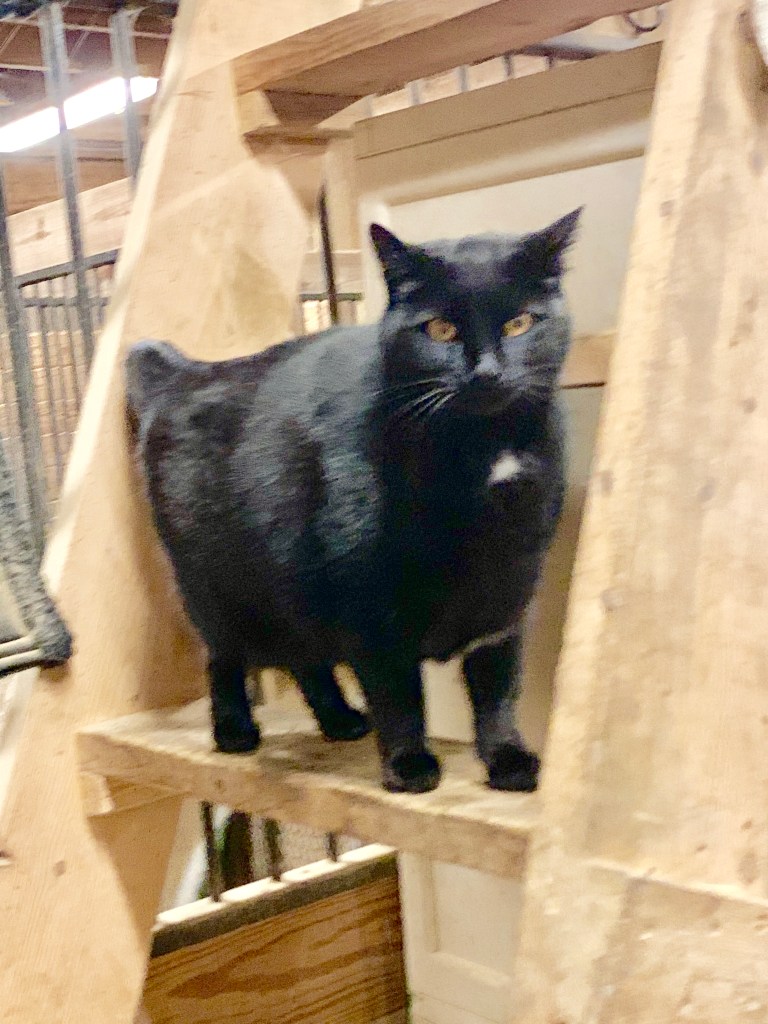
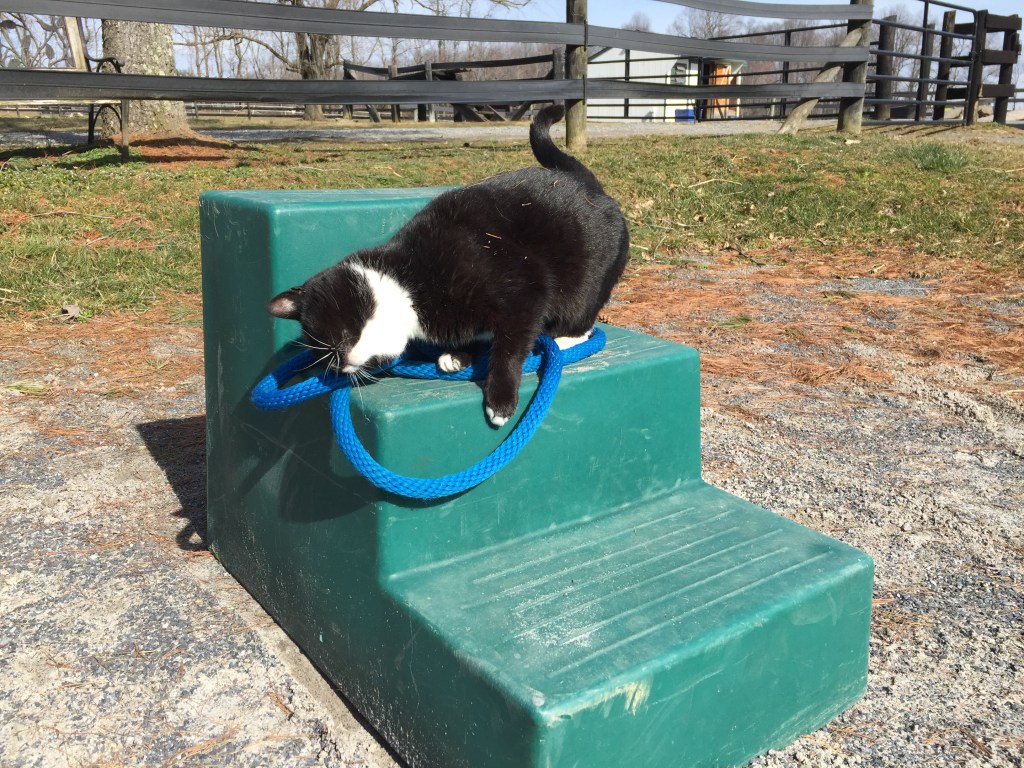
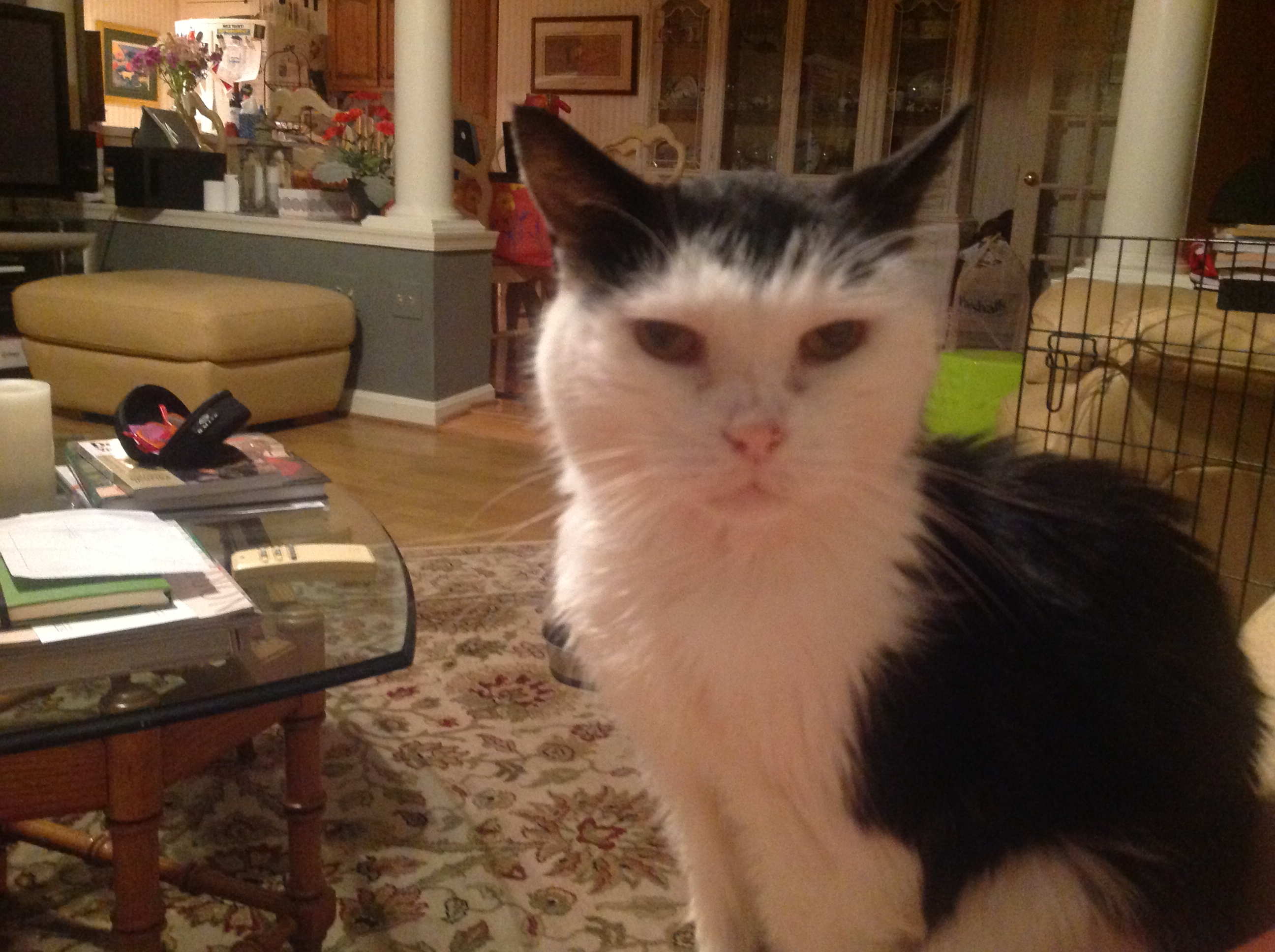
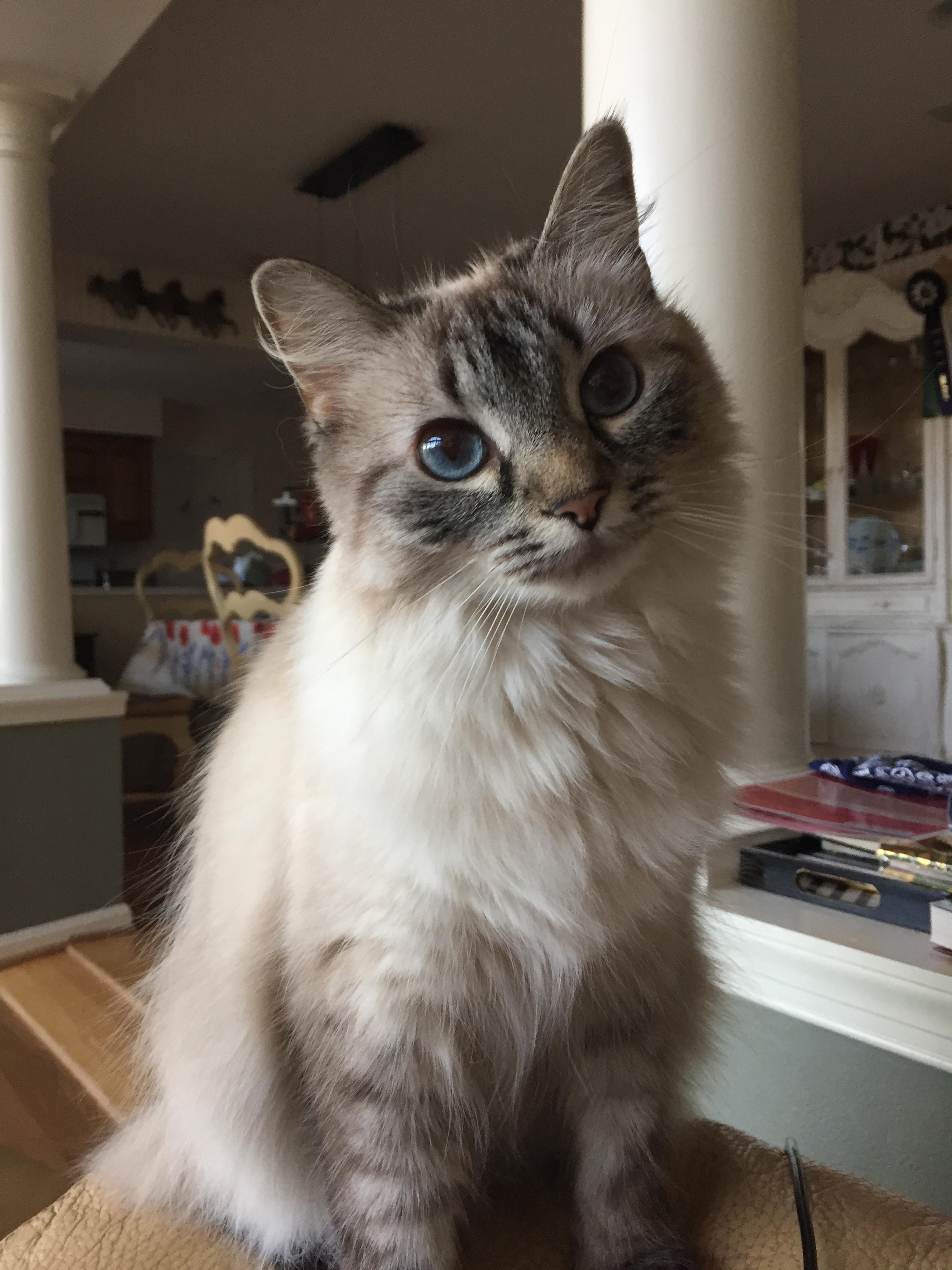
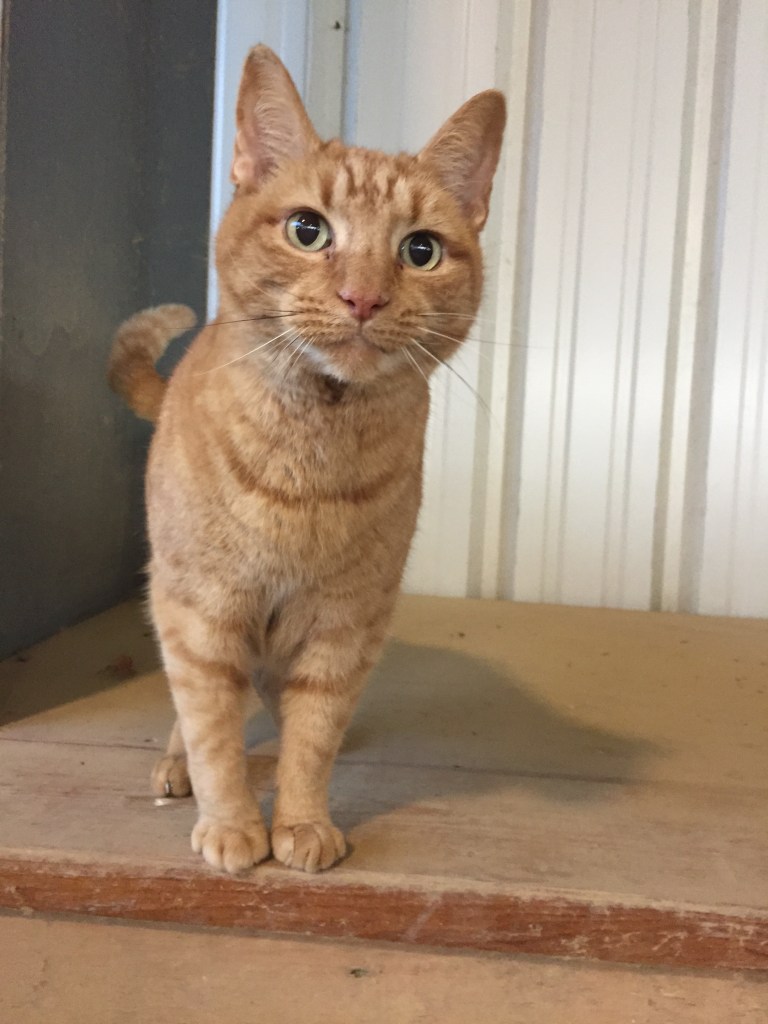
The photographs in this blog are of my cats – past and present. I am impressed by Eliot’s astute observation of cats. He was spot on for each cat, and I speak from experience.
It would not have been possible for me to appreciate T.S. Eliot’s poetry or most other important literature, were it not for my tenth grade English teacher, William Teunis, from whom I discovered the beauty of others’ worlds through their words. From him, I learned everything I ever learned in high school.
A foot hunt – no horses! The Middletown Valley Beagles introduced the Loudoun Fairfax Hunt and The Loudoun Hunt to foot hunting on December 28 at the LFH kennels at Overbrook; Hamilton, VA.
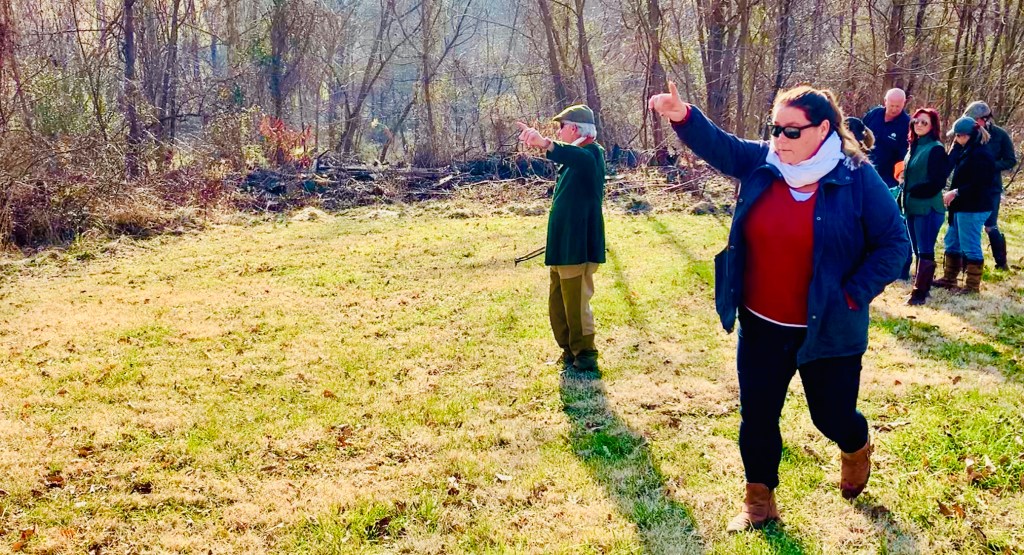
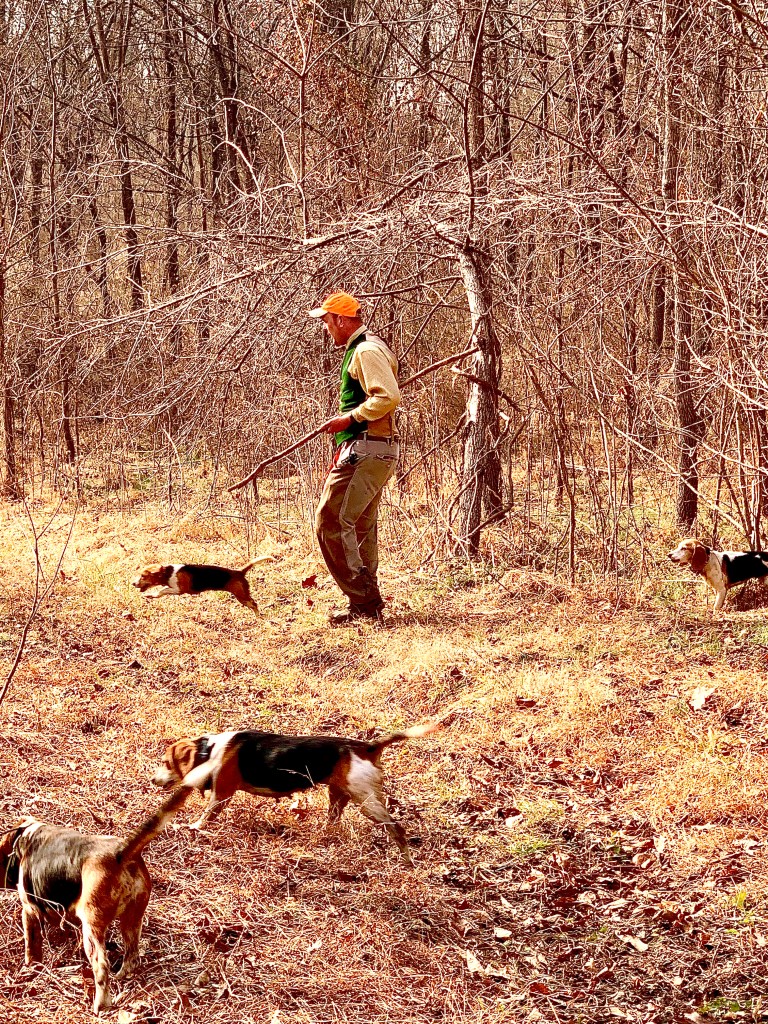
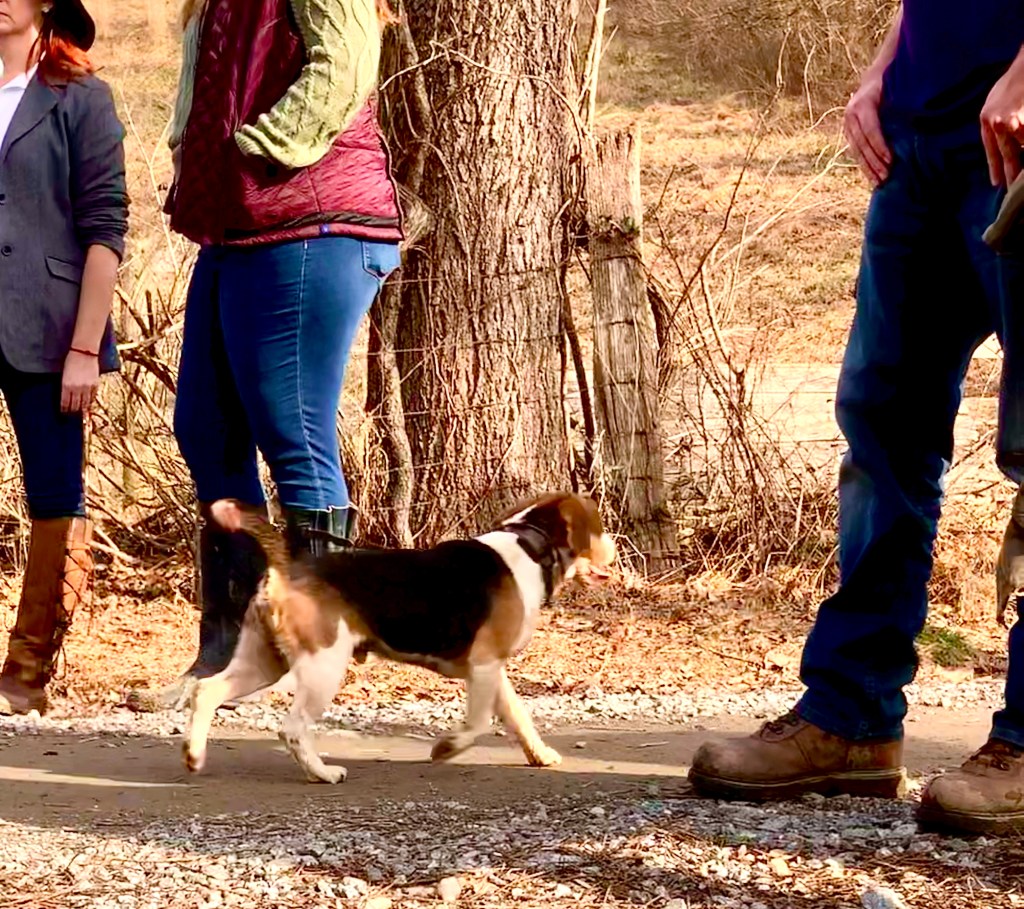
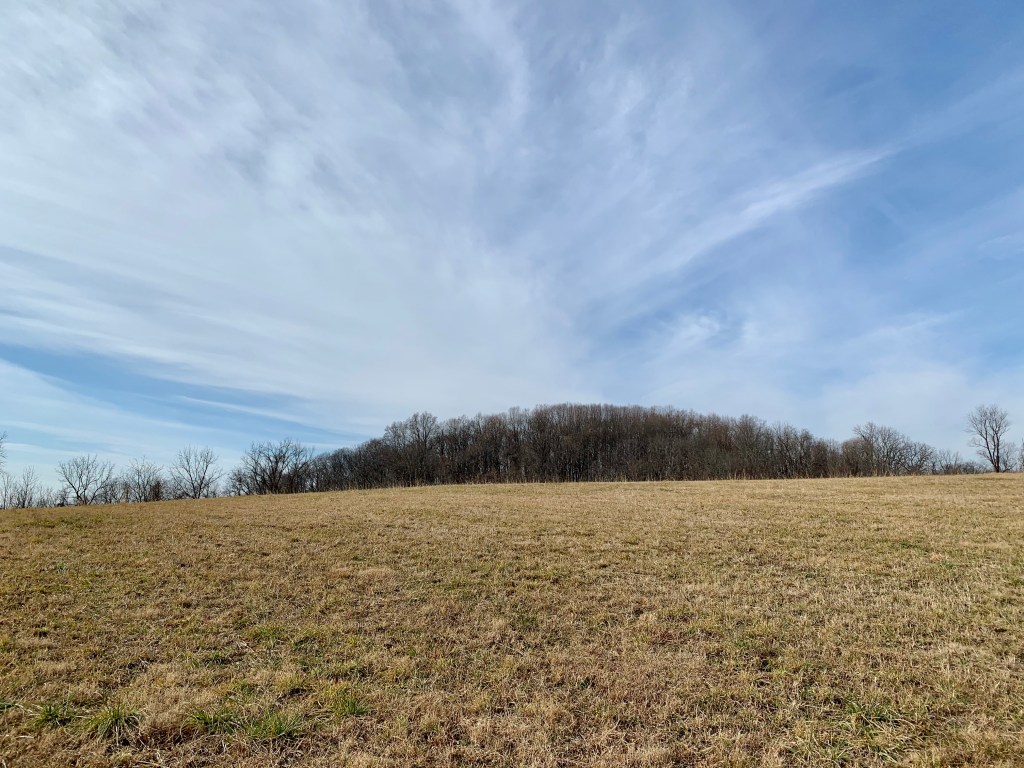
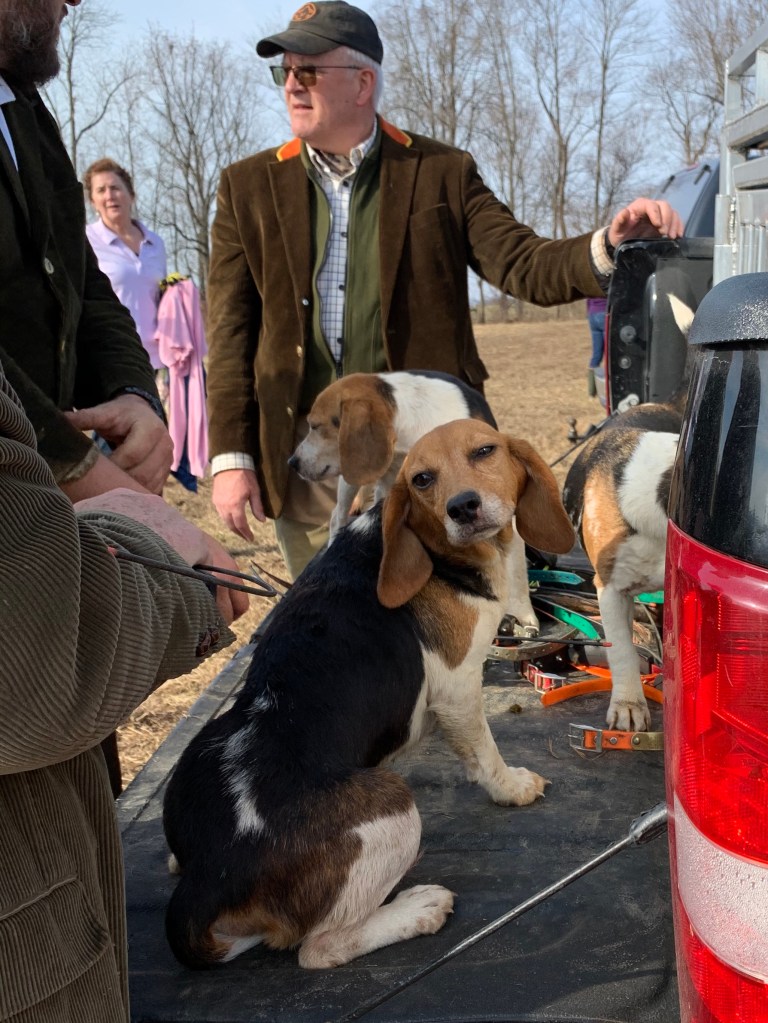
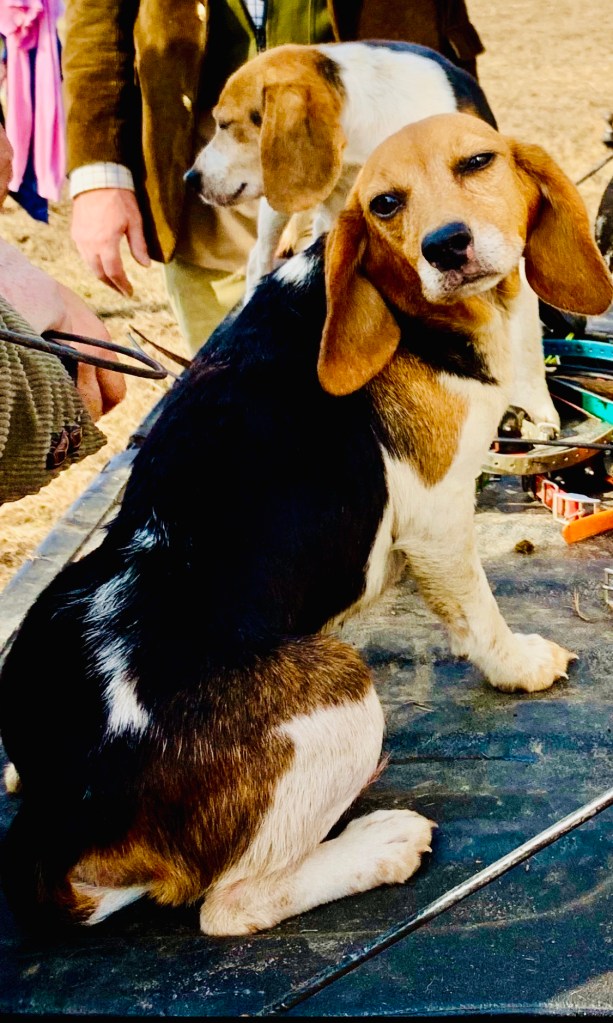
The Middletown Valley Beagles masters and staff arrived in style, complete with adorable beagles with huge eyes and long ears. The day was fair and the skies were blue. It was ideal for a walk across open fields, jumping over a few ditches, picking our way through low-lying muddy areas, to observing the hard working beagles, and catching glimpses of smart rabbits.
On the scent!
A delight for children
The View!
Bill Kopp, 1st Whipper-In
Alasdair Storer, MB and Huntsman
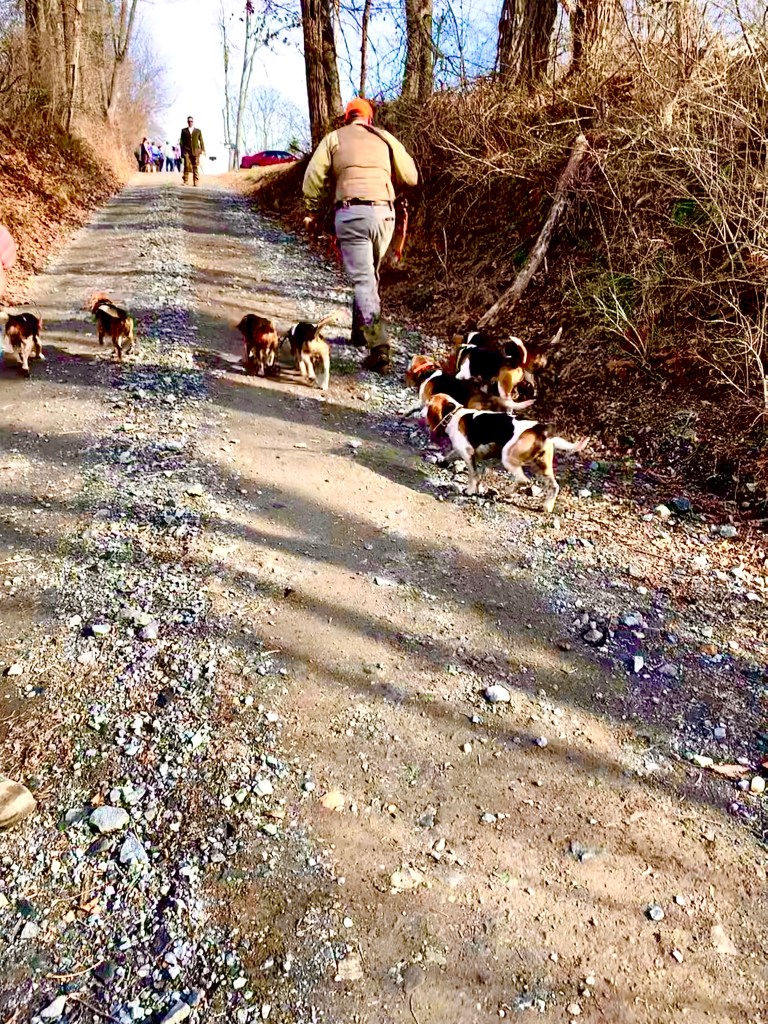
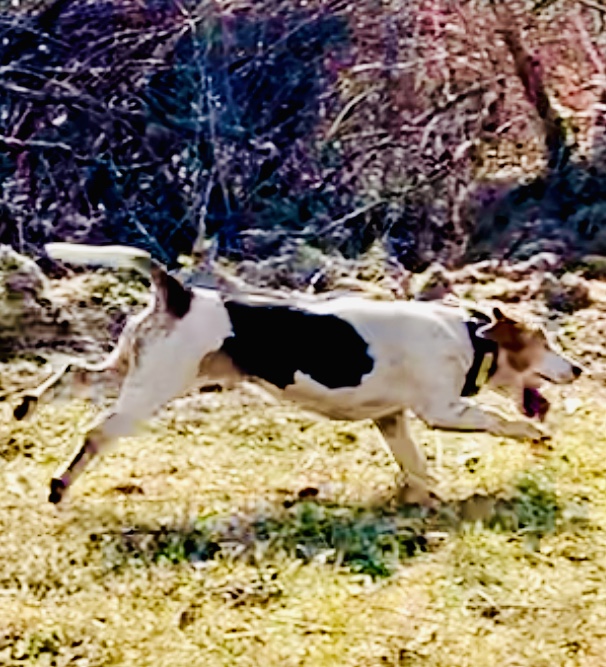
Their tails pointed up; their noses were to the ground. All at once, there was a symphony of beagle voices alerting us that they were on the scent of a rabbit! My heart skipped a beat with delight. It has been a long time since I have heard hounds work and now I see how much I have missed them. Fond memories flooded my mind.
As riders, we take hills for granted
Steffanie Burgevin
Steffanie Burgevin, Linda Devan, MFH LFH, Hannah Rogers Tucker
Rita Kaseman
Michelle Johns and Gretchen Kuney
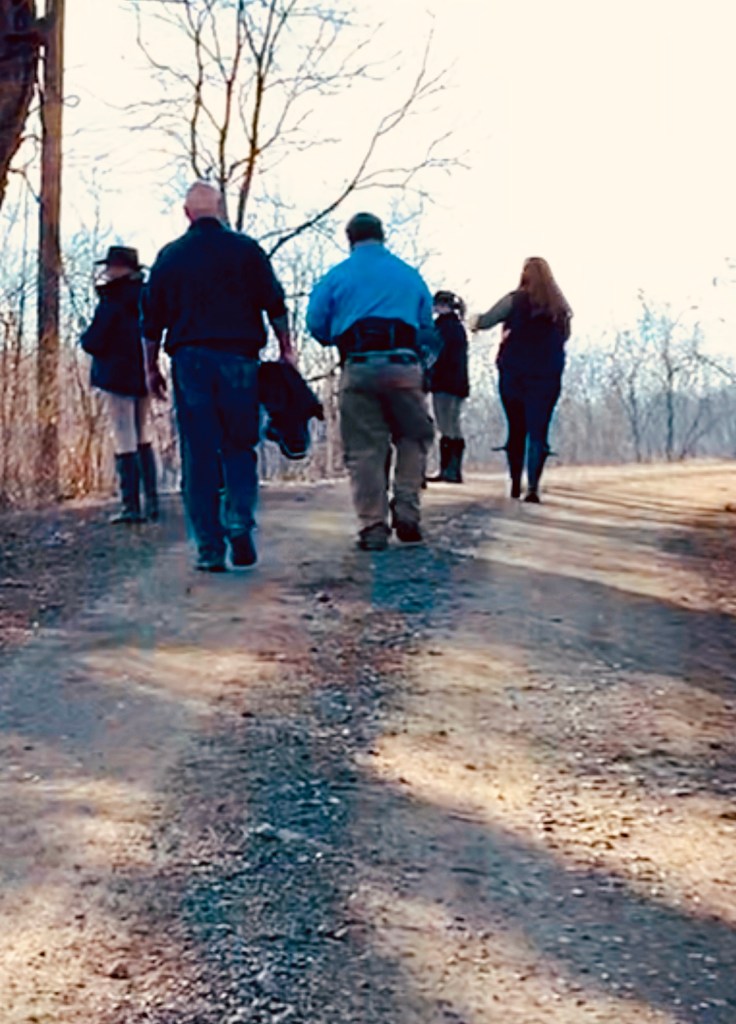
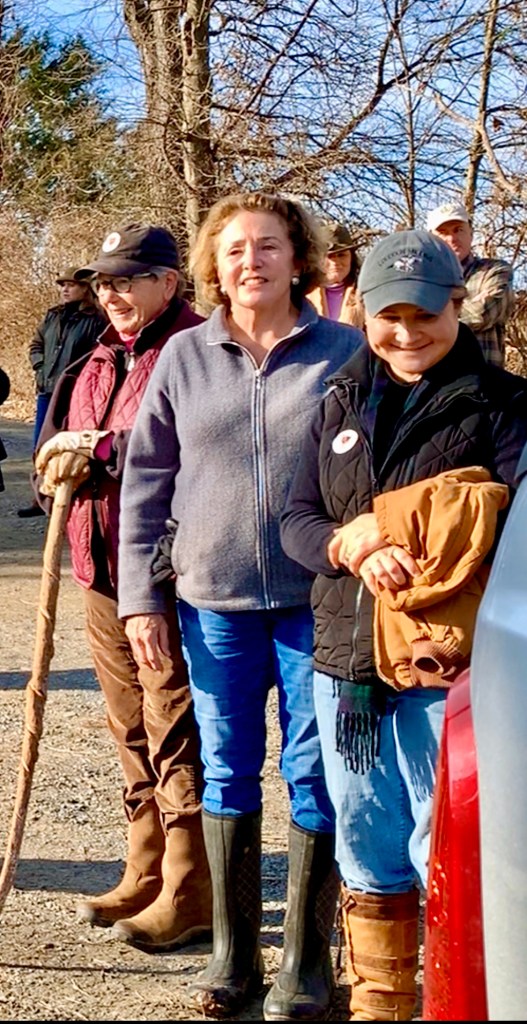
It was a wonderful time to catch up with friends, and business associates whom I never would have expected to be avid fox hunters. We walked, we stopped, we listened and watched. All of a sudden, a rabbit darted out from a thicket, across a large open field and back into a wood. The beagles, in pursuit, stopped at the edge of the thicket to sniff for the rabbit. While they sniffed, their prey disappeared into the woods.
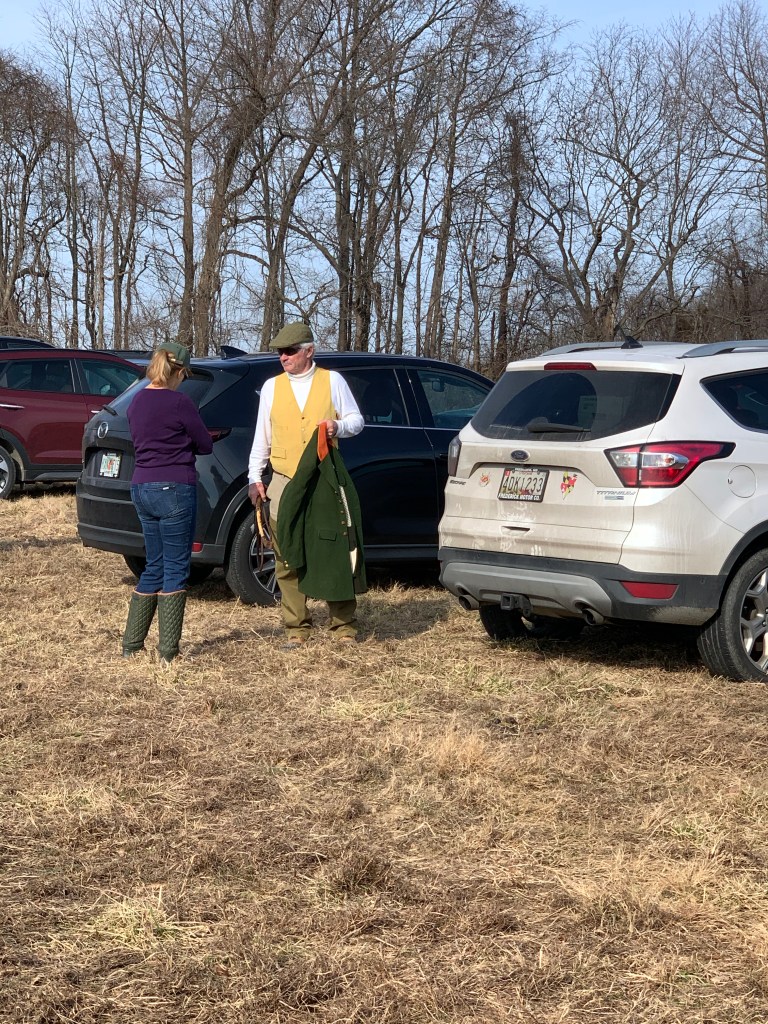
Much like a formal fox hunt, the Middeltown Valley Beagle staff and masters were dressed in their formal attire. Unlike fox hunts where scarlet coats are worn, the masters wore green coats with their club’s colors on the collars. The foot hunters enjoyed watching the beagles work. Their sweet melodic voices brought us to attention. The huntsman and his helpers never stopped walking and running; directing and following the beagles. The huntsman must be extremely fit because he never paused and ran up and down hills, over roads and through ravines.
On to business
Serene Views
The Day is Done – Heading Back
Overbrook
Paul Wilson, MFH LFH; Steffanie; Linda Devan, MFH LFH
The beagles were attentive and busy. They were expert sniffers and great communicators. They ran, they sniffed, they listened to the huntsman’s horn. Being much smaller than fox hounds, watching them work put us at a different and more intimate vantage point.
What a great learning experience! In my more than 20 years of fox hunting, I never appreciated the hounds’ work because I was focused on my horse and those near us. On foot, there were no distractions and we got much closer to the action. At the end of the hunt, no rabbits were harmed, three rabbits were discovered with each giving the beagles good sport, and the “hunters” enjoyed an interesting adventure with great camaraderie.
Honorary Field Master, Randy Medd
One of the 10 (5 couple) beagles
Sport under blue skies
Lt. Col. Ken Jacobsen, DVM, Kennel Veterinarian and Whipper-In speaking with Steve Minnick, Whipper-In






































 Good News. Reviews. Events.