
A Woman’s Passion as Powerful as the Stars She Studied

Laura C. Harris (center) with Emily Kester, Jonathan David Martin, Holly Twyford and
Nora Achrati. Photo by Scott Suchman.
“I insist on the exceptional!” proclaimed Henrietta Leavitt, astronomer, Summa cum Laude Radcliff graduate, a woman ahead of her time, and the central character of the Lauren Gunderson play, Silent Sky. Filled with the passion for understanding, “Who, what, why are we in the universe,” Henrietta “Henry”, boldly steps into a position at Harvard College expecting to be a full astronomer. The play is performed at Ford’s Theater until February 23. It is directed by Seema Sueko, deputy artistic director at Arena Stage.
Set two years before women could vote in the United States, Henry is caught between family and professional passion. She enlists her sister’s help to convince their father to release her dowry, “I need to start my life . .. with daddy’s money,” she proclaims to her acquiescing sister, Margie. Margie and Henry, although sisters, are different in every way. Henry tells her, “We look in the same direction but with different understanding,” when Margie tries to encourage her passionate sister to stay close to home and build a family of her own and not become a “spinster.” Margie prevails on their father and Henry heads to Harvard, “And so I go!”

Photo by Scott Suchman
Armed with confidence, passion, and a brilliant mind, Henrietta sets off to become a member of the astronomy department at Harvard. Instead, she finds herself in “Pickering’s Harem,” the human computers, handed glass slides by male superiors and denied access to the “great refracting telescope,’ which was reserved for men only. This is where wide-eyes innocence crashes into the reality of 1918. She was at the “edge of the wide world,” with a male superior who could not see beyond the Milky Way.
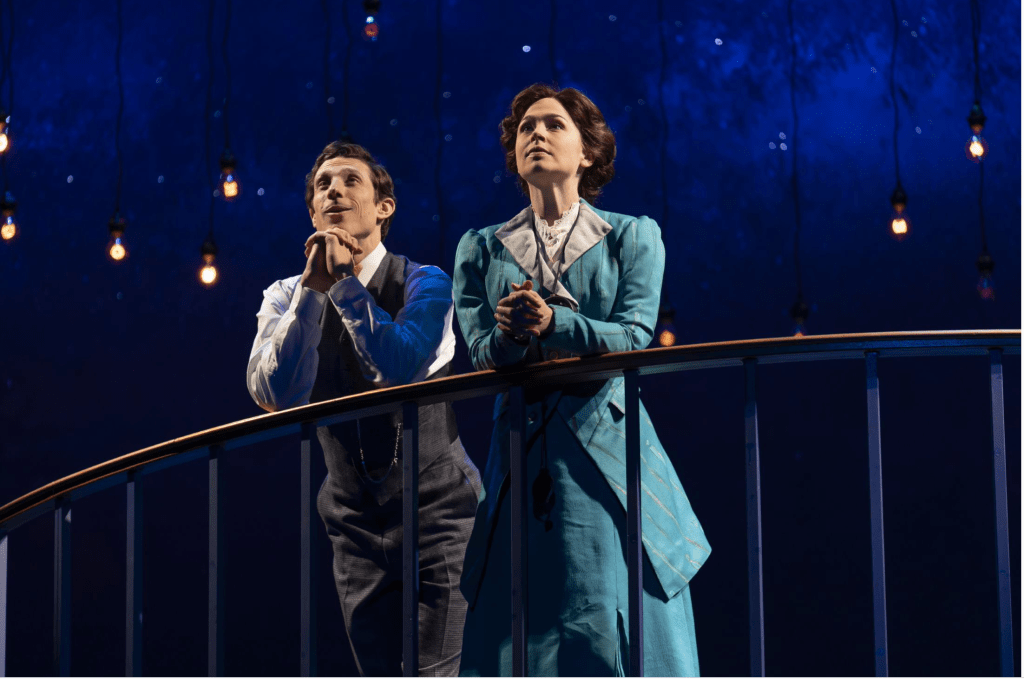
Photo by Scott Suchman
Settling for mundane positions in the Harem, she and her co-workers console themselves that they are “Cleaning up the universe for the men . . . laughing behind their backs. We are mapping the sky. We are the dirt from which mighty oaks grow.” Women of vision, passion, and tremendous intellect subordinating themselves to men of limited vision for the sake of slim opportunities to reach toward their interests. Henry quietly pursues her studies of Chephid stars which would eventually lead to the measuring of distances on an intergalactic scale and ultimately change astronomy.
The play is poignant on a number of levels. Women were on the move in many areas of society including the sufferget movement. While appearing to work within the established system, they pursued their interests quietly. Henry goes on to change astronomy and its understanding of the time and space.

Photo by Scott Suchman.
The play is kind and sweet. There was nothing socially shocking. The women focused on their desire to discover and grow. It is portrait of relentless curiosity enveloped by humanity.
As the play ended, I was struck by the fact that this woman’s contribution to astronomy has for the most part fallen into obscurity. Like the “computers” featured in the movie, Hidden Figures, women have left their finger prints upon the universe. It is up to us to keep their memories alive and encourage new generations of women to reach for the stars. My final question after watching this play – how is it that so many women are “afraid” of mathematics when it is women who computed time and distance to measure the universe and put man on the moon?
 Good News. Reviews. Events.