When Shakespeare Goes Cinema:

A Night with Macbeth at the Crossroads of Traditional and Modern

There’s something deliciously ironic about preparing to watch “The Scottish Play” through a screen. Armed with Marjorie Garber’s scholarly insights and Paul Cantor’s lectures queued on YouTube, I found myself straddling centuries – one foot in traditional academic preparation, the other in digital-age convenience. But nothing could have prepared me for the way that the filmed live Max Webster-directed production at London’s  Donmar Warehouse; starring David Tennant and Cush Jumbo; would dissolve that careful distance between viewer and viewed.

The Seduction of Simplicity

In an era where productions often compete to outdo each other with elaborate sets and costumes, this Macbeth takes a boldly minimalist approach. The stark staging serves not as a constraint but as a canvas, allowing the raw power of Shakespeare’s language and the actors’ craft to paint vivid pictures in our minds. It’s a reminder that sometimes, less is more – especially with performers of exceptional caliber commanding the space.

The Intimacy of Technology

Things get interesting with the production’s use of binaural sound technology and the theater’s 5.1 surround sound transformed what could have been a mere filming of a stage play into something more visceral. Every whispered plotting, every sharp intake of breath, every moment of hesitation becomes startlingly intimate. This is psychological cinema at its finest. Using modern technology to achieve what Shakespeare himself must have dreamed of – the ability to place the audience not just in front of the action, but inside of it. Macbeth’s eye contact with the viewer is both thrilling and chilling.

Gender, Power, and the Space Between Desire and Action

At the heart of the play is an exploration of gender dynamics that feels startlingly relevant to contemporary discussions. Lady Macbeth emerges not simply as an ambitious woman, but as a complex figure trapped in a society that offers her “no chance of independent action and heroic achievement.” Her transformation of nouns into verbs – turning the Weird Sisters’ prophecies into calls for action – speaks to a deeper truth about power and agency.

The production masterfully highlights how Lady Macbeth’s infamous “unsex me here” speech resonates with modern conversations about gender constraints. Her willingness to “dash out the brains” of her nursing infant becomes not just an act of horror, but a violent rejection of prescribed feminine roles. In Jumbo’s portrayal, we see a woman who has internalized the brutal logic of a masculine world, turning it back on itself with devastating effect.

The Question of Responsibility

Perhaps the most unsettling aspect of this production is how it implicates its audience. Through the immersive sound design and intimate camera work, we become less spectators and more accomplices. Each choice, each action, each consequence feels personal in a way that traditional staging rarely achieves. The production asks us, in our era of influence and manipulation, whether we are ever truly responsible for our actions – a question that echoes far beyond the theater walls.

A New Kind of Shakespeare Experience

What makes this production remarkable is not just its technical achievements or stellar performances, but how it manages to honor both theatrical tradition and contemporary sensibilities. It’ is Shakespeare for our time: psychologically acute, technologically sophisticated, yet deeply rooted in the timeless power of language and performance.

For those planning to view the film: Yes, do your homework. Garber will guide you through the text and Cantor illuminates the themes. But, be prepared to have all that careful preparation wonderfully undermined by a production that refuses to let you remain a distant spectator. In bridging the gap between stage and screen, between past and present, this Macbeth creates something entirely new – and utterly compelling.

For optimal viewing, resist the urge to maintain analytical distance. This is one production where surrender yields the richest rewards. To whet your appetite take a little tour.

A Year With William Shakespeare

Reading the Entire Canon in 2020

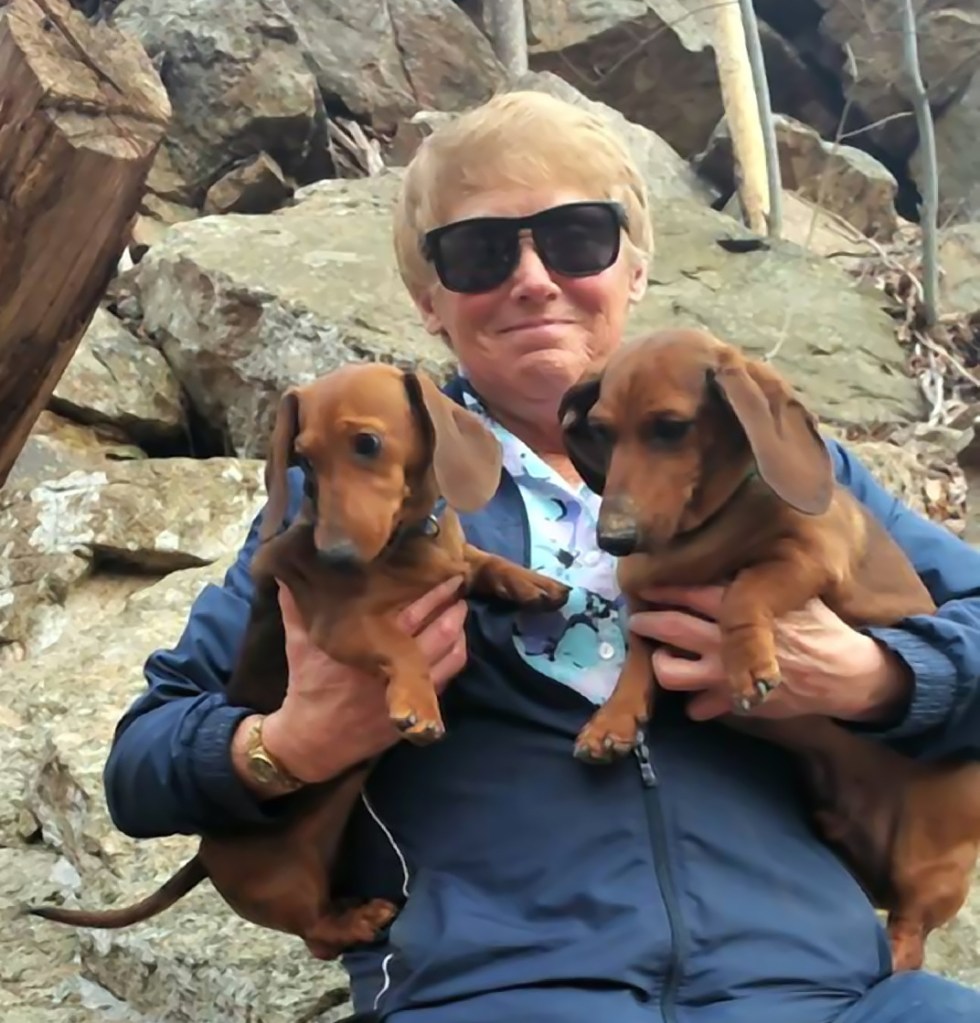
In January 2020, a friend posted a Facebook link to a Shakespeare project, “Shakespeare 2020,” reading all of the plays, Sonnets, and poems by William Shakespeare in 12 months. I did not think twice, I joined the group. What had I just signed up for??? I own a busy real estate brokerage firm, run a horse farm, I have a husband, 2 dogs, and 5 cats, and my 96-year-young mother had come to live with us just before Christmas 2019. And . . Shakespeare too?

Why NOT? I would give it a try. No cost, no commitment except to myself, and I wanted to see if I was smart enough to work through literature for which I had more than a mild curiosity. One compelling reason was to improve and strengthen my writing.

My good fortune is that I attended an unusual and experimental public high school. There, my luck expanded to be placed in an English class with an incredible teacher, William Teunis. He piqued my interest in literature (especially, Shakespeare) through his enthusiasm and exceptional teaching.  In his class, we read plays – acting out roles; we wrote short stories, essays, parodies, and plays. Shakespeare was attainable and most enjoyable. The more we did, the more I reached. My English experience abruptly ended with his drowning at the end of my sophomore year. Since then, I doubt that I have written a sentence without asking myself, “What will Mr. Teunis say about this?”

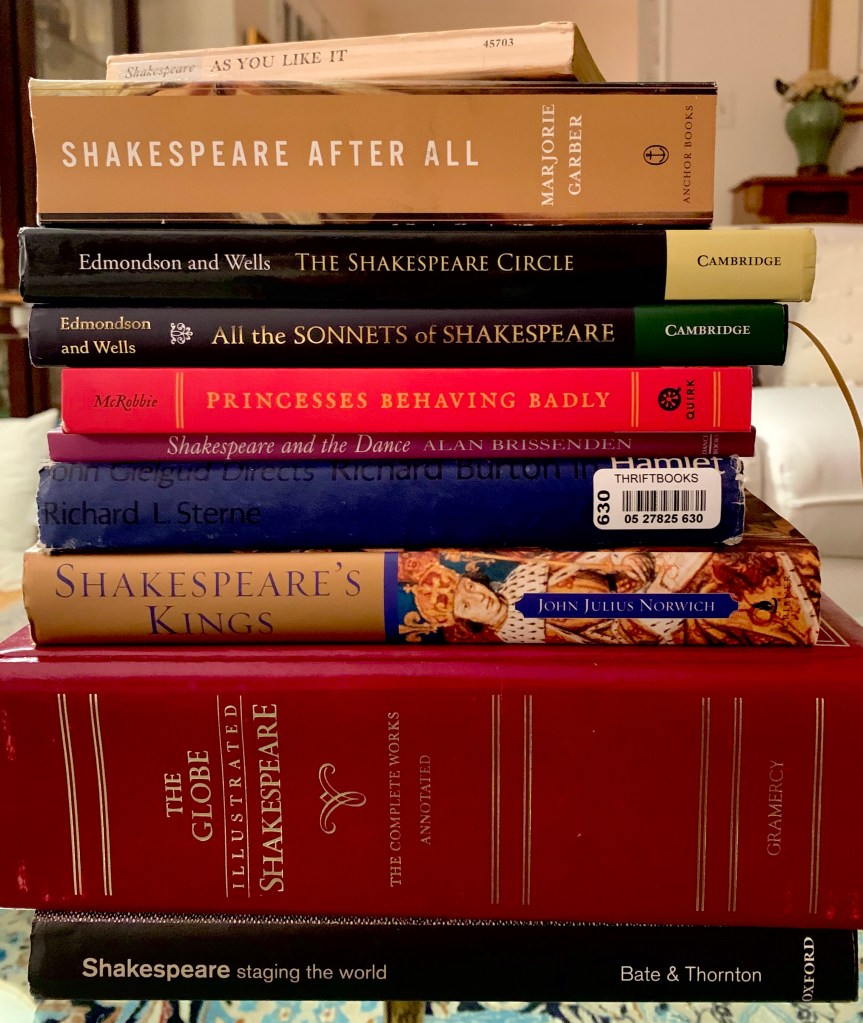
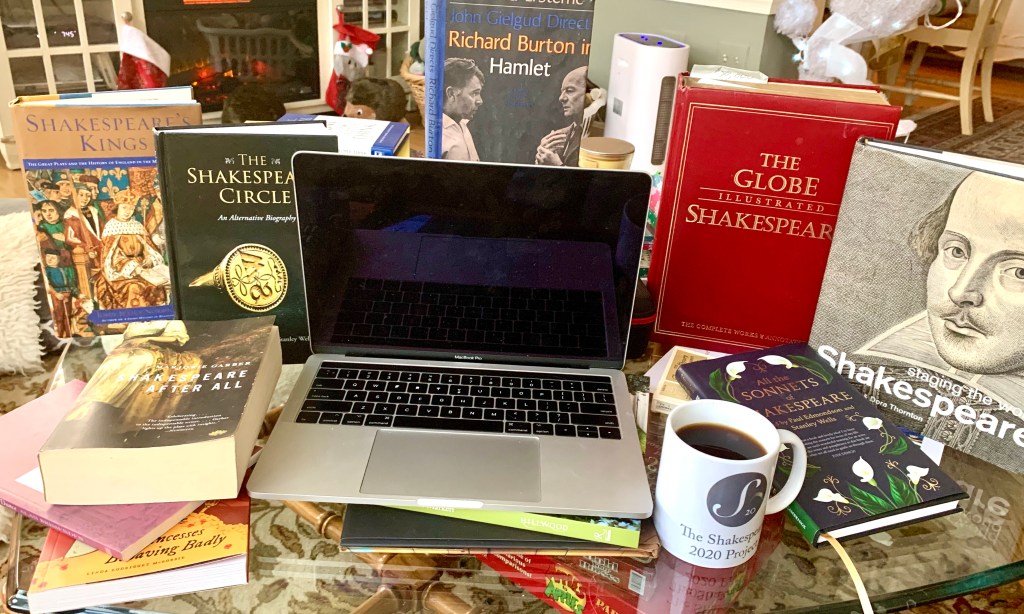
Over the years, my Shakespeare interest was occasionally rekindled whenever I found a book related to the plays. Once, when I was shopping in Costco, I came across the Complete Works of Shakespeare. “This would be a good resource if I ever have the time to sit and read,” I thought, being the eternal optimist. I purchased the book. Other times, also in Costco, I bought, Shakespeare’s Kings, in hopes of one day learning something about the histories (because I glazed over in my British History course in college); another time, I discovered and bought the 3-CD set of the Sonnets which I played in my car for months. So…when the Project appeared, I was armed and dangerous.

My journey began on January 9, 2020 with Twelfth Night. Yikes! The print in my book was microscopic! I focused my eyes and found that the words readable. Somewhere in Act 2, I remembered my English teacher’s remarks that Shakespeare wrote plays which were performed to audiences. He wrote for theater and not for fireside reading. How was I going to do ALL that reading when the plays must be experienced? I discovered Librivox!

On Librivox, talented and generous people joined forces from around the world to read almost all of the plays. YES! I was thrilled by my discovery. Aside from my relentlessly working and riding horses, I am passionate about walking my dogs for miles (we walk a 15 minute mile most days for 2-5 miles). I took Librivox on our walks.

I listened to Hamlet at the magical arboretum where trees took on the personae of the ghost, Gertrude, Hamlet, Laertes, Polonius, Claudius, and a stick in the pond resembled Ophelia. When I was annoyed that Great Falls Park had been closed, we hailed elsewhere where Macbeth was the perfect answer for my dark mood. The early spring blossoms in our sweet town’s yards were a nice backdrop for Measure For Measure. We heard acts of plays in my car or truck en route to our destinations. I have a favorite gas station where I buy inexpensive diesel for my truck. I love that my broadcasts are not interrupted when I turned off the ignition to fuel. I recall something about a “pie” from Titus Andronicus while the diesel flowed into the tank of my bright blue Silverado.

The Shakespeare 2020 project was brilliantly developed to be completed in 12 months. Well, being very curious, and having determined that I would complete the entire canon before Mr. Teunis’ 50th anniversary of his drowning (so that I could write a tribute article about him) I accelerated my reading/listening and behold, I finished the canon. There were times in King Lear and the Rape of Lucrece that the thought of closing the book and deleting the Librivox link were very compelling. HOW can a decent person know about such stuff and write about it, and worse, WHO would want to be entertained by THAT???? I decided not to judge by my values and carried on.

Opportunities to discuss Shakespeare arise in unexpected places

The Project was not just a syllabus, it was a treasure trove of intelligent, knowledgeable, and creative people who already knew a great deal. They shared their insights and enthusiasm with the 4,900 members of the group the Facebook page . The depth of resources, intellect, and understanding was staggering.  My Shakespeare “library” grew along with my curiosity and understanding.

During my haydays in Mr. Teunis’ class, I heard him tell us that theater, during the Elizabethan era, competed for audiences from among other public interests including bear baiting and public hangings. “Uh-hu, OK, whatever,” I thought, at the time. Now it came to back to me why certain plays were so grotesque. The poor playwright had to capture audiences’ attention and be competitive. Therefore, Titus Andronicus, Lear, Rape of Lucrece, among others.

My friends with whom I shared my Shakespeare adventure looked at me sideways most of the time. One friend, much older than I, said to me, “He should have died earlier. There would be fewer plays with which to torture students.” It seems that he is not alone in that opinion and that most people’s literary experiences were not as positive as mine. My friends were surprised that I cared about Shakespeare, let alone that I would embark on this journey.

My book collection grew

Until this Project, I had danced around the periphery of the Bard. I had done my share of academic study with Mr. Teunis, then, watched fabulous ballets including A Midsummer Night’s Dream with New York City Ballet and the Paris Opera Ballet; The Winter’s Tale and Romeo and Juliet with the Royal Ballet and attended Folger Theater performances throughout the years. After completing the canon, I purposed to watch as many plays as possible. I have managed to see about 20 plays, listened to Patrick Stewart reading the Sonnets, and I discovered brilliant lecturers from Harvard, Yale, and the University of Virginia.

The Shakespeare 2020 Project opened a new world of discovery and connections as I never expected. I met (virtually) fascinating people (some of whom I could not find a single point of agreement) who stimulated me to think in different ways. I became acquainted with the creator of the Project, Ian Doescher, a young, creative author who has written many wonderful books in the “Shakespeare style” (do look at his link, you will be amazed by his creativity) on themes including Star Wars, Clueless, Luke Skywalker, and myriad more. My new connections and friendships are treasures. Another bonus is that I connected with high school friends who also valued Mr. Teunis (I should mention that our strange, experimental, free-for-all high school turned out amazing humans who touch the far reaches of the world because of Teunis [and others like him]).

As the Project draws to a conclusion, the experience, the discoveries, the friendships, the challenges, and the curiosity have helped me learn much about myself, given me discipline to persevere, and hopefully helped me write a little better (all the while hearing Mr. Teunis’ remarks, lectures, and gentle admonitions to do “better”).

By writing this article, I experienced the vastness that is Shakespeare. Questions continually arise. My opinions have no bounds. Stay tuned for future supplements to my “Shakespeare Adventure.” The learning is just beginning.

I had a Dream and I Tried It

Diane Crump:

A Horse-Racing Pioneer’s Life InThe Saddle

A New Book by Mark Shrager

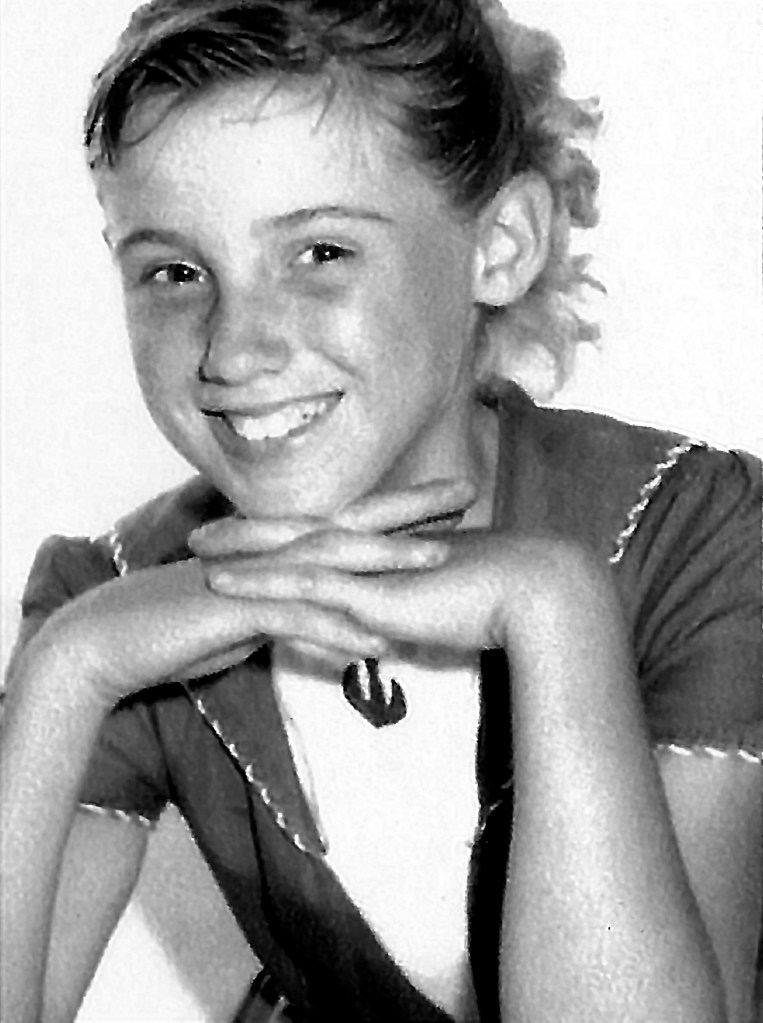
A horse loving girl, Diane Crump. Image courtesy of Mark Shrager and Diane Crump

“’Hey, Bert, there’s a woman jockey riding in the Kentucky Derby this year, first time that’s ever happened. Can you believe it? And her name is Crump. Coincidence, huh?’” Said a squad member to Bert Crump, persuading him to join the others in listening to the Armed Forces Radio broadcast of the Kentucky Derby. Bert was tired from a tough day in the field in Vietnam. “There was only one possible explanation for a woman named Crump riding in the Kentucky Derby and coincidence had nothing to do with it,” says Bert in his recollection of that day. He asked if her first name was Diane. “Yea, that’s her name – Diane Crump, do you know her?” said the man. “It’s my sister!” replied Bert. That was on May 2, 1970. Jockey, Diane Crump made racing history that day. “It was a surreal feeling being in Vietnam . . .while my sister rode in the Kentucky Derby with my buddies cheering her on,” recounts Bert in Mark Shrager’s book, Diane Crump A Horse-Racing Pioneer’s Life in the Saddle.

Cover – Diane Kissing Fathom, her Derby Horse – Image courtesy of Publisher, Lyons Press

An image of the book cover caught my eye while I perused Facebook posts. I quickly returned to the image and learned of the newly published book. Being an insatiable horse girl myself, I had to know more. I remembered the furor of a female jockey in the Kentucky Derby. “What’s the big deal?” I had thought, “As long as  they are good to the horse, stay on, and stay out of the way of the other horses, what difference is it if a man or a woman is riding?.”

I had to feature the new book about this remarkable athlete who happened to share my passions for horses, riding, and speed. After some introductory emails, making “friends” with Mark Shrager and Diane Crump on Facebook, and a unique relationship formed. I read the book, underlining important aspects and dog-earing corners of pages. I wrote a first draft.

I reread the book. This time, I put little sticky arrows on the pages I wanted to cite. “Passion.” “Love of the horse.” “Had to ride.” “Exhilaration of speed.” “She wanted to inhale the atmosphere, to ride, to care for horses, to learn everything about them,”  “… yearned for …having dramatic horseback adventures… being with close friends, in a school-free environment, and riding, riding, riding, ”writes Mark. He talks about “Diane’s unstoppable work ethic.”

It is important to understand that certain people are born with an “extra gene” – the gene that makes horses irresistible – their fragrance (some might call it an odor; a stench), their sweat, their breath, their silken hair, their eyelashes, their snorts (and yes, their gas and gut sounds are thrilling), their personalities, and their many “buttons.” This book is about such a woman.

What makes the story in the book special is that Diane’s mother encouraged her to “Follow your dreams.” Jean Crump was her daughter’s biggest advocate. She became Diane’s horse-riding  friends’ favorite mother. Many of her friends wished for a mother just like her. What they did not know in their childhood was that Jean was special not only for her nurturing and encouraging her daughter’s  horse passion, but for her unwavering trust in her faith and her remarkable dreams that she wrote down and often illustrated in paintings.

On my third reading of the book, it became clear that while this is a story about horse-racing, riding, and a tenacious woman, it is also about a mother’s journey with God, who, trusting through her faith, opened her hand and let her little bird fly. It took tremendous faith to agree to let the 16-year-old Diane travel with a racehorse trainer and live in unfamiliar housing with people she had never met so that she could to continue her horse training and riding journey. Her faith quelled her concerns.

Mark Shrager Image courtesy of Mark Shrager

“How did you happen to select Diane’s story for your book,” I asked Mark. He replied that he had finished his prior book, The Great Sweepstakes of 1877, and was looking to write the next book. He had made many friends on Facebook through his first book .Diane was one of those friends. He told me, “When I realized there had been no books written about her I called and asked whether I might write her biography.  I was excited to tell the story of an amazing person who was so much more than just a jockey.”

Diane was ready to tell her story. Diane settled in Virginia. While no longer racing, she is a horse broker. She said, “I wanted to find someone to stick to the principal of what I wanted told. Mark did exactly that.”

Author, Mark Shrager,  lives in California. He has been handicapping horse races since his high school days. He is not a rider. His father was adamantly opposed to gambling and horse racing. “I got into handicapping mostly to annoy my father, but I won enough money with which to buy my first car, ” he said. Two people, living on opposite coasts; with different parental experiences; a Christian woman and a Jewish man; happened to share the exact birthdate – 3000 miles apart – Mark in Los Angeles and Diane in Connecticut as their birth state. A writer / handicapper and a jockey, came together to tell a remarkable story.

In speaking with both Mark and Diane, I asked whether the book result was what they had expected. Mark told me, “The happiest part of this process was Diane reading it and telling me, ‘This is exactly what I wanted! Thank you!’” Diane added, “It leaves nothing out without saying too much!”

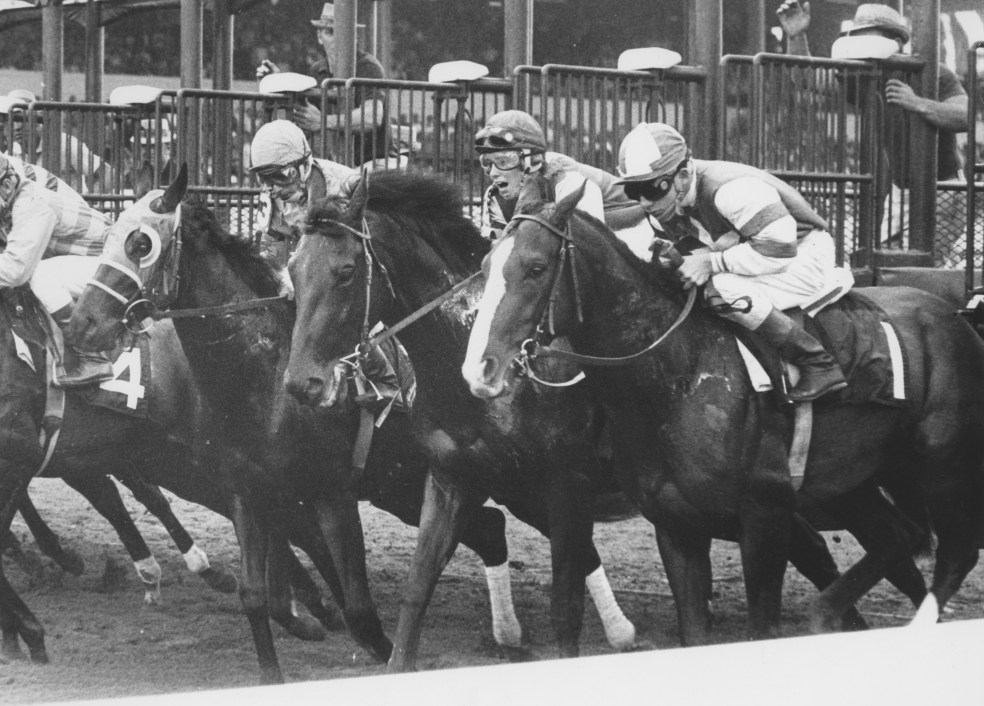
Diane (second from right) on Bridle ‘n Bit PC: Jim Raftety – Keenland Library Collection Courtesy of Mark Shrager

When you read the book, you will discover that it is packed with thrills, adventures, and against-all-odds finishes. You will learn about a tousle in a match race with an encroaching jockey holding her saddle cloth to slow her horse, and about the incomparable feeling of crossing the finish line first. Mark’s elegant storytelling made my heart beat faster as I imagined the wind in my ears and the sound of thundering hooves upon the track.

It is not often that horse racing and Christian faith turn up in the same sentence, much less in the same book. Like an onion with many layers, the book wraps a child’s heart for a pony; with a will to ride and a love for speed; with a faithful mother (and supportive father and family); with grit, focus, and determination;  covered by love and grace. 

The  little girl who loved horses shattered the bias and presumption that “Racing is too tough for women.” In this book, you will read about how Diane’s love of horses and riding and her focus in spite of protests and objections, sustained her throughout her career. She rode a thousand morning workouts, on a thousand difficult, opinionated thoroughbreds that no one else would ride. “I rode every bad tempered horse …, if they reared up, ran off, if they were stupid, that’s what I got. I had to prove myself over and over again.” She raced in an “Under the microscope atmosphere that no other jockey in history had ever experienced,” writes Mark. She lived her dream and rode in the Kentucky Derby. Diane’s message is about the faith and grace that took her to the heights of her profession and that continue sustain her.

Diane discussing pre-race strategy with trainer Tom Calumet – PC: Jim Raftery – Keenland Library Collection courtesy of Mark Shrager

Mark dedicates the book to “Every female athlete everywhere.” He told me, “What awakened my interest in women athletes was Diane.  Learning all she’d gone through to be a jockey led me to recognize that women athletes in many sports were probably encountering the same sorts of prejudice and negativity Diane confronted.  Dedicating the book to female athletes was my way of encouraging them to live their dreams and overcome the naysayers, like Diane did.”

This book is about horse racing. It is about women’s equity. It about a young girl’s determination to learn about horse and to ride them.  It is about faith. The message is universal. The book is available in hardback and on Kindle . It is a must read for every parent with a passionate child, every horse-crazed person, for people of faith and for those in search of theirs, and for everyone who loves to root for the underdog.

The Power of the Painter’s Brush

J Douglas – Artist

Gumdo, is a long Samurai-like sword. J (just J) Douglas earned his first black belt in that martial art. For 17 years J owned and operated an Olympic World Taekwondo martial arts school. How does a martial arts master change careers? By picking up a paint brush.

J
Image Courtesy of J Douglas

J delivers power with his paint brush. His “disruptive representationalism” blends powerful energy with classical realism. Yet, as a high school student  in Texas, his representational realistic style was deemed mere “photography” by his abstract-loving art teacher. “So, I got into drama instead,” said J. “I went through phases of art forms from dance to drama to commercial art until 2008. Then, I was inspired to pursue my passion of oil painting.”

“In 2008, I watched Henry Asencio paint in person. I was inspired to return to my fine art roots. I bought my paints and supplies and haven’t looked back,” said J.

“I feel that I am a lifetime student of the arts. Study and grow or get stagnant and die. I love where I am now with my art,” he says.  His journey from disheartened, but seeking student; to dance and ballet; to the martial arts; and back to painting has taken interesting turns throughout his life. The constant has been his passion for painting.

On Pointe by J
Image courtesy of J Douglas

I met J at the Salamander Resort’s Gold Cup Wine Bar a number of years ago. He was my server. Immediately, I sensed something intriguing about him. I had to ask questions. I learned that his name was simply, J.  He joked, “When you’re as famous as me, just your first letter will do.” From our brief conversation, I learned that he was an artist. I also learned that his prints were for sale in the resort gift shop. That day, I bought my first J print, On Pointe. Today, we like to say that he is “an artist costumed as a server.”

Salamander Resort (Middleburg, Virginia) owner, Sheila Johnson, has a keen eye for art. Beautiful paintings of pastoral  scenes and powerful horses grace the walls of  “Middleburg’s living room” and hallways leading to the spa and ballrooms of the Salamander Resort.  Among those stunning oil paintings is a 5’ X 7’ painting titled, Destiny,  by J. The Salamander Resort is his gallery. “Sheila Johnson made me an international artist. Thanks to her, I have been able to get commissions and patrons.”

Destiny by J is prominently displayed at Salamander Resort
Image courtesy of J Douglas

Destiny is not only very large, but very powerful as well. Looking at the painting, I can hear the horse breathing, the sand spraying on the jump standards upon takeoff, and I can tell where the next jump is from the focused look in the eye of the rider. It is a work of balance, understanding, appreciation, and respect for animal, sport, and rider. It fits beautifully into the quiet atmosphere of excellence of Ms. Johnson’s vision for the resort.

Self Portrait by Rembrandt
Image from Public Domain

Rembrandt is J’s favorite artist. J explained, “He was a master of the face and color. There are hundreds of colors in the faces of his subjects, although we see flesh tones.” Surely, a closer look at Rembrandt’s Self Portrait reveals  multiple pallets of colors masterfully applied to beguile the eye. “The bodies of humans and horses, are captivating,” says J. “Their eyes, their strength, agility, textures, colors, and moods keep me asking and delving deeper,” he explained.

When asked about his materials, he said that oil paint is his favorite medium and that he stretches his own canvas. “Oil paints are the most forgiving medium,” he explained. He shared that there are hundreds of colors and qualities of paints. He uses only about eight colors that he mixes to achieve the exact color. His works mostly with a brush but a pallet knife has occasionally come in handy.

He works on commissions first. For his personal projects, he has a “wet wall” that he turns to when time permits. The flexibility of oil paints allows him the privilege to let some pieces “rest.” On social media, J features many time lapse videos of his work. Take a look at one for Destiny:

Watch Tine Lapse Video
of the creation of this painting
Courtesy of J Douglas

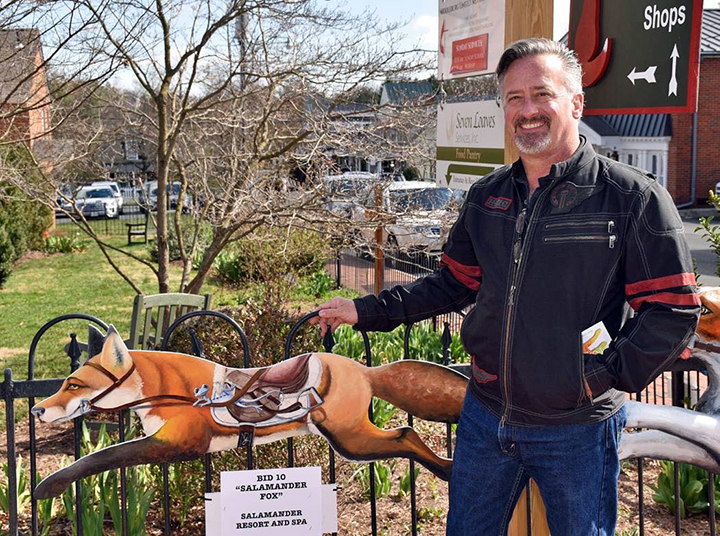
J gives much back to his community. He has supported the local ballet company with his On Pointe print, created a Salamander Fox for the Middleburg Garden Club’s biennial “Foxes on the Fence fundraiser,” and consults for the greater good of the area.

The Salamander Fox
for Middleburg Garden Club’s Biennial Foxes on the Fence Fundraiser
Image courtesy of J Douglas

Always growing and trying different approaches, his artistic includes graphic an commercial art. A popular and still available image is the “Parrotheads” (of Jimmy Buffet fame) “License to Chill” license plate that he created for the Virginia Department of Motor Vehicles.

License to Chill” by J
Image courtesy of J Douglas

As an avid horse enthusiast and a fan of J’s equestrian paintings, I had to ask, “Do you ride horses?” “I am learning and loving it. My wife wants me to stay safe so I take riding lessons,” he replied. Being from Texas does not automatically bestow equestrian prowess. He is a horse-studier and horse lover. He naturally understands the power, spirit, movement, and essence of the horse. His paintings seem to get it just right.

Best Friends by J
Image courtesy of J Douglas

J wants people to love the art they acquire and commission. He understands that it can be an economic extravagance. To help more people be able to enjoy his art, “We are now teaming up with Patreon.   Patreon is a site that allows people to support the arts.  Almost like an internet tip jar.  But, we don’t want to just ask for support.  We created a system to spread your payments out over 12 easy payments.   You decide the level of support, choose the subject of your painting and then in one year you have your original piece of art.”

J, the man, exemplifies the “polymath,” the Renaissance man. The power of his brushes tell mesmerizing stories.

Essential: Food for the Soul

Pansies, Henri Fantin-Latour, 1874, National Gallery of Art, Washington DC

“The world will surprise you with its grace,” is a line from a movie that I have watched many times. In today’s environment, this line has been brought to fruition in the most generous ways. We are all affected in how we move about, how we work, how we interact with friends and family, and how we entertain ourselves.

Detail of Frederick Edwin Church El Rio de Luz
National Gallery of Art, Washington, D.C.

As in Sleeping Beauty, theater, music, art, dance, intellectually stimulating courses, and much of our in-person physical activities have ceased for the moment. However, the outpouring of generosity on the part of performers, museums, theaters, educators, and trainers have amazed me over and over. Sometimes I have blinked to be sure that what I was reading is true. And, so it is. We need grace and must exercise generosity now. We need the arts now more than ever. What better way to experience grace and generosity now?

From Paris to Seoul, from London to  Washington, DC , Florence to New York City,  and from Harvard to Yale, and Princeton, along with many others, the best and greatest are sharing with us their best and greatest. We can nourish our souls (this is not a theological article) profoundly by a click on our computers . We can regroup. Perhaps this is our opportunity to explore, learn, reinforce, and discover the beauty of the arts. Our souls will be better for it.

Through my love for the arts, I feel like a kid in a candy store – where to go first – what to watch first?? Actually, I am feeling like I did on my first visit to Fortnum and Mason, “Must focus. Time is fleeting.”

To help make the most of our situation, I have compiled links to complimentary  (some are pay what you can) videos from some of the world’s greatest resources. To these generous and gracious people and organizations, I give heartfelt thanks. Please remember them when times change and support them by become patrons, buying tickets, attending exhibitions, and buying future streaming services. They have gone above and beyond our expectations to feed our souls with beauty, creativity, adventure, and grace.

Ballet and Opera:

Theater:

Music:

  • Arts on the Hill – University of Virginia – weekly videos – jazz, poetry, and so much more!
  • National Philharmonic – musicians share their musical contributions – #MusicalNotes – brilliant segments  of music

Tours / Architecture:

Art and Museums:

Movies / Shows /Documentaries:

  • HBO provides movies, programs, and documentaries free to stream
  • Amazon Prime SXSW 2020 Film Festival – ““Prime Video presents the SXSW 2020 Film Festival Collection” offers filmmakers in the 2020 SXSW Film Festival lineup an invitation to opt in to take part in this online film festival, which will play exclusively on Prime Video in the U.S. for 10-days. The one-time event will be available in front of the Prime Video paywall and free to all audiences around the country, with or without an Amazon Prime membership, all that is needed is a free Amazon account.”

Literature / Books

Free Courses:

Pilates:

Petite danseuse de quatorze ans
Edgar Degas

Let’s be prepared with greater knowledge and appreciation for when the doors are opened and curtains rise once again.