Farewell, Diane. Your Spirit and Determination Live On
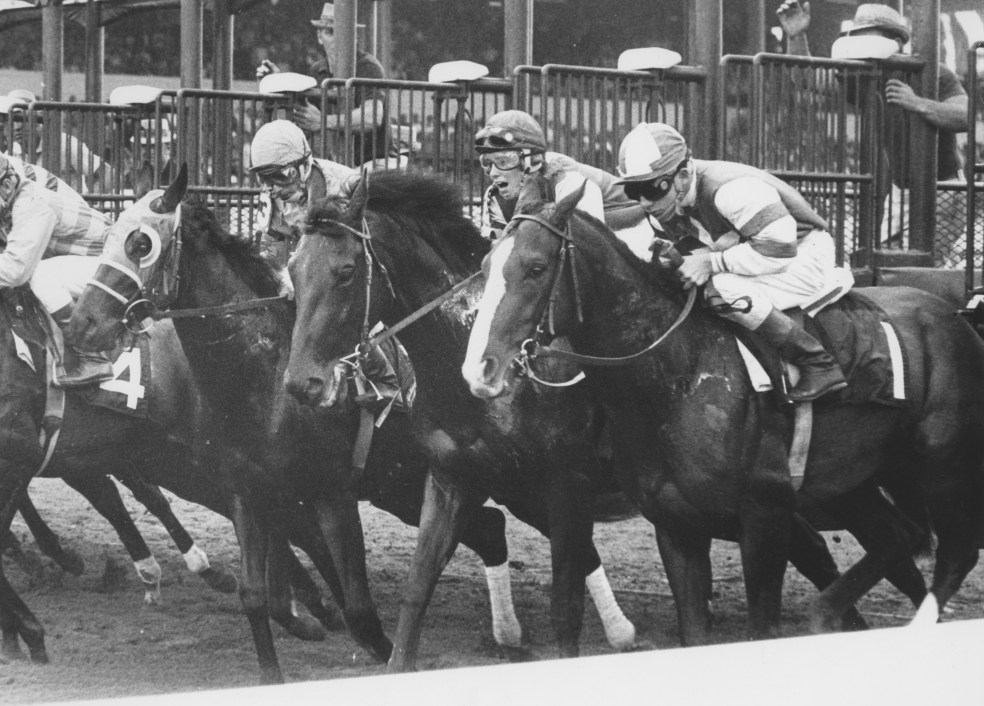
Diane discussing pre-race strategy with trainer Tom Calumet – PC: Jim Raftery – Keenland Library Collection courtesy of Mark Shrager
Diane Crump was not an intentional trailblazer. She pursued her passion. That happened to be in the world of the male-dominated 1960s horse racing industry. Who had ever heard of a woman jockey? Today, we all know the name – Diane Crump. She broke barriers not only for horse racing but for women, in general. “Because of women like Diane . . . women became lawyers, physicians, and astronauts. Diane’s efforts unlocked the doors, then we jumped in,” wrote a friend on her social media page. Read our blog about Diane and Mark Shrager’s book,Diane Crump: A Horse-Racing Pioneer’s Life in the Saddle.
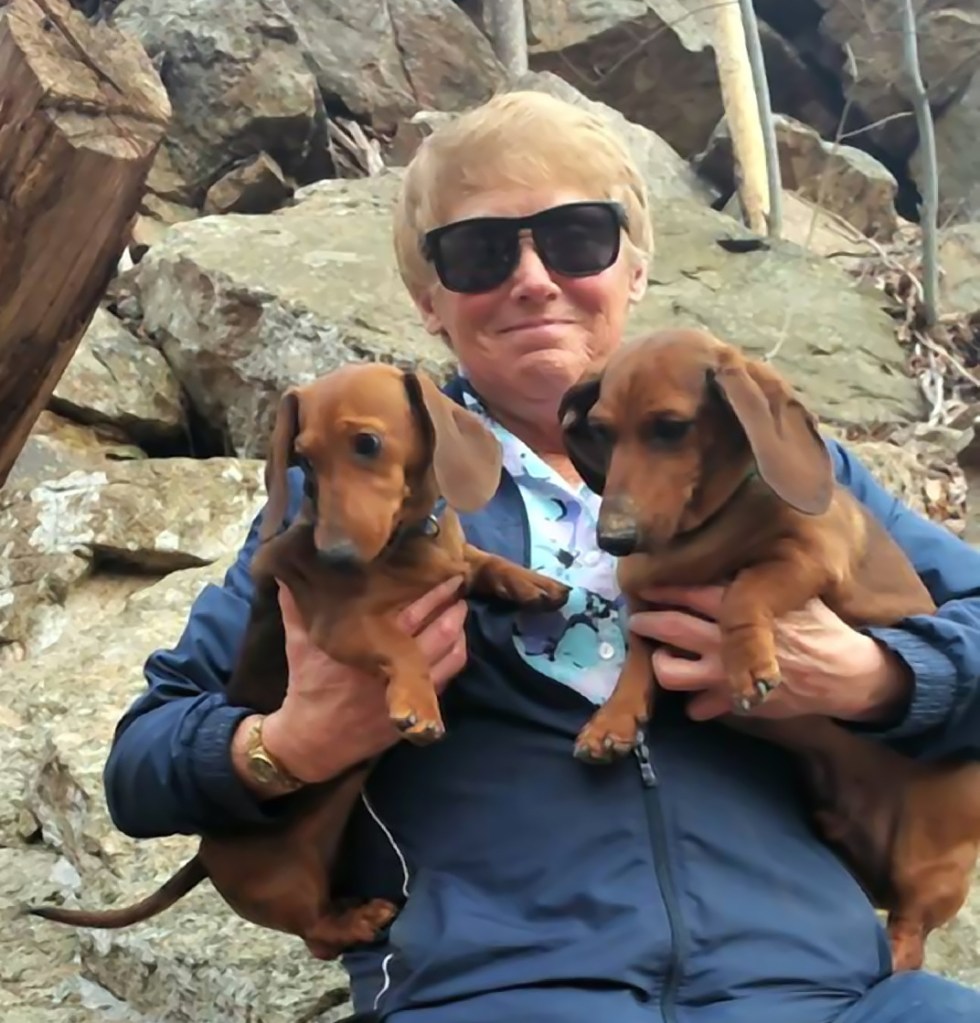
In 1970, Diane was the first female jockey to race in the Kentucky Derby. She won 228 races over her nearly 30-year career. She devoted her life to family and healing hearts and spirits in her subsequent 27 years where she created a ministry of hope and comfort with her three dachshunds – Animal Assisted Therapy program. She touched people’s lives wherever she went.
As a horse-crazy girl, Diane was my hero. Her tenacity and forward momentum helped propel women’s goals and professions. She inspired me to believe in my competence throughout my life. She made incredible contributions to our world. We lost the person but her beacon shines on. Rest in peace, Diane.
Memorial services will be held on January 24th from 10 AM to 12 PM at Fishnet Church in Front Royal, Va.
On February 5, 2026, the National Sporting Library & Museum will host a special evening with veteran turf writer Mark Shrager, author of Diane Crump: A Horse-Racing Pioneer’s Life in the Saddle.
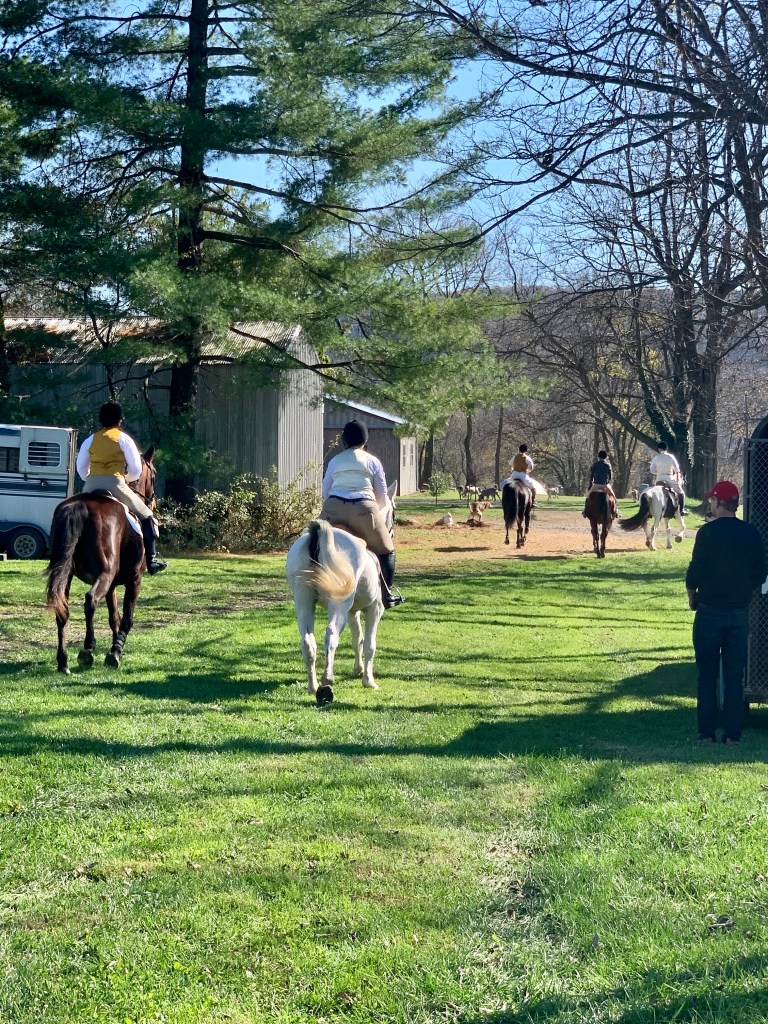
The Loudoun Fairfax Hunt “opening meet” on November 2 marked the official start of the fox hunting season. A “stirrup cup” to toast to the season welcomed riders and all guests. The meet was held at Overbrook Farm, the club’s hunt property, in Hamilton, Virginia.
Steffanie Burgevin Serves A stirrup cup Jon Henkel serving with Paul’s tray Bervely Dickerson serves apple cider
Fox hunting on horseback is a heart-racing, sport where good riding skills and instincts are key. The goals of the hunt club are camaraderie, sport, and the preservation of open land. The goal is not to kill the fox but to view it. A good view feeds week-long conversations, stories, and delight.
L: A whipper in ready at the position, Center:Kate Dendinger and Rita Caseman, R: Lawrence T. Dale, MFH and Mrs. Carroll Galvin (Nadine)
The pageantry is poetic, but the autumnal landscape takes one’s breath away. There Is nothing more delightful and invigorating than riding along a ridge engulfed in autumn color and feeling the brisk fall air across the cheeks.
Turnout is an important part in the pageantry of Opening meet – MFH Carroll Galvin’s Horse is study in refined braiding and turnout
The horses were cleaned, bathed, clipped, and braided to be at their absolute show best. They understand and feel the excitement. They too, have friends in the hunt field. It is not uncommon to hear stablemates call for each other when they separate.
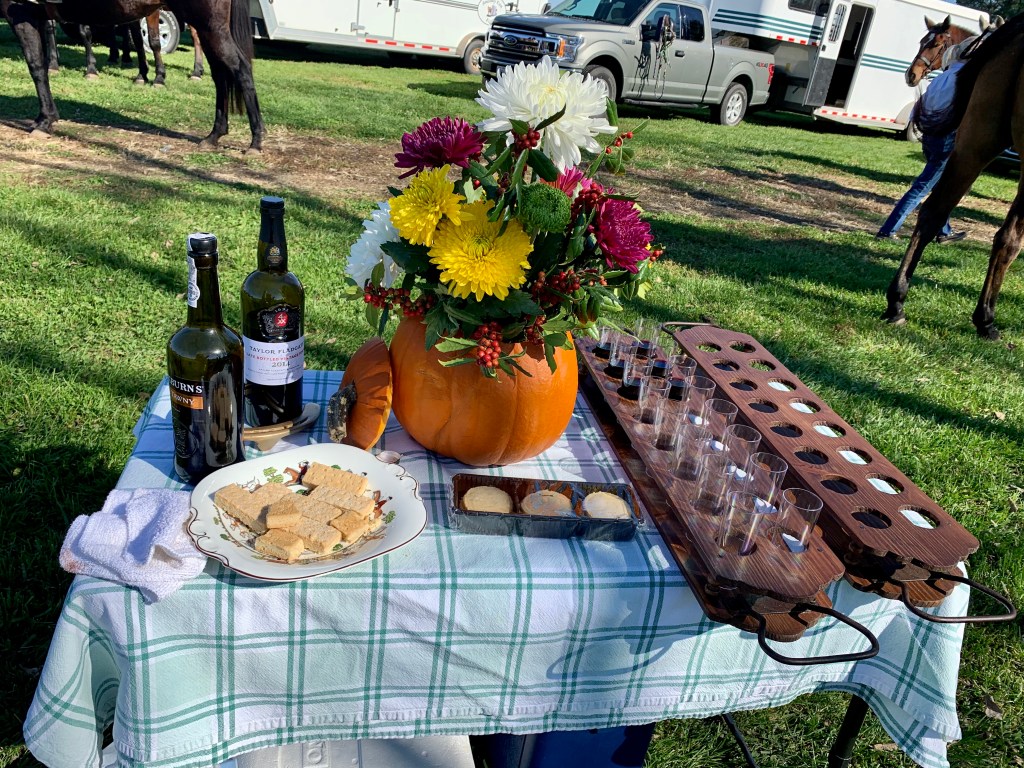
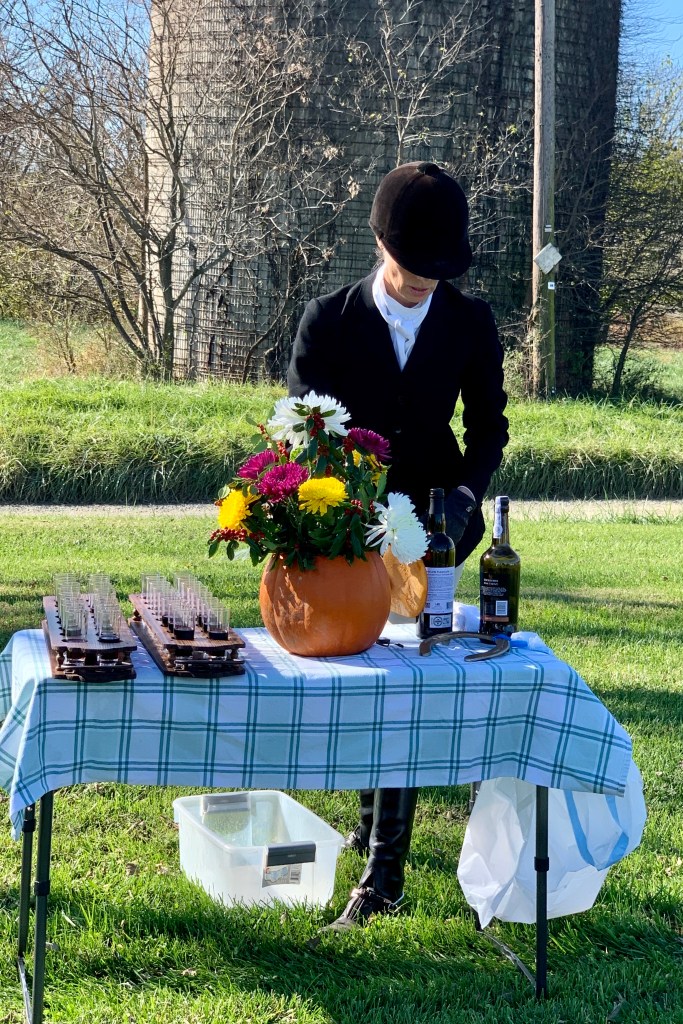
Stirrup cups of sherry, whiskey, port, and apple cider were served on elegant wood trays crafted by Master Paul Ritsema. Beyond tradition, the stirrup cup gives just the right warmth and ‘confidence’ with which to commence the ride.
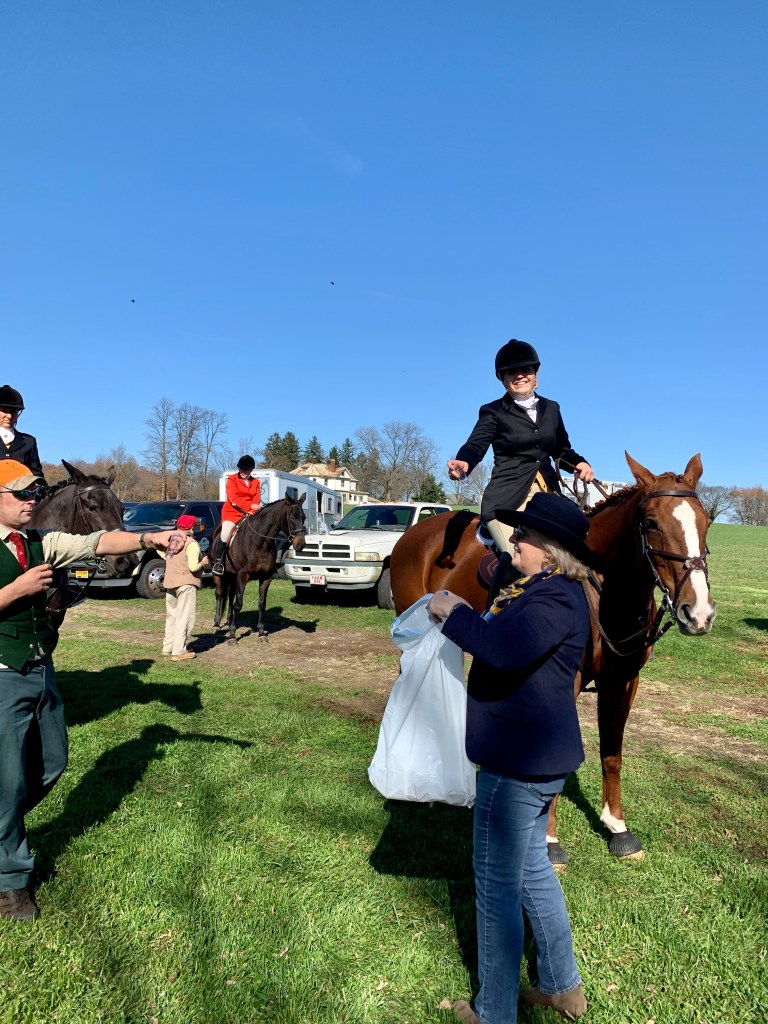
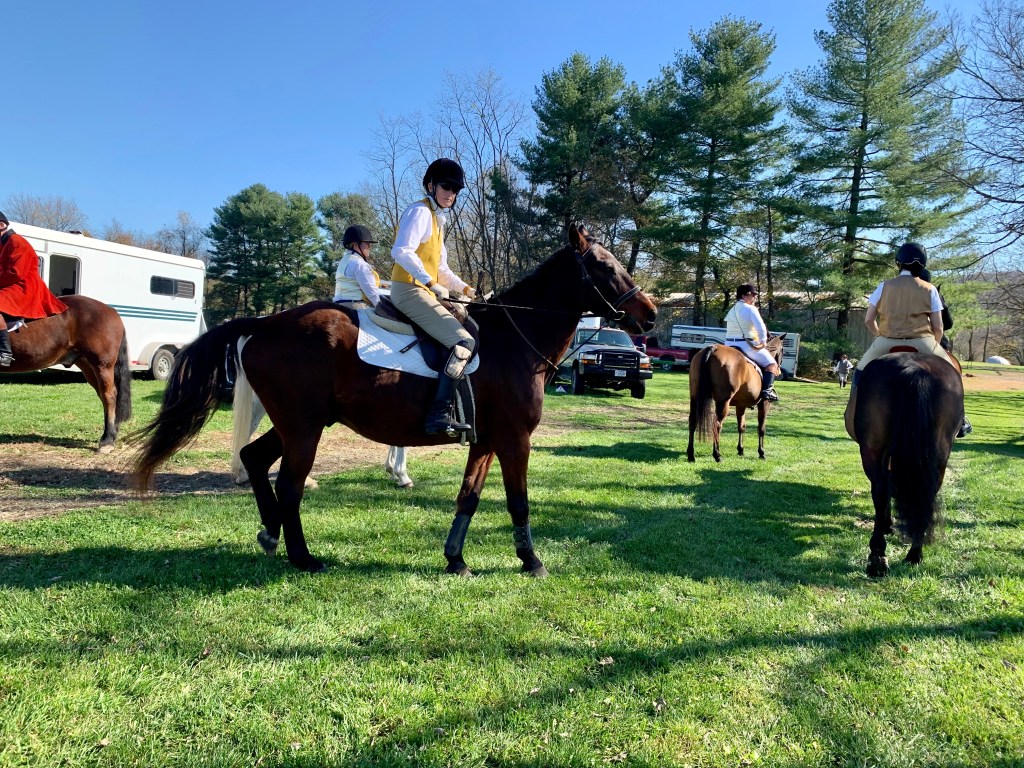
Lining up five horses with ears forward is a challenge – the rider-horse connection works miracles
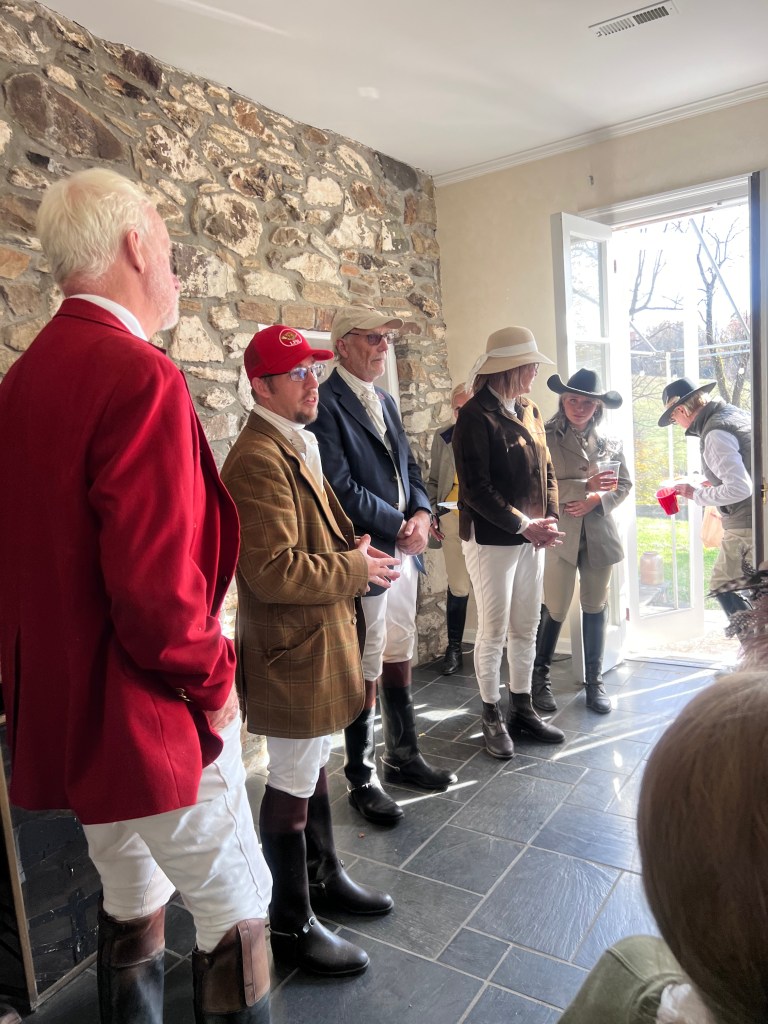
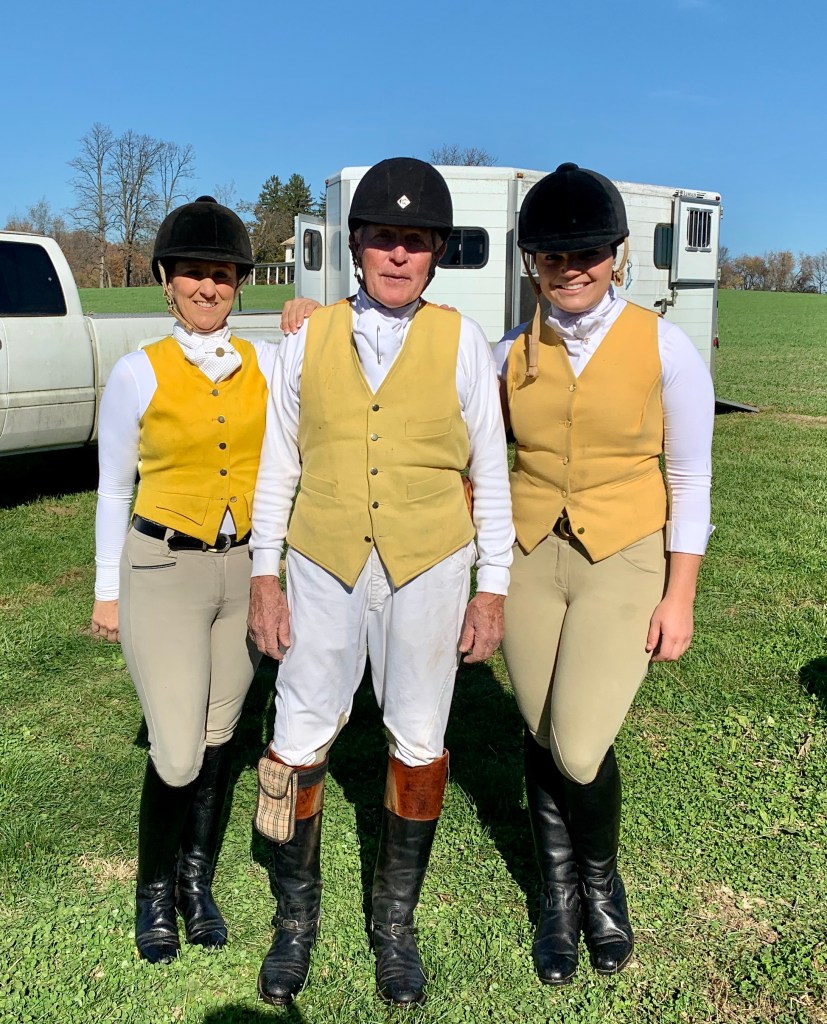
The hunt protocol is simple – good manners, proper dress, well behaved horses. The members of the hunt and their guests dressed in “formal attire” – gentlemen who are members with “colors” wore scarlet coats and the ladies with colors wear black or navy blue. Color members reflect their club affiliation by the ‘colors: on the collars of their coats. The Loudoun Fairfax colors are yellow/gold. Coats display the club’s buttons. With LH monogramed.
Master of the Hunt: top L: Paul Ritsema. top C: Michael Harper. R: Mary Sell. Bottom: Dr. Carroll Galvin
Members who do not have colors wear black. Breeches are buff, beige, or canary. Of course, proper safety helmets are a must. The tall black dress boots are polished to a gleam. Showing wear on boots denotes avid hunting but polished and clean.
The attire and horse turn out are not only for show, but to honor and respect the landowners who permit the sport on their farms. Having 20-40 horses gallop on one’s farm is a big deal for which the hunt is grateful and very respectful.
Larry Campbell Brooke Rogers Hannah Rogers
Fox hunting is a centuries old English sport that is steeped in tradition and protocol. Proper manners, proper ‘turnout” for both horse and human are expected. Tradition dictates clean and simple, in every aspect. Besides attire, horse tack and equipment consists of plain flat brown bridles, martingales, simple saddles, well fitted saddle pads, laced leather reins (although progress in technology has loosened this). The simplicity of design also helps in the cleaning of mud-caked tack after a rigorous hunt.
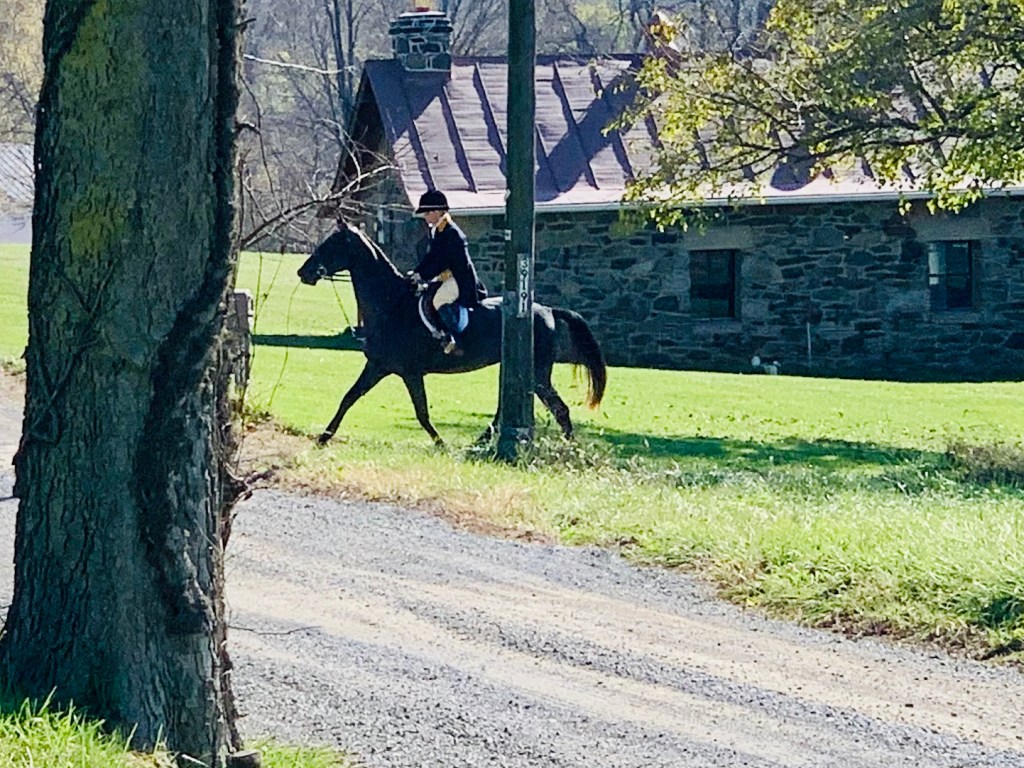
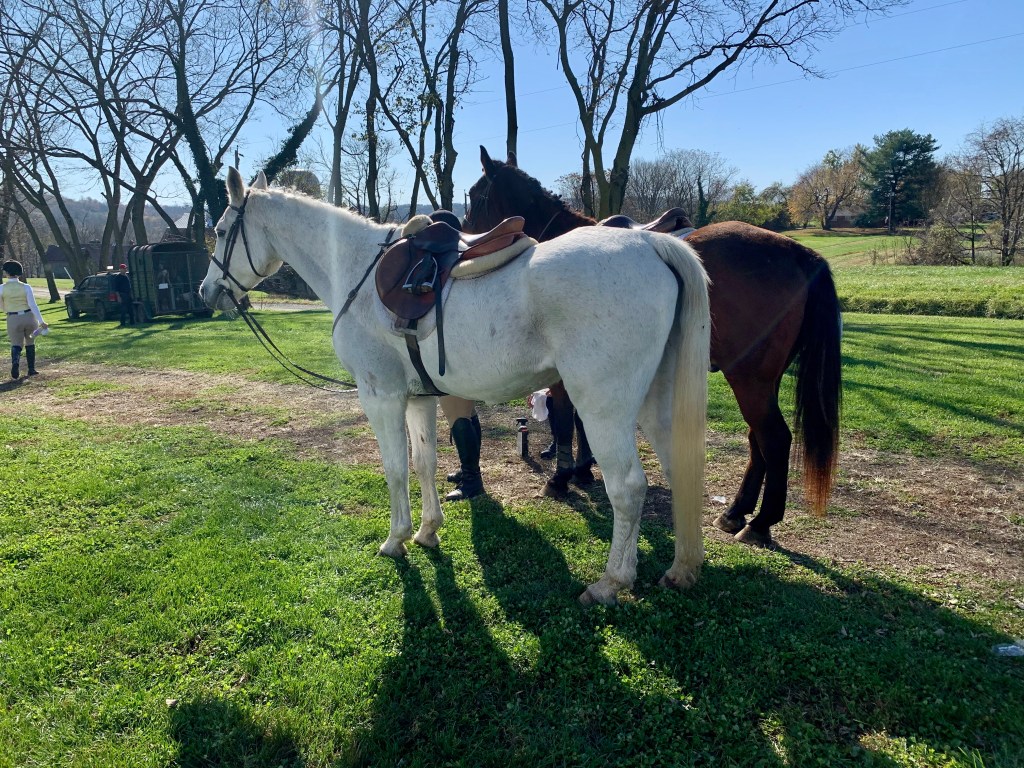
A great hunt horse will be relaxed, calm, and attentive as demonstrated by Paul Ritsema’s relaxed mount, Twins – Heather and Lisa’s horses who accommodated hugs and photos; Carrol Galvin’s horse who took the cast off in stride.
To be deemed a hunt horse, a horse has been trained to professional standards for obedience (HALT is the foremost order), agility, respecting the hounds and giving them priority – never kicking. In addition, the hunt horse must have strength and stamina to comfortably go for up to four hours. Some days the hunting is slow, others days, the fox give good sport that everyone rips through the countryside. Even on the fast days, there is order and decorum. Once they are credible hunters, the training continues with reinforcement. We ride animals of prey, creatures with a flight instinct. Our calm leadership builds their trust which keeps us safe, most of the time.
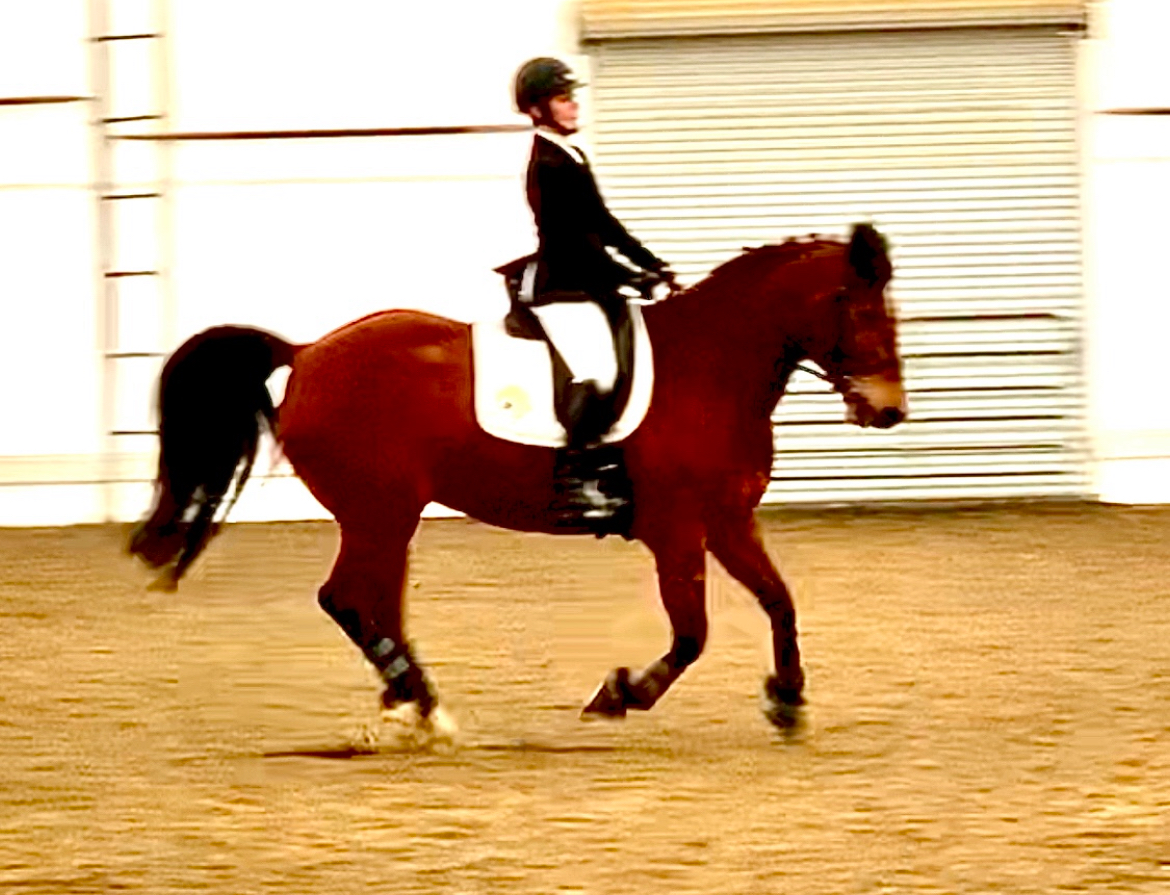
Having hunted the beautiful Loudoun territory for nearly 20 years, I write from experience albeit a bit wistfully. To be able to fully enjoy the sport of fox hunting, a steady, responsive horse is necessary. I had the privilege of having the golden horse who learned hunting quickly and was remarkably adept and obedient. At a downhill gallop, there is no time to negotiate with a horse. When she passed away, try as I might to find another suitable mount I repeatedly wound up with and collected dressage horses. After the third one, I determined that it was a message to stop hunting.
The Hilltoppers follow Master David Moyes in front of the Overbrook Club House
Master (MFH) David Moyes welcomed the riders and asked Huntsman, Jeff Woodall, to ready the hounds. Dr. Carroll Galvin, MFH, expressed gratitude to the landowners for their generosity.
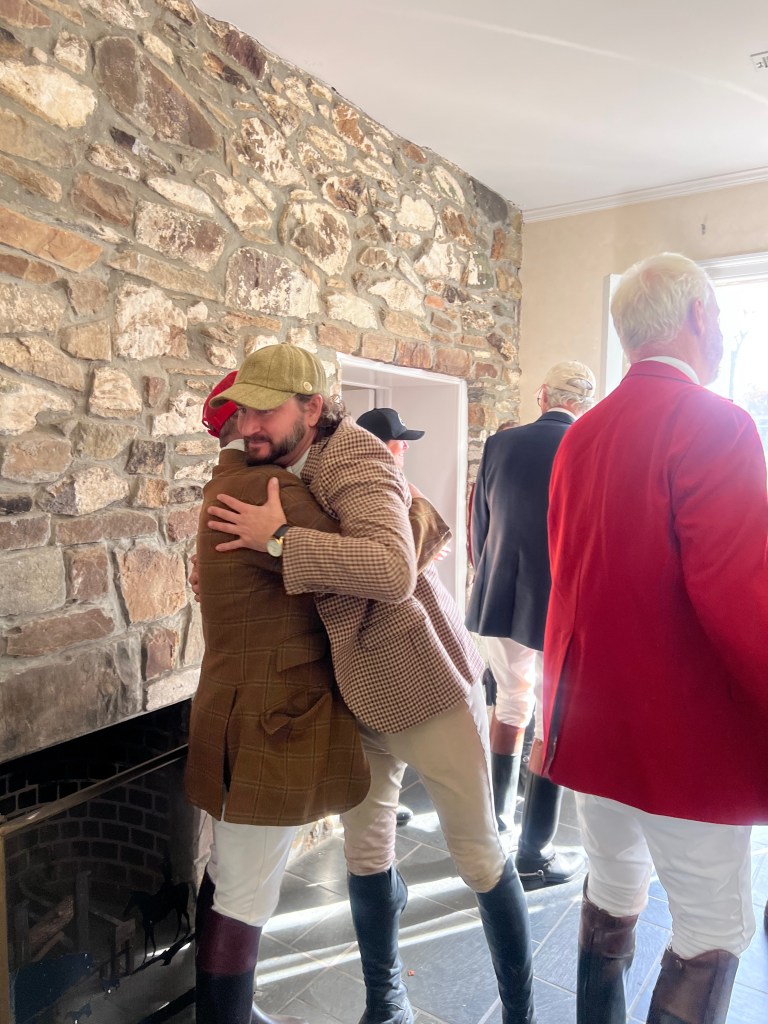
Members relax after the morning’s ride, sharing stories and laughter over the Hunt Breakfast at Overbrook Farm.Top R: Dr. Kathy Stern and Lawrence T. Dale, MFH; Middle L: Twins Heather and Lisa; Paul Ritsema, MFH and Grill Master; Rita Caseman and Steffanie Burevin; L; Master Lawrernce T. Dale; Bottom Row: David Moyes, MFH (profile); Old hunting buddies – Krasi Henkel and Joseph Keusch
The warm temperature made scenting difficult for the hounds and the riders returned after a few hours of sport to enjoy an opulent hunt breakfast and camaraderie. The horses were watered and comfortably eating hay in their trailers while the riders happily retold their riding and fox-viewing adventures.
Russell Shifflet and Andrew Camp receive their Colors from the Master of Loudoun Fairfax Hunt in recognition of service to the Loudoun Fairfax Hunt.
At the Hunt Breakfast, two industrious and generous members were awarded their Colors. Russell Shifflet and Andrew Camp were recognized for their tireless work on helping clear trails and jumps, helping with social events, and working on the Hunter Pace, the Point-to-Point races and at the Hound Show. Getting one’s colors is a significant milestone in one’s fox hunting career. As Color Members, the gentlemen will sport scarlet coats with the club colors on their collars as well as the buttons of their coats will be engraved with the club’s initials. It is indeed a high honor and well deserved. As in all social clubs, it takes everyone’s contribution to reach success.
The beauty of the hunt club is that whether one rides or not, the social gatherings and friendships do not disappear. The 2025/26 season opened on a brilliant November morning. There will be a subsequent hunt for the Blessing of the Hounds, and a Hunt Ball will be held at the Birkby House before Christmas.
Rows of trailers
Have you dreamed of riding with the hunt? There are many ways you can accomplish that if you already ride well. A call to the Masters for permission to ride might be all that is needed. If you are a beginner, there are outstanding training facilities for you and your horse. My advice: do not risk being hurt if you are not a secure rider, and your horse is not up to the job.
Though my hunting days are behind me, my heart still leaps at the sound of the horn and the sight of the field setting off into the morning mist.
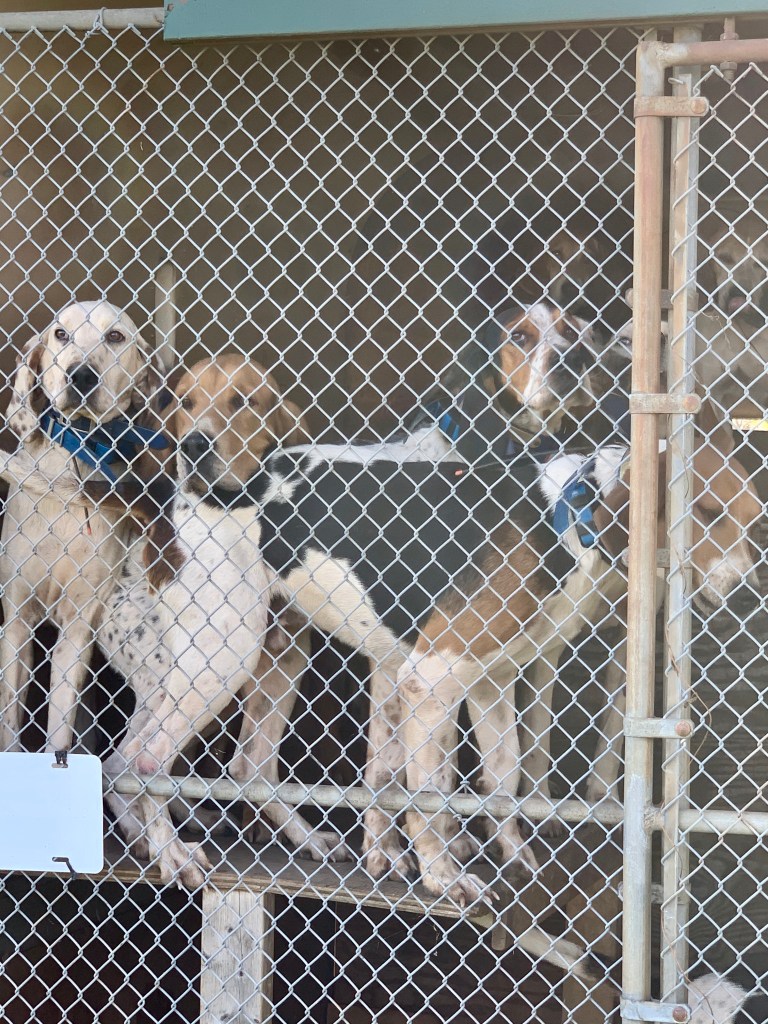
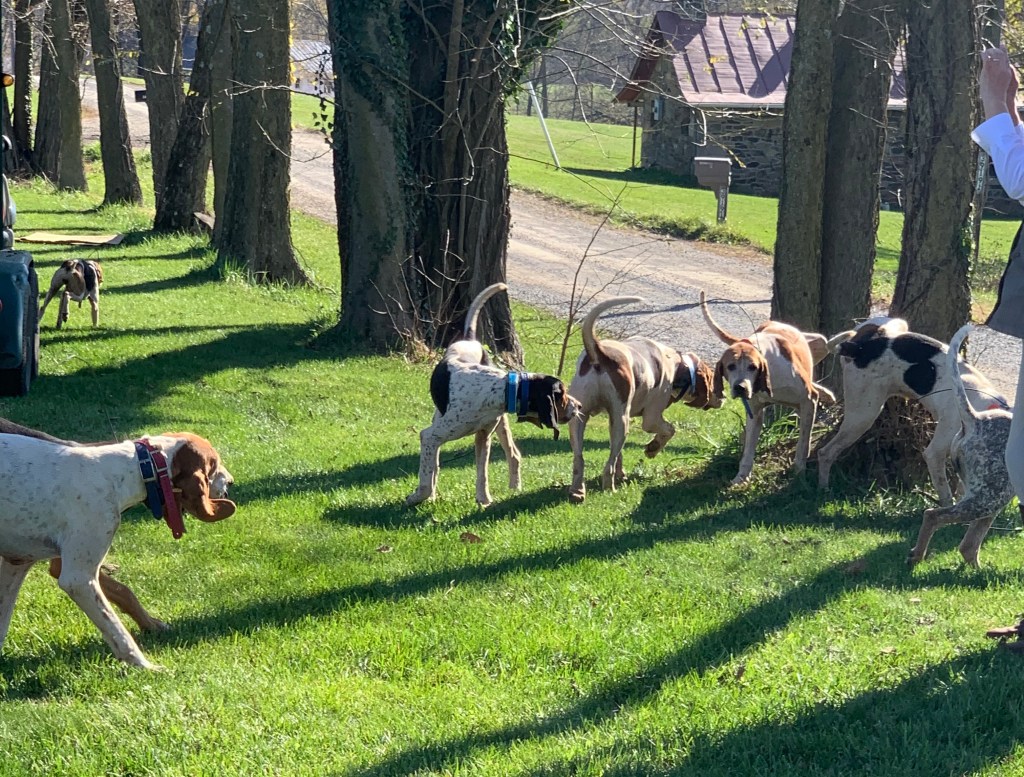
The stars of the hunt: the hardworking, obedient, and lovable hounds of the Loudoun Fairfax Hunt
Hounds go out on Fridays and Sundays. We encourage juniors and guests to join us and experience the thrill of our sport. We are always happy to see new faces in the hunt field! Information on capping can be found here.
It is Friday, July 26, 2024, the XXXIII Olympiad, Paris 2024, is beginning with pageantry. The events have been anticipated and Paris has worked tirelessly to put on a safe and successful Olympiad. Yet, disappointment hangs over the equestrian games. The news and video show Charlotte Dujardin’s suspension. This suspension resulted from abusive training tactics.
Approximately 10,500 athletes have worked, practiced, and competed their way to the pinnacle of their individual sports. Dujardin will not be joining them. Watching the video is devastating. I felt embarrassed to be a student of dressage. My disbelief turned to rage. Then it turned to disappointment, to sadness, and now to pragmatism.
The issue is much greater than an “error of judgement,” as stated by Dujardin. Should she be eliminated from Olympic competition? I believe so, based on what I have seen in that video. Should she be the martyr for equestrian sports? NO. Bad decisions plague equestrian sports. These decisions affect not only Dressage, but also horse racing. They impact jumpers, fox hunting, and Western disciplines. Pony Clubs are not exempt. Eventing and show hunters experience similar issues. Endurance competitions are troubled too. Even trail riding faces challenges. The victims are typically the horses but riders also suffer abuse. The idea of causing a horse to buck with a rider on its back is mind-bending. I wonder if Carl Hester knew the techniques employed to get a horse to move his feet?
The overarching issue is poor horsemanship and lack of compassion. I do not buy the sweet words uttered to the horse while a spur is buried in its side. Realize that equestrian disciplines are military / cavalry based. Horses won and lost wars. They were trained to carry worriers, supplies, and pull wagons and ammunition. Horses were utilitarian, they had to perform on command. We do not live in horse-driven days. Horses are supposed to be respected athletes. They should be team members with their riders. Who wants to be on a team with an abusive member? I have been involved in horse racing, jumpers, hunters, eventing, Pony Club, dressage (of sorts), fox hunting, and trail riding. I have witnessed hair-raising abuse of both horses and riders. I have seen gross absence of horsemanship. I have seen tiny 9-year-old girls have to carry 40 pound buckets of water and push 50 pound wheelbarrows across large expanses of areas for Pony Club activities.. How about having jumper rallies in 104 degree weather? I saw horses sliding backwards down a muddy embankment into a creek on a cold December. The hunt master chose the route. He did this without regard for the safety of his followers or their horses. I have seen, in warm-up arenas, adult men intentionally cause their horse to misbehave near timid riders and/or horses. I have heard trainers yell at their students to “stick that spur in his side.” I observed fox hunters return to the trailers, leaving their horses who have carried them for hours tied to the trailers while they go off to party. I have been called a “stick-in-the-mud” for not joining their festivities because I insisted on cooling off my horse, giving her water and hay and removing studs from her shoes first. Can we talk about racing “two-year-old” babies who are not yet two?
My thought is that rather than martyr Dujardin, she should perform public service. She can teach horsemanship. She can become a role model for good horsemanship. She can help make commonsense horsemanship important. It would be a shame to simply heap ridicule and shame without benefitting our equestrian partners. I hope that the rider and horse who endured Dujardin’s error of judgement did not do so in vain.
Long ago I determined that there are horse-people and horse users. I am a horsewoman. My horses’ welfare is always my priority. I have shown vets, farriers, and trainers the gates of my farm who did not respect my values and/or my equine family. I have stood up to hunt masters and clinicians for the welfare of my horses. I refuse to sacrifice my horses or compromise my horsemanship for an award or ribbon. Finally, after decades of thinking that I am unskilled and untalented, I have realized that my priorities have consistently favored my horses. I choose to ride without spurs, draw reins, side reins, flash nosebands, and punishing bits. I choose to take small steps and develop my horses into willing, obedient team members even if a judge never writes, “nice team,” on a score sheet. Riding performance notwithstanding, if horsemanship is lacking, there is nothing but sad horses.
The Team GB boat just passed under a bridge of the Seine with a very notable absence. Heartbreaking on so many levels. Hoping that horsemanship ethics result from the recent events.
A Glorious Morning for the 126th Opening Meet of The Loudoun Hunt
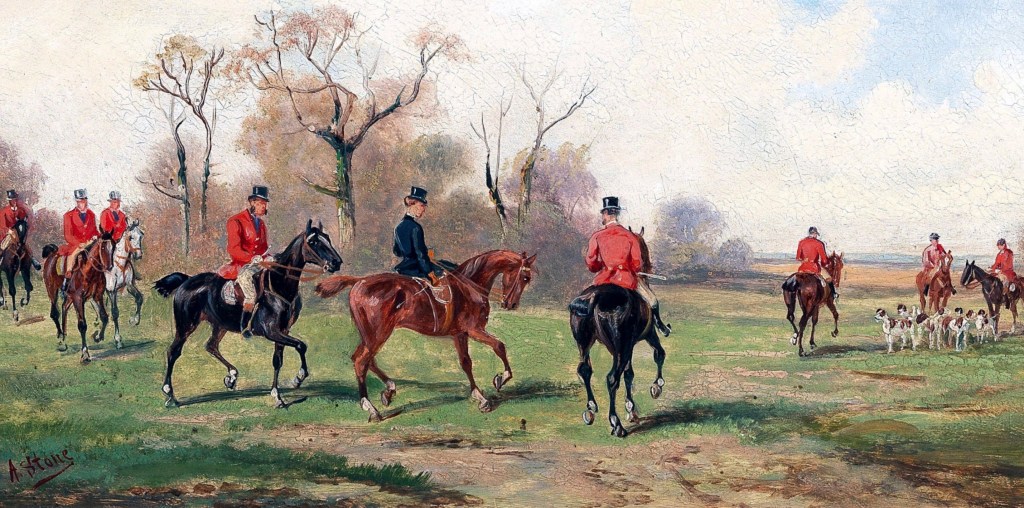
A Classic Hunt Scene (painting in the public domain)
Trucks pulling horse trailers kept arriving. Some fortunate riders who live close to the meet, hacked over. It is THAT Time of the Year – Opening Meet! There is a cheer and anticipation unlike other meets. What is special about today? Tradition, the hard work leading up to this day, and the anticipation of the combination of formality with fellowship.
Arriving by trailer or Hannah Rogers Tucker Hackingover
Perfection! The term, “perfection,” used in the same sentence with the word, horse, can get tricky, but everyone aims for perfection or as close as possible, even if for just a moment, especially for t his day.
The well turned out riders in their formal attire, the horses with their braided manes and fancy clips, are finally clean and sparkly. For the moment. The pageantry of Opening Meet starts days before the appointed date. Horses are bathed, their hair clipped, their manes pulled, their hooves polished, their tack cleaned, trucks have been washed and trailers have been rearranged, jackets have been picked up from the cleaners, boots gleam, and breeches are spotless.
(L to R: In their Canary Vests (worn under the hunt coats) – Rita Kaseman, Lawrence T. Dale III, MFH, and Kate Dendinger; Milton, the amazing 33-year-old gelding;Joint-Master, Ms. Mary Sell; Join Master, Larry Dale with his horse, Clancy.
On the morning of the meet, most riders begin before dawn preparing their horses and organizing their tack and clothes. Time flies. Arriving on time is a must. All want to present an elegant classic image.
Loudoun Hunt Board President, Paul Ritzema, prepares the stirrup cup table, complete with his design and creation of the “Fox Hunting Communion Trays” from which to securely serve the “cup.” Paul said, “This will be used for Hunt High Holy Days.”
The horses, on the other hand, have spent the night rolling in the grass or in their stall, scratching their necks to release any pre-braided portions of their manes, and if they can find a nice fresh pile of manure, especially if they are a grey horse, roll extra hard to leave contrasting spots and stains. They eat their breakfasts knowing that this is a special day. They can smell and feel the upcoming event.
With stains defeated, horses tacked up and loaded, riders dressed, trailers packed, and lists checked; the truck engines start and the trailers slowly pull out. On to the Meet!
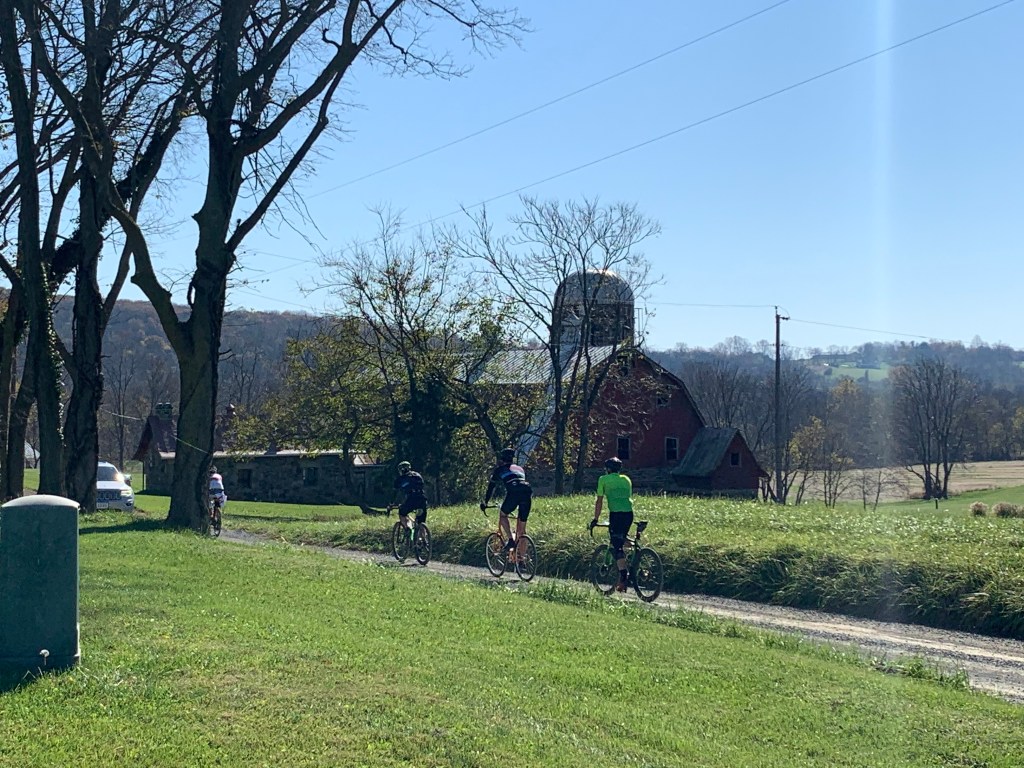
The “Fixture” for the 2020 Opening Meet was Harris’ Diggs Valley; Roads are shared with bicycle enthusiasts,; Milton and Jasper stand at the ready
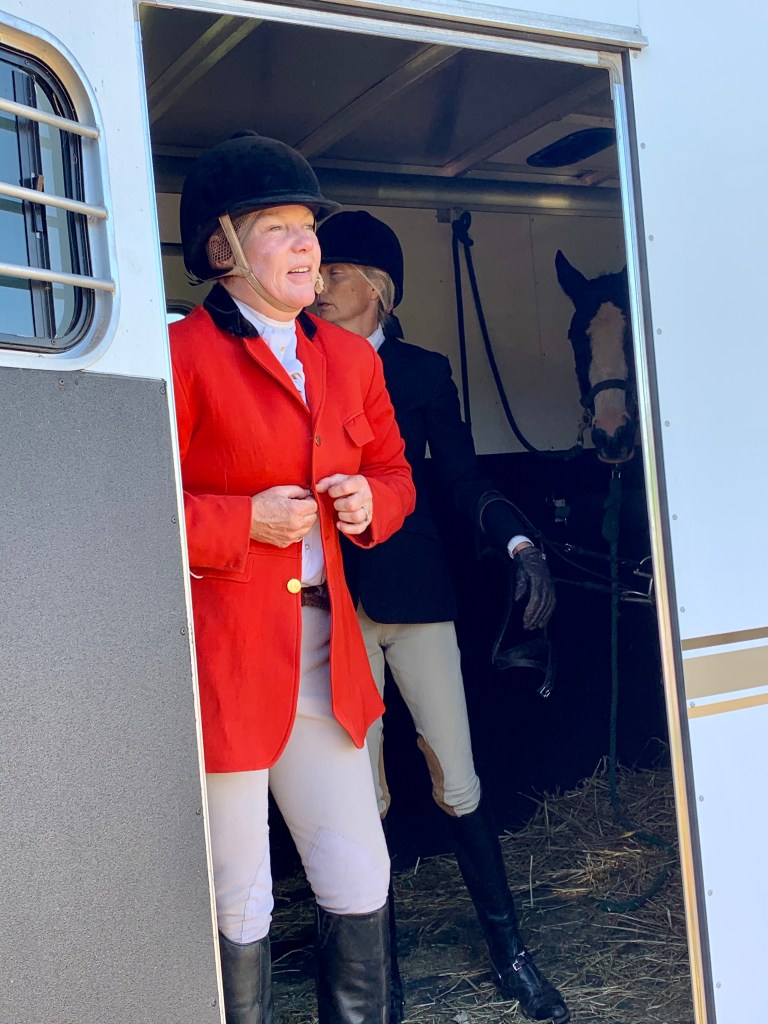
Arriving early assures the plumb parking spots. The larger rigs covet those spots for ease of unloading, loading, and leaving. At the meet, tables are set with festive tablecloths, shot glasses, bottles of port, and cookies for the stirrup cup. In the meantime, each trailer is a small hub of energy – horses eagerly stamping their feet and giving an occasional whinny; riders tying stock tires, putting on their vests and coat, pulling on their gloves, and reaching for their whip; they finally lead their horses from their trailers, adjusting tack before mounting. This is an important process and no steps can be omitted without a consequence. Finally, girths are cinched and riders mount.
There is congeniality, greetings, and a toast to the day’s hunt. The masters and huntsman confer on strategy and direction. Finally, the hounds are released from their trailer. With tails (“masts” in fox hunting terms”) wagging, sniffing, and hound camaraderie, they settle down and await their orders from the huntsman. Announcements, compliments and gratitude to landowners for the privilege to hunt their land, the masters lead off in search for the elusive fox.
From L to R: Dr. Kathy Stern helps hold horses; Stirrup Cup cheers; Dr. Kathy Stern ready for the chase; Nadine Galvin toasts to the day; Paul Ritsema on Steinway; Huntsman, Ron Johnsey; Lizzie Hummel on Milton; Kristen Cook; The hunds; Joint Master, Carroll Galvin, Ron Johnsey, and Joint Master, Mary Sell
The art of the hunt is steeped in tradition that is hundreds of years old. Upholding tradition is paramount. However, today, on a nearly 80 degree day, the traditional Melton hunt coats were waived. Visitors re always welcome to see the hunt off. Loudoun Fairfax Hunt Joint Master, Donna Rogers and Middletown Valley Beagles Huntsman, Alasldair (Ally) Storer, were among the day’s guests.
Fox hunting today is not hunting with intent to kill, It is “hunting” in the hope of viewing the fox, watching the hounds work, riding across beautiful open country, while riding one’s favorite horse, and enjoying good fellowship.
Hounds start work
The Loudoun Hunt was established in 1894 making 2020 its 126th season. Joint Masters, Lawrence T. Dale III, Mary Sell, and Carroll Galvin took the field with huntsman, Ron Johnsey, and their pack of American fox hounds. Tally-Ho! (That is the call when the fox is viewed).
They are off!
Those spotlessly clean horses with their polished hooves and the riders with their clean shiny boots will return with leaves in their pockets, mud splatters, and sometimes a few cuts and scrapes on noses and cheeks from low-lying branches and brambles. The conversation will revolve around which way the fox went, and how the hounds worked, while sipping appropriate refreshments and enjoying bites of tasty delights that had been lovingly prepared the day before. And the fox(es)? They snicker on a log that all those humans on their horses and their dogs were no match for their cunning and agility.
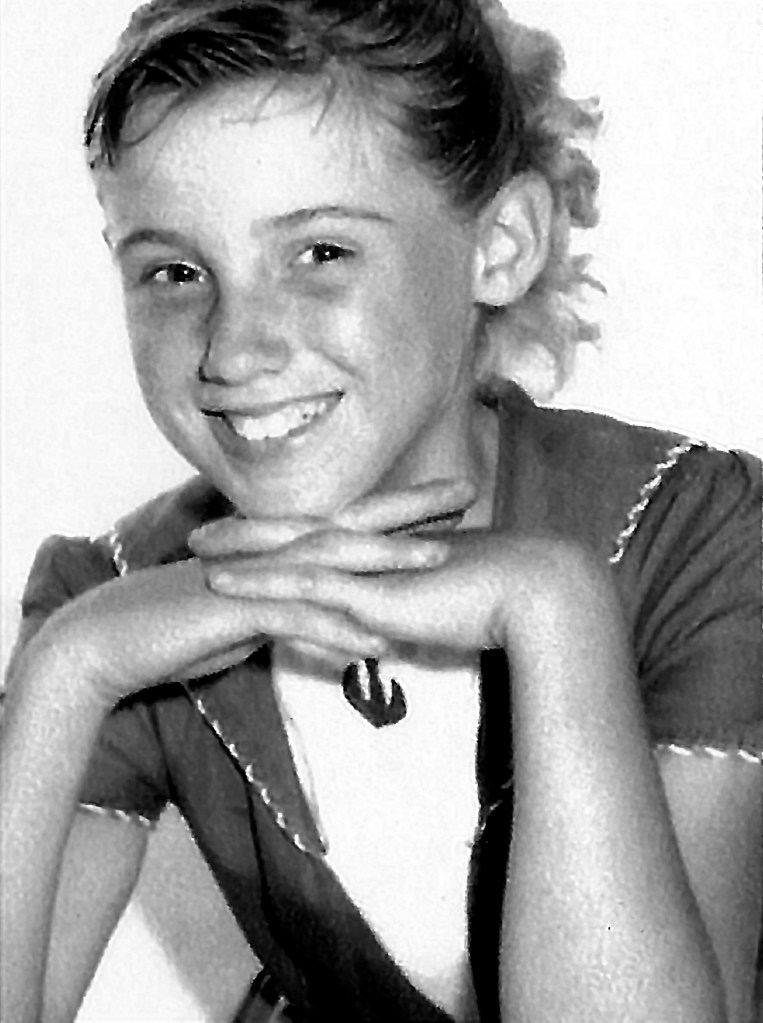
A horse loving girl, Diane Crump. Image courtesy of Mark Shrager and Diane Crump
“’Hey, Bert, there’s a woman jockey riding in the Kentucky Derby this year, first time that’s ever happened. Can you believe it? And her name is Crump. Coincidence, huh?’” Said a squad member to Bert Crump, persuading him to join the others in listening to the Armed Forces Radio broadcast of the Kentucky Derby. Bert was tired from a tough day in the field in Vietnam. “There was only one possible explanation for a woman named Crump riding in the Kentucky Derby and coincidence had nothing to do with it,” says Bert in his recollection of that day. He asked if her first name was Diane. “Yea, that’s her name – Diane Crump, do you know her?” said the man. “It’s my sister!” replied Bert. That was on May 2, 1970. Jockey, Diane Crump made racing history that day. “It was a surreal feeling being in Vietnam . . .while my sister rode in the Kentucky Derby with my buddies cheering her on,” recounts Bert in Mark Shrager’s book, Diane Crump A Horse-Racing Pioneer’s Life in the Saddle.
Cover – Diane Kissing Fathom, her Derby Horse – Image courtesy of Publisher, Lyons Press
An image of the book cover caught my eye while I perused Facebook posts. I quickly returned to the image and learned of the newly published book. Being an insatiable horse girl myself, I had to know more. I remembered the furor of a female jockey in the Kentucky Derby. “What’s the big deal?” I had thought, “As long as they are good to the horse, stay on, and stay out of the way of the other horses, what difference is it if a man or a woman is riding?.”
I had to feature the new book about this remarkable athlete who happened to share my passions for horses, riding, and speed. After some introductory emails, making “friends” with Mark Shrager and Diane Crump on Facebook, and a unique relationship formed. I read the book, underlining important aspects and dog-earing corners of pages. I wrote a first draft.
Dogeared pages
Notes and more notes
I reread the book. This time, I put little sticky arrows on the pages I wanted to cite. “Passion.” “Love of the horse.” “Had to ride.” “Exhilaration of speed.” “She wanted to inhale the atmosphere, to ride, to care for horses, to learn everything about them,” “… yearned for …having dramatic horseback adventures… being with close friends, in a school-free environment, and riding, riding, riding, ”writes Mark. He talks about “Diane’s unstoppable work ethic.”
It is important to understand that certain people are born with an “extra gene” – the gene that makes horses irresistible – their fragrance (some might call it an odor; a stench), their sweat, their breath, their silken hair, their eyelashes, their snorts (and yes, their gas and gut sounds are thrilling), their personalities, and their many “buttons.” This book is about such a woman.
What makes the story in the book special is that Diane’s mother encouraged her to “Follow your dreams.” Jean Crump was her daughter’s biggest advocate. She became Diane’s horse-riding friends’ favorite mother. Many of her friends wished for a mother just like her. What they did not know in their childhood was that Jean was special not only for her nurturing and encouraging her daughter’s horse passion, but for her unwavering trust in her faith and her remarkable dreams that she wrote down and often illustrated in paintings.
On my third reading of the book, it became clear that while this is a story about horse-racing, riding, and a tenacious woman, it is also about a mother’s journey with God, who, trusting through her faith, opened her hand and let her little bird fly. It took tremendous faith to agree to let the 16-year-old Diane travel with a racehorse trainer and live in unfamiliar housing with people she had never met so that she could to continue her horse training and riding journey. Her faith quelled her concerns.
Mark Shrager Image courtesy of Mark Shrager
“How did you happen to select Diane’s story for your book,” I asked Mark. He replied that he had finished his prior book, The Great Sweepstakes of 1877, and was looking to write the next book. He had made many friends on Facebook through his first book .Diane was one of those friends. He told me, “When I realized there had been no books written about her I called and asked whether I might write her biography. I was excited to tell the story of an amazing person who was so much more than just a jockey.”
Diane was ready to tell her story. Diane settled in Virginia. While no longer racing, she is a horse broker. She said, “I wanted to find someone to stick to the principal of what I wanted told. Mark did exactly that.”
Author, Mark Shrager, lives in California. He has been handicapping horse races since his high school days. He is not a rider. His father was adamantly opposed to gambling and horse racing. “I got into handicapping mostly to annoy my father, but I won enough money with which to buy my first car, ” he said. Two people, living on opposite coasts; with different parental experiences; a Christian woman and a Jewish man; happened to share the exact birthdate – 3000 miles apart – Mark in Los Angeles and Diane in Connecticut as their birth state. A writer / handicapper and a jockey, came together to tell a remarkable story.
In speaking with both Mark and Diane, I asked whether the book result was what they had expected. Mark told me, “The happiest part of this process was Diane reading it and telling me, ‘This is exactly what I wanted! Thank you!’” Diane added, “It leaves nothing out without saying too much!”
Diane (second from right) on Bridle ‘n Bit PC: Jim Raftety – Keenland Library Collection Courtesy of Mark Shrager
When you read the book, you will discover that it is packed with thrills, adventures, and against-all-odds finishes. You will learn about a tousle in a match race with an encroaching jockey holding her saddle cloth to slow her horse, and about the incomparable feeling of crossing the finish line first. Mark’s elegant storytelling made my heart beat faster as I imagined the wind in my ears and the sound of thundering hooves upon the track.
It is not often that horse racing and Christian faith turn up in the same sentence, much less in the same book. Like an onion with many layers, the book wraps a child’s heart for a pony; with a will to ride and a love for speed; with a faithful mother (and supportive father and family); with grit, focus, and determination; covered by love and grace.
The little girl who loved horses shattered the bias and presumption that “Racing is too tough for women.” In this book, you will read about how Diane’s love of horses and riding and her focus in spite of protests and objections, sustained her throughout her career. She rode a thousand morning workouts, on a thousand difficult, opinionated thoroughbreds that no one else would ride. “I rode every bad tempered horse …, if they reared up, ran off, if they were stupid, that’s what I got. I had to prove myself over and over again.” She raced in an “Under the microscope atmosphere that no other jockey in history had ever experienced,” writes Mark. She lived her dream and rode in the Kentucky Derby. Diane’s message is about the faith and grace that took her to the heights of her profession and that continue sustain her.
Diane surrounded by guards, nears the Hialeah saddling enclosure before her first race – amid protests of being a female in a man’s sport, “an uppity wannabe.” PC: Jim Raftery – Kennland Library Collection courtesy of Mark ShargerDiane discussing pre-race strategy with trainer Tom Calumet – PC: Jim Raftery – Keenland Library Collection courtesy of Mark Shrager
Mark dedicates the book to “Every female athlete everywhere.” He told me, “What awakened my interest in women athletes was Diane. Learning all she’d gone through to be a jockey led me to recognize that women athletes in many sports were probably encountering the same sorts of prejudice and negativity Diane confronted. Dedicating the book to female athletes was my way of encouraging them to live their dreams and overcome the naysayers, like Diane did.”
Ever the animal lover, Diane hugs her assistants Image courtesy of Diane Crump
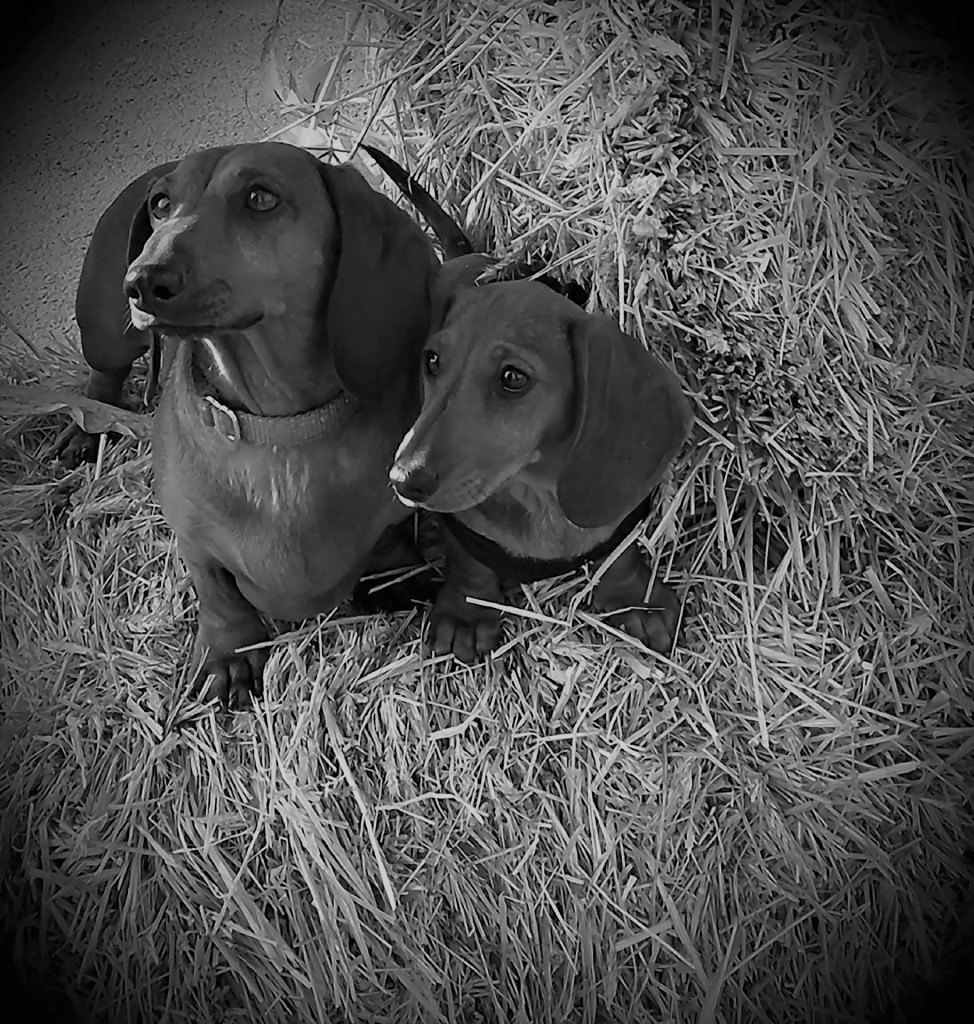
Diane’s dachshunds, Potter and Pippi, help reach people in need image courtesy of Diane Crump
This book is about horse racing. It is about women’s equity. It about a young girl’s determination to learn about horse and to ride them. It is about faith. The message is universal. The book is available in hardback and on Kindle . It is a must read for every parent with a passionate child, every horse-crazed person, for people of faith and for those in search of theirs, and for everyone who loves to root for the underdog.
Gumdo, is a long Samurai-like sword. J (just J) Douglas earned his first black belt in that martial art. For 17 years J owned and operated an Olympic World Taekwondo martial arts school. How does a martial arts master change careers? By picking up a paint brush.
J Image Courtesy of J Douglas
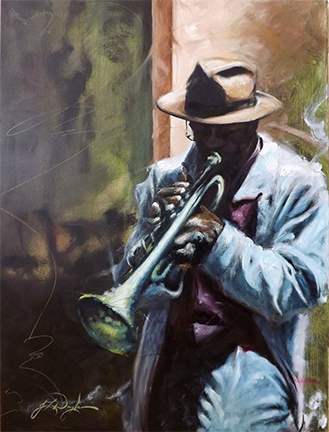
J delivers power with his paint brush. His “disruptive representationalism” blends powerful energy with classical realism. Yet, as a high school student in Texas, his representational realistic style was deemed mere “photography” by his abstract-loving art teacher. “So, I got into drama instead,” said J. “I went through phases of art forms from dance to drama to commercial art until 2008. Then, I was inspired to pursue my passion of oil painting.”
“In 2008, I watched Henry Asencio paint in person. I was inspired to return to my fine art roots. I bought my paints and supplies and haven’t looked back,” said J.
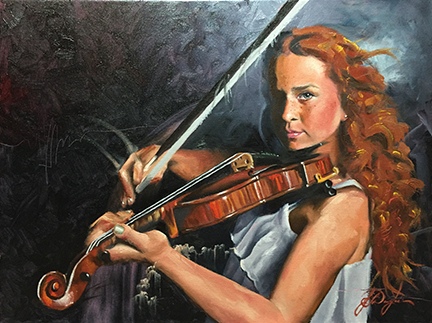
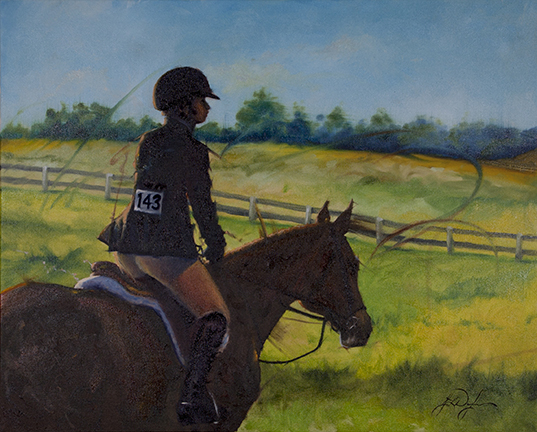
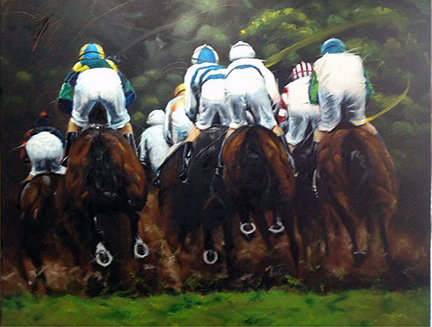
The emotions are palpable Paintings by J Images courtesy of J Douglas
“I feel that I am a lifetime student of the arts. Study and grow or get stagnant and die. I love where I am now with my art,” he says. His journey from disheartened, but seeking student; to dance and ballet; to the martial arts; and back to painting has taken interesting turns throughout his life. The constant has been his passion for painting.
On Pointe by J Image courtesy of J Douglas
I met J at the Salamander Resort’s Gold Cup Wine Bar a number of years ago. He was my server. Immediately, I sensed something intriguing about him. I had to ask questions. I learned that his name was simply, J. He joked, “When you’re as famous as me, just your first letter will do.” From our brief conversation, I learned that he was an artist. I also learned that his prints were for sale in the resort gift shop. That day, I bought my first J print, On Pointe. Today, we like to say that he is “an artist costumed as a server.”
Companions
Commission
Commission
Bottoms Up
Into the Sunset
Original Oil Paintings by J Images courtesy of
Salamander Resort (Middleburg, Virginia) owner, Sheila Johnson, has a keen eye for art. Beautiful paintings of pastoral scenes and powerful horses grace the walls of “Middleburg’s living room” and hallways leading to the spa and ballrooms of the Salamander Resort. Among those stunning oil paintings is a 5’ X 7’ painting titled, Destiny, by J. The Salamander Resort is his gallery. “Sheila Johnson made me an international artist. Thanks to her, I have been able to get commissions and patrons.”
Destiny by J is prominently displayed at Salamander Resort Image courtesy of J Douglas
Destiny is not only very large, but very powerful as well. Looking at the painting, I can hear the horse breathing, the sand spraying on the jump standards upon takeoff, and I can tell where the next jump is from the focused look in the eye of the rider. It is a work of balance, understanding, appreciation, and respect for animal, sport, and rider. It fits beautifully into the quiet atmosphere of excellence of Ms. Johnson’s vision for the resort.
Self Portrait by Rembrandt Image from Public Domain
Rembrandt is J’s favorite artist. J explained, “He was a master of the face and color. There are hundreds of colors in the faces of his subjects, although we see flesh tones.” Surely, a closer look at Rembrandt’s Self Portrait reveals multiple pallets of colors masterfully applied to beguile the eye. “The bodies of humans and horses, are captivating,” says J. “Their eyes, their strength, agility, textures, colors, and moods keep me asking and delving deeper,” he explained.
When asked about his materials, he said thatoil paint is his favorite medium and that he stretches his own canvas. “Oil paints are the most forgiving medium,” he explained. He shared that there are hundreds of colors and qualities of paints. He uses only about eight colors that he mixes to achieve the exact color. His works mostly with a brush but a pallet knife has occasionally come in handy.
The Wet Wall
Portraits – J captures “the souls of his subjects through their eyes” the painting top left and bottom left is a work in progress. The reflections in the sunglasses tells a story.
He works on commissions first. For his personal projects, he has a “wet wall” that he turns to when time permits. The flexibility of oil paints allows him the privilege to let some pieces “rest.” On social media, J features many time lapse videos of his work. Take a look at one for Destiny:
Watch Tine Lapse Video of the creation of this painting Courtesy of J Douglas
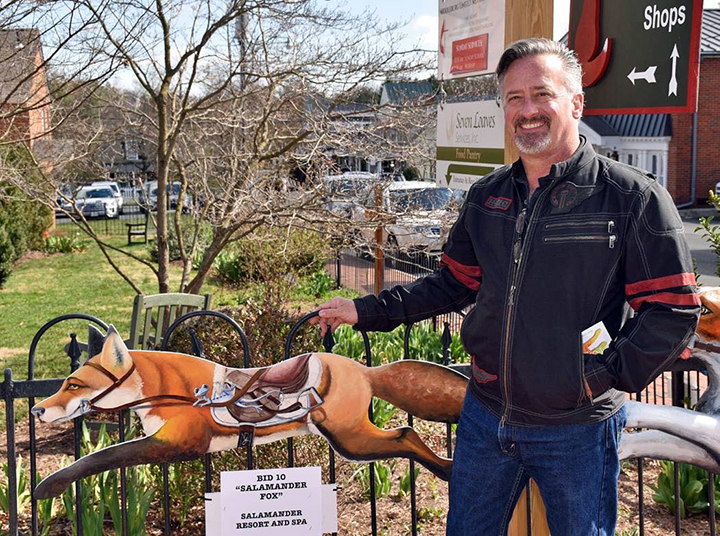
J gives much back to his community. He has supported the local ballet company with his On Pointe print, created a Salamander Fox for the Middleburg Garden Club’s biennial “Foxes on the Fence fundraiser,” and consults for the greater good of the area.
The Salamander Fox for Middleburg Garden Club’s BiennialFoxes on the Fence Fundraiser Image courtesy of J Douglas
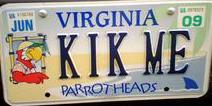
Always growing and trying different approaches, his artistic includes graphic an commercial art. A popular and still available image is the “Parrotheads” (of Jimmy Buffet fame) “License to Chill” license plate that he created for the Virginia Department of Motor Vehicles.
“License to Chill” by J Image courtesy of J Douglas
As an avid horse enthusiast and a fan of J’s equestrian paintings, I had to ask, “Do you ride horses?” “I am learning and loving it. My wife wants me to stay safe so I take riding lessons,” he replied. Being from Texas does not automatically bestow equestrian prowess. He is a horse-studier and horse lover. He naturally understands the power, spirit, movement, and essence of the horse. His paintings seem to get it just right.
Best Friendsby J Image courtesy of J Douglas
J wants people to love the art they acquire and commission. He understands that it can be an economic extravagance. To help more people be able to enjoy his art, “We are now teaming up with Patreon. Patreon is a site that allows people to support the arts. Almost like an internet tip jar. But, we don’t want to just ask for support. We created a system to spread your payments out over 12 easy payments. You decide the level of support, choose the subject of your painting and then in one year you have your original piece of art.”
J, the man, exemplifies the “polymath,” the Renaissance man. The power of his brushes tell mesmerizing stories.































 Good News. Reviews. Events.