“O, beware, my lord, of jealousy; it is the green-eyed monster…”

Othello

London’s West End Stage to Film

I invited a dear friend to join me for another Shakespeare adventure at the movies. Last year it was Macbeth with David Tennant. This year it was Othello with David Harewood and Toby Jones.

When I first read and studied Othello, I found it fascinating and relevant in any society. Iago was a very recognizable character from real life.

Years ago, I shared professional space with someone whose behavior followed that same pattern of whispering, scheming, and quiet manipulation. It was subtle and persistent. It was the kind of influence that works in corners rather than in daylight. Eventually I recognized the pattern for what it was. I plainly told him that he should never apply for any position I might advertise following my next promotion. That experience left me with a clear understanding of the kind of personality Shakespeare presented in Iago. He was not promoted.

Per my usual habit before attending a Shakespeare performance, I refreshed my memory of the play. I confirmed the characters and revisited several key lines. I prepared for full immersion.

I picked up my friend and we drove to the Angelika Film Center. After enduring the usual advertisements and trailers, some of which looked fascinating, the film began.

This production is a stage-to-film presentation from London’s West End. I understand and expect such productions to rely on minimal sets, modernized costuming, and strong performances to carry the play. The first two expectations were met. The third is where this production faltered.

I have since read many responses praising this performance as brilliant, beautiful, and extraordinary. I regret to say that I do not share that opinion.

Because I stream a great deal of classical music, I have noticed that many streaming services flatten the sound to create a continuous listening experience. The dynamics disappear. Quiet passages and crescendos lose their contrast.

My sense of this Othello was much the same.

Throughout the performance I waited for the drama to ignite. Shakespeare’s language was spoken clearly. Recitation alone does not create atmosphere, set a scene, or draw the audience into the tragedy.

Toby Jones delivered Iago’s thousand lines with precision and confidence. His performance felt curiously without emotional force. I saw his lips move. I wanted to see Iago scheme. I wanted to see him whisper. I wanted to watch the quiet manipulation that slowly poisons Othello’s mind. The lines were delivered clearly. They were delivered without the emotional architecture that gave the character his terrifying power. I wanted to dislike Iago and root for Desdemona. I found that I cared about neither.

David Harewood presented a plausible Othello. He was physically convincing as a general and commanding as an authoritarian figure. Desdemona, played by Caitlin FitzGerald, was visually striking and entirely believable as the beautiful object of Othello’s infatuation. The character lacked the humility and innocence that traditionally anchor Desdemona’s role. There was, instead, a noticeable note of modern attitude that felt out of place within Shakespeare’s tragic world.

Venetia Robinson’s Emilia was strong and believable. I sensed that she was trying to carry the magnitude of the play on her shoulders. The remaining roles were competently handled.

When watching theater, I allow myself to be enveloped by the performance. I want to enter the world of the play and remain there until the curtain call.

That did not happen. The experience felt more like looking into minimally decorated Christmas windows where scenes are suggested and not lived. The sense of immersion never arrived.

Without emotional contrast, the play felt flattened.

I admire the discipline required to perform a role as demanding as Iago. Memorizing and delivering that volume of text is no small achievement. Toby Jones deserves recognition for that accomplishment, as does David Harewood for his portrayal of Othello and Venetia Robinson for her compelling Emilia.

Good Shakespeare is not meant to be flattened. His plays breathe through contrast—whispers and outbursts, suspicion and innocence, tenderness and violence.

Those dynamics never appeared. The tragedy remained intact on the page. It did not live on the stage, and certainly not in our theater.

_____________________________________________________________________________

**Aside:  Emdashes are grammatical tools and not the invention of AI. My work is personal and not contrived.

A Year With William Shakespeare

Reading the Entire Canon in 2020

In January 2020, a friend posted a Facebook link to a Shakespeare project, “Shakespeare 2020,” reading all of the plays, Sonnets, and poems by William Shakespeare in 12 months. I did not think twice, I joined the group. What had I just signed up for??? I own a busy real estate brokerage firm, run a horse farm, I have a husband, 2 dogs, and 5 cats, and my 96-year-young mother had come to live with us just before Christmas 2019. And . . Shakespeare too?

Why NOT? I would give it a try. No cost, no commitment except to myself, and I wanted to see if I was smart enough to work through literature for which I had more than a mild curiosity. One compelling reason was to improve and strengthen my writing.

My good fortune is that I attended an unusual and experimental public high school. There, my luck expanded to be placed in an English class with an incredible teacher, William Teunis. He piqued my interest in literature (especially, Shakespeare) through his enthusiasm and exceptional teaching.  In his class, we read plays – acting out roles; we wrote short stories, essays, parodies, and plays. Shakespeare was attainable and most enjoyable. The more we did, the more I reached. My English experience abruptly ended with his drowning at the end of my sophomore year. Since then, I doubt that I have written a sentence without asking myself, “What will Mr. Teunis say about this?”

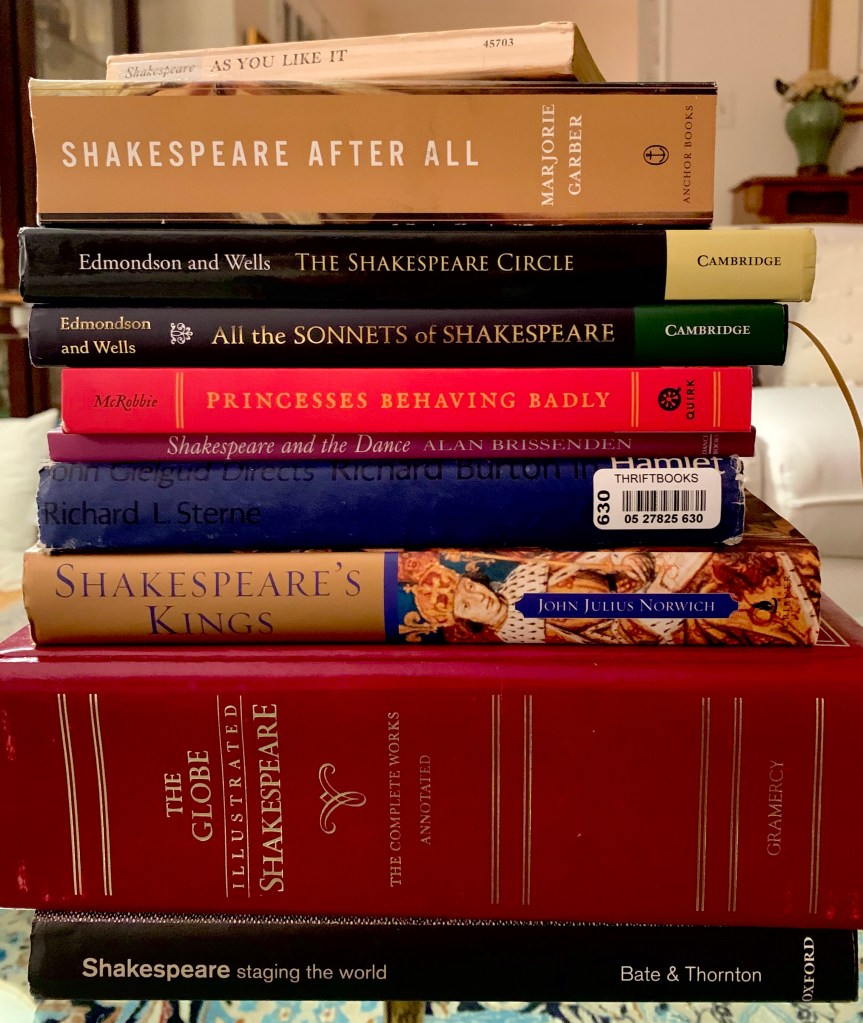
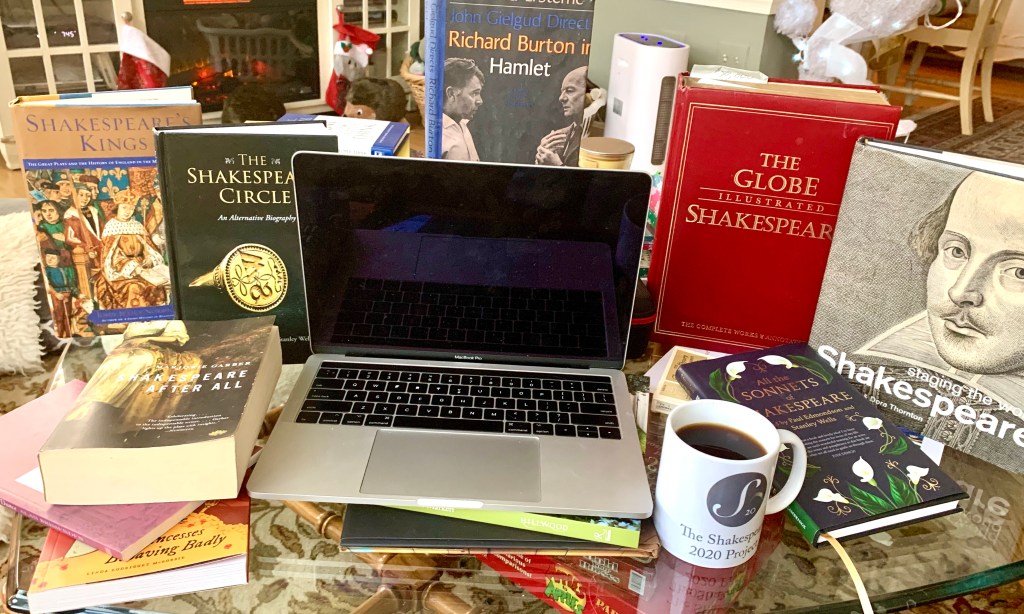
Over the years, my Shakespeare interest was occasionally rekindled whenever I found a book related to the plays. Once, when I was shopping in Costco, I came across the Complete Works of Shakespeare. “This would be a good resource if I ever have the time to sit and read,” I thought, being the eternal optimist. I purchased the book. Other times, also in Costco, I bought, Shakespeare’s Kings, in hopes of one day learning something about the histories (because I glazed over in my British History course in college); another time, I discovered and bought the 3-CD set of the Sonnets which I played in my car for months. So…when the Project appeared, I was armed and dangerous.

My journey began on January 9, 2020 with Twelfth Night. Yikes! The print in my book was microscopic! I focused my eyes and found that the words readable. Somewhere in Act 2, I remembered my English teacher’s remarks that Shakespeare wrote plays which were performed to audiences. He wrote for theater and not for fireside reading. How was I going to do ALL that reading when the plays must be experienced? I discovered Librivox!

On Librivox, talented and generous people joined forces from around the world to read almost all of the plays. YES! I was thrilled by my discovery. Aside from my relentlessly working and riding horses, I am passionate about walking my dogs for miles (we walk a 15 minute mile most days for 2-5 miles). I took Librivox on our walks.

I listened to Hamlet at the magical arboretum where trees took on the personae of the ghost, Gertrude, Hamlet, Laertes, Polonius, Claudius, and a stick in the pond resembled Ophelia. When I was annoyed that Great Falls Park had been closed, we hailed elsewhere where Macbeth was the perfect answer for my dark mood. The early spring blossoms in our sweet town’s yards were a nice backdrop for Measure For Measure. We heard acts of plays in my car or truck en route to our destinations. I have a favorite gas station where I buy inexpensive diesel for my truck. I love that my broadcasts are not interrupted when I turned off the ignition to fuel. I recall something about a “pie” from Titus Andronicus while the diesel flowed into the tank of my bright blue Silverado.

The Shakespeare 2020 project was brilliantly developed to be completed in 12 months. Well, being very curious, and having determined that I would complete the entire canon before Mr. Teunis’ 50th anniversary of his drowning (so that I could write a tribute article about him) I accelerated my reading/listening and behold, I finished the canon. There were times in King Lear and the Rape of Lucrece that the thought of closing the book and deleting the Librivox link were very compelling. HOW can a decent person know about such stuff and write about it, and worse, WHO would want to be entertained by THAT???? I decided not to judge by my values and carried on.

Opportunities to discuss Shakespeare arise in unexpected places

The Project was not just a syllabus, it was a treasure trove of intelligent, knowledgeable, and creative people who already knew a great deal. They shared their insights and enthusiasm with the 4,900 members of the group the Facebook page . The depth of resources, intellect, and understanding was staggering.  My Shakespeare “library” grew along with my curiosity and understanding.

During my haydays in Mr. Teunis’ class, I heard him tell us that theater, during the Elizabethan era, competed for audiences from among other public interests including bear baiting and public hangings. “Uh-hu, OK, whatever,” I thought, at the time. Now it came to back to me why certain plays were so grotesque. The poor playwright had to capture audiences’ attention and be competitive. Therefore, Titus Andronicus, Lear, Rape of Lucrece, among others.

My friends with whom I shared my Shakespeare adventure looked at me sideways most of the time. One friend, much older than I, said to me, “He should have died earlier. There would be fewer plays with which to torture students.” It seems that he is not alone in that opinion and that most people’s literary experiences were not as positive as mine. My friends were surprised that I cared about Shakespeare, let alone that I would embark on this journey.

My book collection grew

Until this Project, I had danced around the periphery of the Bard. I had done my share of academic study with Mr. Teunis, then, watched fabulous ballets including A Midsummer Night’s Dream with New York City Ballet and the Paris Opera Ballet; The Winter’s Tale and Romeo and Juliet with the Royal Ballet and attended Folger Theater performances throughout the years. After completing the canon, I purposed to watch as many plays as possible. I have managed to see about 20 plays, listened to Patrick Stewart reading the Sonnets, and I discovered brilliant lecturers from Harvard, Yale, and the University of Virginia.

The Shakespeare 2020 Project opened a new world of discovery and connections as I never expected. I met (virtually) fascinating people (some of whom I could not find a single point of agreement) who stimulated me to think in different ways. I became acquainted with the creator of the Project, Ian Doescher, a young, creative author who has written many wonderful books in the “Shakespeare style” (do look at his link, you will be amazed by his creativity) on themes including Star Wars, Clueless, Luke Skywalker, and myriad more. My new connections and friendships are treasures. Another bonus is that I connected with high school friends who also valued Mr. Teunis (I should mention that our strange, experimental, free-for-all high school turned out amazing humans who touch the far reaches of the world because of Teunis [and others like him]).

As the Project draws to a conclusion, the experience, the discoveries, the friendships, the challenges, and the curiosity have helped me learn much about myself, given me discipline to persevere, and hopefully helped me write a little better (all the while hearing Mr. Teunis’ remarks, lectures, and gentle admonitions to do “better”).

By writing this article, I experienced the vastness that is Shakespeare. Questions continually arise. My opinions have no bounds. Stay tuned for future supplements to my “Shakespeare Adventure.” The learning is just beginning.