Julius X – A Triple Treat

Playwright Al Letson PC: Amir Arsalan Shamsabadi on Unsplash Julius X Played by Brandon Carter

Julius X was born from rejection. When Al Letson was not cast as Mark Antony in a Julius Caesar production because of race, he decided, “Screw it, I’m going to write my own.” This was not bravado. It was love. He had fallen for Mark Antony’s speech in 10th grade and read Malcolm X’s autobiography in 7th. Both stayed with him. Years later, he realized Julius Caesar’s arc fit almost perfectly with Malcolm X’s life. This is how a dyslexic kid who learned to read through comics, a flight attendant who competed in poetry slams across America, an award-winning journalist and Shakespearean, spent over two years creating what is now playing at the Folger Theatre through October 26. I discovered Al Letson through Julius X.

Julius Caesar by William Shakespeare is a popular high school literature topic. How it is studied and how Shakespeare is presented often affects students for a lifetime. In Letson’s case, Caesar spoke to him. To others, it was just something to get through to close a chapter on high school English. I too studied Julius Caesar in high school. After my beloved Shakespeare teacher’s drowning the prior summer, I was uninspired to seriously pursue the play, and my new teacher was marking time. All was not lost for me. I read Shakespeare’s entire canon in five months in honor of my inspirational teacher’s 50th anniversary of his drowning and published a blog about him and Shakespeare. That blog remains the most read of all of my blogs. Julius Caesar was, of course, reread. This time with real interest.

In preparing to see Julius X, I opened my books once again. Marjorie Garber’s essay in her book, Shakespeare After All, and Paul Cantor’s Shakespeare and Politics lectures on YouTube helped me prepare. I then researched the life of Malcolm X. As a child, I remember hearing my parents discussing his assassination on the day it happened. The parallels between the two men are remarkable. Yes, they were different, however, their passion, their vision, and their boldness are indisputable.

Al Letson so aptly married the two tragic heroes by meeting their arcs, their mission, their loyalty, and their fire. Having prepared, I was happy to feel like a participant rather than a spectator. I felt the rhythm of the verses, the drive of the characters, the commitment to community of the friends, and the loving fear of the wives. Sitting close to the stage, I saw facial expressions shift with each revelation – what performers call rubber faces, the ability to communicate entire thoughts through the smallest movement. The wives were remarkable: Julius’s wife in her impeccable teal suit with braid detailing, Portia animated and desperate, both showing love and intuition that their husbands would not, could not, hear. Julius X is fast paced. There is no time to wallow or worry. Things happen quickly, and while the interpretation is impressive and surprising, being prepared was key to my Julius X journey.  I was enthralled rather than bewildered.
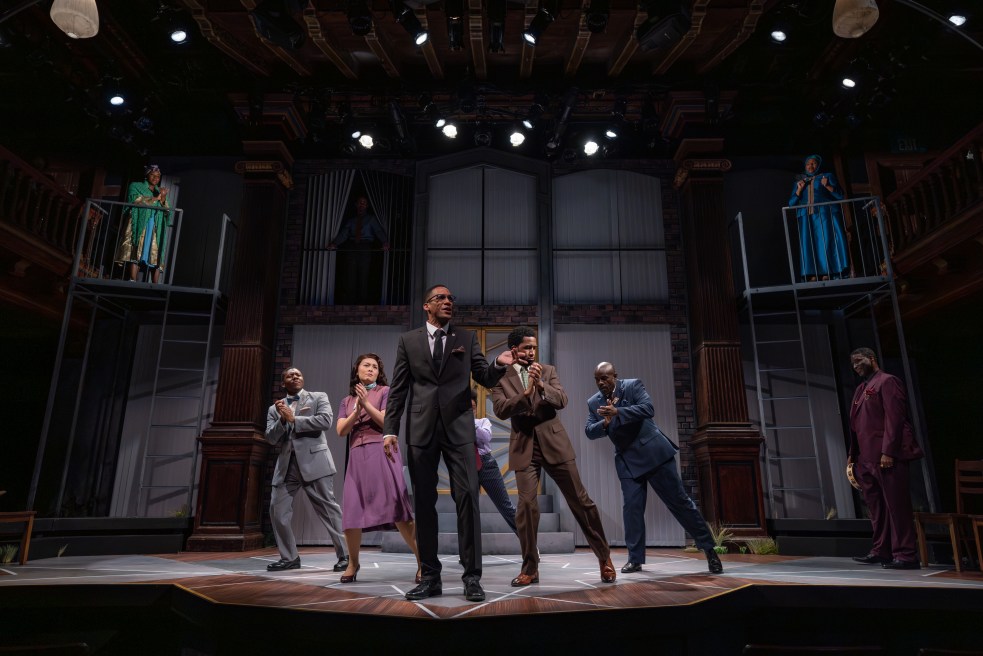
Harlem of the 1960s was not Rome. Rome was regal, authoritative, imperial. But Harlem was home—brownstones and street corners, community and belonging. Its residents cannot live in Harlem without loving it. Harlem was Malcolm X’s ‘Rome.’  It was intimate, not monumental. It was his world. He had a burning passion. He wanted more for himself, his family, and his people. A militant who reconsidered his path but never abandoned his passion posed a threat to his supporters. The key? Ambition.

Caesar is a pivotal character. He has been compared to Alexander the Great by Plutarch in his biographies, Parallel Lives, in approximately 110 AD, to being featured by Shakespeare in the Tragedy of Julius Caesar in 1599, to being analyzed by Paul Cantor in the 21st century, juxtaposing him between Coriolanus and Antony and Cleopatra, and now, to being reimagined as Julius X by Letson in the 2020s. Almost 2000 years have passed. There is nothing new under the sun. Ambition is considered threatening by those with opposing vision or small thinking.

Julius X is entertaining, thought provoking, classic, and unapologetically bold. Playing through October 26 at the Folger Theatre, it rewards preparation and challenges assumptions. Good that Letson was not pigeonholed as Mark Antony. You can buy tickets now.

All photo credits: Erika Nizborski and Brittany Diliberto.

A Room in the Castle – Ophelia’s Story

Lauren Gunderson’s brilliant re-imagining of Shakespeare’s “Hamlet” shifts the spotlight from the brooding prince to the women who orbit his world. In A Room in the Castle, Gunderson accomplishes in 85 minutes what Shakespeare took four hours to convey, creating an intimate portrait focused on Ophelia, her handmaid, Anna, and Queen Gertrude. Kaja Dunn’s elegant directing delivers a thought-provoking production. Gunderson was commissioned to write the play by the Cincinnati Shakespeare Company where it opened before it’s World Premiere on March 9, 2025 at the Folger Theater.

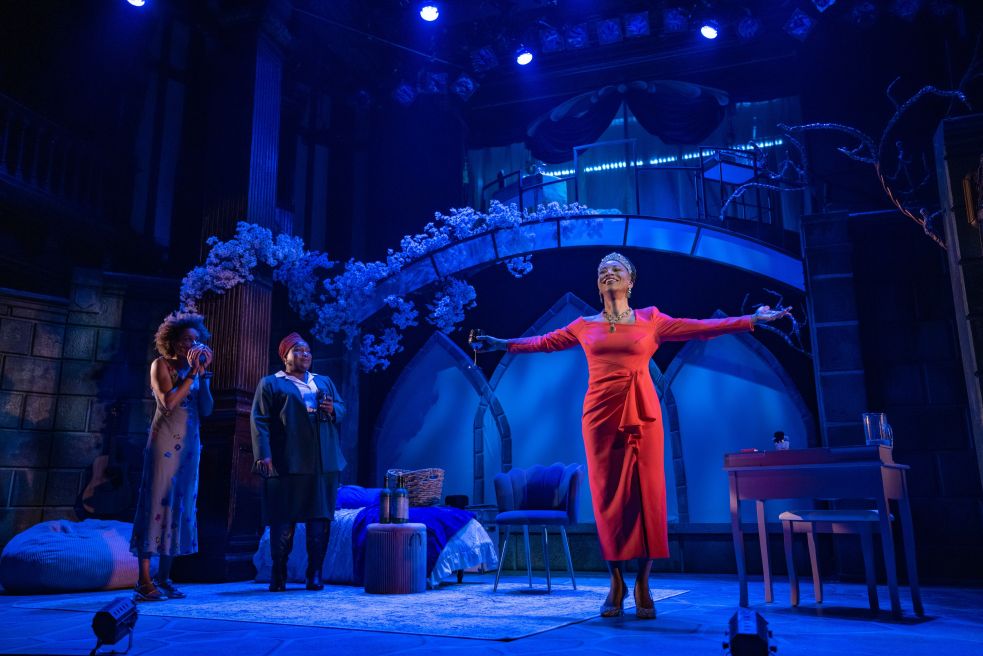
A Room in the Castle Dress Rehearsal 85:Sabrina Lynne Sawyer, Oneika Phillips, and Burgess Byrd in Folger Theatre’s world premiereof A Room in the Castle, written by Lauren M. Gunderson, directed by Kaja Dunn, co-produced with Cincinnati Shakespeare Company, on stage at the Folger Shakespeare Library, March4-April 6, 2025. Photo by Erika Nizborski

With only illusions to the narcissistic, gaslighting Hamlet of the original text, he is never seen. Not even the skull. Instead, we witness the story through the female perspective, exploring Ophelia as a motherless young woman navigating complex relationships and expectations. The production examines her circumstances: torn between her perceived love for Hamlet, her father and brother’s disapproval of him, Anna’s protective caution, and Queen Gertrude’s insistence on their marriage. Perhaps, it is “ . . .not to be.”

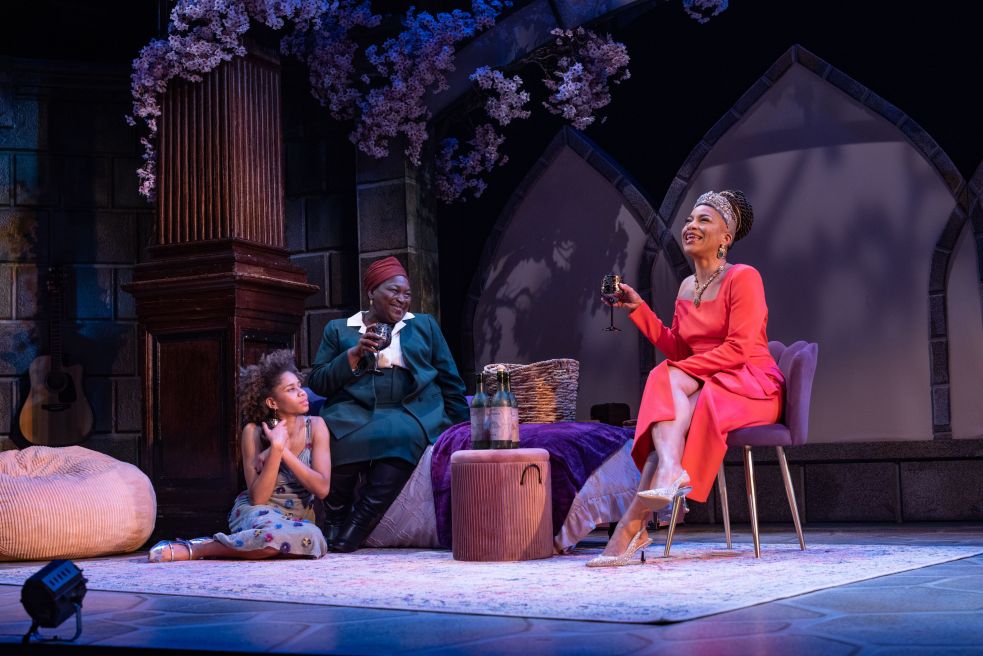
The all-female cast of three, delivers superb performances. Ophelia ( Sabrina Lynne Sawyer) emerges as a fully realized character – sometimes ambivalent, occasionally petulant, but ultimately autonomous. She is transformed from Shakespeare’s tragic figure into someone relatable in the 21st Century. Gertrude (Oneika Philips) commands the stage with regal confidence and impeccable dresses. Anna (Burgess Byrd) brings love and devotion to her role, having lost her own son and finding in Ophelia someone to mother and protect. Costume designer, Nicole Jescinth Smith’s costumes were visually stunning and spoke volumes about status and intent.

A Room in the Castle Dress Rehearsal 68: Oneika Phillips, Sabrina Lynne Sawyer, and Burgess Byrd in Folger Theatre’s world premiere of A Room in the Castle, written by Lauren M. Gunderson, directed by Kaja Dunn, co-produced with Cincinnati Shakespeare Company, on stage at the Folger Shakespeare Library, March4-April 6, 2025. Photo by Erika Nizborski

As we entered the Theater, I asked my guest and daughter, Tiffany, about her expectations of the play and to tell me her take on the original characters. Her immediate reply was that, “Hamlet was a madman, gaslighting Ophelia to her demise.”  I shared that I found, “Both whiny and that she was needy and ‘a few cards short of a full deck.” Tiffany expected see a play about strength and perseverance over narcissistic dysfunction.  I hoped that she was right and that after 425 years of waiting, Ophelia would find her voice.

The audience was greeted by the newly appointed director of the Folger Shakespeare Library, Dr. Farah Karim-Cooper, “I spent the last Twenty years of my life at Shakespeare’s Globe Theater in London. Over there, I was the resident scholar and director of education and research and it’s also where visceral performance informed all of my work, so I know something about theater.  This is why I can say that I’m so inspired by the compelling and inclusive vision that’s emerging from the culture of this theater and our artistic leader Karen Ann Daniels.”  

The intimate theater space enhances the experience, with its warm wood paneling, carved columns, and half-timbered walls – reminiscent of an Elizabethan setting. The set strikes an interesting juxtaposition between the now and then. When does this play take place? That really doesn’t matter.

A Room in the Castle Dress Rehearsal 93: Sabrina Lynne Sawyer, Oneika Phillips, and Burgess Byrd in Folger Theatre’s world premiere of A Room in the Castle, written by Lauren M. Gunderson, directed by Kaja Dunn, co-produced with Cincinnati Shakespeare Company, on stage at the Folger Shakespeare Library, March4-April 6, 2025. Photo by Erika Nizborsk

What makes this production special is that it honors Shakespeare’s world while boldly asking, “why not?” As Gunderson herself stated, “The play dances and duels with Shakespeare’s Hamlet, foregrounding the women in the play and re-imagining them with agency, vitality, and radical hearts eager for a new ending,… ripping a hole in the fabric of their suffocating story… because this play is anything but hopeless and tragic.”

There were frequent laughs and knowing sighs of recognition from the audience. While I won’t reveal the ending, I can say that it offers a satisfying conclusion to Ophelia’s journey. “A Room in the Castle” proves that sometimes the most interesting stories are found not with the titular character, but in the castle’s side chambers where the women speak their truths. “Obey, Agree, Assist?” How about “Rebel, Reject, Resist.”

A Room in the Castle Dress Rehearsal 91:Sabrina Lynne Sawyer, Burgess Byrd, and Oneika Phillips in Folger Theatre’s world premiere of A Room in the Castle, written by Lauren M. Gunderson, directed by Kaja Dunn, co-produced with Cincinnati Shakespeare Company, on stage at the Folger Shakespeare Library, March4-April 6, 2025. Photo by Erika Nizborski
A Room in the Castle Dress Rehearsal 87:Sabrina Lynne Sawyer, Burgess Byrd, and Oneika Phillips in Folger Theatre’s world premiere of A Room in the Castle, written by Lauren M. Gunderson, directed by Kaja Dunn, co-produced with Cincinnati Shakespeare Company, on stage at the Folger Shakespeare Library, March4-April 6, 2025. Photo by Erika Nizborski

Perhaps the most enduring power of Shakespeare lies not in the answers his works provide but in how each generation finds its own questions within them. Through my daughter’s unflinching modern lens, I watched not another classic Hamlet, but a study in how Ophelia finally gets the chance to exist beyond being defined by the men around her.

A Room in the Castle Dress Rehearsal 93: Sabrina Lynne Sawyer, Oneika Phillips, and Burgess Byrd in Folger Theatre’s world premiere of A Room in the Castle, written by Lauren M. Gunderson, directed by Kaja Dunn, co-produced with Cincinnati Shakespeare Company, on stage at the Folger Shakespeare Library, March4-April 6, 2025. Photo by Erika Nizborski

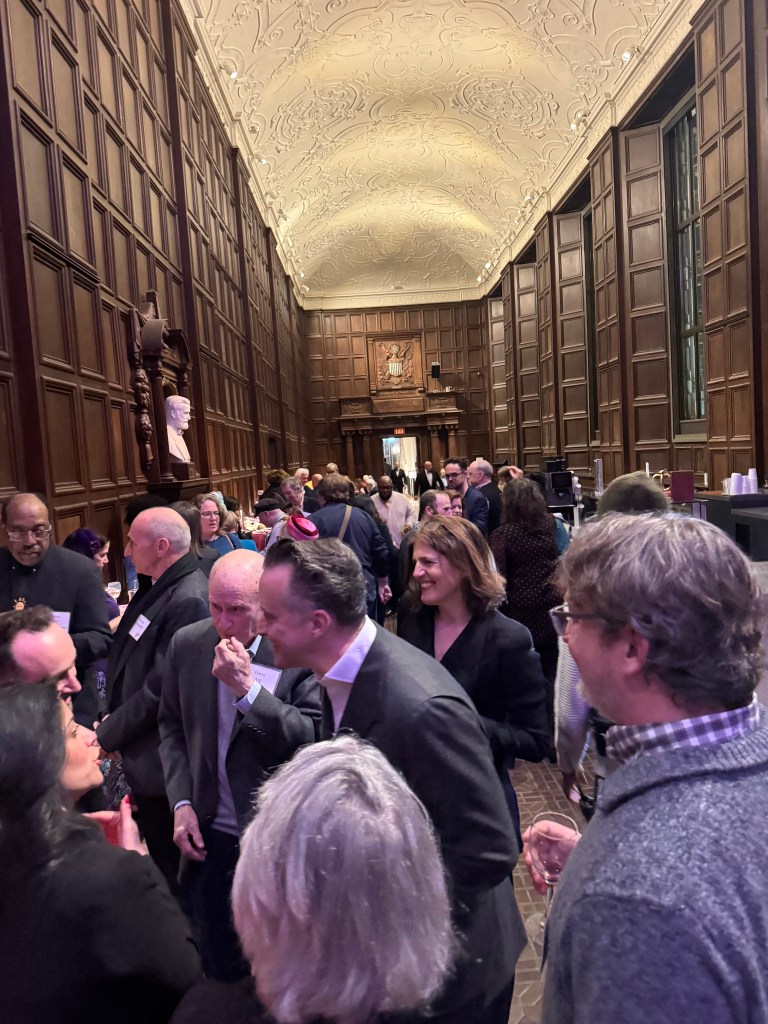
The cast, production team, and Folger staff greeted guests in the Great Hall for an elegant and enjoyable reception. Keeping with the woman theme, DJ, Miss H.E.R., provided invigorating music at the perfect volume for conversation. The reception gave us an opportunity to express our gratitude for the many levels of remarkable talent and work and to share snippets of insight and surprises.  Meeting Dr. Karim-Cooper and Lauren Gunderson was an unexpected pleasure. Their generosity of spirit and depth of intellect and dedication to the Folger was inspiring.

The depth of intellect, knowledge, and commitment to both the production and the Folger Library Theater could have been overwhelming had not everyone been incredibly hospitable, responsive, and gracious.

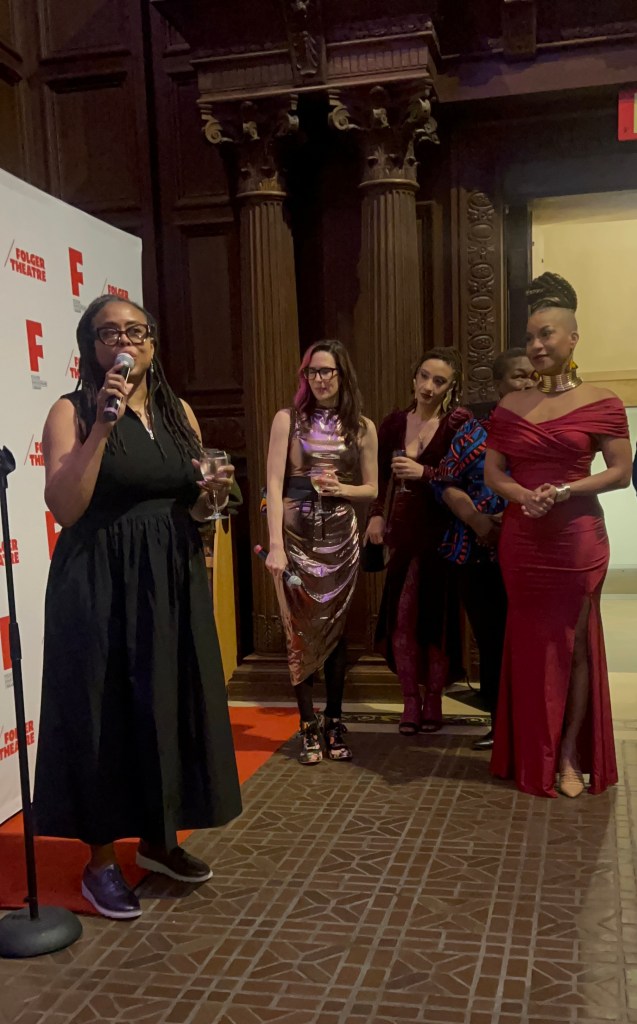
Playwright Lauren Gunderson shares her creative process PC: Henkel

Meeting the cast, Sabrina Lynne Sawyer – Ophelia, and Oneika Philips – Gertrude gave additional focus to the characters. Sabrina is entirely invested in Ophelia. She wanted Ophelia to be liked and appreciated. When I shared my original opinion and how her representation changed my mind, she gave me a genuine hug and thanked me for being flexible and seeing the other side. Oneika, dressed in another stunning gown, this time in scarlet, carried herself as the regal queen that she portrayed. She was born to be the Queen. She complimented costumer, Nicole Jescinth Smith’s vision and impeccable attention to detail. Burgess Byrd and I managed to always be on opposite sides of the Hall – my compliments to her for bringing palpable warmth and love through her talent.

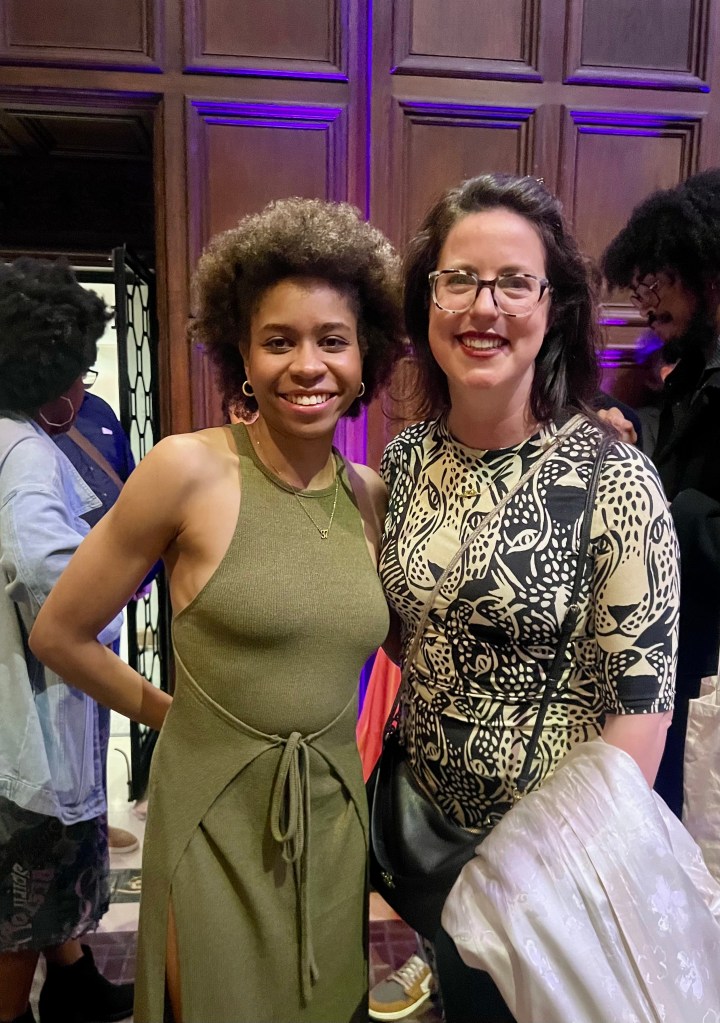
Top: Kaja Dunn, Lauren Gunderson, Nicole Jescinth Smith, Oneika Philips, Burgess Byrd Right: Lauren and Nicole Bottom Left: DJ MissH.E.R. Bottom Center: the Great Halls Bottom Right: Sabrina Lynn Sawyer and Tiffany Henkel PC: Henkel

I want to thank The Folger Press Secretary, Colleen Kennedy, for her generosity for allowing me to participate in this momentous event.  I hope that this Blog will pique your interest to see this play. You will be glad that you did.

This delightful production plays until April 6 at the beautiful Folger Theater in Washington, DC. Tickets are limited. Don’t miss this chance to watch this modern production and see Ophelia in a new light. Click here for tickets

Colleen Kennedy, Right, with Krasi Henkel PC: Henkel

When Shakespeare Goes Cinema:

A Night with Macbeth at the Crossroads of Traditional and Modern

There’s something deliciously ironic about preparing to watch “The Scottish Play” through a screen. Armed with Marjorie Garber’s scholarly insights and Paul Cantor’s lectures queued on YouTube, I found myself straddling centuries – one foot in traditional academic preparation, the other in digital-age convenience. But nothing could have prepared me for the way that the filmed live Max Webster-directed production at London’s  Donmar Warehouse; starring David Tennant and Cush Jumbo; would dissolve that careful distance between viewer and viewed.

The Seduction of Simplicity

In an era where productions often compete to outdo each other with elaborate sets and costumes, this Macbeth takes a boldly minimalist approach. The stark staging serves not as a constraint but as a canvas, allowing the raw power of Shakespeare’s language and the actors’ craft to paint vivid pictures in our minds. It’s a reminder that sometimes, less is more – especially with performers of exceptional caliber commanding the space.

The Intimacy of Technology

Things get interesting with the production’s use of binaural sound technology and the theater’s 5.1 surround sound transformed what could have been a mere filming of a stage play into something more visceral. Every whispered plotting, every sharp intake of breath, every moment of hesitation becomes startlingly intimate. This is psychological cinema at its finest. Using modern technology to achieve what Shakespeare himself must have dreamed of – the ability to place the audience not just in front of the action, but inside of it. Macbeth’s eye contact with the viewer is both thrilling and chilling.

Gender, Power, and the Space Between Desire and Action

At the heart of the play is an exploration of gender dynamics that feels startlingly relevant to contemporary discussions. Lady Macbeth emerges not simply as an ambitious woman, but as a complex figure trapped in a society that offers her “no chance of independent action and heroic achievement.” Her transformation of nouns into verbs – turning the Weird Sisters’ prophecies into calls for action – speaks to a deeper truth about power and agency.

The production masterfully highlights how Lady Macbeth’s infamous “unsex me here” speech resonates with modern conversations about gender constraints. Her willingness to “dash out the brains” of her nursing infant becomes not just an act of horror, but a violent rejection of prescribed feminine roles. In Jumbo’s portrayal, we see a woman who has internalized the brutal logic of a masculine world, turning it back on itself with devastating effect.

The Question of Responsibility

Perhaps the most unsettling aspect of this production is how it implicates its audience. Through the immersive sound design and intimate camera work, we become less spectators and more accomplices. Each choice, each action, each consequence feels personal in a way that traditional staging rarely achieves. The production asks us, in our era of influence and manipulation, whether we are ever truly responsible for our actions – a question that echoes far beyond the theater walls.

A New Kind of Shakespeare Experience

What makes this production remarkable is not just its technical achievements or stellar performances, but how it manages to honor both theatrical tradition and contemporary sensibilities. It’ is Shakespeare for our time: psychologically acute, technologically sophisticated, yet deeply rooted in the timeless power of language and performance.

For those planning to view the film: Yes, do your homework. Garber will guide you through the text and Cantor illuminates the themes. But, be prepared to have all that careful preparation wonderfully undermined by a production that refuses to let you remain a distant spectator. In bridging the gap between stage and screen, between past and present, this Macbeth creates something entirely new – and utterly compelling.

For optimal viewing, resist the urge to maintain analytical distance. This is one production where surrender yields the richest rewards. To whet your appetite take a little tour.