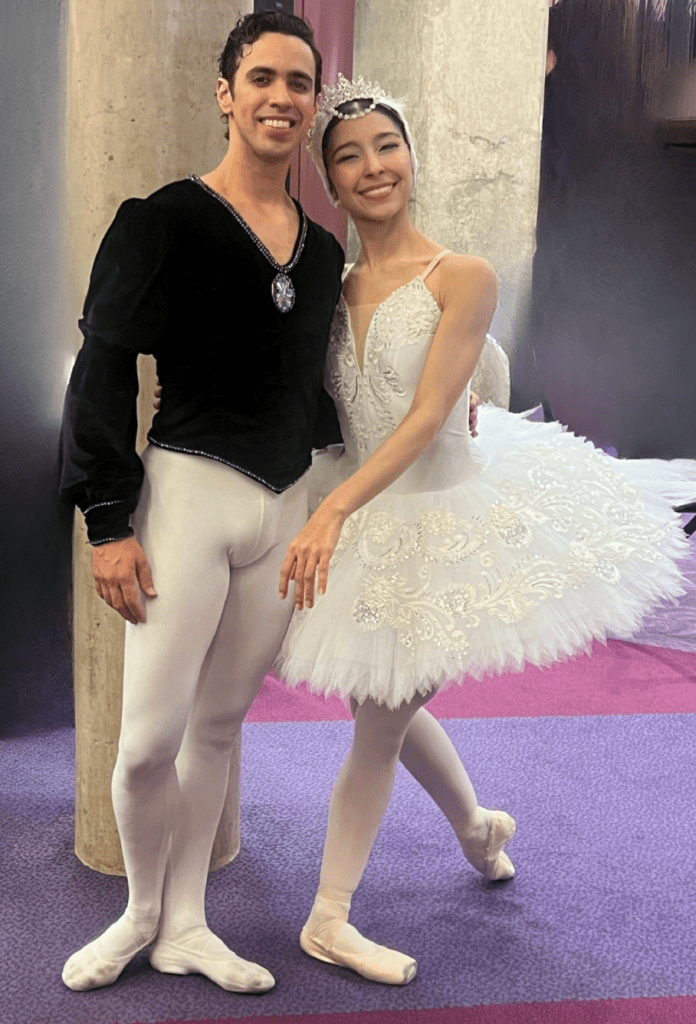
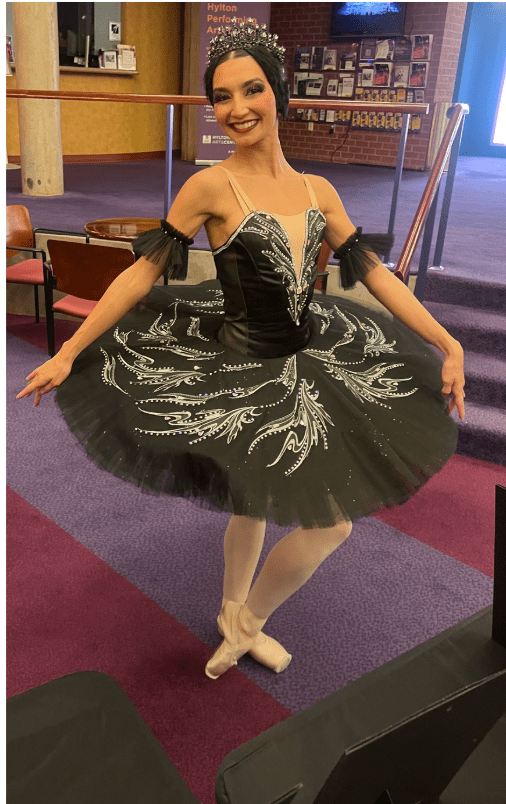
L: Livan Gonzalez as Prince Siegfried and Nicole Ramirez as Odette R: Sierra Stipetich as Odile
The Hylton Performing Arts Center was the site of much activity and appreciation on Friday, March 20. The Virginia National Ballet staged their Swan Lake ballet with music by none other than Tchaikovsky.
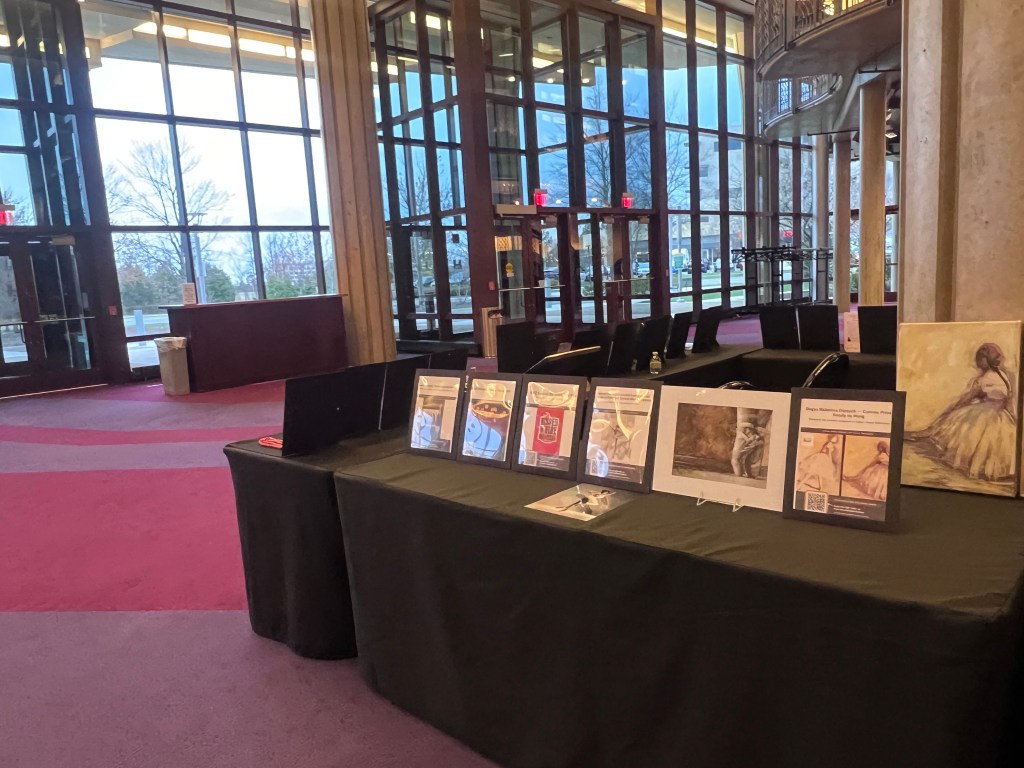
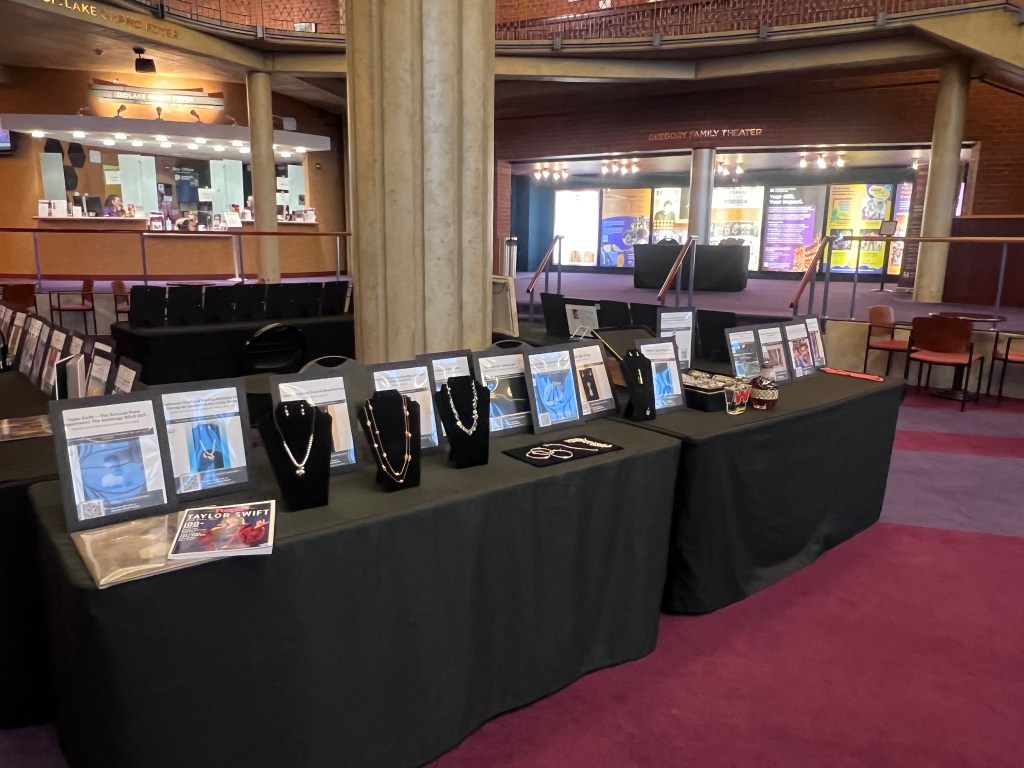
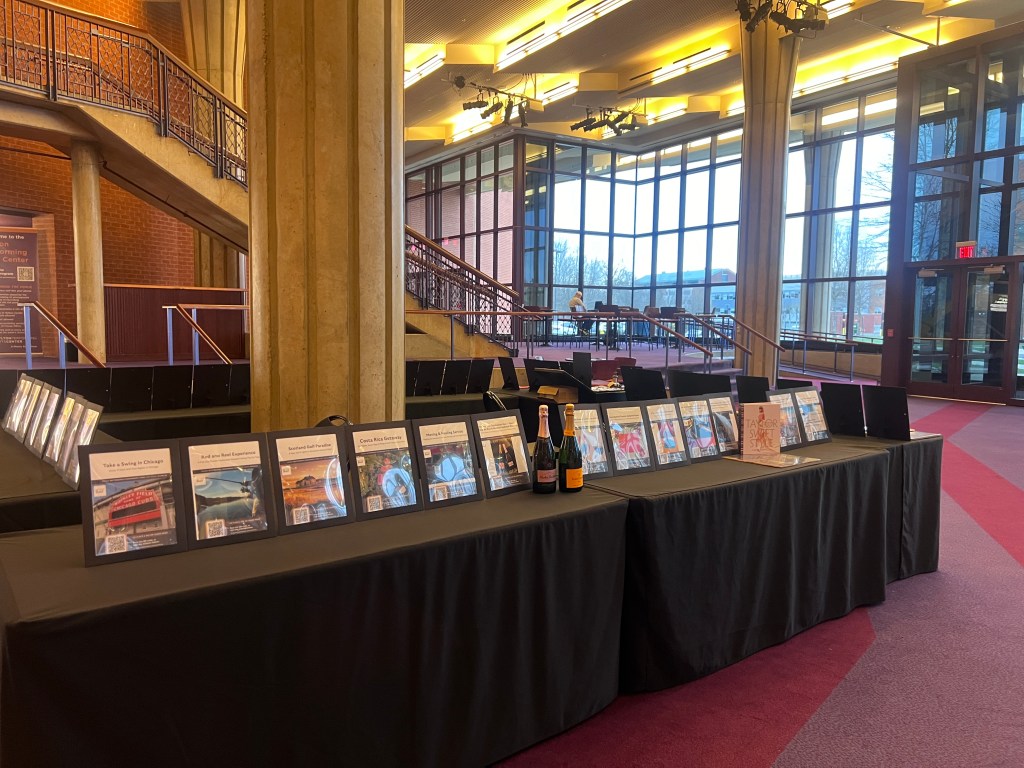
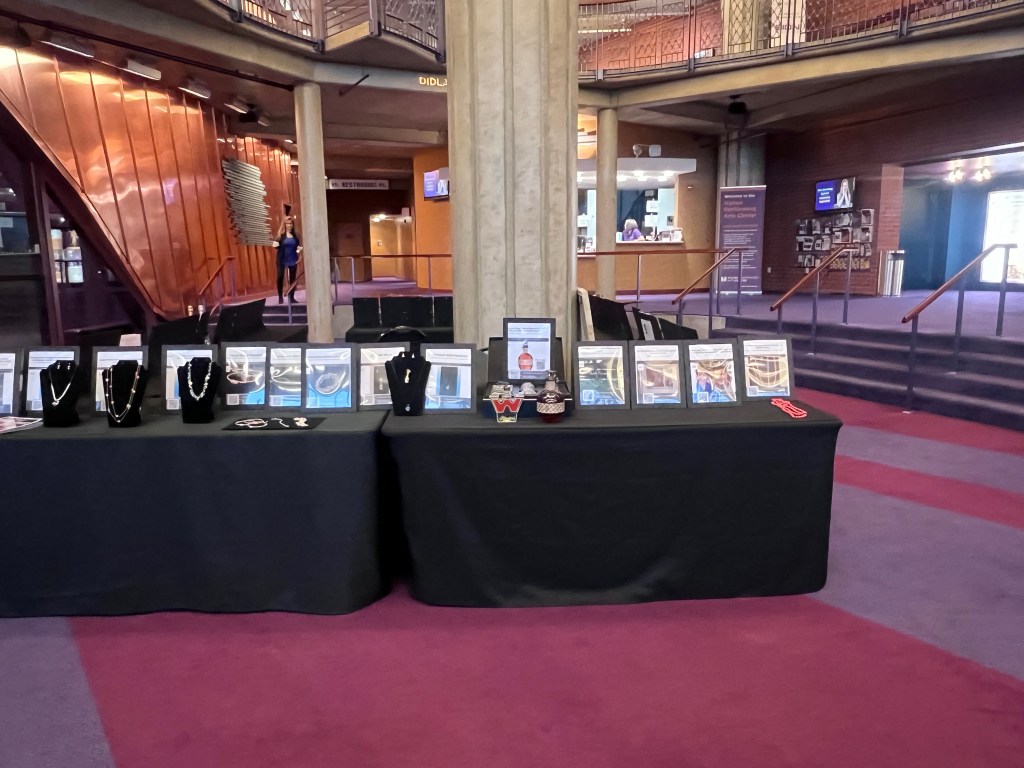
I volunteered to manage the silent auction in the main lobby while the performance awed the audience in the theater. I heard loud applause, “Oohs and ahhs,” and a very long curtain call.
During intermission, I observed members of the audience emerge from the theater with smiles on their faces. When they visited the auction tables, I asked for their feedback. “It was amazing,” said one man. “This is my first ballet and now, I want to see more,” said another patron. A third guest shared that they drove from Danville, Virginia for this performance.
The silent auction was well attended and bidding seemed brisk.
With the auditorium doors closed, I heard a roar of applause and ovations. When the doors opened, the guests emerged happy and animated. Back at the auction tables, I asked more questions. One woman volunteered that she has watched the Moscow and Mariinsky Ballets and that performance was just as good, if not better.
The White Swan and the Black Swan emerged in full costumes. The squeals from their fans were loud and loving.
The Virginia National Ballet Benefit Silent Auction is live online until April 1. You can bid on jewelry, art, libations, adventures, services, and travel, among many other delightful items.
A few tickets for the March 28 performance at Capital One Hall are still available. This is an incredible opportunity to watch world-class ballet at very reasonable prices.
Congratulations to the company, the dancers, and staff!
Hayley Podschun in Guys and Dolls at Shakespeare Theatre Company. Photo by Teresa Castracane Photography.
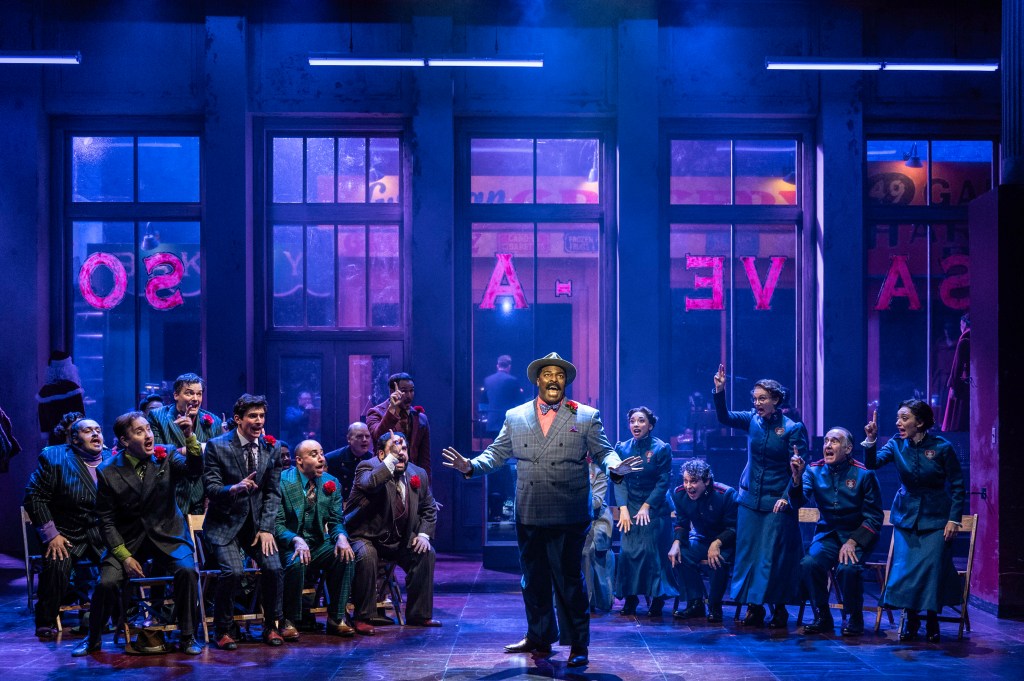
Guys and Dolls – the quintessential feel-good play – hopeful, energetic; dynamic. The performance inspired patrons to dance with big smiles on their faces.
From a technical and performance perspective, the play lived up to its Broadway roots. In many ways it surpassed them. On my drive home, I turned on the Broadway cast soundtrack. Accounting for recording and broadcast quality, its energy and enthusiasm did not compete with STC. Well done!
Top left – bottom: The cast of Guys and Dolls at Shakespeare Theatre Company. Photo by Teresa Castracane Photography. Lawrence Redmond, John Syger, Julie Benko, Jimena Flores Sanchez, and Katherine Riddle in Guys and Dolls at Shakespeare Theatre Company. Photo by Teresa Castracane Photography. Calvin McCullough and Kyle Taylor Parker in Guys and Dolls at Shakespeare Theatre Company. Photo by Teresa Castracane Photography. The cast of Guys and Dolls at Shakespeare Theatre Company. Photo by Teresa Castracane Photography.
After months of attending powerful productions at the Shakespeare Theatre Company, I found myself at a Preview that offered something refreshingly different. The company was opening Guys and Dolls at Harman Hall. The beloved American musical is presented here with remarkable vibrancy. I was fortunate to see it before the official opening, catching the energy of a nearly sold-out house. It opened to such acclaim and demand that four additional performances were added.
This is not critique. This is anticipation. This is the excitement building toward what promises to be a joyful and spirited theatrical experience, perfect for the season of hope and joy. The live music set outside the picture windows of the Salvation Army, with the perfectly attired band leader, created the ideal atmosphere for the memorable performance.
The artistic team behind this production is impressive. Director Francesca Zambello, Artistic Director of Washington National Opera, brings operatic sensibilities to Damon Runyon’s stylized world. Choreographer Joshua Bergasse, whose Broadway credits include On the Town, delivers legitimate musical theater dancing that feels both classic and fresh. STC continues to expand its presentation range while maintaining its exacting artistic standards, thanks in great part to the vision of Artistic Director, Simon Godwin.
Top Left to Bottom: Julie Benko in Guys and Dolls at Shakespeare Theatre Company. Photo by Teresa Castracane Photography. Hayley Podschun in Guys and Dolls at Shakespeare Theatre Company. Photo by Teresa Castracane Photography. Nick Alvino, Tommy Gedrich, and the cast of Guys and Dolls at Shakespeare Theatre Company. Photo by Teresa Castracane Photography. The cast of Guys and Dolls
What makes Guys and Dolls endlessly enjoyable is its ‘plausible relatability’ in the world it creates – the gamblers, the nightclubs, the dance scenes, the romance, and the comedic timing that lands perfectly again and again. There are no ‘bad guys.’ Some just had a few ‘bad habits.’ Damon Runyon’s language and characters form a theatrical universe that is playful, distinct, and instantly recognizable. Frank Loesser understood this when he composed the score in 1950. He did not try to naturalize Runyon’s style; he amplified it. He gave it music, and that music carries the story with humor, color, and emotional lift.
Top Left to Bottom Right: Hayley Podschun and Julie Benko in Guys and Dolls at Shakespeare Theatre Company. Photo by Teresa Castracane Photography. Jacob Dickey and Julie Benko in Guys and Dolls at Shakespeare Theatre Company. Photo by Teresa Castracane Photography. Hayley Podschun and Rob Colletti in Guys and Dolls at Shakespeare Theatre Company. Photo by Teresa Castracane Photography. Jacob Dickey and Julie Benko in Guys and Dolls at Shakespeare Theatre Company. Photo by Teresa Castracane Photography.
At Harman Hall, I experienced this world take shape. Sarah Brown was uncompromising, Sky Masterson made impossible bets, Nathan Detroit ran the oldest established permanent floating crap game in New York, and Miss Adelaide developed psychosomatic colds from fourteen years of broken marriage promises. It was all there: the charm, the humor, the rhythm, the dancing, the romance, and the fun. The performance quality of acting, singing, and dancing was exceptional. See for yourself – buy your tickets and make it a holiday event for your family. You too can walk out with a big smile.
Luck be a Lady Tonight – Roll the Dice!
Left: Graciela Rey, Aria Christina Evans, Hayley Podschun, Jessie Peltier, and Jimena Flores Sanchez in Guys and Dolls at Shakespeare Theatre Company. Photo by Teresa Castracane Photography.Right: The cast of Guys and Dolls at Shakespeare Theatre Company. Photo by Teresa Castracane Photography.
Ibsen’s Rarest Masterpiece Flies Through Moral Fog
Robert Stanton as Håkon Werle and Mahira Kakkar as Mrs Sørby in The Wild Duck. Photo by Hollis King
Looking for the garage exit elevator into Klein Theatre last Thursday evening, I met Angela Lee Gieras, Executive Director of Shakespeare Theatre Company, She accompanied me in the correct elevator to the main lobby where she introduced me to Artistic Director Simon Godwin. Shaking my hand, he offered quiet advice that stirred my curiosity, “This might be the only and last time you will see this play in our lifetime.”
That alone should compel you to see Henrik Ibsen’s The Wild Duck before it closes November 16.
Unique and Complex
Henrik Ibsen (1828-1906), often called “the father of modern drama” and three-time Nobel Prize nominee, built his reputation on explosive social critiques—A Doll’s House, Ghosts, An Enemy of the People—plays that attacked the hypocrisies of 19th-century society. In The Wild Duck, considered by many to be his finest work, he turns his sharp eye inward. Here, he draws from his privileged Norwegian family. Ibsen created Gregers Werle, the idealistic crusader determined to expose truth at any cost. This was inspired by members of his own patrician class. He named his young duck-loving heroine, Hedvig, the same name as his grandmother.
The play is complex. Understanding the author’s circumstances, background, and character, helps hold the ‘color’ of the play. In The Wild Duck, Ibsen was not attacking society’s lies. He was attacking the idealism of his family and overeager reformers. The question is not whether we should seek truth, but whether forcing truth on others is salvation or destruction. That moral ambiguity is perhaps, why this masterpiece has been performed so rarely.
L. Alexander Hurt as Gregers Werle, Robert Stanton as Håkon Werle in The Wild Duck. Photo by Hollis King. R. Alexander Hurt as Gregers Werle, Nick Westrate as Hjalmar Ekdal in The Wild Duck. Photo by Gerry Goodstein.
Nothing Is As It Seems
Simon Godwin’s production, adapted by David Eldridge, opens with Victorian elegance—men in tails, ladies in ornate gowns, an elaborate dinner party. The set is bathed in shades of green. A small, grey-bearded man vanishes through a green door then reappears. He resembled a quintessential leprechaun though the play is set in Norway. He is the disgraced nature-loving Lieutenant who raises then hunts and shoots rabbits in his son’s loft. His son has embarked on a mission to restore his father’s honor.
The production is punctuated by haunting musical interludes—Alexander Sovronsky performs arrangements of 19th-century Norwegian folk and classical music on viola, Hardanger fiddle, and langeleik. Like the narrators in Shakespeare’s plays, the music shifts between melodic reflection and foreboding darkness, guiding us through the play’s emotional terrain.
As Godwin notes in the program, Ibsen is asking something far more dangerous than honor: “In the battle for moral certainty, who is the casualty? What is the price of truth?”
L. Melanie Field as Gina Ekdal Center: Maaike Laanstra-Corn as Hedvig R. Maaike Laanstra-Corn as Hedvig, Melanie Field as Gina Ekdal in The Wild Duck. Photos by Gerry Goodstein.
The Typhoid Mary of Idealism
The wealthy idealist, Gregers Werle, ‘knows’ what is best for everyone. He spreads his convictions like contagion—what I describe as ‘Typhoid Mary’ in Victorian tails – delusional in his certainty that he is saving everyone by forcing them to face “truth.”
Ibsen was intimately familiar with this character. Ibsen belonged to Norway’s patrician elite, and The Wild Duck draws from his own family’s dynamics as they navigated the evolution of society. Gregers embodies the dangers of Ibsen’s own class—reformers who wield truth as a weapon.
What happens when someone appoints themselves the arbiter of others’ honesty? When does truth-telling become destruction? The answers are not simple. This is perhaps, why this play has been performed so rarely.
L: Alexander Hurt as Gregers Werle Photo by Hollis King Center: Alexander Hurt as Gregers Werle, Nick Westrate as Hjalmar Ekdal Photo by Gerry Goodstein R: Maaike Laanstra-Corn as Hedvig, Melanie Field as Gina Ekdal, Alexander Hurt as Gregers Werle Photo by Hollis King
Mental Gymnastics Required
The Wild Duck demands the audience’s full attention for which they are rewarded. Nick Westrate (recently in STC’s Frankenstein) and Melanie Field (the heartbreaking Sonya in STC’s Uncle Vanya) lead a flawless ensemble. Maaike Laanstra-Corn’s Hedvig, the young duck-loving girl, caught in the adults’ web of lies, delivers a performance that lingers long after the stage goes dark. The 26-year-old Washington, DC native and Brown University graduate is an artist to watch.
I felt like a voyeur and a gossip throughout the play. I was the voyeur at that dinner party, wondering what came next. Then a gossip, observing the Ekdal household. It felt like I was overhearing through a parlor wall. It felt intimate, forbidden, yet addictive. I was inside their home, yet uninvited. My real estate mind went into calculation mode of the Ekdal house – how many rooms, how many square feet, how much were they asking for the rent of their spare room?
The audience was silent. No one even cleared their throat. When the lights dimmed, and the play ended, the audience stood up in unison, applauding politely. The applause was respectful, reverent, and slightly haunted. We were processing.
L: Nick Westrate as Hjalmar Ekdal, Maaike Laanstra-Corn as Hedvig – Photo by Hollis King. L: Melanie Field as Gina Ekdal, Nick Westrate as Hjalmar Ekdal – Photo by Gerry Goodstein
Why You Should Go
The Wild Duck is not a feel-good play. It is a feel-smart play. If you want to wrestle with questions about truth and delusion that feel urgently relevant in 2025, when crusaders of all stripes claim absolute certainty about what is best for everyone—this is your play.
What makes this play essential is Ibsen’s unprecedented psychological depth and intricacy of character. He peels back layers of late 19th-century culture and morals with surgical precision, revealing not just what people said, but what they believed, feared, and concealed. Anton Chekhov, who considered Ibsen his favorite writer, adopted this pioneering focus on psychological realism—the exploration of ordinary lives with extraordinary depth. Chekhov developed his own distinctive style with greater emphasis on subtext and naturalistic dialogue, but the foundation was Ibsen’s radical insistence that theatre could reveal the human psyche with the intuition of a psychological case study.
If you were moved by Melanie Field’s Sonya in Uncle Vanya earlier this season, then you will appreciate the direct inspiration from Ibsen to Chekhov being honored by the Shakespeare Theater Company. Both playwrights understood that the most profound dramas unfold not in grand gestures, but in the quiet devastation of people confronting uncomfortable truths about themselves and the society that shaped them.
Ibsen meticulously controlled how his work was interpreted; writing detailed instructions to directors for The Wild Duck productions. This most personal of his plays deserves to be seen with the care Godwin has brought to it, even if just once. After exploring Ibsen’s background for this blog, I find myself compelled to return—to see with new eyes what I missed the first time, armed now with understanding of what the playwright was truly after.
L: Maaike Laanstra-Corn as Hedvig -Photo by Hollis King R: Maaike Laanstra-Corn as Hedvig, David Patrick Kelly as Old Ekdal, Nick Westrate as Hjalmar Ekdal, Melanie Field as Gina Ekdal, Alexander Hurt as Gregers Werle – Photo by Gerry Goodstein
Julius X was born from rejection. When Al Letson was not cast as Mark Antony in a Julius Caesar production because of race, he decided, “Screw it, I’m going to write my own.” This was not bravado. It was love. He had fallen for Mark Antony’s speech in 10th grade and read Malcolm X’s autobiography in 7th. Both stayed with him. Years later, he realized Julius Caesar’s arc fit almost perfectly with Malcolm X’s life. This is how a dyslexic kid who learned to read through comics, a flight attendant who competed in poetry slams across America, an award-winning journalist and Shakespearean, spent over two years creating what is now playing at the Folger Theatre through October 26. I discovered Al Letson through Julius X.
Julius Caesar by William Shakespeare is a popular high school literature topic. How it is studied and how Shakespeare is presented often affects students for a lifetime. In Letson’s case, Caesar spoke to him. To others, it was just something to get through to close a chapter on high school English. I too studied Julius Caesar in high school. After my beloved Shakespeare teacher’s drowning the prior summer, I was uninspired to seriously pursue the play, and my new teacher was marking time. All was not lost for me. I read Shakespeare’s entire canon in five months in honor of my inspirational teacher’s 50th anniversary of his drowning and published a blog about him and Shakespeare. That blog remains the most read of all of my blogs. Julius Caesar was, of course, reread. This time with real interest.
In preparing to see Julius X, I opened my books once again. Marjorie Garber’s essay in her book, Shakespeare After All, and Paul Cantor’s Shakespeare and Politics lectures on YouTube helped me prepare. I then researched the life of Malcolm X. As a child, I remember hearing my parents discussing his assassination on the day it happened. The parallels between the two men are remarkable. Yes, they were different, however, their passion, their vision, and their boldness are indisputable.
Al Letson so aptly married the two tragic heroes by meeting their arcs, their mission, their loyalty, and their fire. Having prepared, I was happy to feel like a participant rather than a spectator. I felt the rhythm of the verses, the drive of the characters, the commitment to community of the friends, and the loving fear of the wives. Sitting close to the stage, I saw facial expressions shift with each revelation – what performers call rubber faces, the ability to communicate entire thoughts through the smallest movement. The wives were remarkable: Julius’s wife in her impeccable teal suit with braid detailing, Portia animated and desperate, both showing love and intuition that their husbands would not, could not, hear. Julius X is fast paced. There is no time to wallow or worry. Things happen quickly, and while the interpretation is impressive and surprising, being prepared was key to my Julius X journey. I was enthralled rather than bewildered.
Harlem of the 1960s was not Rome. Rome was regal, authoritative, imperial. But Harlem was home—brownstones and street corners, community and belonging. Its residents cannot live in Harlem without loving it. Harlem was Malcolm X’s ‘Rome.’ It was intimate, not monumental. It was his world. He had a burning passion. He wanted more for himself, his family, and his people. A militant who reconsidered his path but never abandoned his passion posed a threat to his supporters. The key? Ambition.
Caesar is a pivotal character. He has been compared to Alexander the Great by Plutarch in his biographies, Parallel Lives, in approximately 110 AD, to being featured by Shakespeare in the Tragedy of Julius Caesar in 1599, to being analyzed by Paul Cantor in the 21st century, juxtaposing him between Coriolanus and Antony and Cleopatra, and now, to being reimagined as Julius X by Letson in the 2020s. Almost 2000 years have passed. There is nothing new under the sun. Ambition is considered threatening by those with opposing vision or small thinking.
Julius X is entertaining, thought provoking, classic, and unapologetically bold. Playing through October 26 at the Folger Theatre, it rewards preparation and challenges assumptions. Good that Letson was not pigeonholed as Mark Antony. You can buy tickets now.
All photo credits: Erika Nizborski and Brittany Diliberto.
Brodie Donougher PC: Poetry Film Productions The DancerPhoto by Lumosia Photography London One of the many faces of Brodie Donougher
“Watch me, watch me, watch me make this flip,” five-year-old Brodie Donougher implored his parents as he flipped off the living room sofa. That was the beginning of Brodie’s performing career. He was a happy, enthusiastic, and energetic child, who loved to share his talents with anyone who wanted to see them. His motivation was to bring enjoyment to others. At 21, he performs professionally for audiences’ enjoyment as an actor, singer, and dancer.
From flips off the sofa at the age of five to today, Brodie has had three major roles: on London’s West End as Billy Elliot for three years; as Rookie with the Grand Rapids Ballet in the United States; and, beginning this month, in Vienna, Austria, in The Phantom of the Opera. What drives Brodie Donougher to immerse himself into a production and embody a character? His infectious enthusiasm to pursue his craft and indulge his drive for excellence, because he says, “You can never be too good.”
Skyline of Opera Garnier, Paris – home of the Phantom
In January 2024, Brodie arrived in Vienna, Austria, to begin rehearsals for Camron Mackintosh’s production of Das Phantom der Oper –The Phantom of the Opera by Andrew Lloyd Webber. He will be performing his roles entirely in German, (the Austrian Hoch Deutsch dialect). Brodie is multilingual speaking Italian, now German, and of course, English. He has already learned ‘The Phantom text’ in Hoch Deutsch. “We have an incredible team of top performers, and I feel honored to be among them,” said Brodie who plays two characters – Hannibal’s Guard, as well as an ensemble member. He explains, “As the ensemble member, my character is an attractive young dancer who performs at the Opera Garnier in Paris. He is quite flirtatious, and loves the attention of the two principals, Carlotta and Piangi. Hannibal’s Guard makes a prominent entrance and poise at the beginning and keeps strong entrances throughout the whole first act. In addition to playing two characters in the performance, I am also a ‘stage hand’ and come and go throughout the different scenes and help keep the narrative going.” The production opens to the public on March 15. Tickets are sold out through June 20. The show will play in Vienna through June 2025.
An insatiable learner, Brodie says, “It’s my belief that every moment that you’re sitting idle, there is opportunity wasted. If I am sitting at home or in a cafe relaxing, there is wasted opportunity when I could go out and learn something new. Don’t get me wrong I relax; everybody needs that, but I have this constant need to be learning or enhancing – to do more. If I can go to a ballet class, I will go, and as soon as I’ve finished it and I learn about a workshop happening, and, if time allows, I will attend that as well. I love using my time to improve and develop my skills.”
Photo Curtesy of Brodie Donougher Flipping and Flying
How has one so young accomplished so much? “I love to give one hundred percent,” explains Brodie. “Sure, I can get by with 70 percent. But then, I think about how the audience might have enjoyed the production if I had given 100 percent. Every actor on a stage reaches the audience. I love to touch each member of the audience and bring them into the production.”
An accomplished and highly recognized ballet dancer, Brodie wanted to use his voice and get back to his “roots” of musical theater. He described his original roots , “I am from Blackpool in the Northwest of England. It is not a very prosperous area, but that is home.” The area’s prosperity or lack thereof did not hold him back. He was scouted as a young child by the Royal Ballet School Primary Steps Program where his hard work and dedication gave him opportunities beyond imagination. They selected him to join the school. He embraced, breathed, and lived every aspect of his dream-come-true. “Whenever I get into a less than optimal situation, I think of my roots. Where I came from and what I have accomplished. I always feel tremendous gratitude and want to give more,” he explained.
One day, while waiting for Brodie at his ballet class, him mother overheard other mothers discussing upcoming auditionsin Manchester, England for Billy Elliot the Musical. She decided to give Brodie the audition experience. He, along with several other students from his ballet school, auditioned. Brodie, at nine years old, sustained the grueling eight-hour initial audition where at every hour contenders for the lead were dismissed. After seven hours, Brodie was still dancing. Over a lengthy audition process, Brodie was offered the part of Billy Elliot. At that time, he also received offers to study with the Royal Ballet School and with the Elmhurst Ballet School, both premier ballet schools in the UK. At his young age, he knew that his decision could affect his future. He accepted the lead in Billy Elliot the Musical.
Photo curtesy of Brodie Donougher PC: Brian Cantwell A real life Billy Elliot
Billy Elliot was a highly acclaimed production on the West End. Brodie was Billy #39 and performed 144 times over three years. He says, “That is when I discovered that I love to perform, when I looked out in the audience and saw thousands of people being entertained.” Brodie performed at the Olivier Awards, representing Billy Elliot for Best West End Musical, in 2015. He performed “Billy” on various television shows, including “This Morning,” a British daytime magazine program, and on the Late Late Show in Ireland. Charisma is among his many talents.
Brodie immersed himself in his ballet education following Billy Elliot. For the four years after the play ended, he studied ballet with the Elmhurst Ballet School and honed his craft.
Photo by Elmhurst Ballet School 15-year-old student, Brodie, at Elmhurst Ballet School
At 18, Brodie brought his talents to the United States, where he was selected by the San Francisco Ballet School for a full scholarship to become a senior student there. According to Data Pointes, the San Francisco Ballet School is ranked among the top ten best ballet schools in the world.
Photo curtesy of Brodie Donougher – PC: Ray Nard Image Maker All That Jazz – Grand Rapids Ballet
Following his two-year study at San Francisco, Brodie joined Grand Rapids Ballet as a professional dancer. His precision, technique, and ability to fully inhabit characters helped elevate the company’s performances. Brodie’s most “cherished” Grand Rapids Ballet role was when he was cast as “Rookie” in the Andy Blankenbuehler (a three-time Tony award winner for Bandstand, In the Heights, and Hamilton), production, Remember Our Song. Brodie explained, “When given the opportunity to portray a role in a show or musical, the biggest part of preparation for your role is research. The most important thing, before you even step into the studio or rehearsal, is to learn who the character is. His thoughts, fears, hopes, loves. I spent two weeks researching. This story was about sailors in WWII who were in a submarine. I tried to imagine myself as that young sailor living below the surface of the sea; not seeing daylight; leaving my mom behind. I slept on a metal cot with the smallest and thinnest cloth for a cover. I read books about submarines and accounts of sailors’ experiences in the depths of the ocean. I WAS Rookie. The Company’s board president came to me after one of my performances and told me, ‘I couldn’t even think it was you dancing…I felt as though I could feel every emotion. You made the performance storytelling.’”
While ballet is as natural as breathing for Brodie, he has much more to offer – acting, speaking, and singing. “I was told not to hide my light under a bushel,” recounts Brodie. “When I share my voice, the audience can experience the full impact of the character that I embody.” Voice, language and music make musical theater touching and memorable. Brodie has been preparing himself for every moment to entertain the audience whether solo or in ensemble. “I love working with my artistic team to produce the best possible theater for our audience. When we all give 100 percent, my heart is full.”
Photo curtesy of Brodie Donougher Snowy ‘Fred Astaire’Photo curtesy of Brody Donougher ‘Fred Astaire’ curtain call
Upon his return to the UK after Grand Rapids, Brodie performed in the West End Christmas production of The Snowman at the Saddlers Wells Peacock Theater. Although initially as a “swing” cast member, on many occasions he performed the role of Fred Astaire with finesse and elegance. His jumps were clean and crisp, his miming and acting were clear and relatable and “he helped bring an extra dimension to the performance,” per a theatergoer who enjoyed the production.
Photo by Brian Cantwell At the Stage Door
Asked what his dream role(s) might be, Brodie replied, “I’ve made a list on my laptop and on my phone of my dream roles and the shows for these roles are, just to name a few, the character of Mush in Newsies, and I would also love to play in Les Misérables. These are truly my dream roles and musicals. Ideally, my number one most desired role would be Enjolras, a ‘thinker and a man of action,’ according to Victor Hugo. He is the handsome young man who swings the red flag. I would also love to play Marius. It would be a dream come true if I could perform in a US touring company.”
At an age where many would still be considered “up-and-coming,” Brodie Donougher has already established himself as a consummate professional and world-class talent. His unrelenting work ethic and deep respect for his craft and production members suggest this is merely the first act in what will undoubtedly be a distinguished career.
Post ballet class exhilarationPhoto curtesy of Brodie Donougher Take a bow, Fred Astaire
Note: I met Brodie at a ballet performance several years ago. I was impressed by his tremendous presence yet humble nature. His fresh, fit, good looks and charisma were palpable. I was sorry to see him return to London because I had hoped to be able to watch him perform in the U.S. Since our first meeting, we have met for coffee and dinner in London. One morning while in London, I received an early morning message that he was performing in The Snowman that day. I managed to acquire tickets in under one hour and arrived at the theater with 10 minutes to spare. His performance was exceptional. This blog is to share this impressive actor with my sphere of readers and friends. He is someone to follow and make an effort to see. He is worth it.
In January 2020, a friend posted a Facebook link to a Shakespeare project, “Shakespeare 2020,” reading all of the plays, Sonnets, and poems by William Shakespeare in 12 months. I did not think twice, I joined the group. What had I just signed up for??? I own a busy real estate brokerage firm, run a horse farm, I have a husband, 2 dogs, and 5 cats, and my 96-year-young mother had come to live with us just before Christmas 2019. And . . Shakespeare too?
Why NOT? I would give it a try. No cost, no commitment except to myself, and I wanted to see if I was smart enough to work through literature for which I had more than a mild curiosity. One compelling reason was to improve and strengthen my writing.
My good fortune is that I attended an unusual and experimental public high school. There, my luck expanded to be placed in an English class with an incredible teacher, WilliamTeunis. He piqued my interest in literature (especially, Shakespeare) through his enthusiasm and exceptional teaching. In his class, we read plays – acting out roles; we wrote short stories, essays, parodies, and plays. Shakespeare was attainable and most enjoyable. The more we did, the more I reached. My English experience abruptly ended with his drowning at the end of my sophomore year. Since then, I doubt that I have written a sentence without asking myself, “What will Mr. Teunis say about this?”
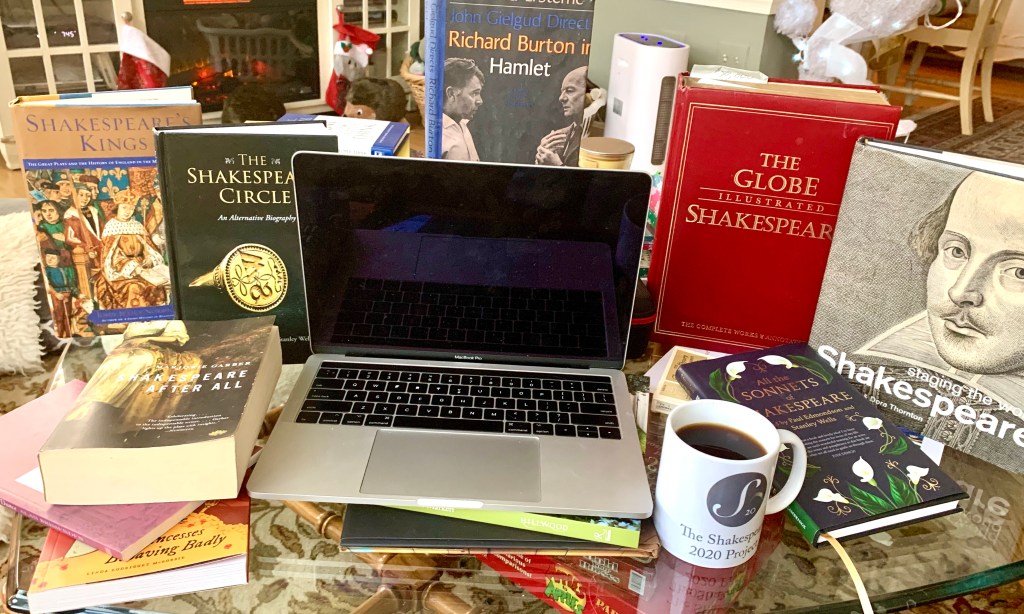
“One day when I have time, I will read the plays.” My thought when I purchased this book in 1994
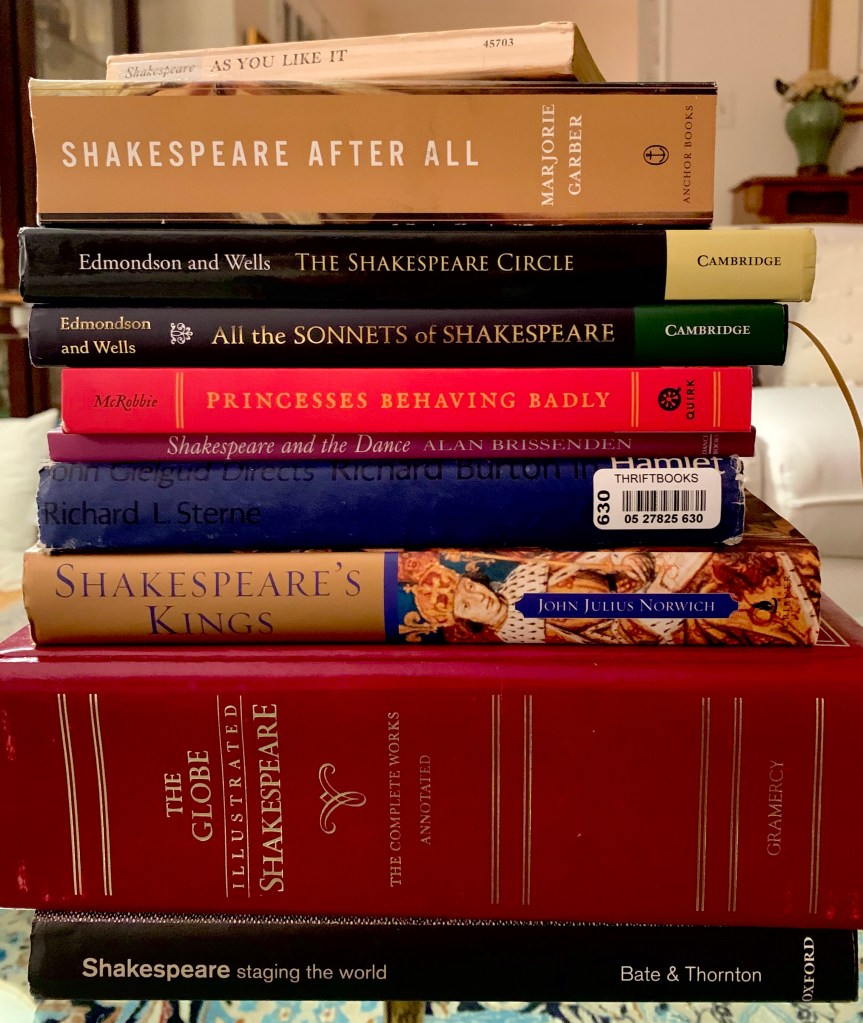
Over the years, my Shakespeare interest was occasionally rekindled whenever I found a book related to the plays. Once, when I was shopping in Costco, I came across the Complete Works of Shakespeare. “This would be a good resource if I ever have the time to sit and read,” I thought, being the eternal optimist. I purchased the book. Other times, also in Costco, I bought, Shakespeare’s Kings, in hopes of one day learning something about the histories (because I glazed over in my British History course in college); another time, I discovered and bought the 3-CD set of the Sonnets which I played in my car for months. So…when the Project appeared, I was armed and dangerous.
So began the adventure of 162 days
My journey began on January 9, 2020 with Twelfth Night. Yikes! The print in my book was microscopic! I focused my eyes and found that the words readable. Somewhere in Act 2, I remembered my English teacher’s remarks that Shakespeare wrote plays which were performed to audiences. He wrote for theater and not for fireside reading. How was I going to do ALL that reading when the plays must be experienced? I discovered Librivox!
On Librivox, talented and generous people joined forces from around the world to read almost all of the plays. YES! I was thrilled by my discovery. Aside from my relentlessly working and riding horses, I am passionate about walking my dogs for miles (we walk a 15 minute mile most days for 2-5 miles). I took Librivox on our walks.
I listened to Hamlet at the magical arboretum where trees took on the personae of the ghost, Gertrude, Hamlet, Laertes, Polonius, Claudius, and a stick in the pond resembled Ophelia. When I was annoyed that Great Falls Park had been closed, we hailed elsewhere where Macbeth was the perfect answer for my dark mood. The early spring blossoms in our sweet town’s yards were a nice backdrop for Measure For Measure. We heard acts of plays in my car or truck en route to our destinations. I have a favorite gas station where I buy inexpensive diesel for my truck. I love that my broadcasts are not interrupted when I turned off the ignition to fuel. I recall something about a “pie” from Titus Andronicus while the diesel flowed into the tank of my bright blue Silverado.
The Shakespeare 2020 project was brilliantly developed to be completed in 12 months. Well, being very curious, and having determined that I would complete the entire canon before Mr. Teunis’ 50th anniversary of his drowning (so that I could write a tribute article about him) I accelerated my reading/listening and behold, I finished the canon. There were times in King Lear and the Rape of Lucrece that the thought of closing the book and deleting the Librivox link were very compelling. HOW can a decent person know about such stuff and write about it, and worse, WHO would want to be entertained by THAT???? I decided not to judge by my values and carried on.
Opportunities to discuss Shakespeare arise in unexpected places
The Project was not just a syllabus, it was a treasure trove of intelligent, knowledgeable, and creative people who already knew a great deal. They shared their insights and enthusiasm with the 4,900 members of the group the Facebook page . The depth of resources, intellect, and understanding was staggering. My Shakespeare “library” grew along with my curiosity and understanding.
During my haydays in Mr. Teunis’ class, I heard him tell us that theater, during the Elizabethan era, competed for audiences from among other public interests including bear baiting and public hangings. “Uh-hu, OK, whatever,” I thought, at the time. Now it came to back to me why certain plays were so grotesque. The poor playwright had to capture audiences’ attention and be competitive. Therefore, Titus Andronicus, Lear, Rape of Lucrece, among others.
My friends with whom I shared my Shakespeare adventure looked at me sideways most of the time. One friend, much older than I, said to me, “He should have died earlier. There would be fewer plays with which to torture students.” It seems that he is not alone in that opinion and that most people’s literary experiences were not as positive as mine. My friends were surprised that I cared about Shakespeare, let alone that I would embark on this journey.
My book collection grew
Until this Project, I had danced around the periphery of the Bard. I had done my share of academic study with Mr. Teunis, then, watched fabulous ballets including A Midsummer Night’s Dream with New York City Ballet and the Paris Opera Ballet; The Winter’s Tale and Romeo and Juliet with the Royal Ballet and attended Folger Theater performances throughout the years. After completing the canon, I purposed to watch as many plays as possible. I have managed to see about 20 plays, listened to Patrick Stewart reading the Sonnets, and I discovered brilliant lecturers from Harvard, Yale, and the University of Virginia.
The Shakespeare 2020 Project opened a new world of discovery and connections as I never expected. I met (virtually) fascinating people (some of whom I could not find a single point of agreement) who stimulated me to think in different ways. I became acquainted with the creator of the Project, Ian Doescher, a young, creative author who has written many wonderful books in the “Shakespeare style” (do look at his link, you will be amazed by his creativity) on themes including Star Wars, Clueless, Luke Skywalker, and myriad more. My new connections and friendships are treasures. Another bonus is that I connected with high school friends who also valued Mr. Teunis (I should mention that our strange, experimental, free-for-all high school turned out amazing humans who touch the far reaches of the world because of Teunis [and others like him]).
A Plutarch Quote: “ The mind is not a vessel to be filled but a fire to be kindled
As the Project draws to a conclusion, the experience, the discoveries, the friendships, the challenges, and the curiosity have helped me learn much about myself, given me discipline to persevere, and hopefully helped me write a little better (all the while hearing Mr. Teunis’ remarks, lectures, and gentle admonitions to do “better”).
By writing this article, I experienced the vastness that is Shakespeare. Questions continually arise. My opinions have no bounds. Stay tuned for future supplements to my “Shakespeare Adventure.” The learning is just beginning.
The Chamber Dance Project of Washington, D.C. Carries on Their Mission
When circumstances derail plans, creativity sets artists free to experiment with and present exceptional virtual opportunities to even more people than would have originally enjoyed performances. Such is the case for the Chamber Dance Project (CDP) in Washington, D.C.
Artistic Director and choreographer, Diane Coburn Bruning, founded the CDP because she believed that dance should be a collaborative process between dancers, musicians and the audience. That process, she says, “Deepens the audience’s experience.” They have grown to be Washington’s premier contemporary ballet company.
Their ballet season takes place in the summer when other companies and dancers are off. Because of this, CPD attracts and features exceptional dancers. Two such dancers are Austin Powers and his wife, Grace-Anne Powers. They are slated to dance in this summer’s CDP performances.
With theaters being dark now, this is an opportunity to expand creativity and communication with audience and patrons. CPD has moved their Open Rehearsals and Evenings with the Artist to on-line adventures via Zoom.
A recent Evening with the Artist featured Emmy Award – Winning ballerina, Grace-Anne Powers. She is a ballerina with Ohio’s BalletMet in the regular season. Grace-Anne met us from her living room in Ohio where she and her husband built a sprung wood floor upon which to rehearse. Typically, a dance floor is covered with a sheet of plastic called Marley which is both smooth and anti-slip for safe dancing. Resourcefully, the couple covered their floor with a fish pond liner instead. This decision was made based on economics and size of the floor.
The Shoe Must Fit – Grace-Anne Powers via Zoom
Pointe shoes are the quintessential piece of equipment for a ballerina. Pointe shoes are generally pink satin with pink ribbons that crisscross over the ankles. What else is there? Grace-Anne calls them, “The most beautiful and torturous item.” She spoke about the manufacturers, the construction, the fragility, and the importance of perfect fit of the beloved pointe shoe in a recent CDP Evening With An Artist.
Grace-Anne’s favorite pointe shoes are made by Freed of London. Every shoe is handmade by highly skilled craftsmen. The craftsmen each have their own mark that they place on the leather sole of the shoe. The “Butterfly” is the shoe that she finds most comfortable. The shoes are handmade just for her. “When I get a new pair of pointe shoes, I have to prepare them for dancing. The toe box is round. The first thing I do is flatten it so that it sits flat on top of my foot,” she demonstrated the process of putting the perfectly new shoe on the floor and unceremoniously stomps on it with her foot. The process continues with the insoles – tearing and cutting away until the arch is in the perfect place. Elastics and ribbons are sewed on and more maneuvering of the shoe continue until it fits like a glove. “It takes about two hours to prepare a pair of pointe shoes,” she told us.
A pair of shoes costs up to $125. Grace-Anne gets 40 pairs of pointe shoes form her home ballet company. “I have bendy feet that are stronger, so I tend to go through my shoes faster,” she explained. She tries to extend their lives with some unorthodox techniques involving jet glue.
pc: Austin Powers
Customizing The Custom Pointe Shoes Austin and Grace-Anne Powers
There is a fine line between being perfectly comfortable and “dead.” Dead shoes are not fit for dancing and can be harmful to the dancer. Did you know that the life of a pointe shoe is very short? Sometimes it is just a week and sometimes two weeks. Let’s see, they are satin, there is a leather outer sole, the sides are canvas with a satin outer shell. The “box” is made of fabric and cardboard and biodegradable materials like water soluble glue. Perspiration tends to dissolve the hardening materials of the box. For that reason, Grace-Anne has devised to coat inside of her well-fitting shoes with jet glue.
“There can be no movement in my shoe, so I double the elastics to keep them tight against my foot. Also, my ribbons are not just ribbons, I like my ribbons to give a little so they have some stretch and give. After the shoes have been flattened, potions cut out, and glued, Grace-Anne darns the pointe part of the shoe and creates a “box.” That also extends the life of the shoe and provides a flat space to “stand.” She uses a doubled macramé cord to create the rim then sews it onto the satin of the shoe. This further helps save the shoe in the contemporary repertoire when the angles become more exaggerated. “I wear a shoe that is a little larger than my foot to help me pad so that I keep corns and bunions from forming.”
The Life of the Pointe Shoe – from flat to “over-the-top”
Ill fitted shoes can cause blisters, bruised toe nails, bunions, even stress reactions. Properly fitted shoes are key to successful classes and performances. Grace-Anne experimented with different shoes, “Some had plastic in the toe. They lasted longer, but did not give me the correct fit and I could not fully articulate my foot. The Freed of London shoes give me the fit and articulation for artistry that I need. It is hard finding the right shoe. When you find the right shoe, it is no longer a foot inside a shoe, but it becomes a part of you.“
pc: Jennifer Zmuda
pc: Belimnda Carhartt
pc: Belimnda Carhartt
pc: Quinn B. Wharton
The Many Shapes of Grace-Anne Powers From Classical to Contemporary en pointe. Images courtesy of Grace-Anne Powers
A world-class ballerina, Grace-Anne, is comfortable with both the classical ballet repertoire and the contemporary realm. She is a perfect fit for CDP with her classical background and ability to extend into the extraordinary. “Contemporary ballet pushes you beyond the vertical and many times off-center. That is when pointe shoes deteriorate even faster since the contact with the floor changes dramatically and parts touch and wear faster,” she explained.
What does Grace-Anne find rewarding in dancing with CDP? “Working in smaller groups is very satisfying. Getting to know the people and the creativity is exciting,” she shared. She likes having the musicians on stage, “They help make dance spontaneous and interactive.” This season she and her husband, Austin, will have the opportunity to dance together. It will be a new experience for them to dance in a partnering capacity.
Grace-Anne Powers pc: Jennifer Zmuda Image courtesy of Grace-Anne Powers
Concluding the evening’s program, Grace-Anne and Austin demonstrated some partnering techniques and the resilience of their new floor. “With a partner, there is greater scope of movement, extension, and reach,” explained Grace-Anne and Austin. They are both able to stay in shape by working together, doing their own barre workouts, Austin works with weights, and there is lots of gardening for the both of them at their new home.
About the 2020 Season, Diane Coburn Bruning said, “I have utmost optimism for our season. For now, we will remain virtual. We are Nimble and creatively flexible.”
Powers’ presentation and Q&A is the first of four planned for May with dancer Julia Erickson discussed transitioning from classical to contemporary ballet roles on May 12. Luz San Miguel and Davit Hovhannisyan will demonstrate classical ballet partnering on May 19 and contemporary ballet partnering on May 26. For further scheduling, please visit the CDP website.
Ballerina. She is as powerful as a panther and as graceful as a gazelle. She speaks not a word but can bring you to tears. She is beautiful, she is intuitive, she is a storyteller, and she is refined yet disciplined. She dances to delight the audience.
George Balanchine, choreographer and founder of the New York City Ballet said, “I don’t want people who dance. I want people who have to dance.” Ballerina, Dahlia Denicore has to dance.
Dahlia Photo by Chas Sumser Image Courtesy of Dahlia Denicore
“I want to bring my very best to the audience who has taken the time and spent their money to come see the performance. I love them and have been preparing all my life for this day,” says Dahlia, senior ballerina with the Loudoun Ballet Performing Arts Company. There are many virtuoso ballerinas, yet very few can connect on a level where they are dancing just for you. An exceptional ballerina transports the audience to the magical place and events of the story.
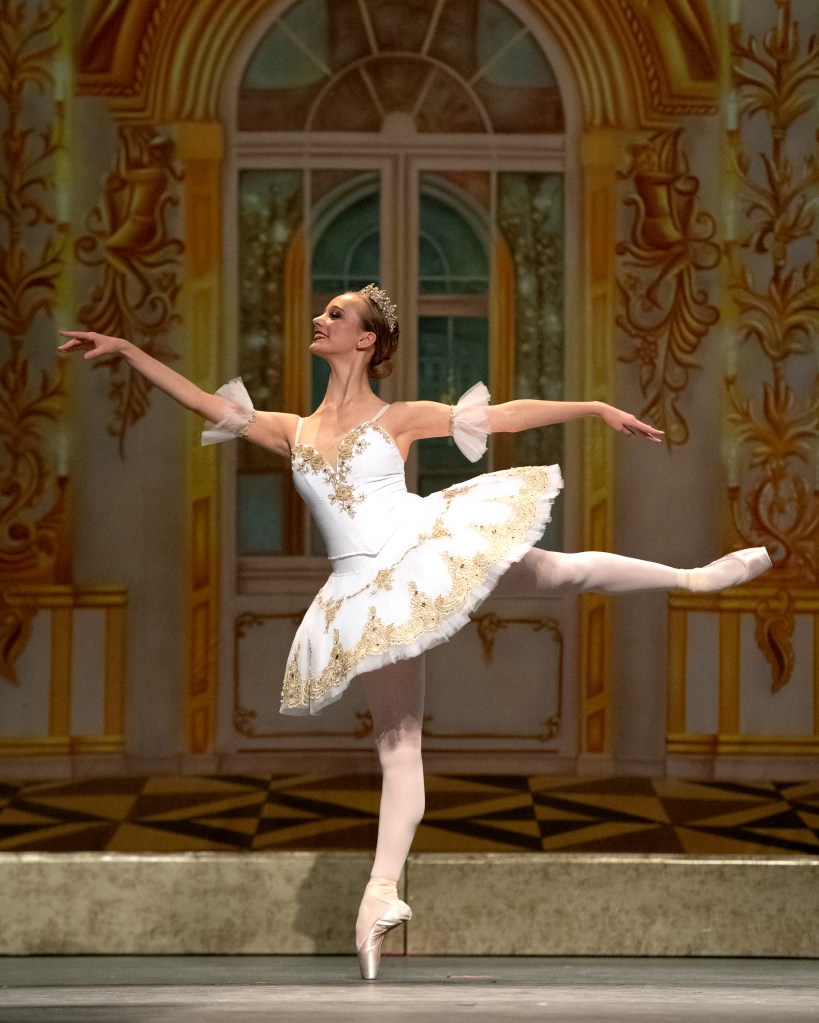
From Sleeping Beauty Photo by Chas Sumser Image Courtesy of Dahlia Denicore
Not yet 18, Dahlia, is a ballerina in every sense of the word. She says, “I love performing; telling the story and connecting with the audience on a personal level.” She bring a character to life through movement, expression, musicality, line, to the smallest tilt of her chin, glance of her eye, or reach of her finger.
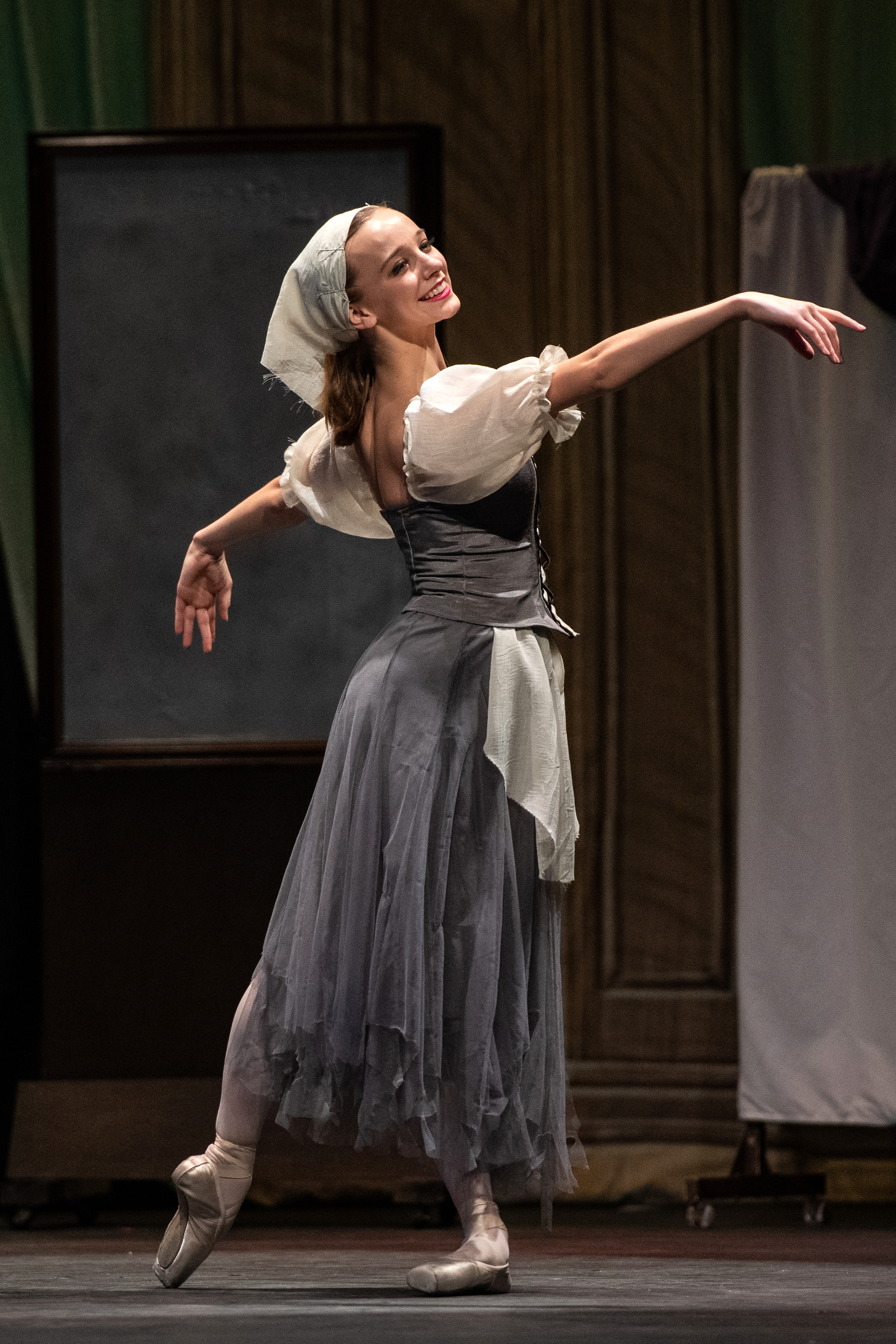
Cinderella photo credit: Chas Sumser Image Courtesy of Dahlia Denicore
Cinderella Photo by Chas Sumser Image Courtesy of Dahlia Denicore
Dahlia’s roles with the preprofessional ballet company have included most, if not all leading roles including Clara, the Sugar Plum Fairy, Cinderella, Alice, Snow Queen, Arabian Princess, and Odette. She has danced supporting and corps roles with the same enthusiasm and passion. She invests herself entirely.
Photo by Chas Sumser Image Courtesy of Dahlia Denicore
“What does it feel like on the day of a performance?” I asked Dahlia. She told me, “On show day, everything I do is for the show. I know that I am prepared. Yet, the excitement and the nerves are very real. I have a set pre-performance routine,” she told me. Interestingly, her warm-up and run through of choreography is not to the performance music, but to a completely different genre of music. “I love all music. I love jazz, pop, 80’s music. It inspires me,” she told me. “Before the performance, I go through barre and floor exercises. I work on my feet by rolling up and down and flexing and relaxing every joint and muscle. Then I put on my pointe shoes and again work my feet stretching, and rising and rolling, to get blood flowing. I keep practicing until the show.”
Staying focused is paramount for a successful and safe performance. In ballet, timing is everything. Pre-show, Dahlia relies on her ear buds to deliver music and keep her focused. Maintaining focus is a learned skill of ballet training. Dahlia explained that she listened to a phycology podcast about nerves, “I learned that people are nervous because they are afraid of being afraid. When I know that I am nervous, I accept it. I know that I will do what I love. Then, I feel my feet sink back into the ground. I visualize the performance and get lost in the story and the emotion of the moment.”
Before the curtain rises, “Roll-down sequences tell me it’s time to go. It wakes up my body,” she explained. Finally, positions and places and the music begins. “On stage, I am living it up! My nerves give way to my love and passion for the dance and pleasing the audience,” says Dahlia.
Asked about her character development, Dahlia explained, “I become that character. When I danced the Arabian Princess in Nutcracker, ‘I AM the Arabian Princess.’ I love to stay in the zone.”
Arabian Princess – The Nutcracker Photo Credit: Chas Sumser Image Courtesy of Dahlia Denicore
Staying focused is paramount for a successful and safe performance. In ballet, timing is everything. Pre-show, Dahlia relies on her ear buds to deliver music and keep her focused. Maintaining focus is a learned skill of ballet training. Dahlia explained that she listened to a phycology podcast about nerves, “I learned that people are nervous because they are afraid of being afraid. When I know that I am nervous, I accept it. I know that I will do what I love. Then, I feel my feet sink back into the ground. I visualize the performance and get lost in the story and the emotion of the moment.”
Snow Queen – Dahlia at age 15 Photo Credit: Chas Sumser
How do I know Dahlia? I am a crazy ballet girl who once danced with a burning passion and refused to settle for ‘good.’ Several years ago, my husband and I happened to be invited to fill stage space in a ballet production as ball guests. There was 14-year-old Dahlia, with the brightest genuine smile, the captivating eye contact, and the beautiful dancing. She caught my attention as someone going places. Because I happen to be friends with the company’s artistic director, I was pulled into way too much participation, but the result was developing a relationship with what the French would call, the “etoile,” Dahlia.
Dahlia repeatedly surprised me with her characters’ development, her emotional involvement, and her connection with the other dancers and the audience. There is a point where choreography ends and personal involvement takes over to reach to the back of the auditorium. How does one so young, accomplish something so difficult that many mature prima ballerinas lack? “I love acting. I have done some community theater. I love to tell the story,” she shared.
New York! Image Courtesy of Dahlia Denicore
In addition to performing with the preprofessional company, Dahlia has competed in the Youth America Grand Prix in Pittsburgh. She won the junior ballet division and competed in New York. This year she placed second in contemporary and in the top 12 in ballet. “I see myself more of a performer than a competitor,” said Dahlia. “In a performance, I tell the story. In a competition, there is very little time to develop the character. I have to bring the character with me and to bring it to life in the few minutes on stage.” She elaborated that competition is very helpful in developing her stage and dance skills . She loves the classes during the event.
In any given week, Dahlia will dance up to 40 hours. She takes class, has private coaching, and rehearsals every week. She is completing her first college year where she is earning top grades and excels in the sciences. While her time precludes her from acting in community theater, she stays involved by providing choreography for their shows.
In the Wings Photo Credit: Chas Sumser Image Courtesy of Dahlia Denicore
“How do you feel when a performance ends?” I asked her. Dahlia told me, “The most special part of a performance is the curtsey and audience appreciation. That day is high adrenaline and joyful. The following day feels like something is missing and somewhat sad. Yet, I try to stay hopeful and happy for the next performance.”
A Break From a Masterclass at Kennedy Center Image Courtesy of Dahlia Denicore
Dahlia has been studying ballet since she was two years old. In addition to her regular ballet and contemporary classes, she takes masterclasses with most of the major ballet companies that come to the Kennedy Center. She stands on the threshold of her professional career. She has received a number of offers from amazing ballet companies. In the summer she will be attending the San Francisco Ballet’s Summer Intensive program. She is evaluating opportunities for the coming year.
The “Dancing Denicores“ Images Courtesy of Dahlia Denicore
Dahlia is the oldest of three exceptional dancing children. She and her family live in the historic village of Waterford, Virginia where they have a fluffy dog, named Toby, a cat, a rabbit, and several chickens. Her younger sister, Daisy, is a beautiful ballerina, her brother, Tucker is an incredible singer and dancer who loves baseball and theater, although he has been “Fritz” in the Nutcracker for many years. Their mother, Amy, helps support the ballet company by sewing costumes, writing for grants, and getting the family fed. Their father, Mark, an attorney, is co-founder of Changing Latitudes, a non-profit organization focusing on education in Haiti where Dahlia has also worked during summer and spring break vacations.
Applause! “The most special part of a performance is the curtsey and audience appreciation. with Norbert Nirewicz Photo Credit: Chas Sumser Image Courtesy of Dahlia Denicore
Pansies, Henri Fantin-Latour, 1874, National Gallery of Art, Washington DC
“The world will surprise you with its grace,” is a line from a movie that I have watched many times. In today’s environment, this line has been brought to fruition in the most generous ways. We are all affected in how we move about, how we work, how we interact with friends and family, and how we entertain ourselves.
Detail of Frederick Edwin Church El Rio de Luz National Gallery of Art, Washington, D.C.
As in Sleeping Beauty, theater, music, art, dance, intellectually stimulating courses, and much of our in-person physical activities have ceased for the moment. However, the outpouring of generosity on the part of performers, museums, theaters, educators, and trainers have amazed me over and over. Sometimes I have blinked to be sure that what I was reading is true. And, so it is. We need grace and must exercise generosity now. We need the arts now more than ever. What better way to experience grace and generosity now?
Washington, DC
Westminster, London
Palais Garnier Paris
Louvre Paris
Royal Opera House London
Royal Opera House London
From Paris to Seoul, from London to Washington, DC , Florence to New York City, and from Harvard to Yale, and Princeton, along with many others, the best and greatest are sharing with us their best and greatest. We can nourish our souls (this is not a theological article) profoundly by a click on our computers . We can regroup. Perhaps this is our opportunity to explore, learn, reinforce, and discover the beauty of the arts. Our souls will be better for it.
Tea . . . Fortnum and Mason
Fortnum and Mason
Through my love for the arts, I feel like a kid in a candy store – where to go first – what to watch first?? Actually, I am feeling like I did on my first visit to Fortnum and Mason, “Must focus. Time is fleeting.”
Oliver Lee Jackson exhibition 2019 at NGA East Wing
The Lacemaker Johannes Vermeer
Allies Day, May 1917 Childe Hassah
A Young Girl Reading by Jean-Honoré Fragonard
To help make the most of our situation, I have compiled links to complimentary (some are pay what you can) videos from some of the world’s greatest resources. To these generous and gracious people and organizations, I give heartfelt thanks. Please remember them when times change and support them by become patrons, buying tickets, attending exhibitions, and buying future streaming services. They have gone above and beyond our expectations to feed our souls with beauty, creativity, adventure, and grace.
12 Museums offer virtual tours – from the Guggenheim and the Washington National Gallery of Art to the Uffizi, to the British Museum, London, and so many repositories of treasured art throughout the world
HBO provides movies, programs, and documentaries free to stream
Amazon Prime SXSW 2020 Film Festival – ““Prime Video presents the SXSW 2020 Film Festival Collection” offers filmmakers in the 2020 SXSW Film Festival lineup an invitation to opt in to take part in this online film festival, which will play exclusively on Prime Video in the U.S. for 10-days. The one-time event will be available in front of the Prime Video paywall and free to all audiences around the country, with or without an Amazon Prime membership, all that is needed is a free Amazon account.”















































 Good News. Reviews. Events.