The Real Macbeth:

Shakespeare’s Greatest Con Job?

So many theater lovers and English majors banter the name Macbeth. Murderer. Usurper. Tyrant. The ambitious thane manipulated by his evil wife into regicide and madness. We think we know the story. Do we?

Let’s unpack this myth and discover the deception.

Shakespeare was not writing history when he penned Macbeth around 1606. He was writing for his job security. The playwright understood his audience with surgical precision, and his most important audience member had just ascended the English throne three years prior. James VI of Scotland had become James I of England in 1603. Shakespeare needed the new royal patronage. The new Scottish king needed legitimacy on English soil.

The Match Made in Theatrical Heaven
The Historical Macbeth

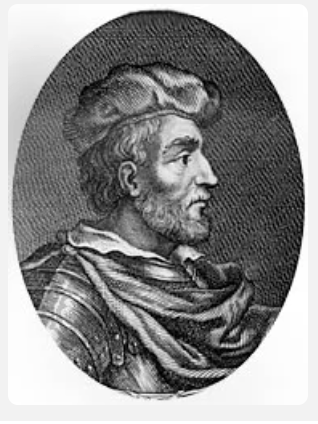
Mac Bethad mac Findlaích ruled Scotland from 1040 to 1057. That was seventeen years of stable rule in medieval Scotland. This was unheard of in the Scotland of the 1000’s where kings were routinely murdered, deposed, or challenged. Tyrants did not last seventeen years.

The historical Duncan I bears no resemblance to Shakespeare’s wise, elderly, benevolent king. The real Duncan I was young, weak, and foolishly aggressive. He invaded Macbeth’s territory of Moray in 1040. Macbeth slew him in the of Battle of Pitgaveny near Elgin. Warrior to warrior – an honorable death between combatants rather than the stabbing of an elderly sleeping guest in his bedchamber.

Macbeth possessed legitimate claim to the Scottish throne through his wife, Gruoch, granddaughter of King Kenneth III. Under the tanistry system of Scottish succession, Macbeth’s claim stood as valid as Duncan’s. Arguably stronger.

During his reign, Macbeth made a pilgrimage to Rome in 1050 to meet with the Pope – a pilgrimage possible only by a secure monarch. Chroniclers of the period recorded that he “scattered money like seed to the poor.” A guilt-ridden, paranoid murderer does not leave his kingdom for months to distribute charity abroad. Only a secure, prosperous, pious king would do so at the time.

The real Macbeth wore regal clothes. Shakespeare stripped them off and dressed him in villain’s rags.

Why the Lies?

Follow the money. Follow the power. This is how we uncover truth in any century.

James I needed several things when he took the English throne. He needed legitimacy, as a Scottish king ruling England was hardly popular with English subjects. He needed cultural acceptance. He craved flattery of his royal lineage. And he demanded entertainment that reinforced his divine right to rule.

Shakespeare delivered all of it with the precision of a master.

By making Duncan righteous and murdered, James’s ancestor became the martyred good king whose death must be avenged. By making Macbeth the evil usurper, anyone who would challenge rightful succession became damned by association. By making Banquo noble and prophesied to father a line of kings, Shakespeare flattered James’s other claimed ancestor as the hero whose bloodline fulfilled destiny. By adding witches and supernatural elements, the playwright appealed directly to James’s obsession with witchcraft. The king had written Daemonologie and fancied himself an expert on the subject. And by showing divine punishment for regicide, Shakespeare reinforced James’s claim to rule by divine right.

This was not art. This was propaganda dressed in iambic pentameter. Magnificent propaganda, certainly. Effective beyond measure. Propaganda, nonetheless.

The Matilda Connection

The bloodlines become truly fascinating when we examine how Scottish royal heritage eventually claimed the English throne.

After Macbeth’s death in 1057, Malcolm III assumed the Scottish crown. This is the “Malcolm” who defeats Macbeth in Shakespeare’s play, the son who avenges his father Duncan’s death. Malcolm married Margaret of Wessex, an Anglo-Saxon princess who fled to Scotland after the Norman Conquest of England.

Their daughter, Edith of Scotland, was born around 1080. When Edith married King Henry I of England in 1100, she changed her name to Matilda. The name sounded more Norman, more acceptable, less conspicuously Scottish to English ears.

This Matilda, born Edith, became the crucial bridge between kingdoms. Through her, Duncan’s blood flowed into the English monarchy via Malcolm III. Through her mother Margaret, descended from Alfred the Great, Anglo-Saxon royal blood joined the mixture. Matilda became the convergence point of Scottish and English royal heritage.

Matilda’s daughter, Empress Matilda, fought for England’s throne during the civil war known as the Anarchy. Her descendants became the Plantagenet kings who ruled England for centuries. The bloodline continued its steady march through history.

When Elizabeth I died childless in 1603, James VI of Scotland possessed the strongest claim to the English throne precisely because of these bloodlines. They traced back through the centuries, through Matilda the name-changer, through Margaret of Wessex the refugee princess, through Malcolm III the avenger, through Duncan the historical king Shakespeare would later slander.

James was not merely some Scottish king seizing an English throne. He represented the convergence of Scottish, Anglo-Saxon, and Norman royal blood meeting in one person. His legitimacy ran deep, and he knew it. He needed others to know it as well.

Shakespeare ensured they did.

A Small Digression

The Shakespeare 2020 Project founded by author, Ian Doescher, had a complete syllabus and timeframe for reading. I read and listened fast and thoroughly, then dug deep into historical relevance. I often listened to the plays while walking my dogs along the magnificent trails of parks and paths in my area. When I arrived at my ‘magiclands’ to find them closed due to the dread virus, I ushered the dogs back into their seats in my car and drove non-stop to a closer park. Furious, I decided that NOW was the time to hear Macbeth! Hear it, I did! We walked for the entire reading. When I returned to my book – I read it in its entirety with the readings still ringing in my ears. Yet, the play was enough. It did not send me on a single rabbit trail. I was too mesmerized by the psychological depth to worry about historical veracity. Until now, that it. Why? Nothing terribly intellectual – a short YouTube video addressing the very topic. I was hooked and the rabbit trail led me to rooms and rooms of pre-1000’s Scottish, English, and Norman history to the assertion of the throne by Macbeth.

What happened to King Macbeth? He was killed at the Battle of Lumphanan by Malcolm Canmore (later Malcolm III), son of Duncan I.

Why has Macbeth been an ill-fated play – sets fell, and actors died then theatrically referred to as simply “that Scottish Play?” Marginalizing and demonizing a past king? Lincoln quoted lines from Macbeth, “Out, out brief candle…” following the fall of Richmond on April 9, 1865. On April 15, 1865, SIX days later, he was assassinated by John Wilkes Booth who had played the title role in Boston two years earlier. Exactly who assassinated Lincoln? Booth or Macbeth?  Where is Macbeth’s reach?

Perhaps we should view all historical narratives with a skeptical eye. Whether from 1606 or from 2025, those who write the story control what becomes truth. Those who flatter power shape how the past is remembered.

The Lesson

I love Shakespeare for his poetry, his psychological insight, his timeless exploration of ambition, guilt, and the human condition. He was a genius wordsmith. In reality – he was a businessman, a survivor, a man who understood power and how to serve it while appearing to entertain.

Macbeth is splendid theater. The poetry soars across centuries. Lady Macbeth’s guilt, the dagger speech, “tomorrow and tomorrow and tomorrow” are extraordinary achievements in dramatic writing. The play deserves its place in the canon.

History? Not close.

The real Macbeth deserves better than four centuries of slander. He ruled well. He ruled long. He had legitimate claim to his throne. He was pious enough to pilgrimage to Rome and generous enough to scatter money to the poor. History should remember him as he was, not as Shakespeare portrayed him.

Politicians make promises. Playwrights craft myths. The winner writes history. The powerful control narratives.

Whether the emperor wears clothes or stands naked before us depends entirely on who holds the pen.

I like to see for myself.

Julius X – A Triple Treat

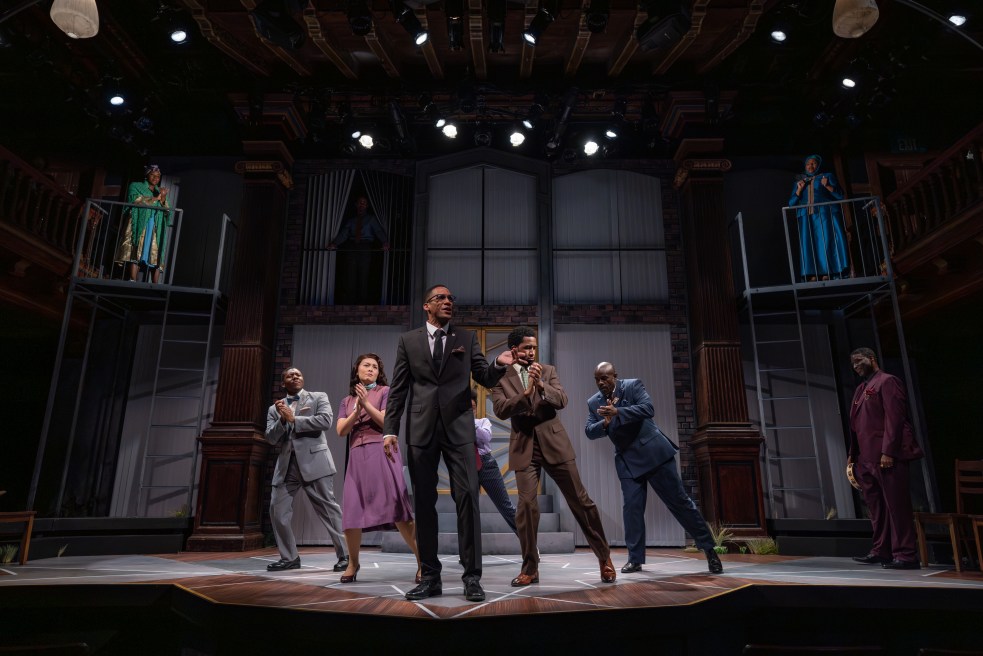
Playwright Al Letson PC: Amir Arsalan Shamsabadi on Unsplash Julius X Played by Brandon Carter

Julius X was born from rejection. When Al Letson was not cast as Mark Antony in a Julius Caesar production because of race, he decided, “Screw it, I’m going to write my own.” This was not bravado. It was love. He had fallen for Mark Antony’s speech in 10th grade and read Malcolm X’s autobiography in 7th. Both stayed with him. Years later, he realized Julius Caesar’s arc fit almost perfectly with Malcolm X’s life. This is how a dyslexic kid who learned to read through comics, a flight attendant who competed in poetry slams across America, an award-winning journalist and Shakespearean, spent over two years creating what is now playing at the Folger Theatre through October 26. I discovered Al Letson through Julius X.

Julius Caesar by William Shakespeare is a popular high school literature topic. How it is studied and how Shakespeare is presented often affects students for a lifetime. In Letson’s case, Caesar spoke to him. To others, it was just something to get through to close a chapter on high school English. I too studied Julius Caesar in high school. After my beloved Shakespeare teacher’s drowning the prior summer, I was uninspired to seriously pursue the play, and my new teacher was marking time. All was not lost for me. I read Shakespeare’s entire canon in five months in honor of my inspirational teacher’s 50th anniversary of his drowning and published a blog about him and Shakespeare. That blog remains the most read of all of my blogs. Julius Caesar was, of course, reread. This time with real interest.

In preparing to see Julius X, I opened my books once again. Marjorie Garber’s essay in her book, Shakespeare After All, and Paul Cantor’s Shakespeare and Politics lectures on YouTube helped me prepare. I then researched the life of Malcolm X. As a child, I remember hearing my parents discussing his assassination on the day it happened. The parallels between the two men are remarkable. Yes, they were different, however, their passion, their vision, and their boldness are indisputable.

Al Letson so aptly married the two tragic heroes by meeting their arcs, their mission, their loyalty, and their fire. Having prepared, I was happy to feel like a participant rather than a spectator. I felt the rhythm of the verses, the drive of the characters, the commitment to community of the friends, and the loving fear of the wives. Sitting close to the stage, I saw facial expressions shift with each revelation – what performers call rubber faces, the ability to communicate entire thoughts through the smallest movement. The wives were remarkable: Julius’s wife in her impeccable teal suit with braid detailing, Portia animated and desperate, both showing love and intuition that their husbands would not, could not, hear. Julius X is fast paced. There is no time to wallow or worry. Things happen quickly, and while the interpretation is impressive and surprising, being prepared was key to my Julius X journey.  I was enthralled rather than bewildered.

Harlem of the 1960s was not Rome. Rome was regal, authoritative, imperial. But Harlem was home—brownstones and street corners, community and belonging. Its residents cannot live in Harlem without loving it. Harlem was Malcolm X’s ‘Rome.’  It was intimate, not monumental. It was his world. He had a burning passion. He wanted more for himself, his family, and his people. A militant who reconsidered his path but never abandoned his passion posed a threat to his supporters. The key? Ambition.

Caesar is a pivotal character. He has been compared to Alexander the Great by Plutarch in his biographies, Parallel Lives, in approximately 110 AD, to being featured by Shakespeare in the Tragedy of Julius Caesar in 1599, to being analyzed by Paul Cantor in the 21st century, juxtaposing him between Coriolanus and Antony and Cleopatra, and now, to being reimagined as Julius X by Letson in the 2020s. Almost 2000 years have passed. There is nothing new under the sun. Ambition is considered threatening by those with opposing vision or small thinking.

Julius X is entertaining, thought provoking, classic, and unapologetically bold. Playing through October 26 at the Folger Theatre, it rewards preparation and challenges assumptions. Good that Letson was not pigeonholed as Mark Antony. You can buy tickets now.

All photo credits: Erika Nizborski and Brittany Diliberto.

A Room in the Castle – Ophelia’s Story

Lauren Gunderson’s brilliant re-imagining of Shakespeare’s “Hamlet” shifts the spotlight from the brooding prince to the women who orbit his world. In A Room in the Castle, Gunderson accomplishes in 85 minutes what Shakespeare took four hours to convey, creating an intimate portrait focused on Ophelia, her handmaid, Anna, and Queen Gertrude. Kaja Dunn’s elegant directing delivers a thought-provoking production. Gunderson was commissioned to write the play by the Cincinnati Shakespeare Company where it opened before it’s World Premiere on March 9, 2025 at the Folger Theater.

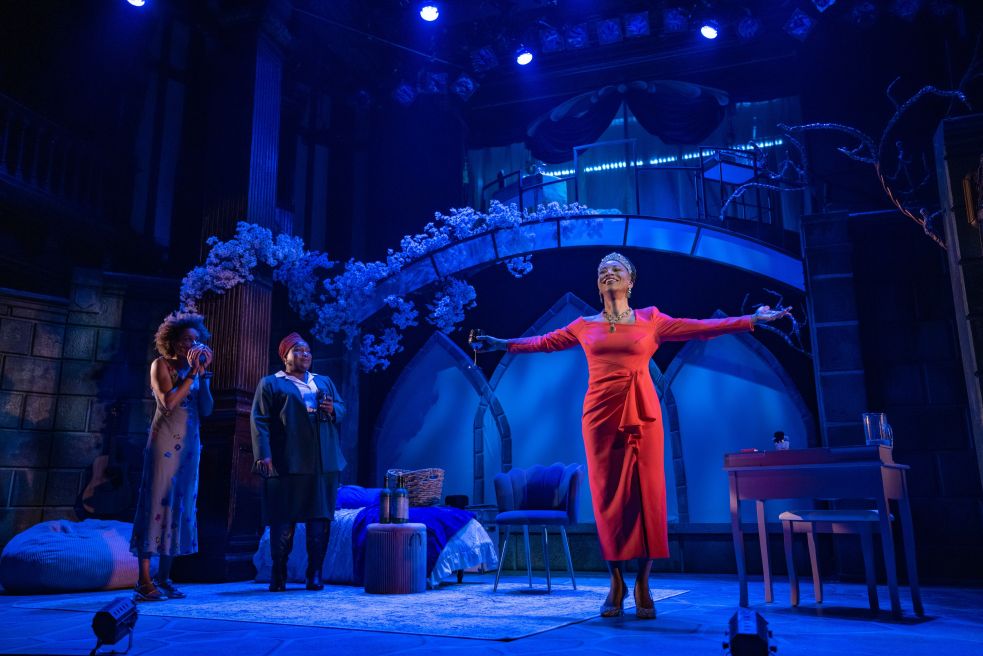
A Room in the Castle Dress Rehearsal 85:Sabrina Lynne Sawyer, Oneika Phillips, and Burgess Byrd in Folger Theatre’s world premiereof A Room in the Castle, written by Lauren M. Gunderson, directed by Kaja Dunn, co-produced with Cincinnati Shakespeare Company, on stage at the Folger Shakespeare Library, March4-April 6, 2025. Photo by Erika Nizborski

With only illusions to the narcissistic, gaslighting Hamlet of the original text, he is never seen. Not even the skull. Instead, we witness the story through the female perspective, exploring Ophelia as a motherless young woman navigating complex relationships and expectations. The production examines her circumstances: torn between her perceived love for Hamlet, her father and brother’s disapproval of him, Anna’s protective caution, and Queen Gertrude’s insistence on their marriage. Perhaps, it is “ . . .not to be.”

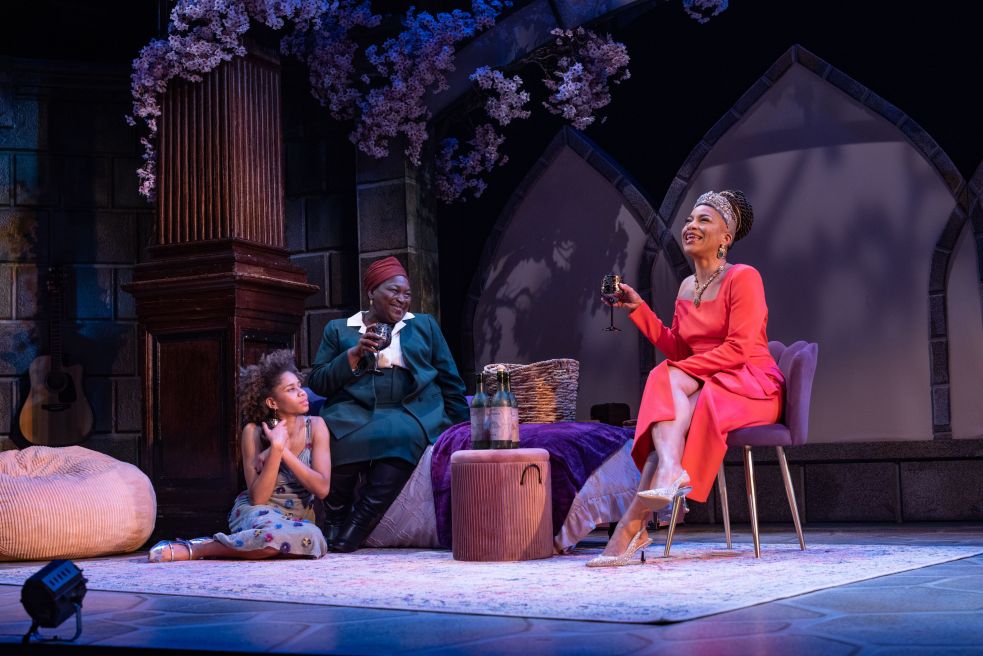
The all-female cast of three, delivers superb performances. Ophelia ( Sabrina Lynne Sawyer) emerges as a fully realized character – sometimes ambivalent, occasionally petulant, but ultimately autonomous. She is transformed from Shakespeare’s tragic figure into someone relatable in the 21st Century. Gertrude (Oneika Philips) commands the stage with regal confidence and impeccable dresses. Anna (Burgess Byrd) brings love and devotion to her role, having lost her own son and finding in Ophelia someone to mother and protect. Costume designer, Nicole Jescinth Smith’s costumes were visually stunning and spoke volumes about status and intent.

A Room in the Castle Dress Rehearsal 68: Oneika Phillips, Sabrina Lynne Sawyer, and Burgess Byrd in Folger Theatre’s world premiere of A Room in the Castle, written by Lauren M. Gunderson, directed by Kaja Dunn, co-produced with Cincinnati Shakespeare Company, on stage at the Folger Shakespeare Library, March4-April 6, 2025. Photo by Erika Nizborski

As we entered the Theater, I asked my guest and daughter, Tiffany, about her expectations of the play and to tell me her take on the original characters. Her immediate reply was that, “Hamlet was a madman, gaslighting Ophelia to her demise.”  I shared that I found, “Both whiny and that she was needy and ‘a few cards short of a full deck.” Tiffany expected see a play about strength and perseverance over narcissistic dysfunction.  I hoped that she was right and that after 425 years of waiting, Ophelia would find her voice.

The audience was greeted by the newly appointed director of the Folger Shakespeare Library, Dr. Farah Karim-Cooper, “I spent the last Twenty years of my life at Shakespeare’s Globe Theater in London. Over there, I was the resident scholar and director of education and research and it’s also where visceral performance informed all of my work, so I know something about theater.  This is why I can say that I’m so inspired by the compelling and inclusive vision that’s emerging from the culture of this theater and our artistic leader Karen Ann Daniels.”  

The intimate theater space enhances the experience, with its warm wood paneling, carved columns, and half-timbered walls – reminiscent of an Elizabethan setting. The set strikes an interesting juxtaposition between the now and then. When does this play take place? That really doesn’t matter.

A Room in the Castle Dress Rehearsal 93: Sabrina Lynne Sawyer, Oneika Phillips, and Burgess Byrd in Folger Theatre’s world premiere of A Room in the Castle, written by Lauren M. Gunderson, directed by Kaja Dunn, co-produced with Cincinnati Shakespeare Company, on stage at the Folger Shakespeare Library, March4-April 6, 2025. Photo by Erika Nizborsk

What makes this production special is that it honors Shakespeare’s world while boldly asking, “why not?” As Gunderson herself stated, “The play dances and duels with Shakespeare’s Hamlet, foregrounding the women in the play and re-imagining them with agency, vitality, and radical hearts eager for a new ending,… ripping a hole in the fabric of their suffocating story… because this play is anything but hopeless and tragic.”

There were frequent laughs and knowing sighs of recognition from the audience. While I won’t reveal the ending, I can say that it offers a satisfying conclusion to Ophelia’s journey. “A Room in the Castle” proves that sometimes the most interesting stories are found not with the titular character, but in the castle’s side chambers where the women speak their truths. “Obey, Agree, Assist?” How about “Rebel, Reject, Resist.”

A Room in the Castle Dress Rehearsal 91:Sabrina Lynne Sawyer, Burgess Byrd, and Oneika Phillips in Folger Theatre’s world premiere of A Room in the Castle, written by Lauren M. Gunderson, directed by Kaja Dunn, co-produced with Cincinnati Shakespeare Company, on stage at the Folger Shakespeare Library, March4-April 6, 2025. Photo by Erika Nizborski
A Room in the Castle Dress Rehearsal 87:Sabrina Lynne Sawyer, Burgess Byrd, and Oneika Phillips in Folger Theatre’s world premiere of A Room in the Castle, written by Lauren M. Gunderson, directed by Kaja Dunn, co-produced with Cincinnati Shakespeare Company, on stage at the Folger Shakespeare Library, March4-April 6, 2025. Photo by Erika Nizborski

Perhaps the most enduring power of Shakespeare lies not in the answers his works provide but in how each generation finds its own questions within them. Through my daughter’s unflinching modern lens, I watched not another classic Hamlet, but a study in how Ophelia finally gets the chance to exist beyond being defined by the men around her.

A Room in the Castle Dress Rehearsal 93: Sabrina Lynne Sawyer, Oneika Phillips, and Burgess Byrd in Folger Theatre’s world premiere of A Room in the Castle, written by Lauren M. Gunderson, directed by Kaja Dunn, co-produced with Cincinnati Shakespeare Company, on stage at the Folger Shakespeare Library, March4-April 6, 2025. Photo by Erika Nizborski

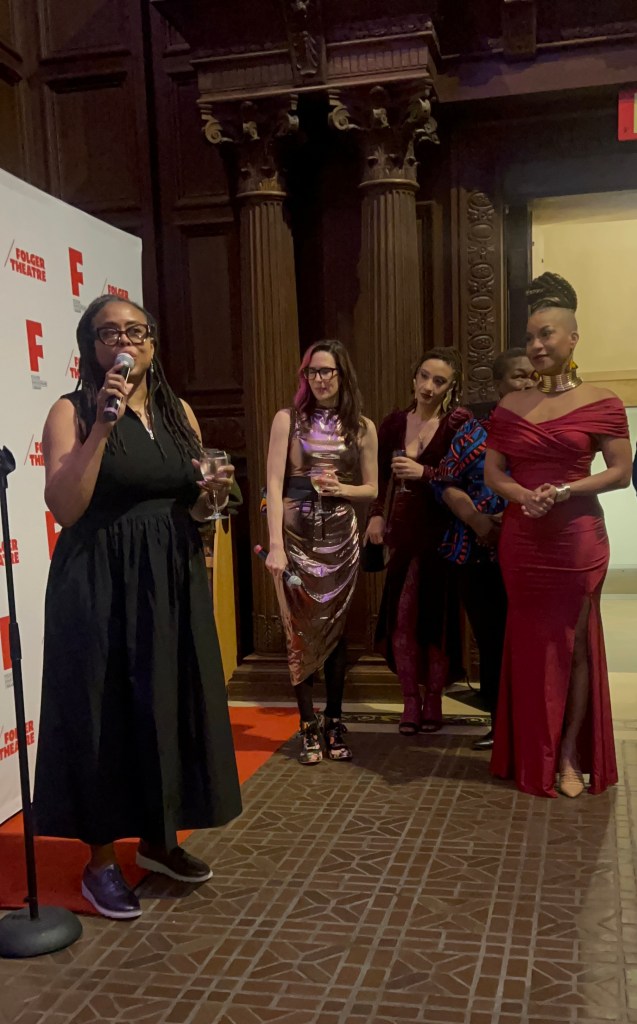
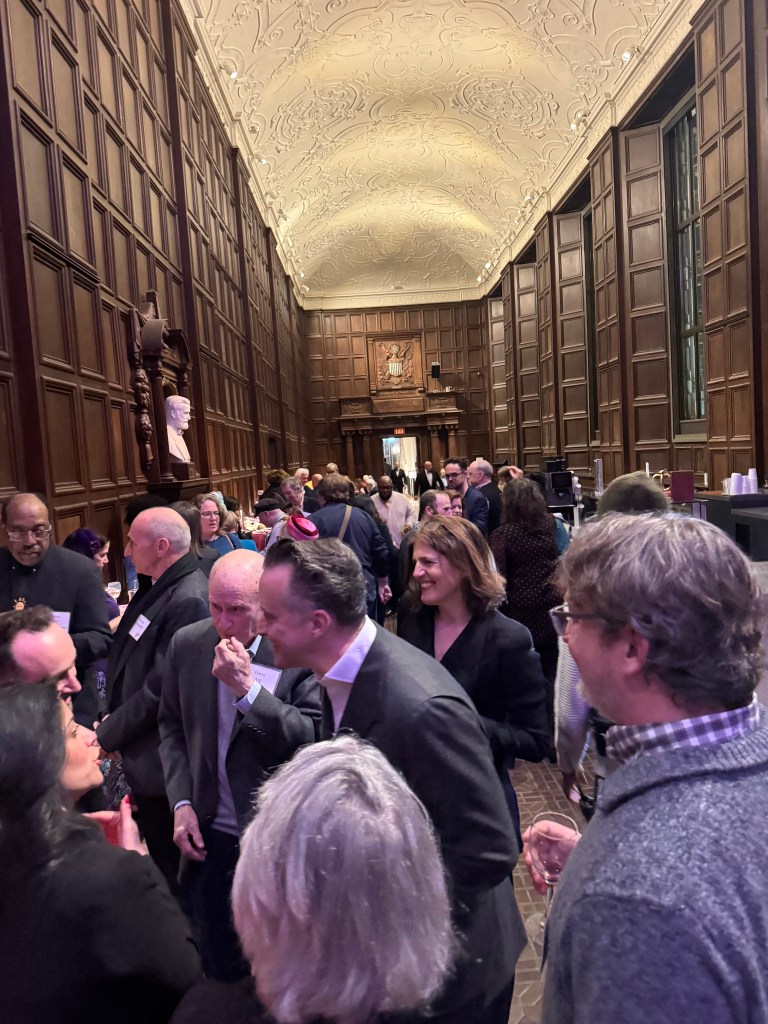
The cast, production team, and Folger staff greeted guests in the Great Hall for an elegant and enjoyable reception. Keeping with the woman theme, DJ, Miss H.E.R., provided invigorating music at the perfect volume for conversation. The reception gave us an opportunity to express our gratitude for the many levels of remarkable talent and work and to share snippets of insight and surprises.  Meeting Dr. Karim-Cooper and Lauren Gunderson was an unexpected pleasure. Their generosity of spirit and depth of intellect and dedication to the Folger was inspiring.

The depth of intellect, knowledge, and commitment to both the production and the Folger Library Theater could have been overwhelming had not everyone been incredibly hospitable, responsive, and gracious.

Playwright Lauren Gunderson shares her creative process PC: Henkel

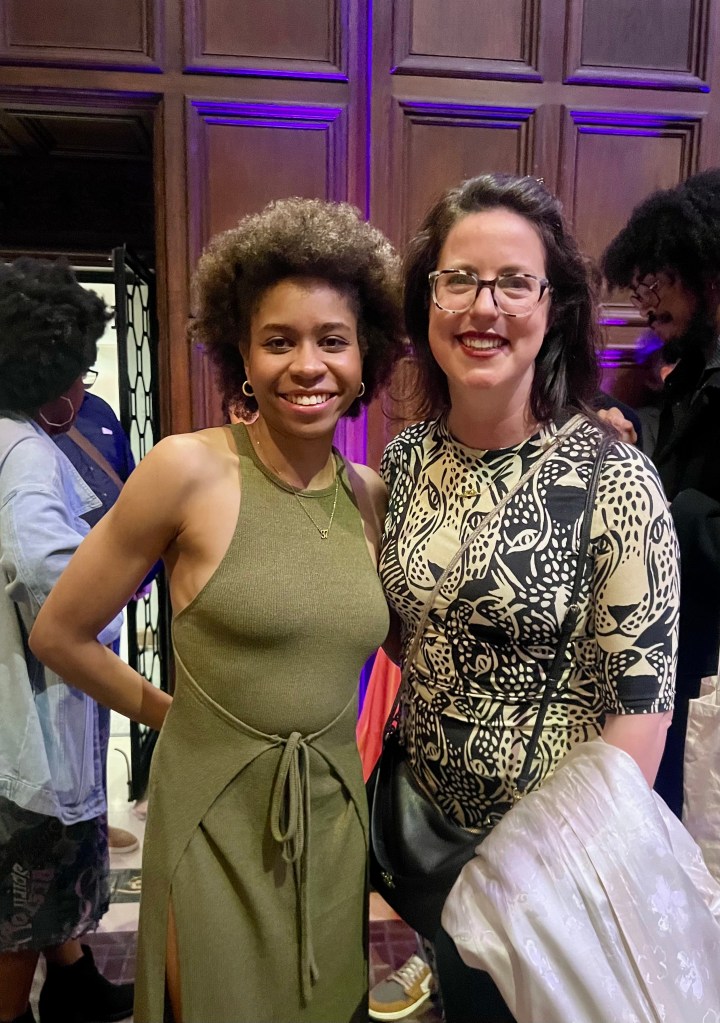
Meeting the cast, Sabrina Lynne Sawyer – Ophelia, and Oneika Philips – Gertrude gave additional focus to the characters. Sabrina is entirely invested in Ophelia. She wanted Ophelia to be liked and appreciated. When I shared my original opinion and how her representation changed my mind, she gave me a genuine hug and thanked me for being flexible and seeing the other side. Oneika, dressed in another stunning gown, this time in scarlet, carried herself as the regal queen that she portrayed. She was born to be the Queen. She complimented costumer, Nicole Jescinth Smith’s vision and impeccable attention to detail. Burgess Byrd and I managed to always be on opposite sides of the Hall – my compliments to her for bringing palpable warmth and love through her talent.

Top: Kaja Dunn, Lauren Gunderson, Nicole Jescinth Smith, Oneika Philips, Burgess Byrd Right: Lauren and Nicole Bottom Left: DJ MissH.E.R. Bottom Center: the Great Halls Bottom Right: Sabrina Lynn Sawyer and Tiffany Henkel PC: Henkel

I want to thank The Folger Press Secretary, Colleen Kennedy, for her generosity for allowing me to participate in this momentous event.  I hope that this Blog will pique your interest to see this play. You will be glad that you did.

This delightful production plays until April 6 at the beautiful Folger Theater in Washington, DC. Tickets are limited. Don’t miss this chance to watch this modern production and see Ophelia in a new light. Click here for tickets

Colleen Kennedy, Right, with Krasi Henkel PC: Henkel

The Best Percolates to the Top

Ann Lowe, Couturier to the Social Register

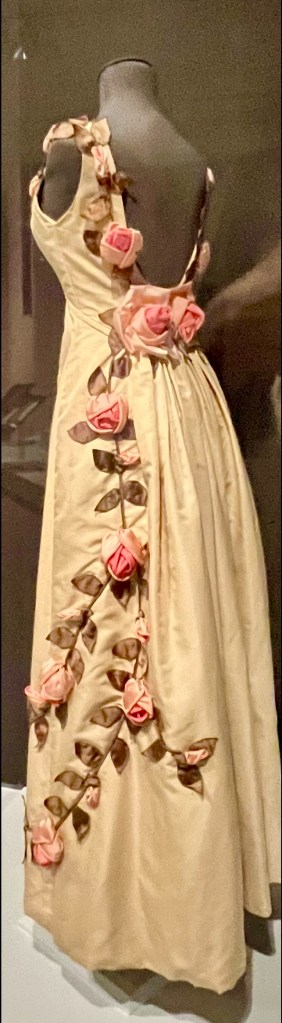
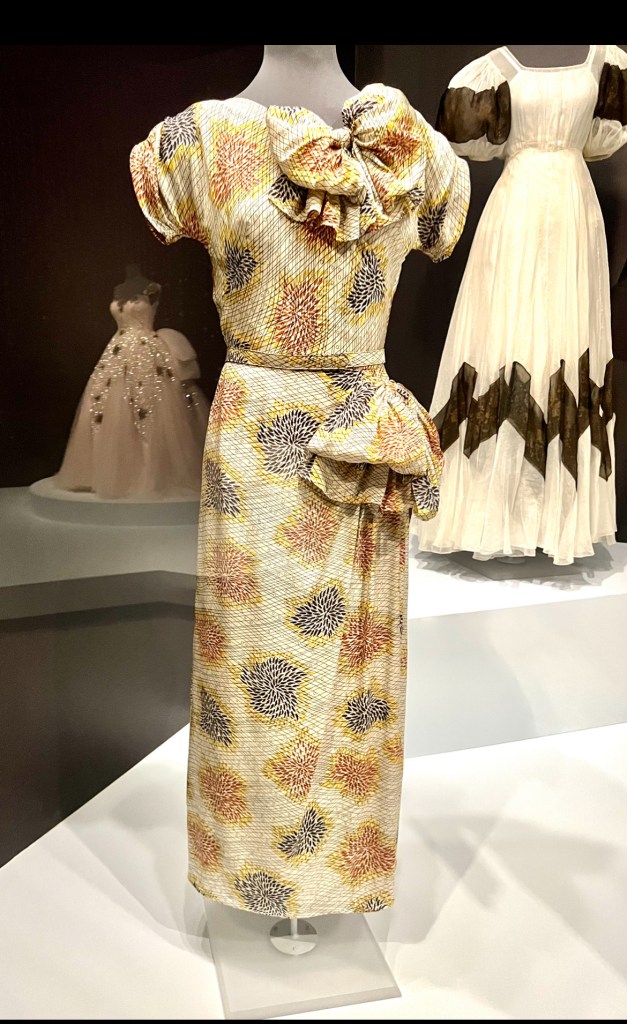
Silk flowers cascade down the back of a silk shantung evening dress. A pink tulle gown shimmers with sugared beading. A satin gown is overlayed with lace; adorned with a matching satin bow. These describe just three of the myriad beautiful gowns and dresses designed by African American designer to the Social Register of the 20th Century, Ann Lowe.

In 2023, the Winterthur Estate Museum and Library put on an incredible exposition of the work of Ann Lowe. One visit was not enough so I went two more times. Each time, I brought a different friend to share the luxury and elegance of the exhibit. Each friend saw new and interesting details that helped me “see through their eyes.”

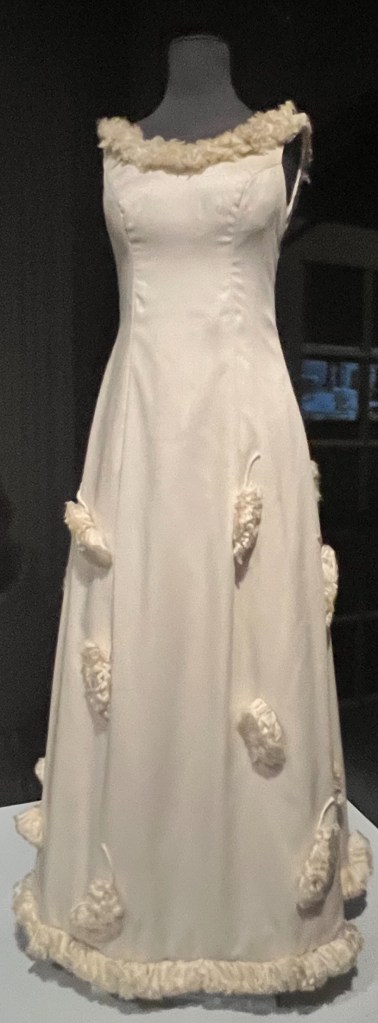
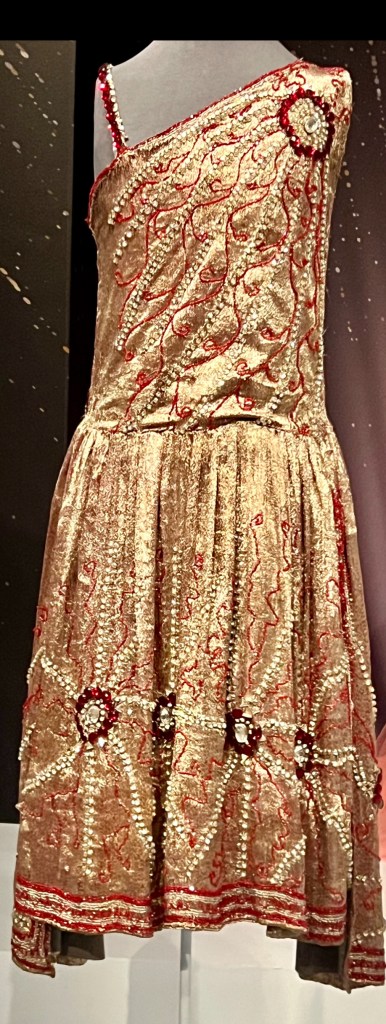
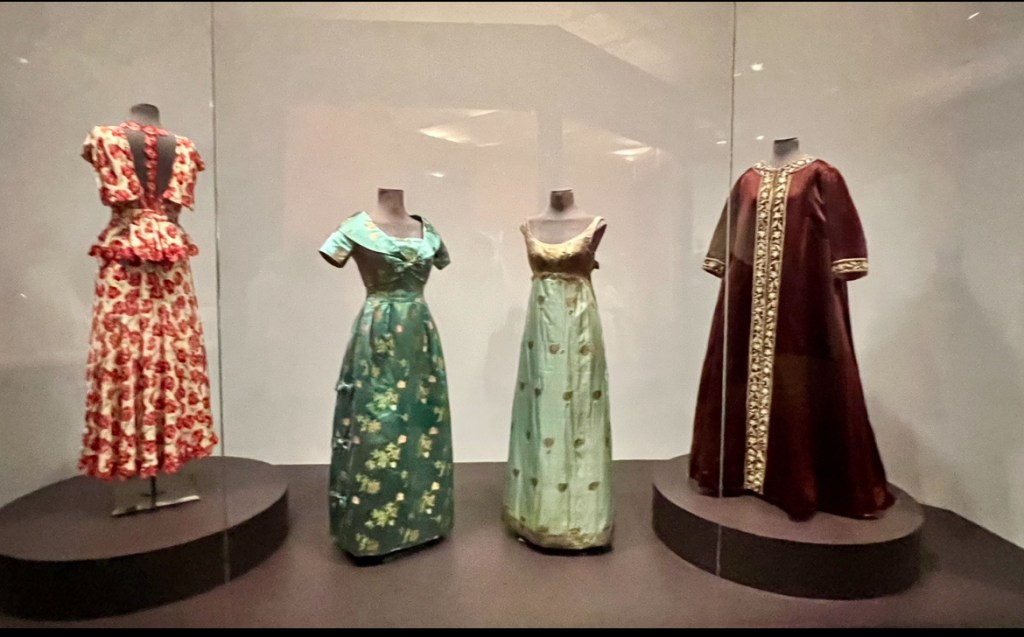
Debutante gowns, wedding gowns, ball gowns, cocktail dresses, daytime suites, sparkled and shimmered with embellishments or simply by the drape of the carefully chosen fabric. The exhibit was a visual delight and a marvelous peek into society dressing at a time I could not have personally observed. That time was replete with luxury, texture, design, and sublime style.

The time, while immersed in style and luxury for the fortunate few, was a time of “equal but separate,” some sat in the back of the bus while others wore their couture suites in limousines. It was “normal” to take the best work of the back of the bus people and revel in the glitter of the times. One such couturier was Ann Lowe. She was the “colored woman,” whom Jackie Kennedy “credited” for the creation of her wedding gown. In 1947, Elizabeth Arden took credit for the debutante gowns of Jackie and her sister, Lee Bouvier.

A gray silk ball gown worn by Marjorie Merriweather Post has been attributed to Ann Lowe; previously listed as an unidentified seamstress. In her portrait, Ms. Post wears the dress adorned by her own sapphire and diamond brooch. The scholarship indicates that the dress was hastily created for a portrait sitting and was never quite finished.

Ann Lowe was a favorite designer of Janet Auchincloss, mother of Jaqueline Bouvier (later Kennedy). She commissioned Jackie’s wedding dress. Jackie attended several fittings with Ann. The “Ann Lowe” label was sewn into the back of the gown. Jackie claimed that it had been made by, “A colored woman.” Jackie disliked the dress and asserted that she felt like she was wearing a “lampshade.”  The subject of Jackie’s wedding dress has been addressed in countless articles and documentaries.

This is not about color or gender, but about humanity and the erasure of “insignificant” people, be it artists, composers, authors, and couturiers. A female African American was a double whammy. Winterthur’s exhibit has shed light on the amazing life and talent of Ann Lowe – her vision, passion, and dedication.

The exhibition was a “memorial and tribute to the life and legacy of Ann Lowe as an American couturier, marked by Winterthur with the largest exhibit of Ann Lowe’s work to date.” (From Preface by Alexandra Deutsch, John L. And Marjorie P. McGraw Director of Collections Winterthur Museum, Gardens, and Library – Book Ann Lowe American Couturier by Elizabeth Way).

The exhibit, per the book, “traces the evolution of Lowe’s long career, persuasively building a history of a remarkable and influential American designer who deserves a firmly established place in the canon of American fashion.”  She created fashion from 1910 through the 1960s. Lowe serves as more than a fashion designer. “She becomes a window into the lived experience of a Black designer navigating a career from the Jim Crow South and to the metropolis of New York City…  Through the extensive scholarship of Margaret Powell, the exhibit came to life and to the consciousness of visitors of the 21st Century.”

Photo taken of exhibit display – part of article in Saturday Evening Post, 1964

Ann Lowe was “Society’s Best Kept Secret,” according to a 1964 article in the Saturday Evening Post.  Her designs were inspired and unusual. Her dresses sold immediately, and commissions included wedding and debutant gowns, among others. Her passion remains palpable. An ex-husband of Ann’s  complained that she was “forever jumping out of bed to sketch a dress.”  Driven by her vision, she was quoted, “I feel so happy when I am making clothes, . . . that I could jump up and down with joy.”   

An Ebony article quoted Ann saying of herself that she was “An awful snob. I love my clothes and I am particular about who wears them. I am not interested in sewing for café society or social climbers…. I sew for the families of the Social Register.” She herself was listed in the National Social Directory; an annual publication used by members of the Social Register.

In Paris, when Marjorie Merriweather Post and Lowe attended the same fashion show, Post introduced Ann Lowe as the “Head of American House of Ann Lowe.”  Ann was not entirely without recognition. Saks Fifth Avenue recognized Ann in their advertising, although left off her name from their couture labels.

Lowe created “wearable” clothing. Gowns were constructed to be easily and comfortably worn with complete and appropriate underpinnings. The wedding gown that she created for Jackie Kennedy was one such garment. The directions of pleating, the pleat sizes, the placement of sleeves, the attachment of the skirt, and the built-in undergarments made it easy for Jackie to casually “float” in her gown on her historic day.

Lowe visualized then created amazing embellishments from shaded silk roses to impeccably dyed feathers. Vines, grapes, bows, and flourishes embellished bespoke gowns.  She created velvet roses for a debutante gown. Her beading work was unsurpassed.

In the mid 1960’s, for concert pianist, Elizabeth Mance, Lowe created a blue satin with lace “concert dress.”  The lace was cut to “mold to the silhouette” of the pianist. Since she would be visible on stage from the side, Lowe created the gown’s focus to be off center facing toward the audience. Additionally, the lace placement was such to allow for comfortable sitting for the pianist. Her vision and attention to detail were unmatched. The careful placement of crystals and lace created sparkling illusions without detracting from the pianist or her performance.

Finances were not Ann Lowe’s forté, and although she managed to stay “afloat,” in her final years she experienced difficult financial circumstances as well as the loss of her eyesight. The IRS closed her business for back taxes. Lowes believed that Jackie Kennedy paid that debt for her. Friends at Henri Bendel and Neiman-Marcus loaned her money to keep operating. Her life was focused on creating, designing, and executing her passion. Her clients’ events were elevated by their couture choices.

Before the Winterthur exhibit, I had only seen photographs of Jackie Kennedy in her wedding gown and viewed the actual gown at the Kennedy Library in Boston. That was the extent of my view of the “American House of Ann Lowe.” It is with gratitude that I write this blog to bring additional note and attention to a woman who was mostly “erased” during an “era” of our history. Ann Lowe continues to inspire fashion.