

Loudoun Fairfax Hunt Opening Meet

Huntsman Jeff Woodall leads hounds
The Loudoun Fairfax Hunt “opening meet” on November 2 marked the official start of the fox hunting season. A “stirrup cup” to toast to the season welcomed riders and all guests. The meet was held at Overbrook Farm, the club’s hunt property, in Hamilton, Virginia.


Steffanie Burgevin Serves A stirrup cup Jon Henkel serving with Paul’s tray Bervely Dickerson serves apple cider
Fox hunting on horseback is a heart-racing, sport where good riding skills and instincts are key. The goals of the hunt club are camaraderie, sport, and the preservation of open land. The goal is not to kill the fox but to view it. A good view feeds week-long conversations, stories, and delight.


L: A whipper in ready at the position, Center:Kate Dendinger and Rita Caseman, R: Lawrence T. Dale, MFH and Mrs. Carroll Galvin (Nadine)
The pageantry is poetic, but the autumnal landscape takes one’s breath away. There Is nothing more delightful and invigorating than riding along a ridge engulfed in autumn color and feeling the brisk fall air across the cheeks.


Turnout is an important part in the pageantry of Opening meet – MFH Carroll Galvin’s Horse is study in refined braiding and turnout
The horses were cleaned, bathed, clipped, and braided to be at their absolute show best. They understand and feel the excitement. They too, have friends in the hunt field. It is not uncommon to hear stablemates call for each other when they separate.
Stirrup cups of sherry, whiskey, port, and apple cider were served on elegant wood trays crafted by Master Paul Ritsema. Beyond tradition, the stirrup cup gives just the right warmth and ‘confidence’ with which to commence the ride.

Lining up five horses with ears forward is a challenge – the rider-horse connection works miracles
The hunt protocol is simple – good manners, proper dress, well behaved horses. The members of the hunt and their guests dressed in “formal attire” – gentlemen who are members with “colors” wore scarlet coats and the ladies with colors wear black or navy blue. Color members reflect their club affiliation by the ‘colors: on the collars of their coats. The Loudoun Fairfax colors are yellow/gold. Coats display the club’s buttons. With LH monogramed.


Master of the Hunt: top L: Paul Ritsema. top C: Michael Harper. R: Mary Sell. Bottom: Dr. Carroll Galvin
Members who do not have colors wear black. Breeches are buff, beige, or canary. Of course, proper safety helmets are a must. The tall black dress boots are polished to a gleam. Showing wear on boots denotes avid hunting but polished and clean.
The attire and horse turn out are not only for show, but to honor and respect the landowners who permit the sport on their farms. Having 20-40 horses gallop on one’s farm is a big deal for which the hunt is grateful and very respectful.


Larry Campbell Brooke Rogers Hannah Rogers
Fox hunting is a centuries old English sport that is steeped in tradition and protocol. Proper manners, proper ‘turnout” for both horse and human are expected. Tradition dictates clean and simple, in every aspect. Besides attire, horse tack and equipment consists of plain flat brown bridles, martingales, simple saddles, well fitted saddle pads, laced leather reins (although progress in technology has loosened this). The simplicity of design also helps in the cleaning of mud-caked tack after a rigorous hunt.


A great hunt horse will be relaxed, calm, and attentive as demonstrated by Paul Ritsema’s relaxed mount, Twins – Heather and Lisa’s horses who accommodated hugs and photos; Carrol Galvin’s horse who took the cast off in stride.
To be deemed a hunt horse, a horse has been trained to professional standards for obedience (HALT is the foremost order), agility, respecting the hounds and giving them priority – never kicking. In addition, the hunt horse must have strength and stamina to comfortably go for up to four hours. Some days the hunting is slow, others days, the fox give good sport that everyone rips through the countryside. Even on the fast days, there is order and decorum. Once they are credible hunters, the training continues with reinforcement. We ride animals of prey, creatures with a flight instinct. Our calm leadership builds their trust which keeps us safe, most of the time.
Having hunted the beautiful Loudoun territory for nearly 20 years, I write from experience albeit a bit wistfully. To be able to fully enjoy the sport of fox hunting, a steady, responsive horse is necessary. I had the privilege of having the golden horse who learned hunting quickly and was remarkably adept and obedient. At a downhill gallop, there is no time to negotiate with a horse. When she passed away, try as I might to find another suitable mount I repeatedly wound up with and collected dressage horses. After the third one, I determined that it was a message to stop hunting.

The Hilltoppers follow Master David Moyes in front of the Overbrook Club House
Master (MFH) David Moyes welcomed the riders and asked Huntsman, Jeff Woodall, to ready the hounds. Dr. Carroll Galvin, MFH, expressed gratitude to the landowners for their generosity.


Members relax after the morning’s ride, sharing stories and laughter over the Hunt Breakfast at Overbrook Farm. Top R: Dr. Kathy Stern and Lawrence T. Dale, MFH; Middle L: Twins Heather and Lisa; Paul Ritsema, MFH and Grill Master; Rita Caseman and Steffanie Burevin; L; Master Lawrernce T. Dale; Bottom Row: David Moyes, MFH (profile); Old hunting buddies – Krasi Henkel and Joseph Keusch
The warm temperature made scenting difficult for the hounds and the riders returned after a few hours of sport to enjoy an opulent hunt breakfast and camaraderie. The horses were watered and comfortably eating hay in their trailers while the riders happily retold their riding and fox-viewing adventures.
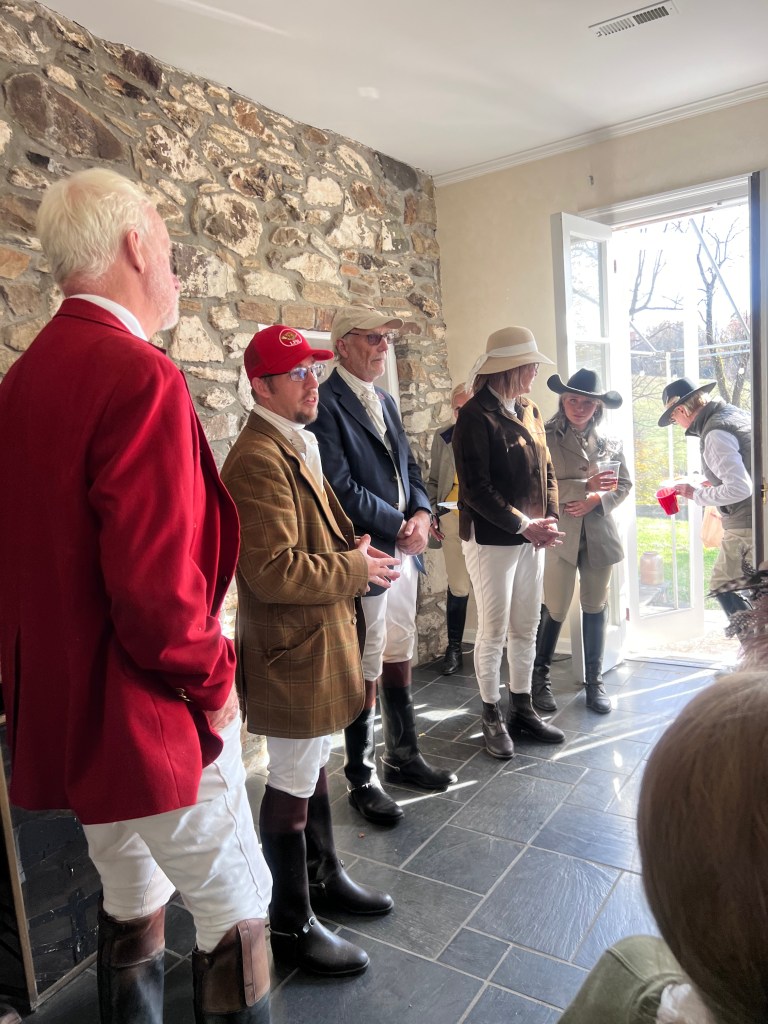

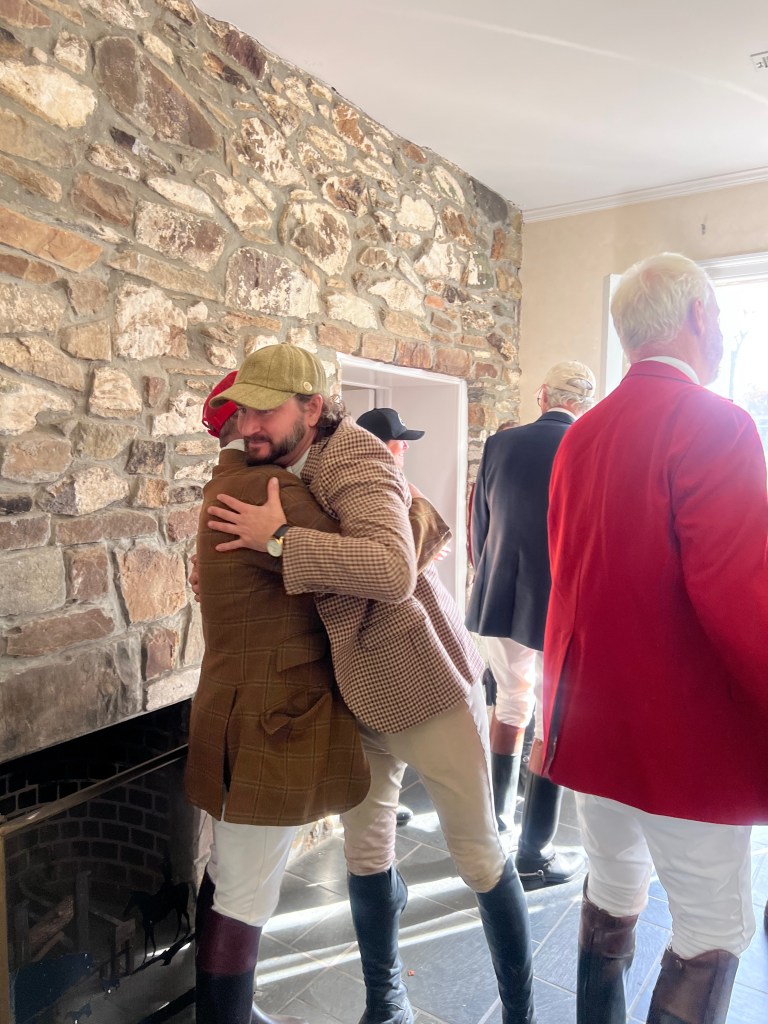

Russell Shifflet and Andrew Camp receive their Colors from the Master of Loudoun Fairfax Hunt in recognition of service to the Loudoun Fairfax Hunt.
At the Hunt Breakfast, two industrious and generous members were awarded their Colors. Russell Shifflet and Andrew Camp were recognized for their tireless work on helping clear trails and jumps, helping with social events, and working on the Hunter Pace, the Point-to-Point races and at the Hound Show. Getting one’s colors is a significant milestone in one’s fox hunting career. As Color Members, the gentlemen will sport scarlet coats with the club colors on their collars as well as the buttons of their coats will be engraved with the club’s initials. It is indeed a high honor and well deserved. As in all social clubs, it takes everyone’s contribution to reach success.
The beauty of the hunt club is that whether one rides or not, the social gatherings and friendships do not disappear. The 2025/26 season opened on a brilliant November morning. There will be a subsequent hunt for the Blessing of the Hounds, and a Hunt Ball will be held at the Birkby House before Christmas.

Rows of trailers
Have you dreamed of riding with the hunt? There are many ways you can accomplish that if you already ride well. A call to the Masters for permission to ride might be all that is needed. If you are a beginner, there are outstanding training facilities for you and your horse. My advice: do not risk being hurt if you are not a secure rider, and your horse is not up to the job.
Though my hunting days are behind me, my heart still leaps at the sound of the horn and the sight of the field setting off into the morning mist.

The stars of the hunt: the hardworking, obedient, and lovable hounds of the Loudoun Fairfax Hunt
Hounds go out on Fridays and Sundays. We encourage juniors and guests to join us and experience the thrill of our sport. We are always happy to see new faces in the hunt field! Information on capping can be found here.


 Good News. Reviews. Events.