

Ibsen’s Rarest Masterpiece Flies Through Moral Fog


Robert Stanton as Håkon Werle and Mahira Kakkar as Mrs Sørby in The Wild Duck. Photo by Hollis King
Looking for the garage exit elevator into Klein Theatre last Thursday evening, I met Angela Lee Gieras, Executive Director of Shakespeare Theatre Company, She accompanied me in the correct elevator to the main lobby where she introduced me to Artistic Director Simon Godwin. Shaking my hand, he offered quiet advice that stirred my curiosity, “This might be the only and last time you will see this play in our lifetime.”
That alone should compel you to see Henrik Ibsen’s The Wild Duck before it closes November 16.
Unique and Complex
Henrik Ibsen (1828-1906), often called “the father of modern drama” and three-time Nobel Prize nominee, built his reputation on explosive social critiques—A Doll’s House, Ghosts, An Enemy of the People—plays that attacked the hypocrisies of 19th-century society. In The Wild Duck, considered by many to be his finest work, he turns his sharp eye inward. Here, he draws from his privileged Norwegian family. Ibsen created Gregers Werle, the idealistic crusader determined to expose truth at any cost. This was inspired by members of his own patrician class. He named his young duck-loving heroine, Hedvig, the same name as his grandmother.
The play is complex. Understanding the author’s circumstances, background, and character, helps hold the ‘color’ of the play. In The Wild Duck, Ibsen was not attacking society’s lies. He was attacking the idealism of his family and overeager reformers. The question is not whether we should seek truth, but whether forcing truth on others is salvation or destruction. That moral ambiguity is perhaps, why this masterpiece has been performed so rarely.

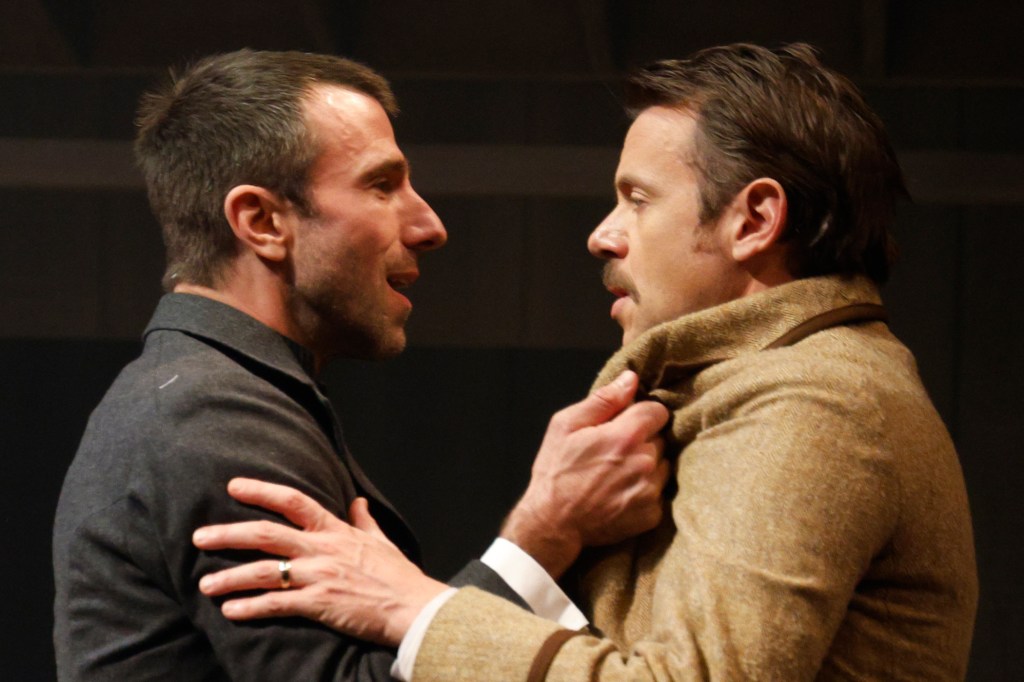
L. Alexander Hurt as Gregers Werle, Robert Stanton as Håkon Werle in The Wild Duck. Photo by Hollis King. R. Alexander Hurt as Gregers Werle, Nick Westrate as Hjalmar Ekdal in The Wild Duck. Photo by Gerry Goodstein.
Nothing Is As It Seems
Simon Godwin’s production, adapted by David Eldridge, opens with Victorian elegance—men in tails, ladies in ornate gowns, an elaborate dinner party. The set is bathed in shades of green. A small, grey-bearded man vanishes through a green door then reappears. He resembled a quintessential leprechaun though the play is set in Norway. He is the disgraced nature-loving Lieutenant who raises then hunts and shoots rabbits in his son’s loft. His son has embarked on a mission to restore his father’s honor.
The production is punctuated by haunting musical interludes—Alexander Sovronsky performs arrangements of 19th-century Norwegian folk and classical music on viola, Hardanger fiddle, and langeleik. Like the narrators in Shakespeare’s plays, the music shifts between melodic reflection and foreboding darkness, guiding us through the play’s emotional terrain.
As Godwin notes in the program, Ibsen is asking something far more dangerous than honor: “In the battle for moral certainty, who is the casualty? What is the price of truth?”

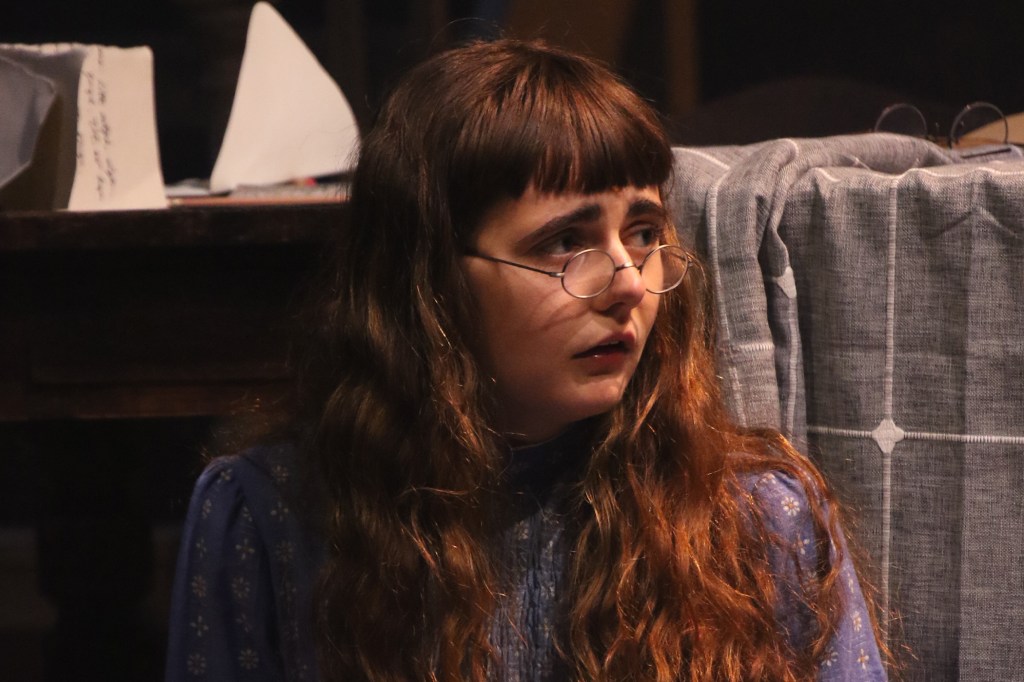

L. Melanie Field as Gina Ekdal Center: Maaike Laanstra-Corn as Hedvig R. Maaike Laanstra-Corn as Hedvig, Melanie Field as Gina Ekdal in The Wild Duck. Photos by Gerry Goodstein.
The Typhoid Mary of Idealism
The wealthy idealist, Gregers Werle, ‘knows’ what is best for everyone. He spreads his convictions like contagion—what I describe as ‘Typhoid Mary’ in Victorian tails – delusional in his certainty that he is saving everyone by forcing them to face “truth.”
Ibsen was intimately familiar with this character. Ibsen belonged to Norway’s patrician elite, and The Wild Duck draws from his own family’s dynamics as they navigated the evolution of society. Gregers embodies the dangers of Ibsen’s own class—reformers who wield truth as a weapon.
What happens when someone appoints themselves the arbiter of others’ honesty? When does truth-telling become destruction? The answers are not simple. This is perhaps, why this play has been performed so rarely.

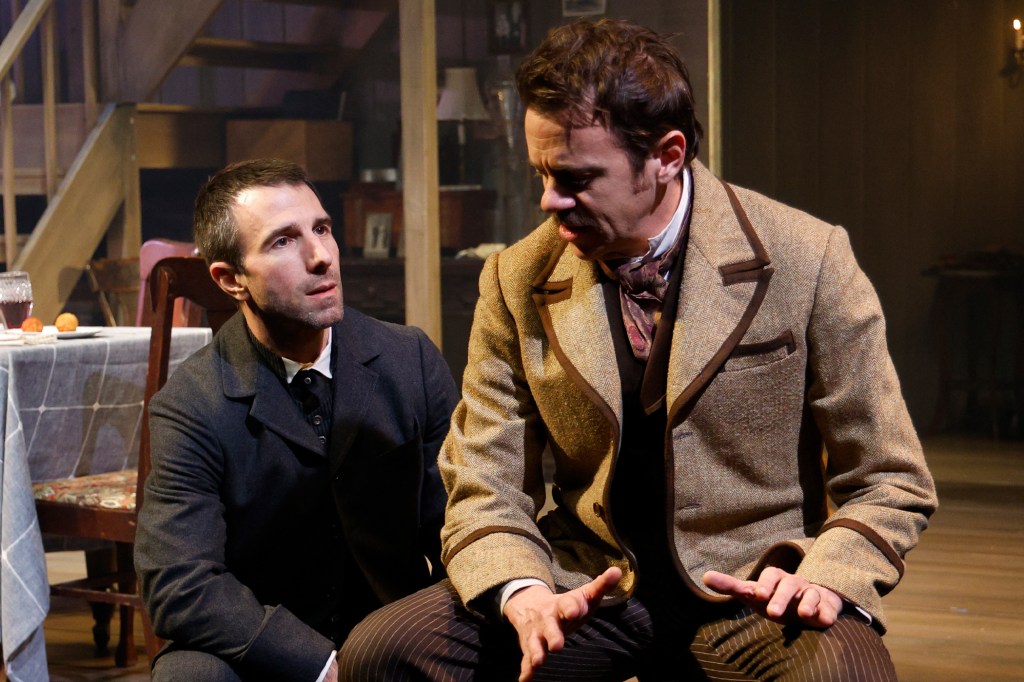

L: Alexander Hurt as Gregers Werle Photo by Hollis King Center: Alexander Hurt as Gregers Werle, Nick Westrate as Hjalmar Ekdal Photo by Gerry Goodstein R: Maaike Laanstra-Corn as Hedvig, Melanie Field as Gina Ekdal, Alexander Hurt as Gregers Werle Photo by Hollis King
Mental Gymnastics Required
The Wild Duck demands the audience’s full attention for which they are rewarded. Nick Westrate (recently in STC’s Frankenstein) and Melanie Field (the heartbreaking Sonya in STC’s Uncle Vanya) lead a flawless ensemble. Maaike Laanstra-Corn’s Hedvig, the young duck-loving girl, caught in the adults’ web of lies, delivers a performance that lingers long after the stage goes dark. The 26-year-old Washington, DC native and Brown University graduate is an artist to watch.
I felt like a voyeur and a gossip throughout the play. I was the voyeur at that dinner party, wondering what came next. Then a gossip, observing the Ekdal household. It felt like I was overhearing through a parlor wall. It felt intimate, forbidden, yet addictive. I was inside their home, yet uninvited. My real estate mind went into calculation mode of the Ekdal house – how many rooms, how many square feet, how much were they asking for the rent of their spare room?
The audience was silent. No one even cleared their throat. When the lights dimmed, and the play ended, the audience stood up in unison, applauding politely. The applause was respectful, reverent, and slightly haunted. We were processing.

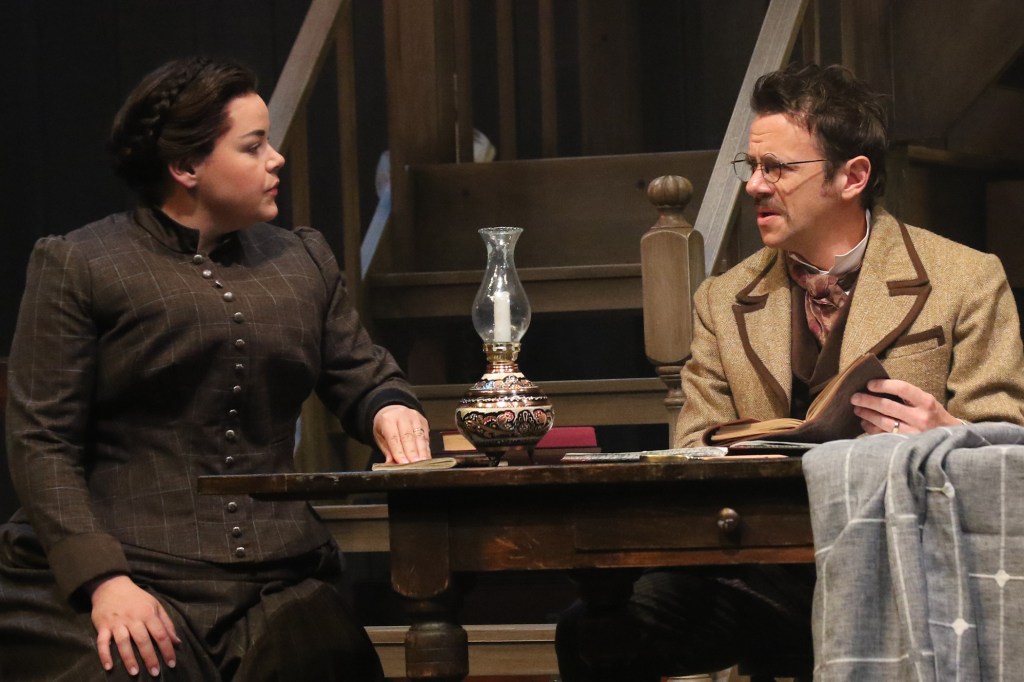
L: Nick Westrate as Hjalmar Ekdal, Maaike Laanstra-Corn as Hedvig – Photo by Hollis King. L: Melanie Field as Gina Ekdal, Nick Westrate as Hjalmar Ekdal – Photo by Gerry Goodstein
Why You Should Go
The Wild Duck is not a feel-good play. It is a feel-smart play. If you want to wrestle with questions about truth and delusion that feel urgently relevant in 2025, when crusaders of all stripes claim absolute certainty about what is best for everyone—this is your play.
What makes this play essential is Ibsen’s unprecedented psychological depth and intricacy of character. He peels back layers of late 19th-century culture and morals with surgical precision, revealing not just what people said, but what they believed, feared, and concealed. Anton Chekhov, who considered Ibsen his favorite writer, adopted this pioneering focus on psychological realism—the exploration of ordinary lives with extraordinary depth. Chekhov developed his own distinctive style with greater emphasis on subtext and naturalistic dialogue, but the foundation was Ibsen’s radical insistence that theatre could reveal the human psyche with the intuition of a psychological case study.
If you were moved by Melanie Field’s Sonya in Uncle Vanya earlier this season, then you will appreciate the direct inspiration from Ibsen to Chekhov being honored by the Shakespeare Theater Company. Both playwrights understood that the most profound dramas unfold not in grand gestures, but in the quiet devastation of people confronting uncomfortable truths about themselves and the society that shaped them.
Ibsen meticulously controlled how his work was interpreted; writing detailed instructions to directors for The Wild Duck productions. This most personal of his plays deserves to be seen with the care Godwin has brought to it, even if just once. After exploring Ibsen’s background for this blog, I find myself compelled to return—to see with new eyes what I missed the first time, armed now with understanding of what the playwright was truly after.

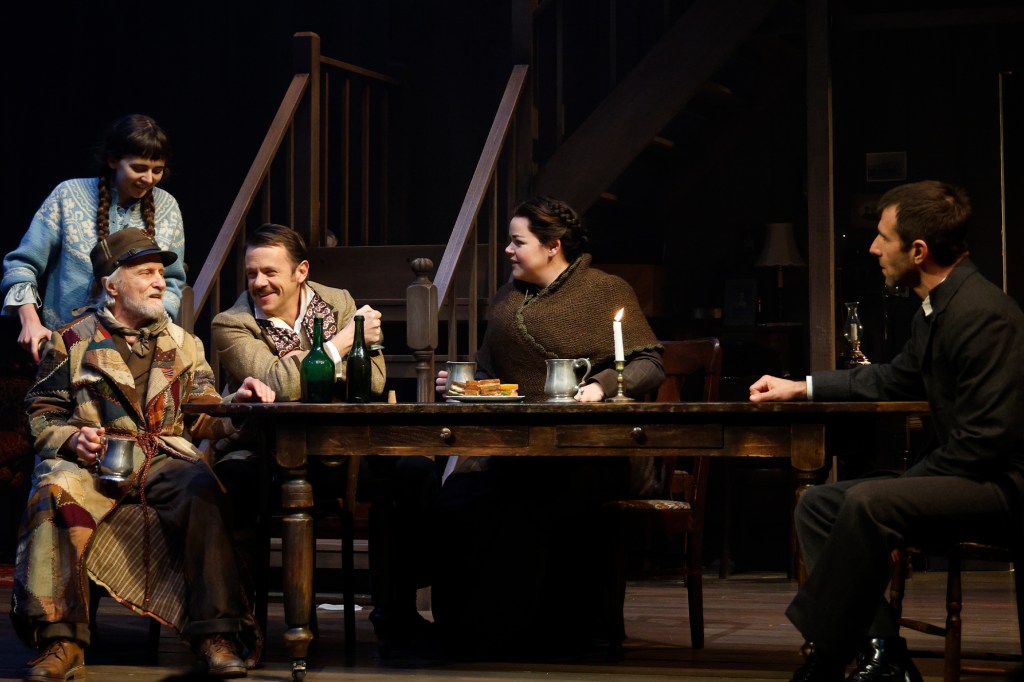
L: Maaike Laanstra-Corn as Hedvig -Photo by Hollis King R: Maaike Laanstra-Corn as Hedvig, David Patrick Kelly as Old Ekdal, Nick Westrate as Hjalmar Ekdal, Melanie Field as Gina Ekdal, Alexander Hurt as Gregers Werle – Photo by Gerry Goodstein
The Wild Duck runs through November 16 at Klein Theatre. Tickets: ShakespeareTheatre.org or 202.547.1122
 Good News. Reviews. Events.