I invited a dear friend to join me for another Shakespeare adventure at the movies. Last year it was Macbeth with David Tennant. This year it was Othello with David Harewood and Toby Jones.
When I first read and studied Othello, I found it fascinating and relevant in any society. Iago was a very recognizable character from real life.
Years ago, I shared professional space with someone whose behavior followed that same pattern of whispering, scheming, and quiet manipulation. It was subtle and persistent. It was the kind of influence that works in corners rather than in daylight. Eventually I recognized the pattern for what it was. I plainly told him that he should never apply for any position I might advertise following my next promotion. That experience left me with a clear understanding of the kind of personality Shakespeare presented in Iago. He was not promoted.
Per my usual habit before attending a Shakespeare performance, I refreshed my memory of the play. I confirmed the characters and revisited several key lines. I prepared for full immersion.
I picked up my friend and we drove to the Angelika Film Center. After enduring the usual advertisements and trailers, some of which looked fascinating, the film began.
This production is a stage-to-film presentation from London’s West End. I understand and expect such productions to rely on minimal sets, modernized costuming, and strong performances to carry the play. The first two expectations were met. The third is where this production faltered.
I have since read many responses praising this performance as brilliant, beautiful, and extraordinary. I regret to say that I do not share that opinion.
Because I stream a great deal of classical music, I have noticed that many streaming services flatten the sound to create a continuous listening experience. The dynamics disappear. Quiet passages and crescendos lose their contrast.
My sense of this Othello was much the same.
Throughout the performance I waited for the drama to ignite. Shakespeare’s language was spoken clearly. Recitation alone does not create atmosphere, set a scene, or draw the audience into the tragedy.
Toby Jones delivered Iago’s thousand lines with precision and confidence. His performance felt curiously without emotional force. I saw his lips move. I wanted to see Iago scheme. I wanted to see him whisper. I wanted to watch the quiet manipulation that slowly poisons Othello’s mind. The lines were delivered clearly. They were delivered without the emotional architecture that gave the character his terrifying power. I wanted to dislike Iago and root for Desdemona. I found that I cared about neither.
David Harewood presented a plausible Othello. He was physically convincing as a general and commanding as an authoritarian figure. Desdemona, played by Caitlin FitzGerald, was visually striking and entirely believable as the beautiful object of Othello’s infatuation. The character lacked the humility and innocence that traditionally anchor Desdemona’s role. There was, instead, a noticeable note of modern attitude that felt out of place within Shakespeare’s tragic world.
Venetia Robinson’s Emilia was strong and believable. I sensed that she was trying to carry the magnitude of the play on her shoulders. The remaining roles were competently handled.
When watching theater, I allow myself to be enveloped by the performance. I want to enter the world of the play and remain there until the curtain call.
That did not happen. The experience felt more like looking into minimally decorated Christmas windows where scenes are suggested and not lived. The sense of immersion never arrived.
Without emotional contrast, the play felt flattened.
I admire the discipline required to perform a role as demanding as Iago. Memorizing and delivering that volume of text is no small achievement. Toby Jones deserves recognition for that accomplishment, as does David Harewood for his portrayal of Othello and Venetia Robinson for her compelling Emilia.
Good Shakespeare is not meant to be flattened. His plays breathe through contrast—whispers and outbursts, suspicion and innocence, tenderness and violence.
Those dynamics never appeared. The tragedy remained intact on the page. It did not live on the stage, and certainly not in our theater.
So many theater lovers and English majors banter the name Macbeth. Murderer. Usurper. Tyrant. The ambitious thane manipulated by his evil wife into regicide and madness. We think we know the story. Do we?
Let’s unpack this myth and discover the deception.
Jame I of England / James VI of Scotland
Shakespeare was not writing history when he penned Macbeth around 1606. He was writing for his job security. The playwright understood his audience with surgical precision, and his most important audience member had just ascended the English throne three years prior. James VI of Scotland had become James I of England in 1603. Shakespeare needed the new royal patronage. The new Scottish king needed legitimacy on English soil.
The Match Made in Theatrical Heaven
DUNCAN I MACBETH
The Historical Macbeth
Mac Bethad mac Findlaích ruled Scotland from 1040 to 1057. That was seventeen years of stable rule in medieval Scotland. This was unheard of in the Scotland of the 1000’s where kings were routinely murdered, deposed, or challenged. Tyrants did not last seventeen years.
The historical Duncan I bears no resemblance to Shakespeare’s wise, elderly, benevolent king. The real Duncan I was young, weak, and foolishly aggressive. He invaded Macbeth’s territory of Moray in 1040. Macbeth slew him in the of Battle of Pitgaveny near Elgin. Warrior to warrior – an honorable death between combatants rather than the stabbing of an elderly sleeping guest in his bedchamber.
Macbeth possessed legitimate claim to the Scottish throne through his wife, Gruoch, granddaughter of King Kenneth III. Under the tanistry system of Scottish succession, Macbeth’s claim stood as valid as Duncan’s. Arguably stronger.
During his reign, Macbeth made a pilgrimage to Rome in 1050 to meet with the Pope – a pilgrimage possible only by a secure monarch. Chroniclers of the period recorded that he “scattered money like seed to the poor.” A guilt-ridden, paranoid murderer does not leave his kingdom for months to distribute charity abroad. Only a secure, prosperous, pious king would do so at the time.
The real Macbeth wore regal clothes. Shakespeare stripped them off and dressed him in villain’s rags.
Why the Lies?
Follow the money. Follow the power. This is how we uncover truth in any century.
James I needed several things when he took the English throne. He needed legitimacy, as a Scottish king ruling England was hardly popular with English subjects. He needed cultural acceptance. He craved flattery of his royal lineage. And he demanded entertainment that reinforced his divine right to rule.
Shakespeare delivered all of it with the precision of a master.
By making Duncan righteous and murdered, James’s ancestor became the martyred good king whose death must be avenged. By making Macbeth the evil usurper, anyone who would challenge rightful succession became damned by association. By making Banquo noble and prophesied to father a line of kings, Shakespeare flattered James’s other claimed ancestor as the hero whose bloodline fulfilled destiny. By adding witches and supernatural elements, the playwright appealed directly to James’s obsession with witchcraft. The king had written Daemonologie and fancied himself an expert on the subject. And by showing divine punishment for regicide, Shakespeare reinforced James’s claim to rule by divine right.
This was not art. This was propaganda dressed in iambic pentameter. Magnificent propaganda, certainly. Effective beyond measure. Propaganda, nonetheless.
The Matilda Connection
The bloodlines become truly fascinating when we examine how Scottish royal heritage eventually claimed the English throne.
After Macbeth’s death in 1057, Malcolm III assumed the Scottish crown. This is the “Malcolm” who defeats Macbeth in Shakespeare’s play, the son who avenges his father Duncan’s death. Malcolm married Margaret of Wessex, an Anglo-Saxon princess who fled to Scotland after the Norman Conquest of England.
Their daughter, Edith of Scotland, was born around 1080. When Edith married King Henry I of England in 1100, she changed her name to Matilda. The name sounded more Norman, more acceptable, less conspicuously Scottish to English ears.
This Matilda, born Edith, became the crucial bridge between kingdoms. Through her, Duncan’s blood flowed into the English monarchy via Malcolm III. Through her mother Margaret, descended from Alfred the Great, Anglo-Saxon royal blood joined the mixture. Matilda became the convergence point of Scottish and English royal heritage.
Matilda’s daughter, Empress Matilda, fought for England’s throne during the civil war known as the Anarchy. Her descendants became the Plantagenet kings who ruled England for centuries. The bloodline continued its steady march through history.
When Elizabeth I died childless in 1603, James VI of Scotland possessed the strongest claim to the English throne precisely because of these bloodlines. They traced back through the centuries, through Matilda the name-changer, through Margaret of Wessex the refugee princess, through Malcolm III the avenger, through Duncan the historical king Shakespeare would later slander.
James was not merely some Scottish king seizing an English throne. He represented the convergence of Scottish, Anglo-Saxon, and Norman royal blood meeting in one person. His legitimacy ran deep, and he knew it. He needed others to know it as well.
Shakespeare ensured they did.
A Small Digression
The Shakespeare 2020 Project founded by author, Ian Doescher, had a complete syllabus and timeframe for reading. I read and listened fast and thoroughly, then dug deep into historical relevance. I often listened to the plays while walking my dogs along the magnificent trails of parks and paths in my area. When I arrived at my ‘magiclands’ to find them closed due to the dread virus, I ushered the dogs back into their seats in my car and drove non-stop to a closer park. Furious, I decided that NOW was the time to hear Macbeth! Hear it, I did! We walked for the entire reading. When I returned to my book – I read it in its entirety with the readings still ringing in my ears. Yet, the play was enough. It did not send me on a single rabbit trail. I was too mesmerized by the psychological depth to worry about historical veracity. Until now, that it. Why? Nothing terribly intellectual – a short YouTube video addressing the very topic. I was hooked and the rabbit trail led me to rooms and rooms of pre-1000’s Scottish, English, and Norman history to the assertion of the throne by Macbeth.
What happened to King Macbeth? He was killed at the Battle of Lumphananby Malcolm Canmore (later Malcolm III), son of Duncan I.
Why has Macbeth been an ill-fated play – sets fell, and actors died then theatrically referred to as simply “that Scottish Play?” Marginalizing and demonizing a past king? Lincoln quoted lines from Macbeth, “Out, out brief candle…” following the fall of Richmond on April 9, 1865. On April 15, 1865, SIX days later, he was assassinated by John Wilkes Booth who had played the title role in Boston two years earlier. Exactly who assassinated Lincoln? Booth or Macbeth? Where is Macbeth’s reach?
Perhaps we should view all historical narratives with a skeptical eye. Whether from 1606 or from 2025, those who write the story control what becomes truth. Those who flatter power shape how the past is remembered.
The Lesson
I love Shakespeare for his poetry, his psychological insight, his timeless exploration of ambition, guilt, and the human condition. He was a genius wordsmith. In reality – he was a businessman, a survivor, a man who understood power and how to serve it while appearing to entertain.
Macbeth is splendid theater. The poetry soars across centuries. Lady Macbeth’s guilt, the dagger speech, “tomorrow and tomorrow and tomorrow” are extraordinary achievements in dramatic writing. The play deserves its place in the canon.
History? Not close.
The real Macbeth deserves better than four centuries of slander. He ruled well. He ruled long. He had legitimate claim to his throne. He was pious enough to pilgrimage to Rome and generous enough to scatter money to the poor. History should remember him as he was, not as Shakespeare portrayed him.
Politicians make promises. Playwrights craft myths. The winner writes history. The powerful control narratives.
Whether the emperor wears clothes or stands naked before us depends entirely on who holds the pen.
Excerpt from Image No. 6. Romeo and Juliet. Act 5. Scene 3. Painted by Mr. Northcote, R.A.
Before the play, Julius X, started I spent the early evening viewing the latest Folger Shakespeare Library exhibition, Imagining Shakespeare: Mythmaking and Storytelling in the Regency Era. I realized that different artists perceive the same Shakespeare scenes in wildly different facets. At the entrance to the exhibit, I was greeted by Henry Fuseli’s witches from 1793, complete with dramatic robes and theatrical setting, juxtaposed with Artist Fellow Elise Ansel’s 2024 abstract interpretation of that same scene, where the witches dissolve into swirling brushstrokes of orange, white, and red against deep black.
Same story. Different worlds.
The Boydell Collection: Shakespeare as Blockbuster
Walking past modernism, I was greeted with Regency Era historical heavyweights. The fourteen canvases now hanging at the Folger come from the Boydell Shakespeare Gallery—the 18th century’s attempt at a Shakespeare cinematic universe. John Boydell and his nephew Josiah opened this fashionable London gallery in 1789, amassing 173 paintings (almost half of them life-size) by 35 different artists. Think of it as the Metropolitan Museum meets a Shakespeare theme park.
Only about one third of these paintings survive today. The Folger has the largest remaining collection. When seen together for the first time since 1805, one realizes that these were not simply illustrations. They were storytelling on a grand scale.
The artists read like a who’s who of British painting: Robert Smirke (32 paintings), William Hamilton, Richard Westall, Francis Wheatley, George Romney, James Northcote, and Julius Ibbetson. Each brought their own style to Shakespeare’s words, sharing a common vision: make the drama leap off the page and into visual space.
When Witches Get a Modern Makeover
Artist Fellows “…tease out the threads connecting the early modern world to our lives today.” Above, Henry Fuseli’s Macbeth Consulting the Vision of the Armed Head (1793) has been reinterpreted by Artist Fellow, Elise Ansel with color, light, and shape.
Fast-forward to today where Folger Artist Fellow Elise Ansel takes on the same Macbeth witches that Fuseli painted in 1793. Instead of recognizable figures in a dark landscape, she renders visual energy—what she calls “graceful, wavelike brushstrokes, echoed in watts of gold.”
In her piece The Nature of Witches, abstract shapes suggest bodies without defining them. In Untying the Winds, the witches become more elemental—muted swirls that might “untie” the winds from Macbeth. The gray brushstrokes feel darker, more aggressive, as if the painting itself embodies the storm building in the play.
Where Fuseli’s witches are frightening and haggish (as Shakespeare wrote them), Ansel transforms them into something more ambiguous. They are powerful, fluid, almost beautiful in their danger.
What Makes Old Master Paintings “Old Master?”
I noticed, as noted, when standing in front of the Boydell paintings that they were created by men for men. That is not a value judgment. This was the art world of the early 19th C. The subjects, the perspectives, the portrayal of women reflected a specific and limited viewpoint.
In her contemporary pieces, Ansel deliberately disrupts the male thesis. By using color and abstraction in what she calls “open-ended visual languages,” she creates “new ways of looking and engaging for modern viewers.” She is not replacing the original stories. She is showing us different angles, different emotional temperatures.
Like hearing a jazz musician interpret a classical piece, the original composition remains; suddenly revealing notes and rhythms never before noticed. One such piece: Beethoven’s Für Elise as updated and performed by jazz pianist, Chick Corea in 1993.
Looking at the Paintings
The Folger stays true to the original Boydell Shakespeare Gallery tradition by providing visitors free booklets listing each painting denoted with a number. Further in the booklet, the paintings are described by play title, act and scene, a description of the scene’s events, the artist’s name, and excerpts from the play’s text.
In the gallery, I was on my own to view, search and interpret. Without immediate instructional labels, the exhibition affords space for interpretation while the booklet affords greater depth, if desired. Standing before the massive canvas of the awakening woman in white, I felt the folly of the deception and ignorance of the friar. When you look, you can recognize your feelings and reactions to the play. Having deep-seated conflict about that play, I first saw deception then agony. What you see will depend on your attitude.
Digging further into the context of the paintings, I opened the booklet to learn about the artist, the play, and the scene. Who painted this? When? What was happening in their world? How did knowing that painting No.10 was from King Lear affect my view? I did not need the booklet to tell me. I also did not need the booklet for painting No. 8. However, painting No.1 could have been any one of Shakespeare’s female characters dressed in men’s clothing. Painting No. 14 is not a play scene; it is a semi-deification of the Bard himself.
From British Imperialism to You
There is truth embedded in these beautiful paintings. By the time the Boydell Gallery closed in 1805, Shakespeare had become “The Bard.” He was no longer a brilliant playwright, but “a larger-than-life symbol of British imperialism and economic power.” These paintings were not simply representational art. They were essentially cultural propaganda.
Two hundred twenty years later, we appreciate the artistry while acknowledging the intent. Shakespeare’s words have always been interpreted through the lens of whoever is doing the looking—whether that is a Royal Academy painter in 1790 or a contemporary Artist Fellow in 2025.
The Contemporary Conversation Continues
The Folger’s Artist Fellowship program ensures that this conversation does not stop with historical canvases. Current Fellows like Elise Ansel join Missy Dunaway, Dominick Porras, Mandy Cano Villalobos, and Alexander D’Agostino create art works “…grounded in research on the stories, art, and objects in our collection,” per the introductory statement.
These artists are not merely making art about Shakespeare. They are using the collection as a springboard to explore how art and literature shape each other; how visual language can expand or challenge written words, how what we see influences what we think we know.
Come See for Yourself
These are not paintings you can experience on a screen. You should stand before them and feel their scale, see the brushwork up close, and notice details that disappear in photographs: how light plays across Ansel’s textured surfaces, the depth of detail and scope of the Boydell canvases, designed to overwhelm and impress.
The 14 Boydell paintings are now permanent residents at the Folger. The contemporary art rotates with each fellowship. Both are free to visit. Both will make you think about Shakespeare in ways you have not before.
Next time you are near Capitol Hill, visit the collection. Spend some time with witches old and new. See what happens when you allow visual artists to have their say about those famous words.
Shakespeare wrote for theater—a visual, physical space where words created the story. These artists are continuing that tradition, reminding us that these plays are as much visual as they are heard.
The Contemporary Art at the Folger exhibition featuring Elise Ansel runs October 3–November 9, 2025. The Boydell Shakespeare Gallery paintings are on permanent display. The Folger Shakespeare Library is located on Capitol Hill in Washington, DC, and admission is free.
Julius X was born from rejection. When Al Letson was not cast as Mark Antony in a Julius Caesar production because of race, he decided, “Screw it, I’m going to write my own.” This was not bravado. It was love. He had fallen for Mark Antony’s speech in 10th grade and read Malcolm X’s autobiography in 7th. Both stayed with him. Years later, he realized Julius Caesar’s arc fit almost perfectly with Malcolm X’s life. This is how a dyslexic kid who learned to read through comics, a flight attendant who competed in poetry slams across America, an award-winning journalist and Shakespearean, spent over two years creating what is now playing at the Folger Theatre through October 26. I discovered Al Letson through Julius X.
Julius Caesar by William Shakespeare is a popular high school literature topic. How it is studied and how Shakespeare is presented often affects students for a lifetime. In Letson’s case, Caesar spoke to him. To others, it was just something to get through to close a chapter on high school English. I too studied Julius Caesar in high school. After my beloved Shakespeare teacher’s drowning the prior summer, I was uninspired to seriously pursue the play, and my new teacher was marking time. All was not lost for me. I read Shakespeare’s entire canon in five months in honor of my inspirational teacher’s 50th anniversary of his drowning and published a blog about him and Shakespeare. That blog remains the most read of all of my blogs. Julius Caesar was, of course, reread. This time with real interest.
In preparing to see Julius X, I opened my books once again. Marjorie Garber’s essay in her book, Shakespeare After All, and Paul Cantor’s Shakespeare and Politics lectures on YouTube helped me prepare. I then researched the life of Malcolm X. As a child, I remember hearing my parents discussing his assassination on the day it happened. The parallels between the two men are remarkable. Yes, they were different, however, their passion, their vision, and their boldness are indisputable.
Al Letson so aptly married the two tragic heroes by meeting their arcs, their mission, their loyalty, and their fire. Having prepared, I was happy to feel like a participant rather than a spectator. I felt the rhythm of the verses, the drive of the characters, the commitment to community of the friends, and the loving fear of the wives. Sitting close to the stage, I saw facial expressions shift with each revelation – what performers call rubber faces, the ability to communicate entire thoughts through the smallest movement. The wives were remarkable: Julius’s wife in her impeccable teal suit with braid detailing, Portia animated and desperate, both showing love and intuition that their husbands would not, could not, hear. Julius X is fast paced. There is no time to wallow or worry. Things happen quickly, and while the interpretation is impressive and surprising, being prepared was key to my Julius X journey. I was enthralled rather than bewildered.
Harlem of the 1960s was not Rome. Rome was regal, authoritative, imperial. But Harlem was home—brownstones and street corners, community and belonging. Its residents cannot live in Harlem without loving it. Harlem was Malcolm X’s ‘Rome.’ It was intimate, not monumental. It was his world. He had a burning passion. He wanted more for himself, his family, and his people. A militant who reconsidered his path but never abandoned his passion posed a threat to his supporters. The key? Ambition.
Caesar is a pivotal character. He has been compared to Alexander the Great by Plutarch in his biographies, Parallel Lives, in approximately 110 AD, to being featured by Shakespeare in the Tragedy of Julius Caesar in 1599, to being analyzed by Paul Cantor in the 21st century, juxtaposing him between Coriolanus and Antony and Cleopatra, and now, to being reimagined as Julius X by Letson in the 2020s. Almost 2000 years have passed. There is nothing new under the sun. Ambition is considered threatening by those with opposing vision or small thinking.
Julius X is entertaining, thought provoking, classic, and unapologetically bold. Playing through October 26 at the Folger Theatre, it rewards preparation and challenges assumptions. Good that Letson was not pigeonholed as Mark Antony. You can buy tickets now.
All photo credits: Erika Nizborski and Brittany Diliberto.
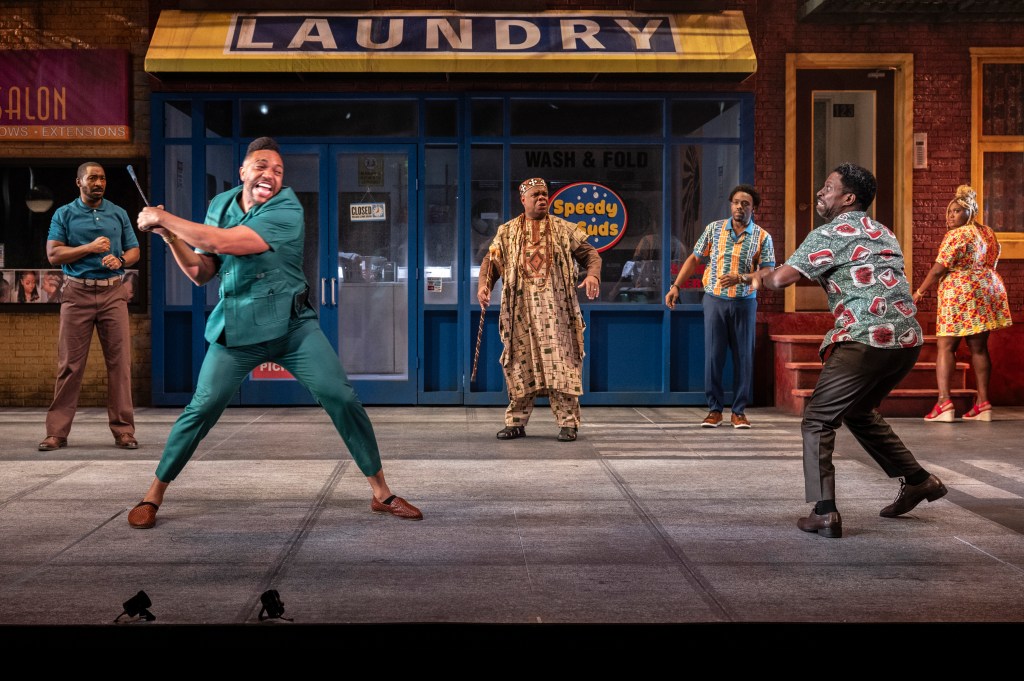
Jacob Ming-Trent in Merry Wives at Shakespeare Theatre Company. Photo by Teresa Castracane Photography.
Last Friday, I witnessed something magical happen in a theater. An entire audience jumped to their feet in spontaneous, thunderous applause. Not the polite, obligatory standing ovation that often closes shows, but the real thing: pure, uncontainable joy erupting from people who had just experienced something extraordinary.
That something was Shakespeare Theatre Company’s brilliant production of Merry Wives.
Jocelyn Bioh’s adaptation of Shakespeare’s The Merry Wives of Windsor sets this domestic comedy in modern day Harlem, centered around the neighborhood laundromat. Suddenly, Shakespeare’s 400-year-old tale of clever wives, bumbling suitors, and one roguish Falstaff feels fresh and immediate.
Jacob Ming-Trent, Felicia Curry, and Oneika Phillips The cast of Merry Wives.
Photos by Teresa Castracane Photography
The laundromat becomes the beating heart of community life where everyone knows everyone else’s business, schemes are hatched over folding clothes, and the famous laundry basket scenes take on brilliant new meaning. This is the kind of creative adaptation that makes us think, “Of course! Most every Shakespeare play has a duel – this play is no exception. However, the weapons are a golf club and a baseball bat! What a great place for drama to ‘unfold’!”
This production soars in how perfectly Shakespeare’s celebration of community wisdom translates to Harlem. The Merry Wives – played by Oneika Phillips as Madam Page and Felicia Curry as Madam Ford – are not simple individual characters pulling pranks. They are part of a vibrant neighborhood that looks out for each other, celebrates together, and collectively deals with troublemakers like Falstaff. They provide the wisdom and cunning for the others.
From L- R : (all PC: Teresa Castracane Photography: Felicia Curry, Jordan Barbour, Nick Rashad Burroughs, Sekou Laidlow, and JaBen Early; Felicia Curry, Jacob Ming-Trent, and Oneika Phillips; Jacob Ming-Trent and Kelli Blackwell
Ah, Falstaff! He is a pivotal character in four of Shakespeare’s plays – Henry IV Parts 1 and 2, Henry V, and The Merry Wives of Windsor. The role is a theatrical tightrope walk – he must be funny enough to carry comedy, charming enough to appreciate his schemes, and ridiculous enough to root for the wives to outwit him. When Falstaff works, everything works, and in this production, he works. In the Harlem laundromat setting, he becomes the beloved neighborhood character that everyone knows and tolerates despite his nonsense – probably holding court, spinning tales, completely convinced that he is irresistible to these smart women who are already three steps ahead of him. The knowing eye-rolls and exasperated gestures reveal their collective tolerance. They see through his schemes while enjoying the entertainment that he provides.
The physical comedy works brilliantly in the setting. When the audience delights in Falstaff’s schemes throughout the evening, his final downfall creates the perfect comic climax sending everyone to their feet cheering. The result is comedy that feels both timeless and completely of-the-moment. Shakespeare’s brilliant character dynamics unfold, as a love letter to community strength, female friendship, and the kind of neighborhood solidarity that makes cities feel like home. One audience member shared that she found the natural energy, wisdom, and strength of the “wives” enveloping.
Oneika Phillips and Felicia Curry (All Photos by Teresa Castracane Photography) The cast of Merry Wives
Streaming services or movies cannot produce the electric moments when an entire audience realizes they are experiencing something special together. When Oneika Phillips delivers a particularly brilliant line, when the ensemble moves in perfect comic synchronization, when the costumes and music and performances align to create theatrical dexterity. This is a joint experience of the audience. The costume design tells its own story – the rich colors and fabrics suggest social hierarchy within this Harlem community, while those amazing shoes worn by both Madams Page and Quickly signal their status and confidence. Every visual choice reinforces character relationships.
The shared experience, the collective intake of breath, and bursts of laughter, make live theater irreplaceable. Last Friday’s standing ovation went beyond appreciation for a good performance. It was a roomful of people celebrating the joy of being surprised, delighted, and moved together in one space at one moment in time.
This production does what great theaters do – taking the familiar and showing aspects never before noticed. Shakespeare’s genius for human psychology emerges through how naturally his insights translate across centuries and cultures. Communities have always been strengthened by clever women who refuse to let pretentious men get away with nonsense. The affected speech patterns – characters moving between Shakespeare’s elevated language and natural vernacular – create layers of authenticity that honor both the original text and the Harlem setting.
The laughter is infectious – not polite chuckles of recognizing a clever line, but the deep, surprising laughter that comes when brilliant performers make centuries-old words feel like they were written yesterday for people you could meet on any neighborhood corner – the genius of Shakespeare.
The romantic subplots raise intriguing questions about love versus social maneuvering. Are these genuine affections or strategic alliances? The production suggests that in tight-knit communities, the line between the two often blurs.
Shakespeare Theatre Company has created a production that honors the original text while making it accessible and relevant to the 21st Century audiences. The performance sparkles, the design choices are inspired, and the production feels like a celebration.
Go see this show. Go for the love of Shakespeare or for the fear of Shakespeare. Go because of the curiosity of Harlem’s cultural richness or simply for the desire to discover it. The experience is worth the effort. Some experiences only happen when we are all in the same room, witnessing brilliance together. Go enjoy the creative sets and gorgeous costumes – and of course, the acting.
The Details
Merry Wives is currently running at Shakespeare Theatre Company. Check their website for tickets and showtimes. Do not wait too long. This production closes on October 5. Tickets sell out quickly.
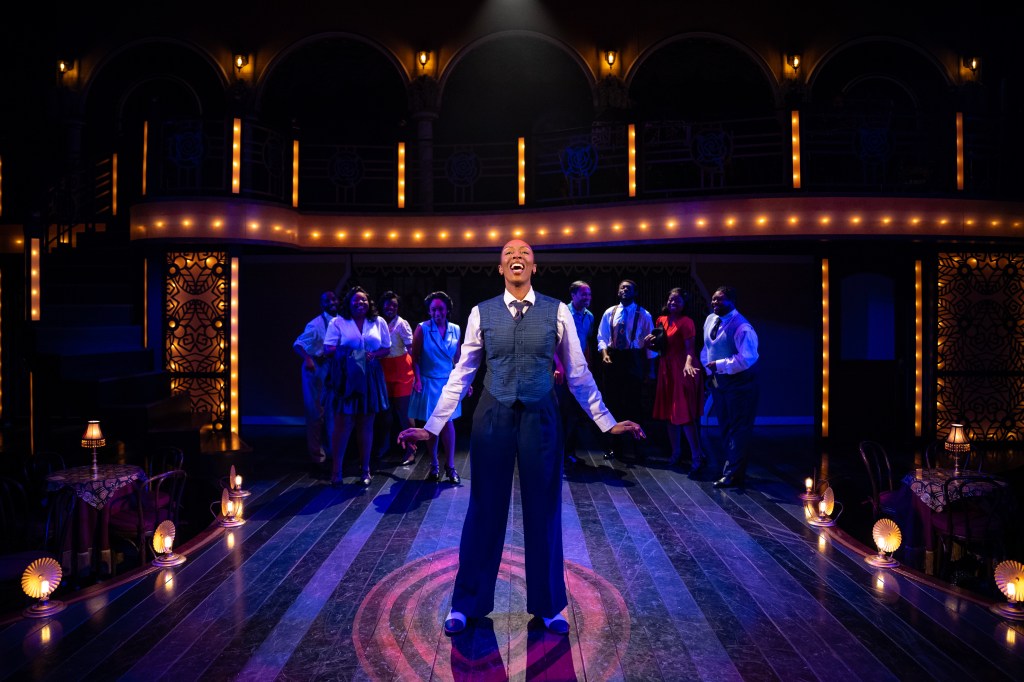
Wesley J. Barnes (Jester)and the cast of Play On! at-Signature Theatre.Photo by Daniel Rader.
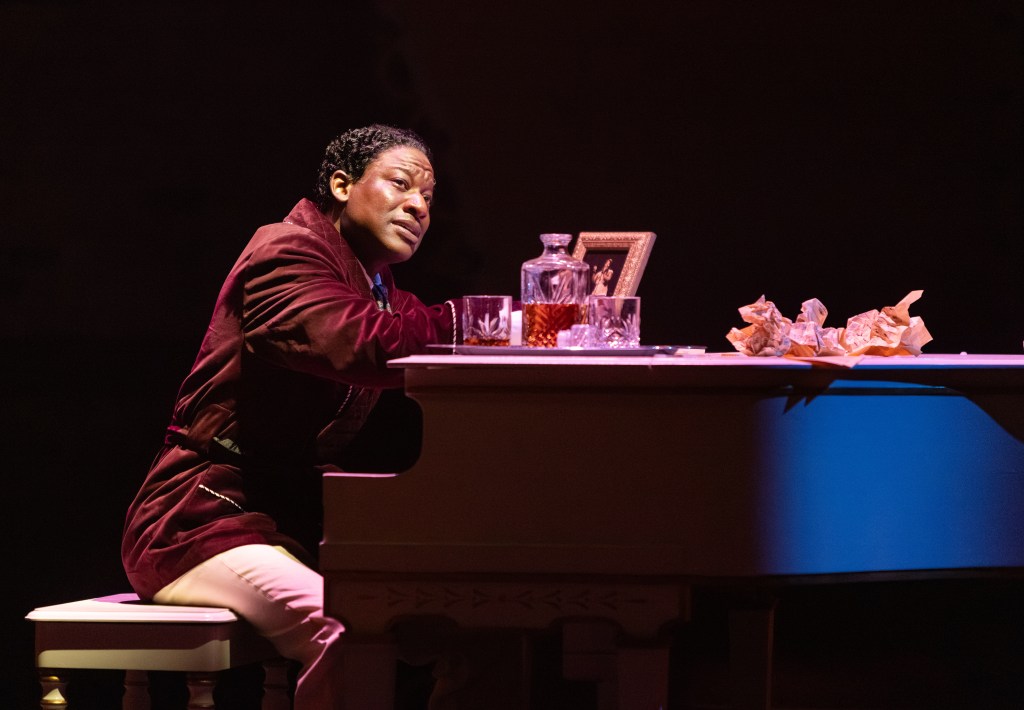
“If music be the food of love, play on,” says Duke Orsino in Act 1, Scene 1 of Shakespeare’s Twelfth Night. Play on, indeed, as Duke Ellington pines for his love interest, Lady Liv, in this lively, energetic production of Cheryl L. West’s jazz adaptation.
Signature Theatre was transformed into 1930s Harlem’s Cotton Club. From my stage-front table, I observed the fast-paced “Play On,” where disguises, mistaken identities, unrequited love, roadblocks, and burning passions energize both performance and progression.
Duke Ellington’s music—including “Take the A Train,” “Mood Indigo,” “It Don’t Mean a Thing If It Ain’t Got That Swing,” “Rocks in My Bed,” and twenty more numbers—tells the story of Duke’s unrequited love for Lady Liv, serious Miss Mary demanding faithfulness from her love interest Sweets, Vy’s secret passion for Duke, and poor Rev’s infatuation with Lady Liv.
Shakespeare’s play adapts beautifully to Prohibition-era America. West streamlines the original by eliminating the shipwreck and twin brother subplot, replacing them with wide-eyed Vy arriving in Harlem to write songs, only to be told by her uncle Jester that women aren’t songwriters in Duke Ellington’s world—or anyone else’s.
Awa Sal Secka (Lady Liv) in Play On! Photo by Christopher Mueller
Jalisa Williams (Vy) and the cast of Pay On! Photo by Christopher Mueller
I observed exceptional depth across every aspect of this production. The set design captured the Cotton Club’s authentic 1930s atmosphere, complete with the “Southern” elements that appealed to the patrons of its time. The costuming was both period-accurate and creative. Lady Liv’s garments were eye-catching and exceptionally flattering, each telling its own story as Awa Sal Secka brilliantly embodied the character. Vy’s yellow “Sunday” hat spoke volumes of her innocence.
My proximity allowed me to observe the actors’ skillful presentations. They were not acting—they were the characters. Their connections were palpable through eye contact, flirtations, and emotional range. I was truly “there, at the Club.”
Top L. Wesley J. Barnes (Jester) Photo by Daniel Rader, Top R. Derrick D. Turby, Jr. (Sweets) and Kanysha Williams (Miss Mary) photo by Christopher Mueller, middle R. Jalisa Williams (Vy- man) and Greg Watkins (Duke) photo by Christopher Mueller, bottom R. Jalisa Williams (Vy) and Awa Sal Secka (Lady Liv) photo by Christopher Mueller, Bottom – Greg Watkins (Duke) and Jalisa Williams (Vy-Man) and the cast of Play On! photo by Daniel Rader.
Like Shakespeare, West addresses social issues without belaboring them. Beyond the obvious romantic entanglements, segregation and dismissal of women’s potential remain present yet were overcome. Women can’t write music? How about a woman in a well-fitted man’s suit and fedora? The solutions were abundant, clever, and thoroughly entertaining.
Greg Watkins (Duke) Photo by: Awa Sal Secka (Lady Liv) Photo by: Jalisa Williams (Vy-Man) Photo by: Daniel Rader Christopher Muller Daniel Rader
Duke Ellington’s beloved music warmed the atmosphere and predisposed us to be entertained. Entertained we were—both myself and the full house. A friend who saw the play later in the week remarked at how much she enjoyed the “Rocks In My Bed” number with Sweets and Jester. My companion told me how she was fascinated by the dance execution going from raucous tap to pin-drop silent dance on the same shoes.
Wesley J. Barnes (Jester) and Derrick D. Turby (Sweets) PC: Christopher Mueller Greg Watkins (Duke),Jalisa Williams (Vy) and Cast PC: Daniel Rader
Play On! runs at Signature Theatre in Arlington, Virginia until October 5. This production is perfect for jazz, musical, dance, and feel-good fans. Of course, Shakespeare fans will find it cleverly entertaining. If you want a happy, energetic production to clear away the day’s concerns—this is it. Buy tickets soon – it sells out.
Lauren Gunderson’s brilliant re-imagining of Shakespeare’s “Hamlet” shifts the spotlight from the brooding prince to the women who orbit his world. In A Room in the Castle, Gunderson accomplishes in 85 minutes what Shakespeare took four hours to convey, creating an intimate portrait focused on Ophelia, her handmaid, Anna, and Queen Gertrude. Kaja Dunn’s elegant directing delivers a thought-provoking production. Gunderson was commissioned to write the play by the Cincinnati Shakespeare Company where it opened before it’s World Premiere on March 9, 2025 at the Folger Theater.
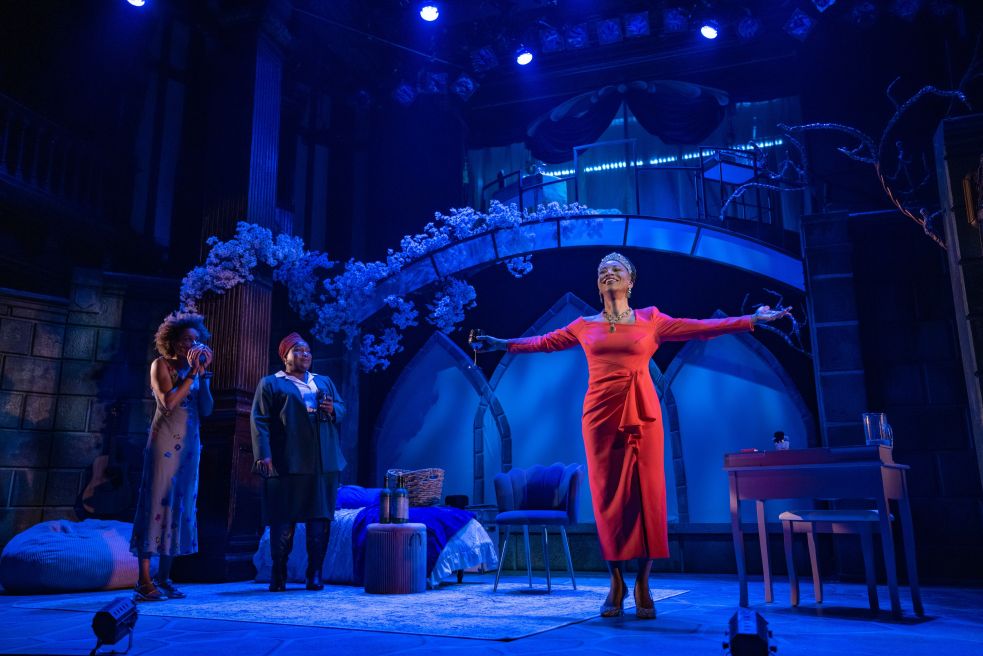
A Room in the Castle Dress Rehearsal 85:Sabrina Lynne Sawyer, Oneika Phillips, and Burgess Byrd in Folger Theatre’s world premiereof A Room in the Castle, written by Lauren M. Gunderson, directed by Kaja Dunn, co-produced with Cincinnati Shakespeare Company, on stage at the Folger Shakespeare Library, March4-April 6, 2025. Photo by Erika Nizborski
With only illusions to the narcissistic, gaslighting Hamlet of the original text, he is never seen. Not even the skull. Instead, we witness the story through the female perspective, exploring Ophelia as a motherless young woman navigating complex relationships and expectations. The production examines her circumstances: torn between her perceived love for Hamlet, her father and brother’s disapproval of him, Anna’s protective caution, and Queen Gertrude’s insistence on their marriage. Perhaps, it is “ . . .not to be.”
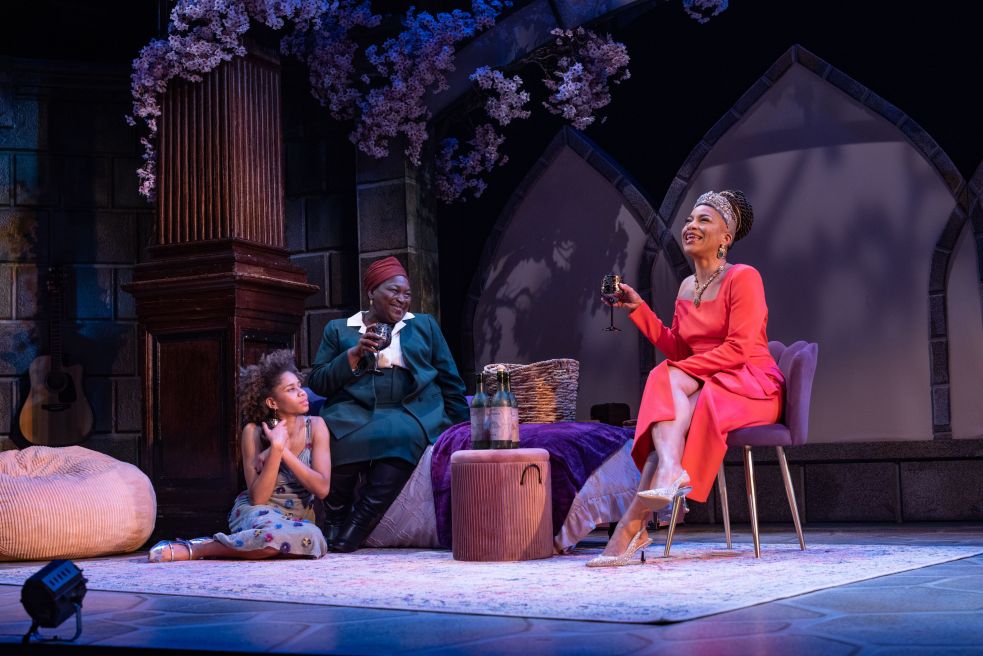
The all-female cast of three, delivers superb performances. Ophelia ( Sabrina Lynne Sawyer) emerges as a fully realized character – sometimes ambivalent, occasionally petulant, but ultimately autonomous. She is transformed from Shakespeare’s tragic figure into someone relatable in the 21st Century. Gertrude (Oneika Philips) commands the stage with regal confidence and impeccable dresses. Anna (Burgess Byrd) brings love and devotion to her role, having lost her own son and finding in Ophelia someone to mother and protect. Costume designer, Nicole Jescinth Smith’s costumes were visually stunning and spoke volumes about status and intent.
A Room in the Castle Dress Rehearsal 68: Oneika Phillips, Sabrina Lynne Sawyer, and Burgess Byrd in Folger Theatre’s world premiere of A Room in the Castle, written by Lauren M. Gunderson, directed by Kaja Dunn, co-produced with Cincinnati Shakespeare Company, on stage at the Folger Shakespeare Library, March4-April 6, 2025. Photo by Erika Nizborski
As we entered the Theater, I asked my guest and daughter, Tiffany, about her expectations of the play and to tell me her take on the original characters. Her immediate reply was that, “Hamlet was a madman, gaslighting Ophelia to her demise.” I shared that I found, “Both whiny and that she was needy and ‘a few cards short of a full deck.” Tiffany expected see a play about strength and perseverance over narcissistic dysfunction. I hoped that she was right and that after 425 years of waiting, Ophelia would find her voice.
The audience was greeted by the newly appointed director of the Folger Shakespeare Library, Dr. Farah Karim-Cooper, “I spent the last Twenty years of my life at Shakespeare’s Globe Theater in London. Over there, I was the resident scholar and director of education and research and it’s also where visceral performance informed all of my work, so I know something about theater. This is why I can say that I’m so inspired by the compelling and inclusive vision that’s emerging from the culture of this theater and our artistic leader Karen Ann Daniels.”
The intimate theater space enhances the experience, with its warm wood paneling, carved columns, and half-timbered walls – reminiscent of an Elizabethan setting. The set strikes an interesting juxtaposition between the now and then. When does this play take place? That really doesn’t matter.
A Room in the Castle Dress Rehearsal 93: Sabrina Lynne Sawyer, Oneika Phillips, and Burgess Byrd in Folger Theatre’s world premiere of A Room in the Castle, written by Lauren M. Gunderson, directed by Kaja Dunn, co-produced with Cincinnati Shakespeare Company, on stage at the Folger Shakespeare Library, March4-April 6, 2025. Photo by Erika Nizborsk
What makes this production special is that it honors Shakespeare’s world while boldly asking, “why not?” As Gunderson herself stated, “The play dances and duels with Shakespeare’s Hamlet, foregrounding the women in the play and re-imagining them with agency, vitality, and radical hearts eager for a new ending,… ripping a hole in the fabric of their suffocating story… because this play is anything but hopeless and tragic.”
There were frequent laughs and knowing sighs of recognition from the audience. While I won’t reveal the ending, I can say that it offers a satisfying conclusion to Ophelia’s journey. “A Room in the Castle” proves that sometimes the most interesting stories are found not with the titular character, but in the castle’s side chambers where the women speak their truths. “Obey, Agree, Assist?” How about “Rebel, Reject, Resist.”
A Room in the Castle Dress Rehearsal 91:Sabrina Lynne Sawyer, Burgess Byrd, and Oneika Phillips in Folger Theatre’s world premiere of A Room in the Castle, written by Lauren M. Gunderson, directed by Kaja Dunn, co-produced with Cincinnati Shakespeare Company, on stage at the Folger Shakespeare Library, March4-April 6, 2025. Photo by Erika Nizborski
A Room in the Castle Dress Rehearsal 87:Sabrina Lynne Sawyer, Burgess Byrd, and Oneika Phillips in Folger Theatre’s world premiere of A Room in the Castle, written by Lauren M. Gunderson, directed by Kaja Dunn, co-produced with Cincinnati Shakespeare Company, on stage at the Folger Shakespeare Library, March4-April 6, 2025. Photo by Erika Nizborski
Perhaps the most enduring power of Shakespeare lies not in the answers his works provide but in how each generation finds its own questions within them. Through my daughter’s unflinching modern lens, I watched not another classic Hamlet, but a study in how Ophelia finally gets the chance to exist beyond being defined by the men around her.
A Room in the Castle Dress Rehearsal 93: Sabrina Lynne Sawyer, Oneika Phillips, and Burgess Byrd in Folger Theatre’s world premiere of A Room in the Castle, written by Lauren M. Gunderson, directed by Kaja Dunn, co-produced with Cincinnati Shakespeare Company, on stage at the Folger Shakespeare Library, March4-April 6, 2025. Photo by Erika Nizborski
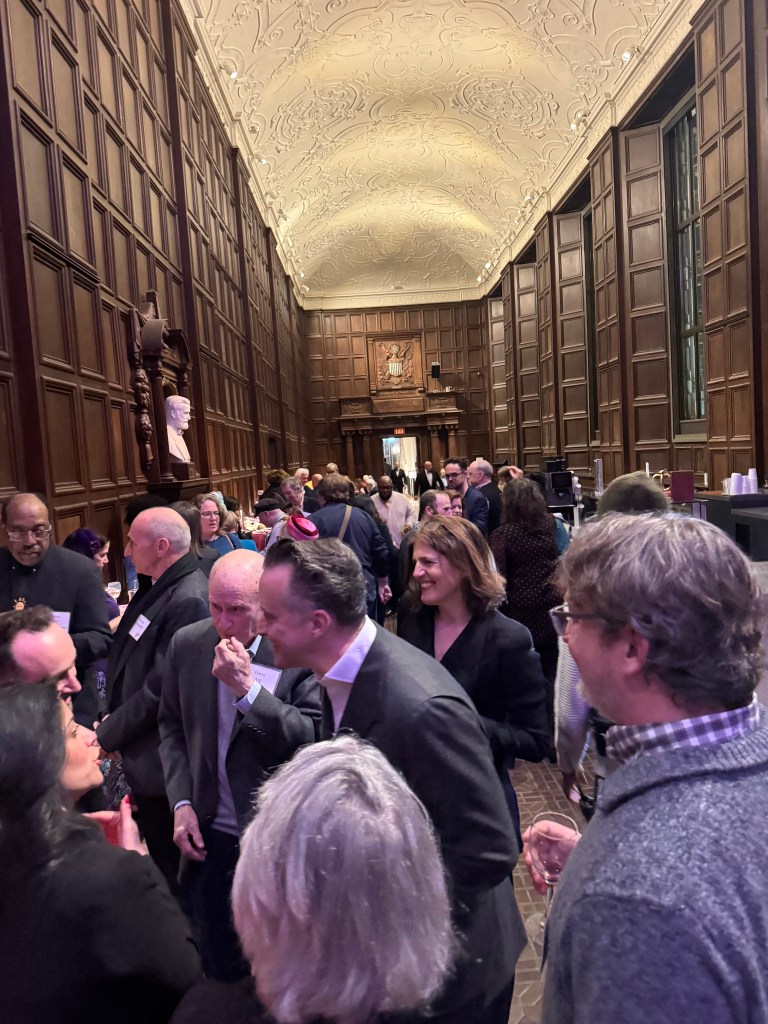
The cast, production team, and Folger staff greeted guests in the Great Hall for an elegant and enjoyable reception. Keeping with the woman theme, DJ, Miss H.E.R., provided invigorating music at the perfect volume for conversation. The reception gave us an opportunity to express our gratitude for the many levels of remarkable talent and work and to share snippets of insight and surprises. Meeting Dr. Karim-Cooper and Lauren Gunderson was an unexpected pleasure. Their generosity of spirit and depth of intellect and dedication to the Folger was inspiring.
The depth of intellect, knowledge, and commitment to both the production and the Folger Library Theater could have been overwhelming had not everyone been incredibly hospitable, responsive, and gracious.
Playwright Lauren Gunderson shares her creative process PC: Henkel
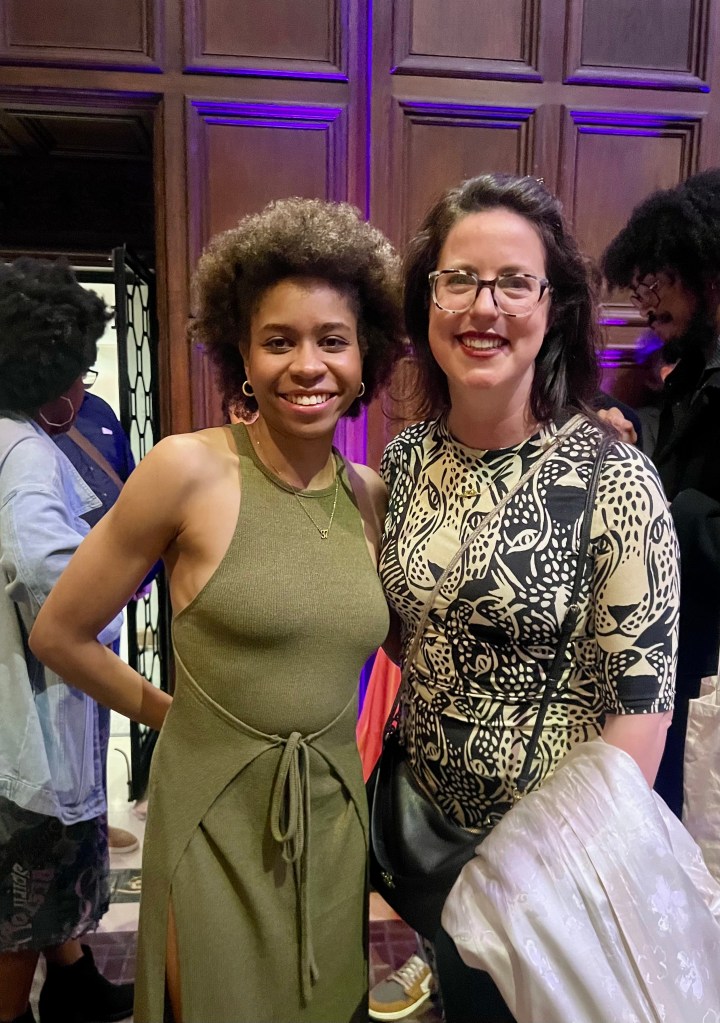
Meeting the cast, Sabrina Lynne Sawyer – Ophelia, and Oneika Philips – Gertrude gave additional focus to the characters. Sabrina is entirely invested in Ophelia. She wanted Ophelia to be liked and appreciated. When I shared my original opinion and how her representation changed my mind, she gave me a genuine hug and thanked me for being flexible and seeing the other side. Oneika, dressed in another stunning gown, this time in scarlet, carried herself as the regal queen that she portrayed. She was born to be the Queen. She complimented costumer, Nicole Jescinth Smith’s vision and impeccable attention to detail. Burgess Byrd and I managed to always be on opposite sides of the Hall – my compliments to her for bringing palpable warmth and love through her talent.
Top: Kaja Dunn, Lauren Gunderson, Nicole Jescinth Smith, Oneika Philips, Burgess Byrd Right: Lauren and Nicole Bottom Left: DJ MissH.E.R. Bottom Center: the Great Halls Bottom Right: Sabrina Lynn Sawyer and Tiffany Henkel PC: Henkel
I want to thank The Folger Press Secretary, Colleen Kennedy, for her generosity for allowing me to participate in this momentous event. I hope that this Blog will pique your interest to see this play. You will be glad that you did.
This delightful production plays until April 6 at the beautiful Folger Theater in Washington, DC. Tickets are limited. Don’t miss this chance to watch this modern production and see Ophelia in a new light. Click here for tickets
Colleen Kennedy, Right, with Krasi Henkel PC: Henkel
A Night with Macbeth at the Crossroads of Traditional and Modern
There’s something deliciously ironic about preparing to watch “The Scottish Play” through a screen. Armed with Marjorie Garber’s scholarly insights and Paul Cantor’s lectures queued on YouTube, I found myself straddling centuries – one foot in traditional academic preparation, the other in digital-age convenience. But nothing could have prepared me for the way that the filmed live Max Webster-directed production at London’s Donmar Warehouse; starring David Tennant and Cush Jumbo; would dissolve that careful distance between viewer and viewed.
The Seduction of Simplicity
In an era where productions often compete to outdo each other with elaborate sets and costumes, this Macbeth takes a boldly minimalist approach. The stark staging serves not as a constraint but as a canvas, allowing the raw power of Shakespeare’s language and the actors’ craft to paint vivid pictures in our minds. It’s a reminder that sometimes, less is more – especially with performers of exceptional caliber commanding the space.
The Intimacy of Technology
Things get interesting with the production’s use of binaural sound technology and the theater’s 5.1 surround sound transformed what could have been a mere filming of a stage play into something more visceral. Every whispered plotting, every sharp intake of breath, every moment of hesitation becomes startlingly intimate. This is psychological cinema at its finest. Using modern technology to achieve what Shakespeare himself must have dreamed of – the ability to place the audience not just in front of the action, but inside of it. Macbeth’s eye contact with the viewer is both thrilling and chilling.
Gender, Power, and the Space Between Desire and Action
At the heart of the play is an exploration of gender dynamics that feels startlingly relevant to contemporary discussions. Lady Macbeth emerges not simply as an ambitious woman, but as a complex figure trapped in a society that offers her “no chance of independent action and heroic achievement.” Her transformation of nouns into verbs – turning the Weird Sisters’ prophecies into calls for action – speaks to a deeper truth about power and agency.
The production masterfully highlights how Lady Macbeth’s infamous “unsex me here” speech resonates with modern conversations about gender constraints. Her willingness to “dash out the brains” of her nursing infant becomes not just an act of horror, but a violent rejection of prescribed feminine roles. In Jumbo’s portrayal, we see a woman who has internalized the brutal logic of a masculine world, turning it back on itself with devastating effect.
The Question of Responsibility
Perhaps the most unsettling aspect of this production is how it implicates its audience. Through the immersive sound design and intimate camera work, we become less spectators and more accomplices. Each choice, each action, each consequence feels personal in a way that traditional staging rarely achieves. The production asks us, in our era of influence and manipulation, whether we are ever truly responsible for our actions – a question that echoes far beyond the theater walls.
A New Kind of Shakespeare Experience
What makes this production remarkable is not just its technical achievements or stellar performances, but how it manages to honor both theatrical tradition and contemporary sensibilities. It’ is Shakespeare for our time: psychologically acute, technologically sophisticated, yet deeply rooted in the timeless power of language and performance.
For those planning to view the film: Yes, do your homework. Garber will guide you through the text and Cantor illuminates the themes. But, be prepared to have all that careful preparation wonderfully undermined by a production that refuses to let you remain a distant spectator. In bridging the gap between stage and screen, between past and present, this Macbeth creates something entirely new – and utterly compelling.
For optimal viewing, resist the urge to maintain analytical distance. This is one production where surrender yields the richest rewards. To whet your appetite take a little tour.
I dreamt that I told you about the love, Of Shakespeare and literature that you inspired. Oh, for another sleep, that I might thank you, For the minds you influenced and For the lives you changed.
Might we be different had you stayed? Your literary passion fueled our curiosity. To see through other’s eyes, To feel through other’s hearts, I would have stayed longer, for one more class with you.
With book in hand, you strode before us, A mischievous twinkle in your eye, Discussing symbolism from Freud’s or Socrates’ perspectives, You evoked the vivid colors of the verbal art, Challenging us to search for meaning.
From Alger to Albee, From Shakespeare to Beckett, From Eliot to Hemmingway and Poe, We read, we explored, and we wrote and wrote. Our assignments were remarkable.
We wrote plays and essays, Short stories and book reports, Verses, sonnets, ballads, limericks, and quatrains, Little nothings, and parodies. Your reactions were inspiring.
You challenged us to ask, “Why not?” Your questions gave space for discovery, Our discussions left us wanting more. You insisted on simplicity. Our rewrites became more elegant.
Your sense of humor was sublime, You were dignified and frank, Your generosity surprised and encouraged the sixteen-year-old me. You are yet my standard-bearer, For I question while I write, “What would Mr. Teunis think?”
There was so much more to glean. Our fledgling skills were just emerging. Your orders to “Condense and simplify,” Resonate a half century later. Alas, you left too soon.
In my dream, you would see that we turned out alright, That the seeds you planted are well tended, That your gifts of literary curiosity and challenging the status quo are well worn. Had you stayed, I see you an esteemed professor, writer, or producer, Subtly stretching and pushing limits.
WILLIAM TEUNIS
The Teunis Experience
Changed Lives
PC: John F. Kennedy Yearbook 1970
Subtle, eloquent, shy. He was a master of words. Words are all that remain with which to honor the all to short life of William Teunis, a man who quietly changed the lives of hundreds of his students. On this, the fiftieth anniversary of his drowning, I remember my remarkable teacher (really, a professor), with fondness, gratitude, and still with a bit of surprise. This endeavor is perhaps, the hardest of all of my writing assignments – one for which I volunteered. I believe that it would be the height of ingratitude not to share his contribution to our lives’ successes. It was his influence that gave me the love and confidence to write, hence this blog.
William Teunis was the chair of the English Department of John F. Kennedy High School in Montgomery County, Maryland. He was Harvard educated (BA and MA and MFA from the University of Iowa). He was a Shakespeare scholar. He was creative and demanding. How did we get so lucky? Why did he give a wit about kids when he could have been producing and staging Shakespeare plays?
Our education at John F. Kennedy High School (Kennedy) was extraordinary. The school opened in 1964 as an “experimental “school. There were no bells, no dress codes, no hall passes, and no honor roll. Students chose their classes each trimester and then decided whether to be graded, to pass/fail, or to audit the courses. Class attendance was optional; independent study was encouraged. The campus was “open.” We went out for breakfast or lunch. There were several smoking lounges. As in many Shakespeare plays, going into the woods to discover, contemplate, or play was standard procedure.
As You Like It October 1969 Production PC: John F. Kennedy Yearbook 1970
Many outsiders considered Kennedy a free-for-all. Yet, much learning took place and we turned out remarkably well. There, a young (not that we thought teachers could be young) English teacher, William Teunis, believed in pressing the limits and did not shy from controversy. He staged a Shakespeare play every autumn. The play of my sophomore year was As You Like It. It was his fourth such production, following, Hamlet, Richard III, and King Lear. I was astonished by its professionalism. While he officially taught 11th and 12th grade English and creative writing, I found myself in his class.
My schooling had been rigorous and traditional. I attended Kennedy under protest. My parents moved. Kennedy became my new school. My boyfriend, friends, horses, and everything I loved were left behind.
Although bright, I had limited motivation. My goal was to get out and get back to my friends. I completed assignments with minimal care and in minimum time. THEN, Mr. Teunis happened. Being somewhat “preppy,” I feared being censured by the liberal leanings of the Kennedy establishment. I was wrong. In Teunis’ class it was minimalism that was unacceptable. His passion for the English language and literature was contagious. He ignited our curiosity changing our lives forever.
On our first day of class studying Shakespeare’s As you Like It, we read roles around the class. Somewhere in the midst of an Act, he stopped. He clued us in to the fact that Shakespeare wrote plays. He wrote plays that would be performed within two to four hours. His audience was torn between attending public hangings, bear baiting, cockfighting, or watching a play. To survive, Shakespeare had to be competitive. He further pointed out that many in the audience were illiterate; while they knew oral histories and mythology, few delved deeply into the plays. There were no Shakespearean scholars then. Teunis tore the curtain from the mystery of Shakespeare and made us see that the plays were created (not written in books to be read) as entertainment, subject to political correctness and scrutiny of the time. There we were, in awe and relieved. Suddenly, Shakespeare became attainable. He shared that it was not rocket science and that one of the most enjoyable aspects of the Bard was the rhythm and energy of the language. He explained that every play contained multiple layers and levels and that at every reading or performance, there would be more revelations and more meanings.
During the 13 weeks that followed, we read plays, poems, and stories. We wrote complex assignments in iambic pentameter, we wrote sonnets, and we wrote plays. Overnight we would write an act of a play. We developed characters, wrote dialogue, and wrote summaries. Many of my topics dealt with loss and personal protest.
Protest. Kennedy students were proficient protesters. They protested the Vietnam War and the demise of the earth. The first Earth Day was observed that year. I had my own protest and wanted to simply finish my assignments and get on with my life. Mr. Teunis diplomatically returned my graded papers with instructions to “rewrite” a better product.
William Teunis respected his students. His low but bold voice urged us to question and reach for more. He gave examples of quality work. One student’s writing stood out. He often read her papers aloud as examples of a “well written paper.” Finally, I heard him, “Oh . . . that’s what he wants!” I thought. My competitiveness emerged, “I can do that.” Minimalism vanished; curiosity and determination took its place. My papers came back with A’s on first draft.
Reflecting upon the experience, I regret wasting his time with my marginal drivel. His kindness and patience remain constant reminders to be better. I am immensely grateful for every minute that I spent in his presence and for the world that he opened to our class and to me. Mr. Teunis changed my life. Fifty years later, I still ask myself while I write, “What will Mr. Teunis think?” then, I take more time and care.
At the age of 34, he was the English Department Chair. He built an English program unrivaled by any educational system that I have experienced either as a student or a parent. He challenged us to read, interpret, comprehend, and emulate literature uncommon for high schools. He challenged us with among others, T.S. Eliot, Hemingway, Poe, Beckett, Albee, and much Shakespeare. By my second trimester, I eagerly anticipated his class and wrote assignments from the heart; taking extra care. Our compelling discussions delved into the phycological, the Freudian, the personal, and the historical or contemporary. One classmate said, “He encouraged us to go beyond the story.”
PC: John F. Kennedy Yearbook 1970
One day, we found that our classroom was dark. There was lit candle on a small table beside his chair. Suddenly, Mr. Teunis appeared, wearing a dark cape and began reading Edgar Allan Poe’s “The Pit and the Pendulum.” So began our spring trimester. Our topics ranged from the journalistic approach of Hemingway, to the disillusionment of T.S. Eliot’s “The Wasteland,” to the tales of Poe, to the absurdity of Albee’s Who’s Afraid of Virginia Woolf? And Beckett’s Waiting for Gadot. I was spellbound. I remember writing and loving every moment. Every assignment was life-changing. Today, I cannot walk past the Café de Flore or Les Deux Magot on the left bank of the Seine without remembering Mr. Teunis’ stories of the heated conversations between Hemingway, Ezra Pound, Gertrude Stein, and other ex-pats of the time, over demitasse coffee.
The “Teunis Experience” has never left many of us. Regardless of the years, Teunis’ students remain grateful and devoted to his impact on their lives. While not all of us went on to study English, literature, or theater, the pull has remained strong to write everything carefully and clearly. Many, following successful careers elsewhere, are returning to their first love of writing, acting, and teaching. One student summarized it elegantly, “The Teunis-echoes became unbearably loud. Playwriting beckoned me.” Another, returned to community theater after fifty years.
PC:PHI DELTA KAPPA January 2008
The far-reaching experience has literally circumnavigated the globe. Former student, Richard Isenberg, took Shakespeare to Mongolia and taught 11-year-olds to perform Romeo and Juliet. In his article published in the January 2008 PHI DELTA KAPPAN Richard wrote, “My school experience was saved pretty much at the last minute, in large part because of a little bit of attention and encouragement that came my way from Mr. Teunis. Had it not been for that, I doubt that I would have mustered the confidence to continue my academic life. A few years later, when I entered upon my own teaching career, I was heavily in his debt.’
‘Mr. Teunis could never have imagined that one of the seeds he planted would bring his beloved Shakespeare to a stage in Inner Mongolia. We all have much to give and much to pay back. And we are all the richer for such a world of wonderfully improbable possibilities.’”
Attorney, Jeff Gorsky, who acted in the Teunis production, Richard III and in A Midsummer Night’s Dream later,in college, writes, “My favorite teacher. I took every class I could with him. Teunis was one of the best teachers of my life, maybe the most influential. Aside from the works he introduced me to—Shakespeare, T.S. Elliot, the essays of Orwell—he passed to me two ideas that shaped my intellectual development. The first was the idea of the canon, a core body of works that every educated person should know. He passed around a multipage mimeographed bibliography of the core works of American literature, and while I haven’t read everything on this list I used it heavily to shape my self-education in American literature. The other idea was the highbrow/middlebrow/lowbrow division, something he probably picked up from the writer Dwight MacDonald. The idea is that middlebrow—much of what used to be in the “Book of the Month Club” tends to be blandly conventional, while lowbrow pulp fiction has an imaginative power that can have important literary qualities as the highbrow. Like Feste, Teunis could sing both high and low. One of the books he assigned was Montana Rides, by Evans Evans, a pen name of Frederick Faust, who was best known as Max Brand. He was open to sci-fi and horror, and as a sci-fi/fantasy geek in high school who also was reading the classics, I found that idea very attractive. I’ve kept to that. While I’ve written high – my peer reviewed academic history Exiles in Sepharad: TheJewish Millennium in Spain (Univ. of Neb. Press/Jewish Publication Society), as well as the legal analysis I write for Law360 such as “An Alternative Legal Argument Against Trump’s Travel Ban,” I have self-published on Kindle a thriller, a Y.A. fantasy, and I am on my third draft of a Sci-fi novel called The Dark Forever, about dark matter and the Kabballah.”
Teunis student, Gail Robinson, said, “He was an amazing teacher. As a writer and occasional teacher of writing, I think of him often.”
John Diamond, Professor of Psychiatry at East Carolina University, remarked, “That man changed my life in many ways. His loss was such a tragedy.”
Julie Tyrrell wrote, “He was a remarkable teacher”
One classmate explained, “Our experience with Mr. Teunis gave us exposure to writers from the Western canon that I did not encounter again in the educational process, despite a liberal-arts education at a respectable college. That is important because a familiarity with those writers, and their style of writing, is helpful in appreciating the richness of the English language and in understanding literary references in later works. In a real sense, Mr. Teunis’ class was the first college course I took, and what he taught me was essentially English as a Second Language for someone who thought it was his first language.”
Images Courtesy of Sue-Ann Staake-Wayne
Sue-Ann Staake-Wayne, Class of 1968, was one of the Teunis Shakespeare performers. She shared, “The creative aspect never left me. He was a big influence for my love of theater.” She played Reagan in King Lear and Queen Elizabeth in Richard III. “Play preparations and rehearsals stared in the summer and performed the following October. Tickets were $1.00,” she recalled.
“That summer I will never forget. Who thought that a 15-year-old could memorize Shakespeare? It was intense. He [Teunis] was everybody’s understudy – he knew the entire play without a script! He would leave us performance notes in our cast mailboxes. In one note, he stressed the importance to make my scene emotionally and physically intense – ‘You are to be making out with Cornwall, not just touching hands. The handholding must be extremely sensual.’”
Image Courtesy of Sue-Ann Staake-Wayne
“He was a shy man. We worked to please him. It was hard to tell, but we learned that if he didn’t say anything, it was OK.”
Images Courtesy of Sue-Ann Staake-Wayne
“The following summer after classes ended, he took our cast to his Shenandoah retreat We swam and relaxed. It was the same place that he died two years later.”
Image Courtesy of Sue-Ann Staake-Wayne
Additional tributes claim, “Mr. Teunis significantly influenced the form of my life. I still look back in awe at all that he taught us. What a gifted teacher he was – he made us think and grow to do more than we ever thought we could.”
“Mr. Teunis’ intellectual challenges, his modesty, humor, and cartoons. still inspired me. He was a true hero and for me, a lifetime role model.”
“What genius, patience, generosity. What a man!”
Before coming to teach at Kennedy, Mr. Teunis taught at another Montgomery County high school. One of their alumni recalled his statement at the beginning of a school year, “I’ve reviewed the English syllabus and reading list prescribed by the Montgomery County Board of Education. And, after careful consideration, have decided to dispense with it.” Several weeks before the end of that school year, he told the class, “It has been brought to my attention that we’ve ignored the whole required course of study. I can’t understand how this happened. To remedy the oversight, I am posting a list of the books we should have covered over the past year. Please hand in a three-page report on any one of them by next week.” Classic Teunis.
He was with us just a short time before perishing at 34, in the Shenandoah River on June 20, 1970. His influence continues. Perhaps, that is the meaning of immortality.
Respectful yet irreverent, conservative yet liberal, generous yet demanding, quiet yet assertive, he disregarded convention, pushing limits out of bounds. William Teunis taught us so much more than reading and writing. He taught us to think, to question, to look beyond the story, and to never settle, but to be extraordinary. We are who we are because he was who he was when our lives met at just the right time. It was an honor to be his student. It is terrifying to write this tribute. We write in hopes of not disappointing him.










































 Good News. Reviews. Events.