Bidding is Open -Amazing Adventures and Items Await
The Virginia National Ballet’s online silent auction is now open, offering supporters a wonderful opportunity to help sustain the artistry and discipline that their professional ballet brings to our community.
The auction features a thoughtfully curated collection of items, from fine art and distinctive gifts to memorable experiences, all generously donated by friends and supporters of the company. Each bid contributes directly to the continued work of Virginia National Ballet and the dancers whose performances inspire audiences throughout Northern Virginia.
Silent auctions carry a particular appeal. You can browse, consider, and return again to see where the bidding stands. Sometimes the most delightful discoveries appear just when you least expect them.
If you enjoy the beauty of ballet, the dedication of its artists, and the cultural vitality it brings to our region, please take a moment to explore the offerings and place a bid.
Your participation helps ensure that Virginia National Ballet continues to flourish – both on the stage and within the community that supports it.
You will surely find something that speaks to you. Please join the bidding. Click here to begin your adventure.
I invited a dear friend to join me for another Shakespeare adventure at the movies. Last year it was Macbeth with David Tennant. This year it was Othello with David Harewood and Toby Jones.
When I first read and studied Othello, I found it fascinating and relevant in any society. Iago was a very recognizable character from real life.
Years ago, I shared professional space with someone whose behavior followed that same pattern of whispering, scheming, and quiet manipulation. It was subtle and persistent. It was the kind of influence that works in corners rather than in daylight. Eventually I recognized the pattern for what it was. I plainly told him that he should never apply for any position I might advertise following my next promotion. That experience left me with a clear understanding of the kind of personality Shakespeare presented in Iago. He was not promoted.
Per my usual habit before attending a Shakespeare performance, I refreshed my memory of the play. I confirmed the characters and revisited several key lines. I prepared for full immersion.
I picked up my friend and we drove to the Angelika Film Center. After enduring the usual advertisements and trailers, some of which looked fascinating, the film began.
This production is a stage-to-film presentation from London’s West End. I understand and expect such productions to rely on minimal sets, modernized costuming, and strong performances to carry the play. The first two expectations were met. The third is where this production faltered.
I have since read many responses praising this performance as brilliant, beautiful, and extraordinary. I regret to say that I do not share that opinion.
Because I stream a great deal of classical music, I have noticed that many streaming services flatten the sound to create a continuous listening experience. The dynamics disappear. Quiet passages and crescendos lose their contrast.
My sense of this Othello was much the same.
Throughout the performance I waited for the drama to ignite. Shakespeare’s language was spoken clearly. Recitation alone does not create atmosphere, set a scene, or draw the audience into the tragedy.
Toby Jones delivered Iago’s thousand lines with precision and confidence. His performance felt curiously without emotional force. I saw his lips move. I wanted to see Iago scheme. I wanted to see him whisper. I wanted to watch the quiet manipulation that slowly poisons Othello’s mind. The lines were delivered clearly. They were delivered without the emotional architecture that gave the character his terrifying power. I wanted to dislike Iago and root for Desdemona. I found that I cared about neither.
David Harewood presented a plausible Othello. He was physically convincing as a general and commanding as an authoritarian figure. Desdemona, played by Caitlin FitzGerald, was visually striking and entirely believable as the beautiful object of Othello’s infatuation. The character lacked the humility and innocence that traditionally anchor Desdemona’s role. There was, instead, a noticeable note of modern attitude that felt out of place within Shakespeare’s tragic world.
Venetia Robinson’s Emilia was strong and believable. I sensed that she was trying to carry the magnitude of the play on her shoulders. The remaining roles were competently handled.
When watching theater, I allow myself to be enveloped by the performance. I want to enter the world of the play and remain there until the curtain call.
That did not happen. The experience felt more like looking into minimally decorated Christmas windows where scenes are suggested and not lived. The sense of immersion never arrived.
Without emotional contrast, the play felt flattened.
I admire the discipline required to perform a role as demanding as Iago. Memorizing and delivering that volume of text is no small achievement. Toby Jones deserves recognition for that accomplishment, as does David Harewood for his portrayal of Othello and Venetia Robinson for her compelling Emilia.
Good Shakespeare is not meant to be flattened. His plays breathe through contrast—whispers and outbursts, suspicion and innocence, tenderness and violence.
Those dynamics never appeared. The tragedy remained intact on the page. It did not live on the stage, and certainly not in our theater.
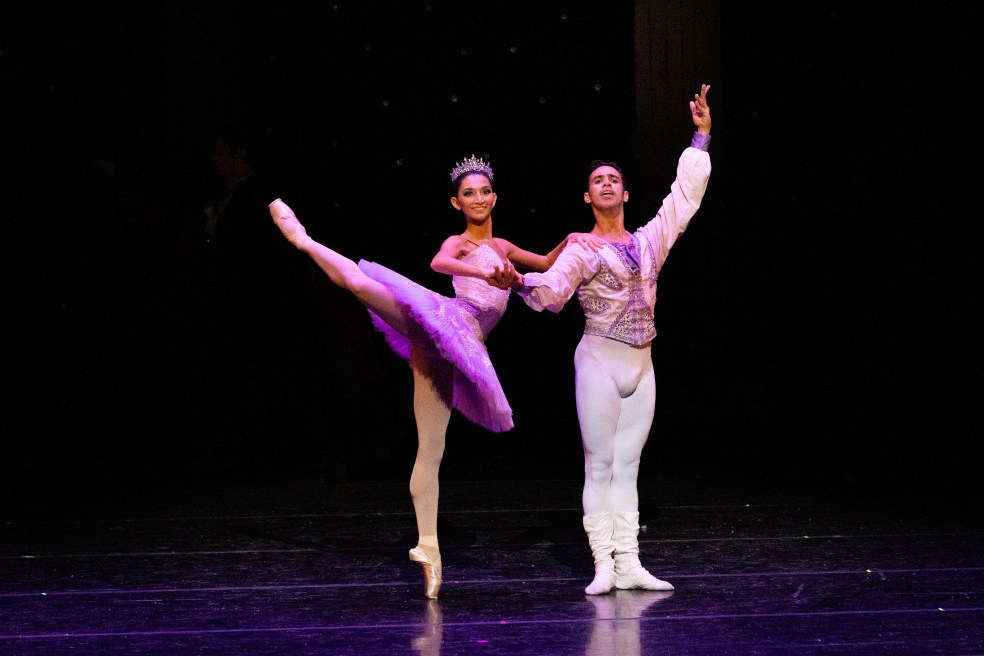
Virginia National Ballet brought heart, warmth, and brilliant dance to Capital One Hall. PC: Krasi Henkel
Mastery, Restraint, and Courage Silenced the Full House
Having attended countless productions of The Nutcracker, I could live happily without another one. Yet Virginia National Ballet made me reconsider my conviction. I attended this performance because I love these dancers and this company. I arrived not seeking novelty or nostalgia, but prepared to watch for creativity, interpretation, and intention.
What unfolded was a joyful celebration of the art of ballet. Correct, energizing, and clean.
Character interpretation and presentation were classical yet carried subtle twists. I caught myself thinking, “How understated, and how clever . . .” This Nutcracker was offered with nuance and a luxurious license to entertain, without tipping into excess or spectacle for its own sake. Lightness was mastery. From the houseguests to the naughty boys, from the magical uncle to the presented toys, the opening scene was effervescent.
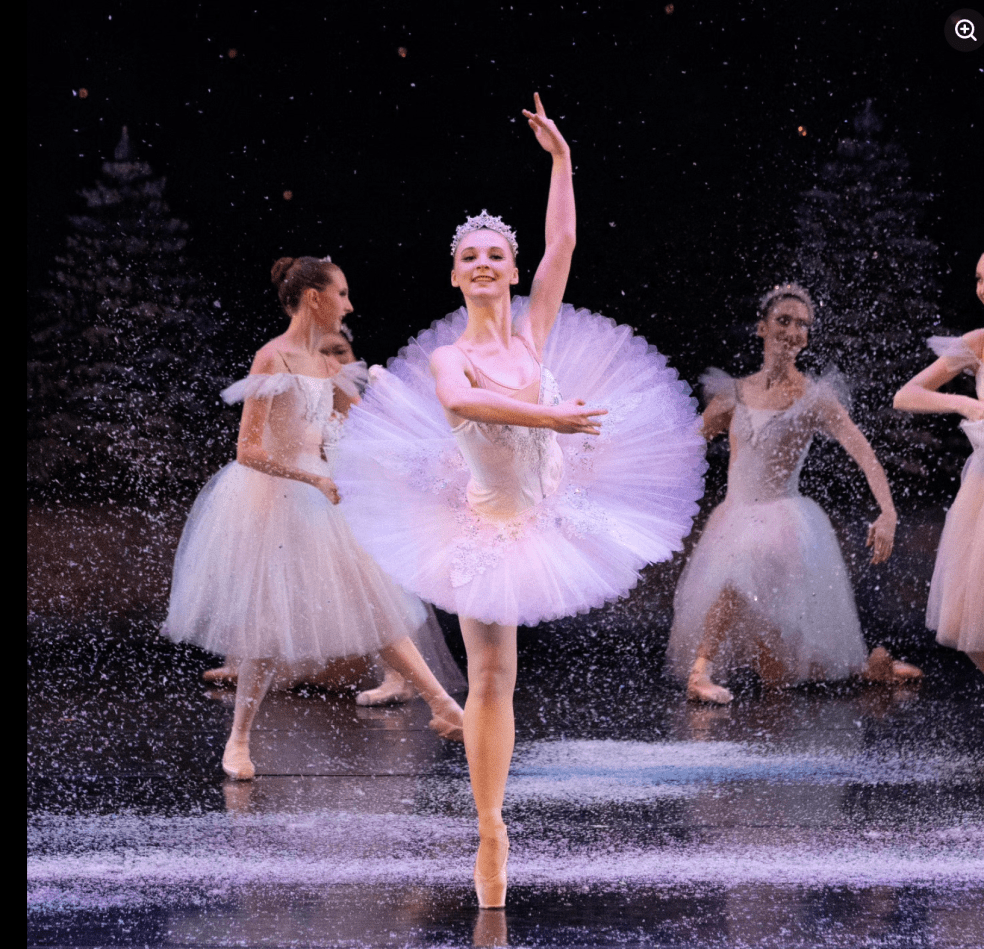
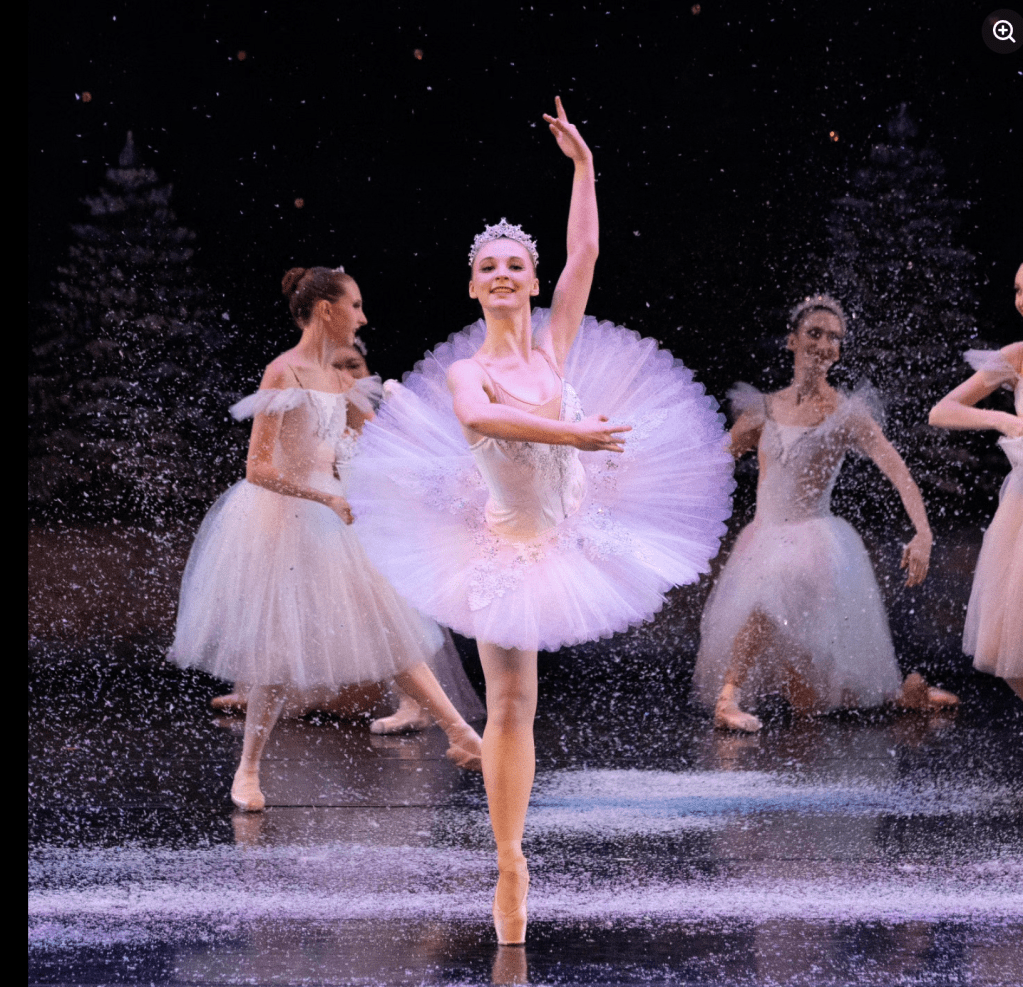
Snow, the etherealscene – photo by Dave Pearson
The sets were creative, economical, and effective. There was just enough and nothing fussy.
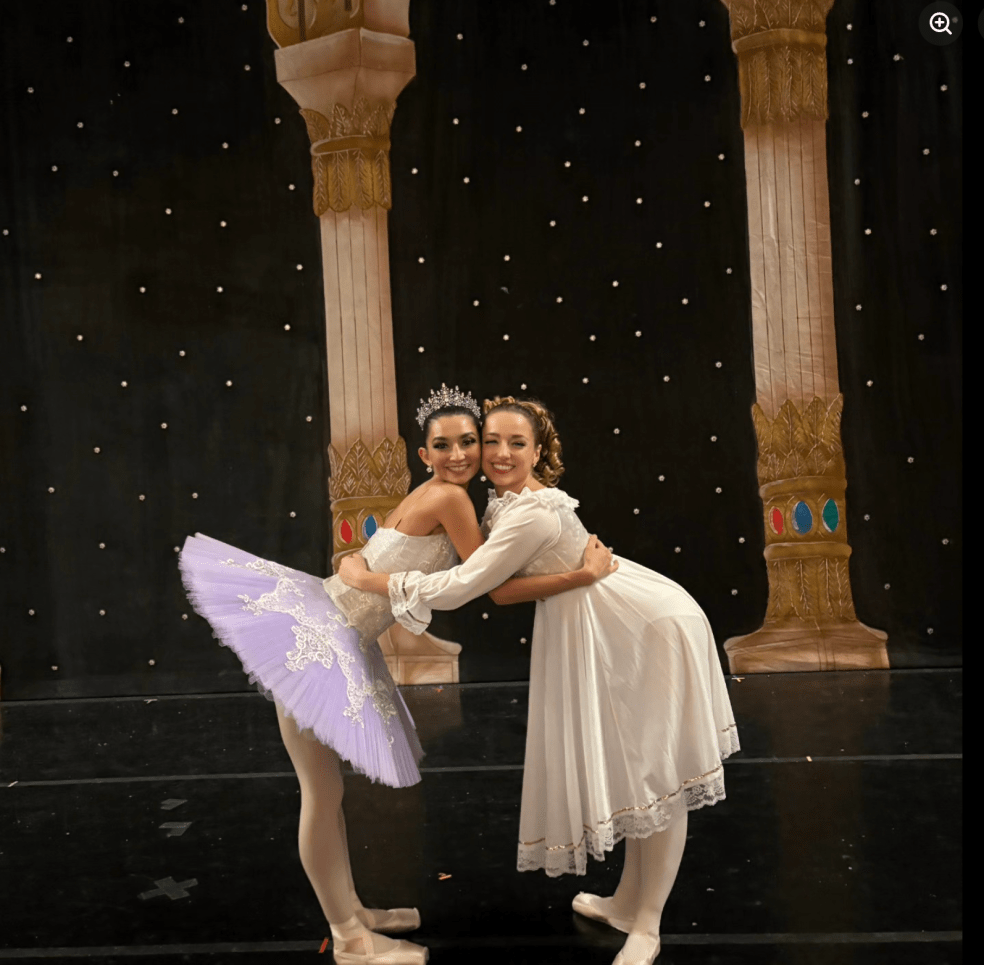
Clara’s princess tutu was debuted for this production. From my seat, it evoked spun sugar. Combined with her elegant technique and storytelling, she set the standard for excellence throughout the production.
Princess Clara’s new tutu demonstrates attention to every detail. Photo by Krasi Henkel
From sparkles to snowflakes, the performance delivered masterful artistry, complete storytelling, and thoughtful structure. Nothing lingered too long. Nothing asked for attention it had not earned. What distinguished this production most clearly was courage in choice.
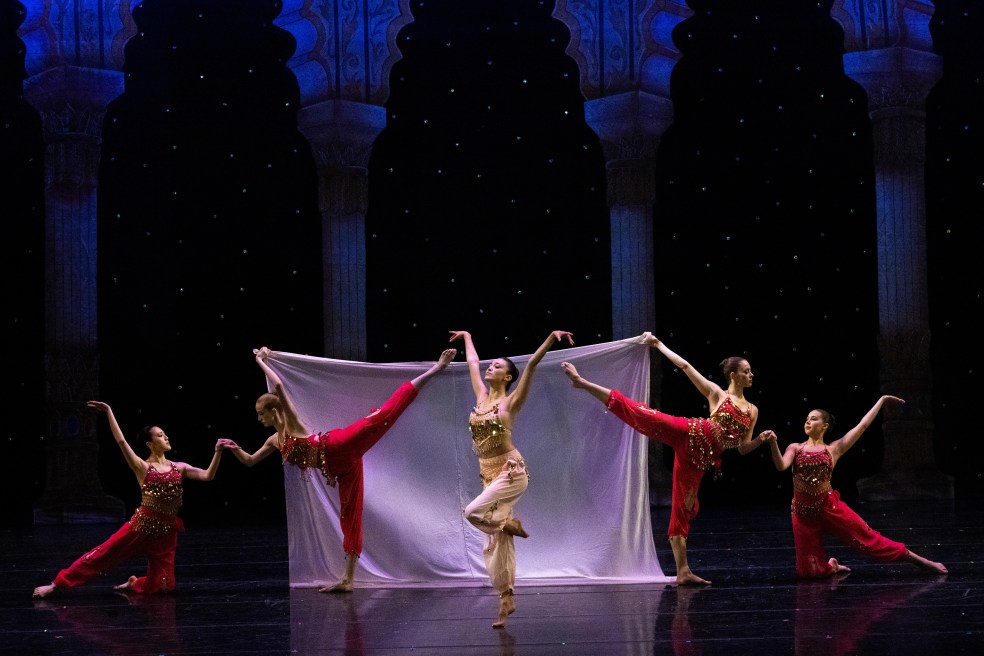
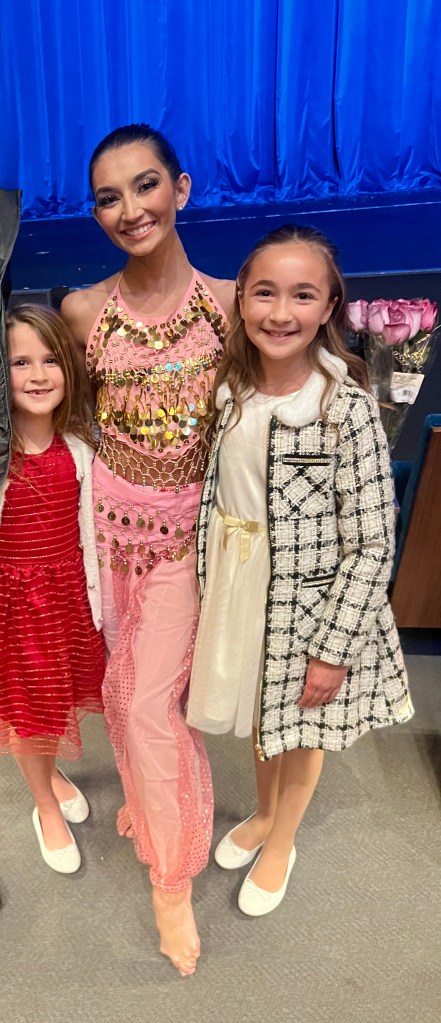
Arabian Scene photo by Dave Pearson
The Arabian scene was performed barefoot – no pointe shoes. That was a new twist in my experience and yet it felt authentic. A singular square of fabric defined the space, evoking a desert tent. Color and costume fused movement with intrigue. The barefooted ballerinas changed the atmosphere of the room. Their freedom from constraint allowed grounded power and presence to take center stage. This was intentional vulnerability.
Spanish Scene Photo by Dave Pearson
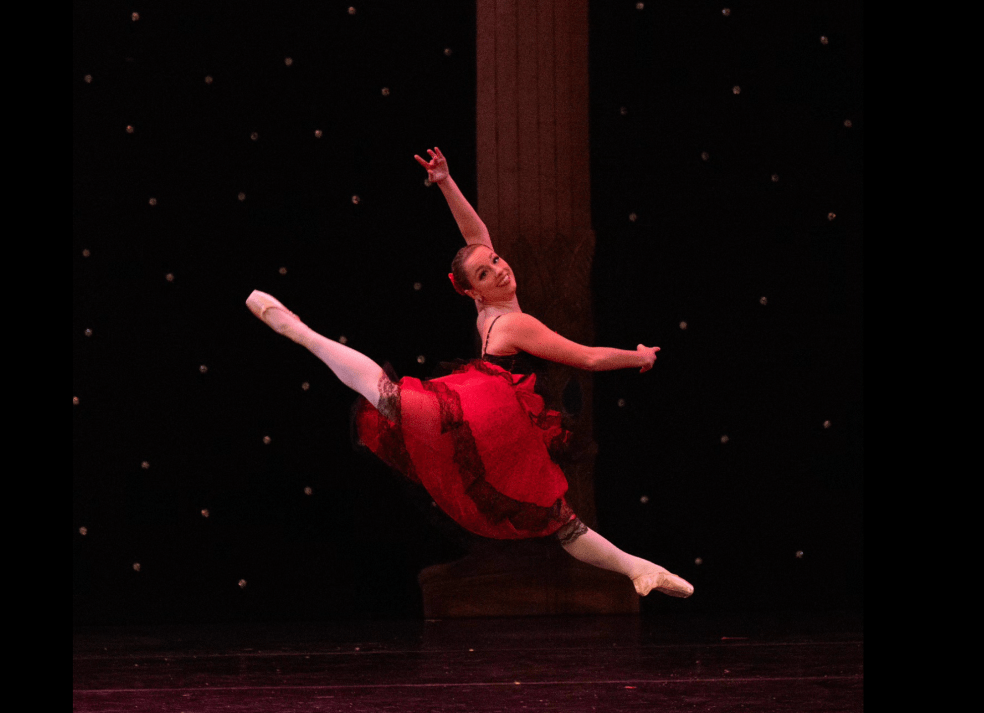
That same intelligence appeared throughout the production. A single dancer, Alexa Glomp, performed the Spanish variation on the very large stage. Although petite, she filled the stage with power, artistry, and enthusiasm. Her presence carried the moment.
Trepak scene – Photo by Dave Pearson
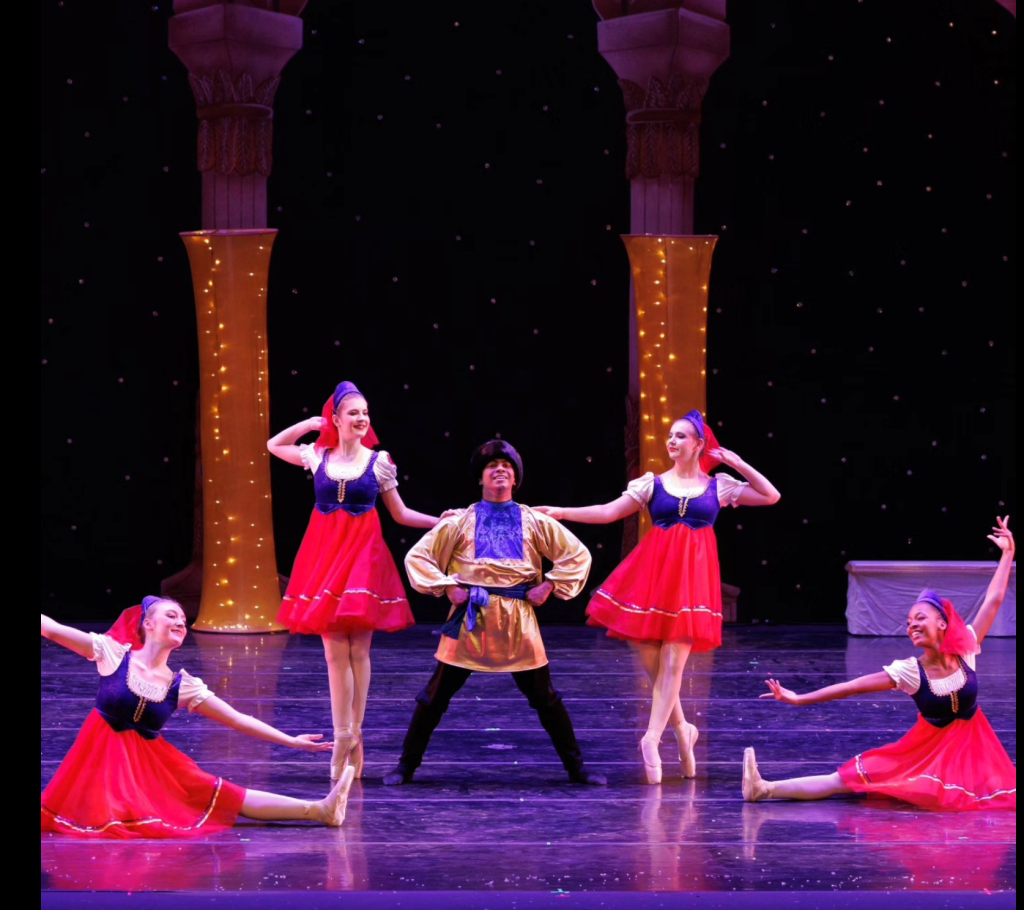
The Eastern European influence in costume and of course, music set the Trepak scene. The soloist’s choreography was delightfully modern from gravity-defying leaps to spins, and even a nod to break dancing. It brought freshness to a stereotyped musical score.
Chinese Scene – photo by Dave Pearson
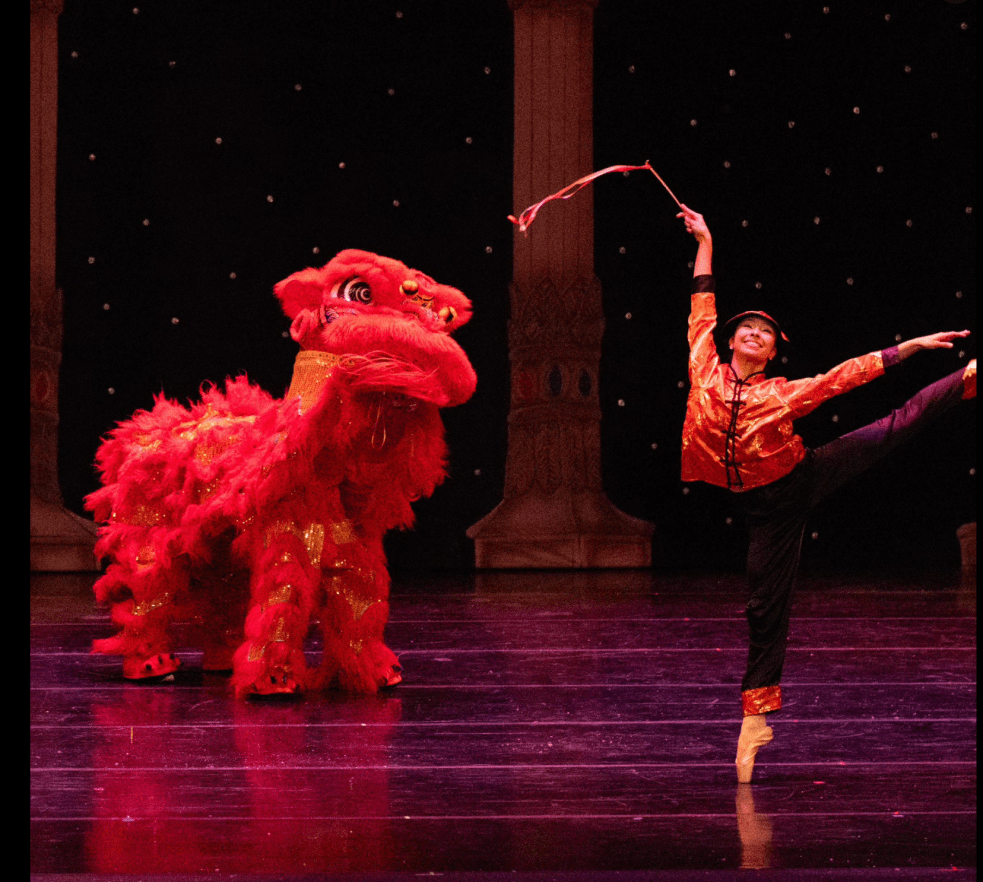
In the spirit of visual economy, the Chinese scene resonated brilliantly with a single brilliant dancer and lovable dragon. The interplay between the two lent humor and whimsy.
Mother Ginger with the gingerbread dancers – Photo by Dave Pearson
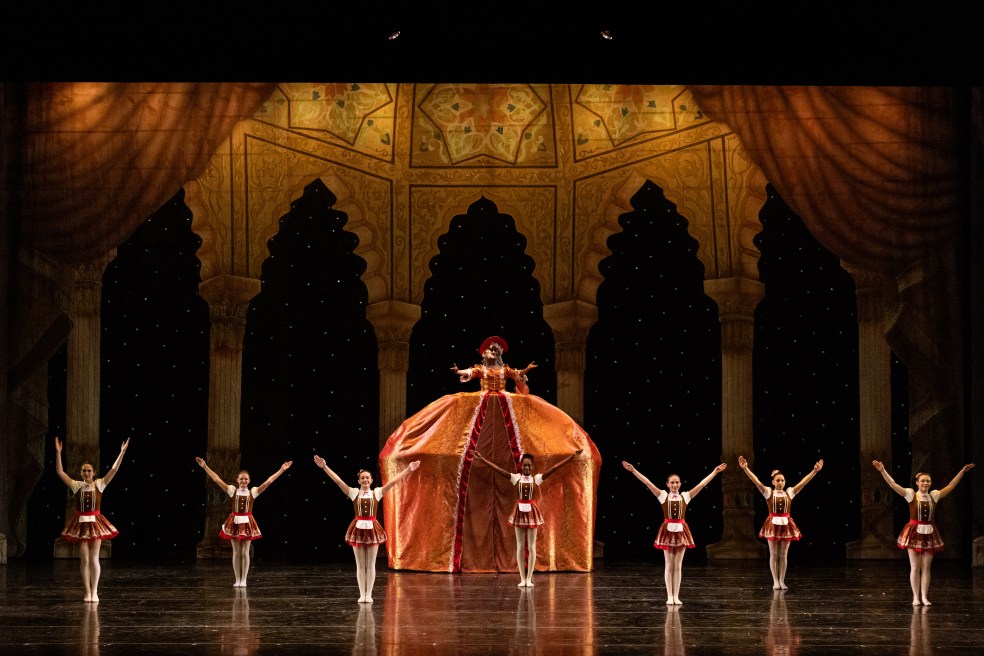
No Nutcracker is complete without Mother Ginger. Dressed in shades of ginger, she concealed an army of gingerbread dancers both large and small. The tiny dancers tugged on heartstrings while the larger dancers carried the scene.
Young Clara embraces her “princess” self. Photo by Dave Pearson
I loved that the Sugar Plum Fairy was Clara, as her dream. Her arc transformed her into a princess then returned her to the child who loved her Nutcracker. The pas de deux was effortless and weightless, as it unfolded in a dream. Display for its own sake was absent, allowing the story to remain clear, confident, and complete.
The choreography dignified the company dancers. It matched real bodies and their spectacular abilities. Costumes, movement, sets, and music were integrated with confidence and restraint.
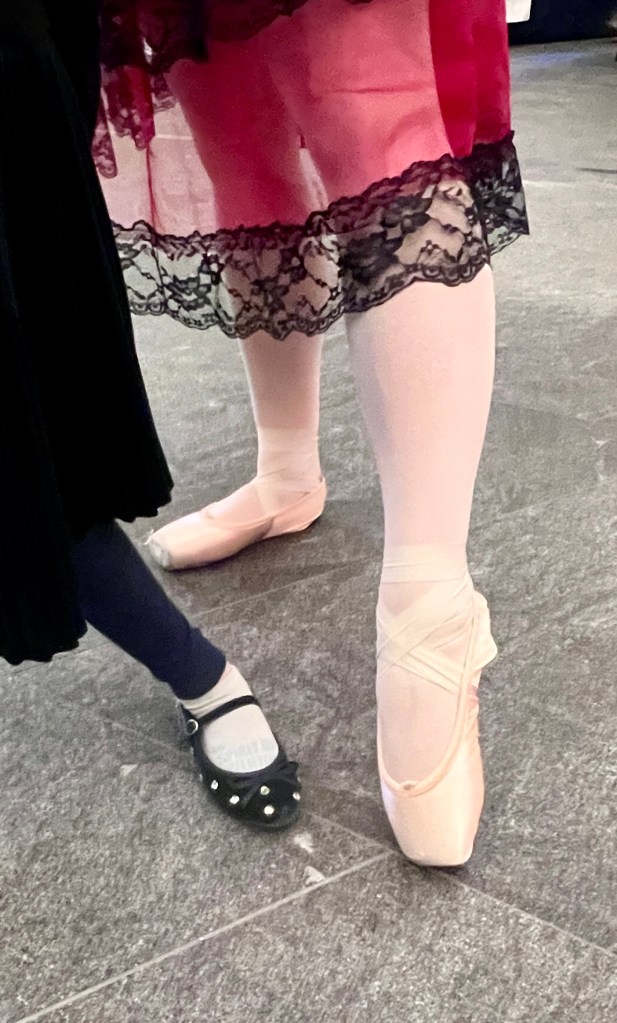
Professional dancers and ballet students harmonized organically. Technique and storytelling were equally respected. Children as mice and soldiers enhanced holiday unity. This is the mark of leadership that serves talent and allows it to flourish.
Snow magically appeared. Photo by Dave Pearson
There were moments when I felt carried away. Suddenly the people behind me stopped rustling paper and kicking my seat. There was a stillness throughout the auditorium. I knew then that this performance was an absolute success.
Stillness means the audience is no longer evaluating, no longer fidgeting; no longer anticipating. It means they were fully inside the experience. On this evening, approximately 1,200 people shared that stillness.
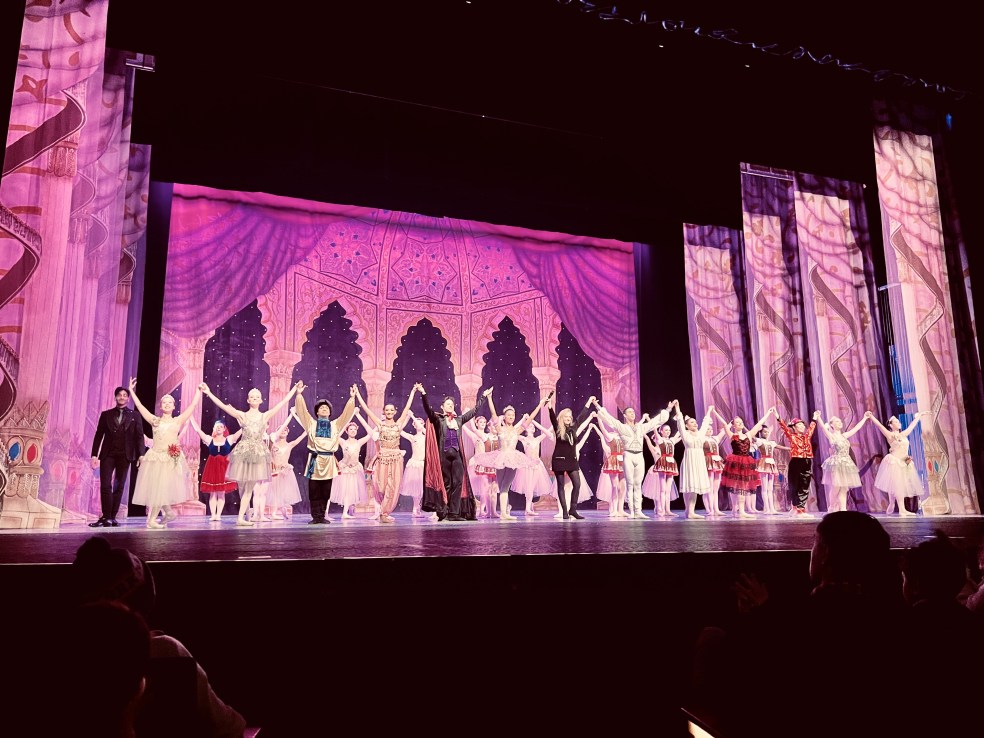
That leadership style was visible at curtain call. When co-founders Rafik Hegab, artistic director and choreographer, and Elysabeth Muscat, Managing Director, came on stage, they first applauded the dancers. Rafik stood to the far side, took a brief bow, and remained focused on the dancers. Ego was absent. Excellence was present. The joy was shared.
I left edified. Nothing had asked me to tolerate it. As spectator, I was invited to participate, intelligently, quietly, and fully.
Following the performance, future ballerinas were warmly greeted by Sierra Stipetich and Alexa Glomp
This Nutcracker was light without being thin, precise without stiffness, joyful without excess. It was designed to carry us through the story and safely return us when the curtain closed.
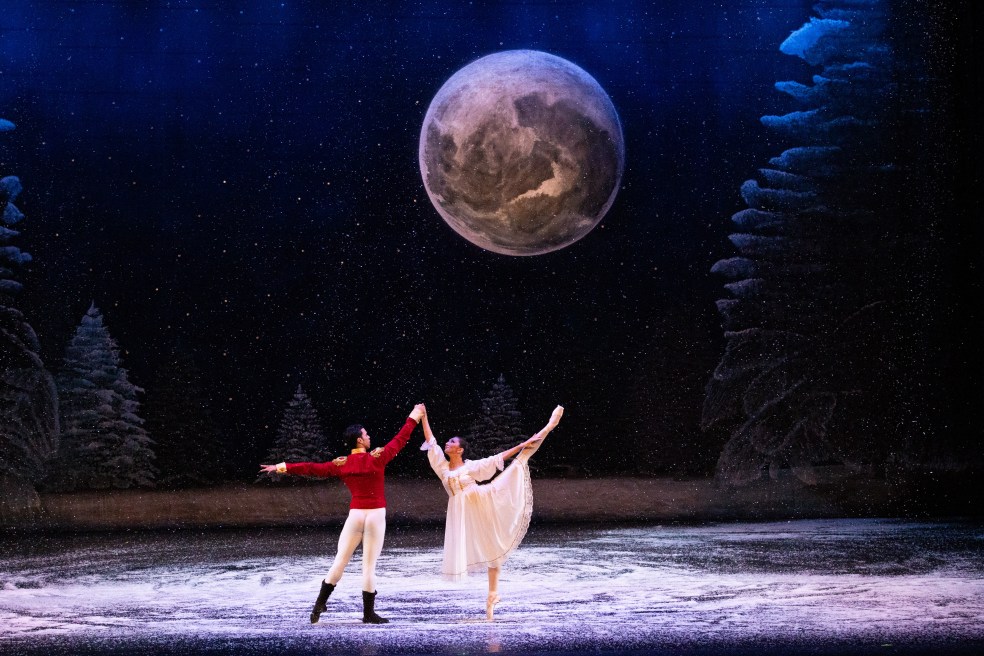
Princess Clara and her prince. Photo by Dave Pearson
Would I see The Nutcracker again? Theirs? Yes. Always.
The next performance for Virginia National Ballet will be the timeless Swan Lake – March 20, 2026 at Hylton Performing Arts Center and March 28, 2026 at Capital One Hall. An online silent auction will be launched in late January. You will be able to bid on trips, art, tickets, and much more. The auction items will be available at both performance venues. Click here for more information on the auction or for tickets.
Hayley Podschun in Guys and Dolls at Shakespeare Theatre Company. Photo by Teresa Castracane Photography.
Guys and Dolls – the quintessential feel-good play – hopeful, energetic; dynamic. The performance inspired patrons to dance with big smiles on their faces.
From a technical and performance perspective, the play lived up to its Broadway roots. In many ways it surpassed them. On my drive home, I turned on the Broadway cast soundtrack. Accounting for recording and broadcast quality, its energy and enthusiasm did not compete with STC. Well done!
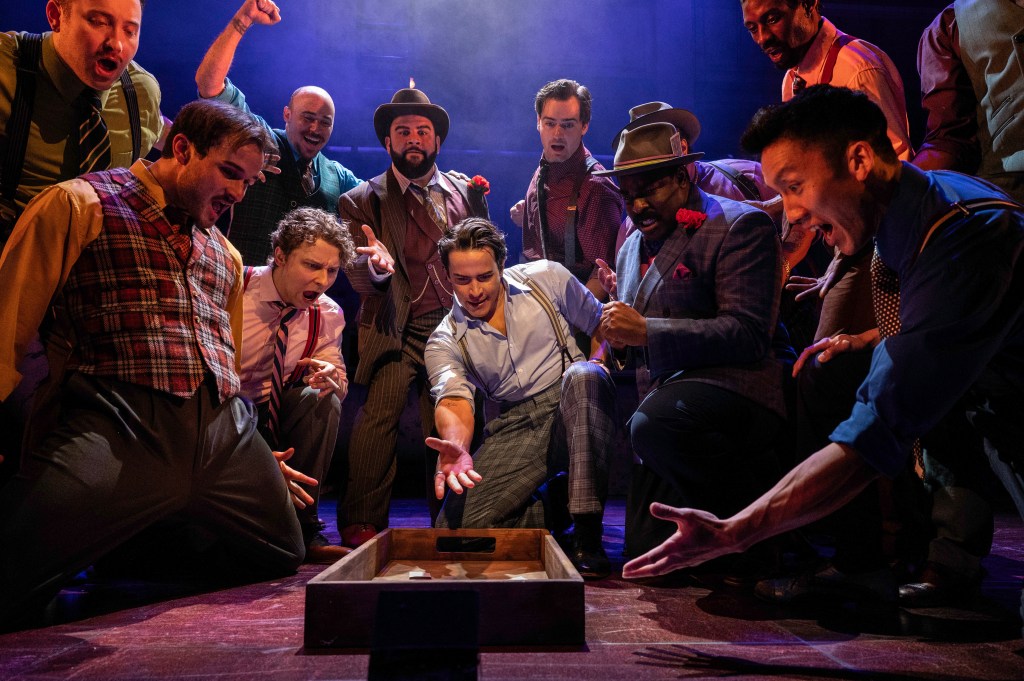
Top left – bottom: The cast of Guys and Dolls at Shakespeare Theatre Company. Photo by Teresa Castracane Photography. Lawrence Redmond, John Syger, Julie Benko, Jimena Flores Sanchez, and Katherine Riddle in Guys and Dolls at Shakespeare Theatre Company. Photo by Teresa Castracane Photography. Calvin McCullough and Kyle Taylor Parker in Guys and Dolls at Shakespeare Theatre Company. Photo by Teresa Castracane Photography. The cast of Guys and Dolls at Shakespeare Theatre Company. Photo by Teresa Castracane Photography.
After months of attending powerful productions at the Shakespeare Theatre Company, I found myself at a Preview that offered something refreshingly different. The company was opening Guys and Dolls at Harman Hall. The beloved American musical is presented here with remarkable vibrancy. I was fortunate to see it before the official opening, catching the energy of a nearly sold-out house. It opened to such acclaim and demand that four additional performances were added.
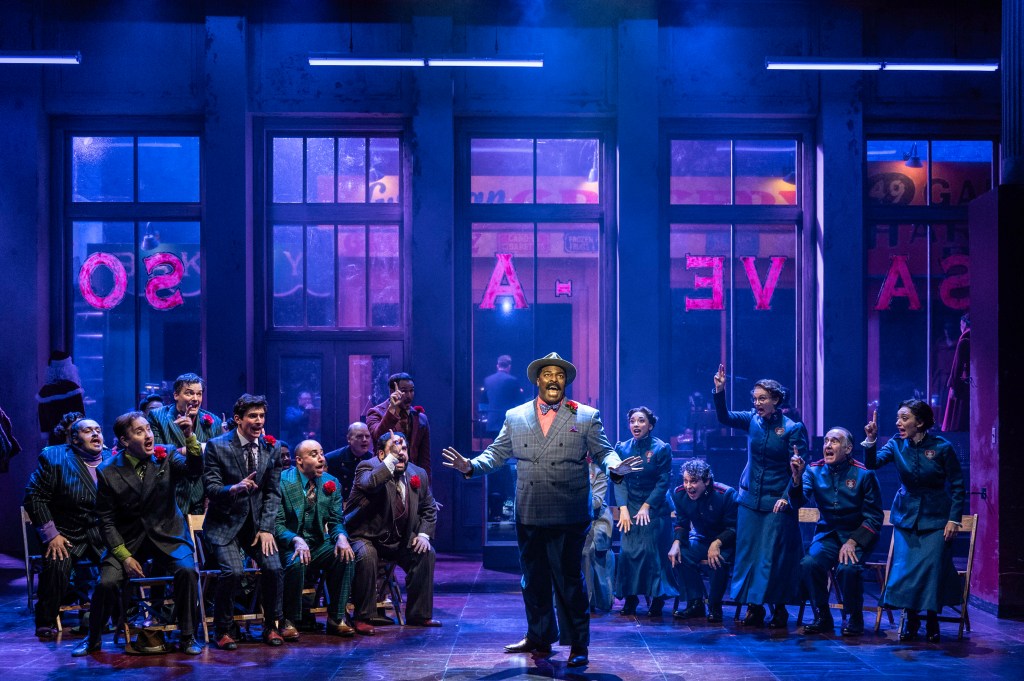
This is not critique. This is anticipation. This is the excitement building toward what promises to be a joyful and spirited theatrical experience, perfect for the season of hope and joy. The live music set outside the picture windows of the Salvation Army, with the perfectly attired band leader, created the ideal atmosphere for the memorable performance.
The artistic team behind this production is impressive. Director Francesca Zambello, Artistic Director of Washington National Opera, brings operatic sensibilities to Damon Runyon’s stylized world. Choreographer Joshua Bergasse, whose Broadway credits include On the Town, delivers legitimate musical theater dancing that feels both classic and fresh. STC continues to expand its presentation range while maintaining its exacting artistic standards, thanks in great part to the vision of Artistic Director, Simon Godwin.
Top Left to Bottom: Julie Benko in Guys and Dolls at Shakespeare Theatre Company. Photo by Teresa Castracane Photography. Hayley Podschun in Guys and Dolls at Shakespeare Theatre Company. Photo by Teresa Castracane Photography. Nick Alvino, Tommy Gedrich, and the cast of Guys and Dolls at Shakespeare Theatre Company. Photo by Teresa Castracane Photography. The cast of Guys and Dolls
What makes Guys and Dolls endlessly enjoyable is its ‘plausible relatability’ in the world it creates – the gamblers, the nightclubs, the dance scenes, the romance, and the comedic timing that lands perfectly again and again. There are no ‘bad guys.’ Some just had a few ‘bad habits.’ Damon Runyon’s language and characters form a theatrical universe that is playful, distinct, and instantly recognizable. Frank Loesser understood this when he composed the score in 1950. He did not try to naturalize Runyon’s style; he amplified it. He gave it music, and that music carries the story with humor, color, and emotional lift.
Top Left to Bottom Right: Hayley Podschun and Julie Benko in Guys and Dolls at Shakespeare Theatre Company. Photo by Teresa Castracane Photography. Jacob Dickey and Julie Benko in Guys and Dolls at Shakespeare Theatre Company. Photo by Teresa Castracane Photography. Hayley Podschun and Rob Colletti in Guys and Dolls at Shakespeare Theatre Company. Photo by Teresa Castracane Photography. Jacob Dickey and Julie Benko in Guys and Dolls at Shakespeare Theatre Company. Photo by Teresa Castracane Photography.
At Harman Hall, I experienced this world take shape. Sarah Brown was uncompromising, Sky Masterson made impossible bets, Nathan Detroit ran the oldest established permanent floating crap game in New York, and Miss Adelaide developed psychosomatic colds from fourteen years of broken marriage promises. It was all there: the charm, the humor, the rhythm, the dancing, the romance, and the fun. The performance quality of acting, singing, and dancing was exceptional. See for yourself – buy your tickets and make it a holiday event for your family. You too can walk out with a big smile.
Luck be a Lady Tonight – Roll the Dice!
Left: Graciela Rey, Aria Christina Evans, Hayley Podschun, Jessie Peltier, and Jimena Flores Sanchez in Guys and Dolls at Shakespeare Theatre Company. Photo by Teresa Castracane Photography.Right: The cast of Guys and Dolls at Shakespeare Theatre Company. Photo by Teresa Castracane Photography.
So many theater lovers and English majors banter the name Macbeth. Murderer. Usurper. Tyrant. The ambitious thane manipulated by his evil wife into regicide and madness. We think we know the story. Do we?
Let’s unpack this myth and discover the deception.
Jame I of England / James VI of Scotland
Shakespeare was not writing history when he penned Macbeth around 1606. He was writing for his job security. The playwright understood his audience with surgical precision, and his most important audience member had just ascended the English throne three years prior. James VI of Scotland had become James I of England in 1603. Shakespeare needed the new royal patronage. The new Scottish king needed legitimacy on English soil.
The Match Made in Theatrical Heaven
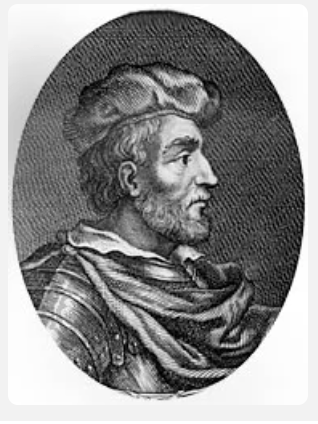
DUNCAN I MACBETH
The Historical Macbeth
Mac Bethad mac Findlaích ruled Scotland from 1040 to 1057. That was seventeen years of stable rule in medieval Scotland. This was unheard of in the Scotland of the 1000’s where kings were routinely murdered, deposed, or challenged. Tyrants did not last seventeen years.
The historical Duncan I bears no resemblance to Shakespeare’s wise, elderly, benevolent king. The real Duncan I was young, weak, and foolishly aggressive. He invaded Macbeth’s territory of Moray in 1040. Macbeth slew him in the of Battle of Pitgaveny near Elgin. Warrior to warrior – an honorable death between combatants rather than the stabbing of an elderly sleeping guest in his bedchamber.
Macbeth possessed legitimate claim to the Scottish throne through his wife, Gruoch, granddaughter of King Kenneth III. Under the tanistry system of Scottish succession, Macbeth’s claim stood as valid as Duncan’s. Arguably stronger.
During his reign, Macbeth made a pilgrimage to Rome in 1050 to meet with the Pope – a pilgrimage possible only by a secure monarch. Chroniclers of the period recorded that he “scattered money like seed to the poor.” A guilt-ridden, paranoid murderer does not leave his kingdom for months to distribute charity abroad. Only a secure, prosperous, pious king would do so at the time.
The real Macbeth wore regal clothes. Shakespeare stripped them off and dressed him in villain’s rags.
Why the Lies?
Follow the money. Follow the power. This is how we uncover truth in any century.
James I needed several things when he took the English throne. He needed legitimacy, as a Scottish king ruling England was hardly popular with English subjects. He needed cultural acceptance. He craved flattery of his royal lineage. And he demanded entertainment that reinforced his divine right to rule.
Shakespeare delivered all of it with the precision of a master.
By making Duncan righteous and murdered, James’s ancestor became the martyred good king whose death must be avenged. By making Macbeth the evil usurper, anyone who would challenge rightful succession became damned by association. By making Banquo noble and prophesied to father a line of kings, Shakespeare flattered James’s other claimed ancestor as the hero whose bloodline fulfilled destiny. By adding witches and supernatural elements, the playwright appealed directly to James’s obsession with witchcraft. The king had written Daemonologie and fancied himself an expert on the subject. And by showing divine punishment for regicide, Shakespeare reinforced James’s claim to rule by divine right.
This was not art. This was propaganda dressed in iambic pentameter. Magnificent propaganda, certainly. Effective beyond measure. Propaganda, nonetheless.
The Matilda Connection
The bloodlines become truly fascinating when we examine how Scottish royal heritage eventually claimed the English throne.
After Macbeth’s death in 1057, Malcolm III assumed the Scottish crown. This is the “Malcolm” who defeats Macbeth in Shakespeare’s play, the son who avenges his father Duncan’s death. Malcolm married Margaret of Wessex, an Anglo-Saxon princess who fled to Scotland after the Norman Conquest of England.
Their daughter, Edith of Scotland, was born around 1080. When Edith married King Henry I of England in 1100, she changed her name to Matilda. The name sounded more Norman, more acceptable, less conspicuously Scottish to English ears.
This Matilda, born Edith, became the crucial bridge between kingdoms. Through her, Duncan’s blood flowed into the English monarchy via Malcolm III. Through her mother Margaret, descended from Alfred the Great, Anglo-Saxon royal blood joined the mixture. Matilda became the convergence point of Scottish and English royal heritage.
Matilda’s daughter, Empress Matilda, fought for England’s throne during the civil war known as the Anarchy. Her descendants became the Plantagenet kings who ruled England for centuries. The bloodline continued its steady march through history.
When Elizabeth I died childless in 1603, James VI of Scotland possessed the strongest claim to the English throne precisely because of these bloodlines. They traced back through the centuries, through Matilda the name-changer, through Margaret of Wessex the refugee princess, through Malcolm III the avenger, through Duncan the historical king Shakespeare would later slander.
James was not merely some Scottish king seizing an English throne. He represented the convergence of Scottish, Anglo-Saxon, and Norman royal blood meeting in one person. His legitimacy ran deep, and he knew it. He needed others to know it as well.
Shakespeare ensured they did.
A Small Digression
The Shakespeare 2020 Project founded by author, Ian Doescher, had a complete syllabus and timeframe for reading. I read and listened fast and thoroughly, then dug deep into historical relevance. I often listened to the plays while walking my dogs along the magnificent trails of parks and paths in my area. When I arrived at my ‘magiclands’ to find them closed due to the dread virus, I ushered the dogs back into their seats in my car and drove non-stop to a closer park. Furious, I decided that NOW was the time to hear Macbeth! Hear it, I did! We walked for the entire reading. When I returned to my book – I read it in its entirety with the readings still ringing in my ears. Yet, the play was enough. It did not send me on a single rabbit trail. I was too mesmerized by the psychological depth to worry about historical veracity. Until now, that it. Why? Nothing terribly intellectual – a short YouTube video addressing the very topic. I was hooked and the rabbit trail led me to rooms and rooms of pre-1000’s Scottish, English, and Norman history to the assertion of the throne by Macbeth.
What happened to King Macbeth? He was killed at the Battle of Lumphananby Malcolm Canmore (later Malcolm III), son of Duncan I.
Why has Macbeth been an ill-fated play – sets fell, and actors died then theatrically referred to as simply “that Scottish Play?” Marginalizing and demonizing a past king? Lincoln quoted lines from Macbeth, “Out, out brief candle…” following the fall of Richmond on April 9, 1865. On April 15, 1865, SIX days later, he was assassinated by John Wilkes Booth who had played the title role in Boston two years earlier. Exactly who assassinated Lincoln? Booth or Macbeth? Where is Macbeth’s reach?
Perhaps we should view all historical narratives with a skeptical eye. Whether from 1606 or from 2025, those who write the story control what becomes truth. Those who flatter power shape how the past is remembered.
The Lesson
I love Shakespeare for his poetry, his psychological insight, his timeless exploration of ambition, guilt, and the human condition. He was a genius wordsmith. In reality – he was a businessman, a survivor, a man who understood power and how to serve it while appearing to entertain.
Macbeth is splendid theater. The poetry soars across centuries. Lady Macbeth’s guilt, the dagger speech, “tomorrow and tomorrow and tomorrow” are extraordinary achievements in dramatic writing. The play deserves its place in the canon.
History? Not close.
The real Macbeth deserves better than four centuries of slander. He ruled well. He ruled long. He had legitimate claim to his throne. He was pious enough to pilgrimage to Rome and generous enough to scatter money to the poor. History should remember him as he was, not as Shakespeare portrayed him.
Politicians make promises. Playwrights craft myths. The winner writes history. The powerful control narratives.
Whether the emperor wears clothes or stands naked before us depends entirely on who holds the pen.
Ibsen’s Rarest Masterpiece Flies Through Moral Fog
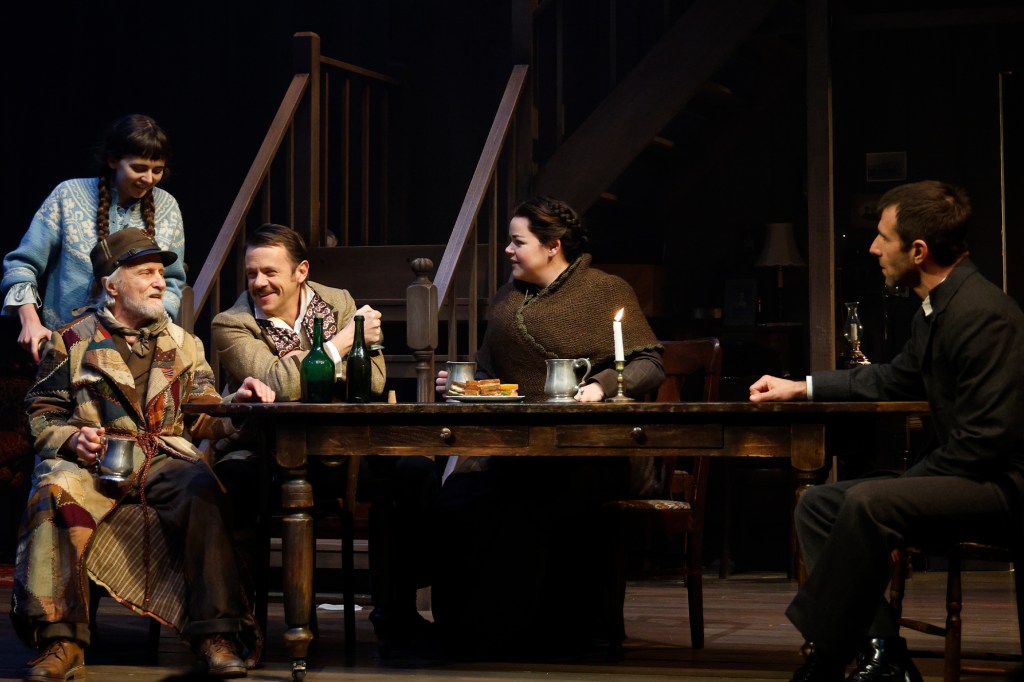
Robert Stanton as Håkon Werle and Mahira Kakkar as Mrs Sørby in The Wild Duck. Photo by Hollis King
Looking for the garage exit elevator into Klein Theatre last Thursday evening, I met Angela Lee Gieras, Executive Director of Shakespeare Theatre Company, She accompanied me in the correct elevator to the main lobby where she introduced me to Artistic Director Simon Godwin. Shaking my hand, he offered quiet advice that stirred my curiosity, “This might be the only and last time you will see this play in our lifetime.”
That alone should compel you to see Henrik Ibsen’s The Wild Duck before it closes November 16.
Unique and Complex
Henrik Ibsen (1828-1906), often called “the father of modern drama” and three-time Nobel Prize nominee, built his reputation on explosive social critiques—A Doll’s House, Ghosts, An Enemy of the People—plays that attacked the hypocrisies of 19th-century society. In The Wild Duck, considered by many to be his finest work, he turns his sharp eye inward. Here, he draws from his privileged Norwegian family. Ibsen created Gregers Werle, the idealistic crusader determined to expose truth at any cost. This was inspired by members of his own patrician class. He named his young duck-loving heroine, Hedvig, the same name as his grandmother.
The play is complex. Understanding the author’s circumstances, background, and character, helps hold the ‘color’ of the play. In The Wild Duck, Ibsen was not attacking society’s lies. He was attacking the idealism of his family and overeager reformers. The question is not whether we should seek truth, but whether forcing truth on others is salvation or destruction. That moral ambiguity is perhaps, why this masterpiece has been performed so rarely.
L. Alexander Hurt as Gregers Werle, Robert Stanton as Håkon Werle in The Wild Duck. Photo by Hollis King. R. Alexander Hurt as Gregers Werle, Nick Westrate as Hjalmar Ekdal in The Wild Duck. Photo by Gerry Goodstein.
Nothing Is As It Seems
Simon Godwin’s production, adapted by David Eldridge, opens with Victorian elegance—men in tails, ladies in ornate gowns, an elaborate dinner party. The set is bathed in shades of green. A small, grey-bearded man vanishes through a green door then reappears. He resembled a quintessential leprechaun though the play is set in Norway. He is the disgraced nature-loving Lieutenant who raises then hunts and shoots rabbits in his son’s loft. His son has embarked on a mission to restore his father’s honor.
The production is punctuated by haunting musical interludes—Alexander Sovronsky performs arrangements of 19th-century Norwegian folk and classical music on viola, Hardanger fiddle, and langeleik. Like the narrators in Shakespeare’s plays, the music shifts between melodic reflection and foreboding darkness, guiding us through the play’s emotional terrain.
As Godwin notes in the program, Ibsen is asking something far more dangerous than honor: “In the battle for moral certainty, who is the casualty? What is the price of truth?”
L. Melanie Field as Gina Ekdal Center: Maaike Laanstra-Corn as Hedvig R. Maaike Laanstra-Corn as Hedvig, Melanie Field as Gina Ekdal in The Wild Duck. Photos by Gerry Goodstein.
The Typhoid Mary of Idealism
The wealthy idealist, Gregers Werle, ‘knows’ what is best for everyone. He spreads his convictions like contagion—what I describe as ‘Typhoid Mary’ in Victorian tails – delusional in his certainty that he is saving everyone by forcing them to face “truth.”
Ibsen was intimately familiar with this character. Ibsen belonged to Norway’s patrician elite, and The Wild Duck draws from his own family’s dynamics as they navigated the evolution of society. Gregers embodies the dangers of Ibsen’s own class—reformers who wield truth as a weapon.
What happens when someone appoints themselves the arbiter of others’ honesty? When does truth-telling become destruction? The answers are not simple. This is perhaps, why this play has been performed so rarely.
L: Alexander Hurt as Gregers Werle Photo by Hollis King Center: Alexander Hurt as Gregers Werle, Nick Westrate as Hjalmar Ekdal Photo by Gerry Goodstein R: Maaike Laanstra-Corn as Hedvig, Melanie Field as Gina Ekdal, Alexander Hurt as Gregers Werle Photo by Hollis King
Mental Gymnastics Required
The Wild Duck demands the audience’s full attention for which they are rewarded. Nick Westrate (recently in STC’s Frankenstein) and Melanie Field (the heartbreaking Sonya in STC’s Uncle Vanya) lead a flawless ensemble. Maaike Laanstra-Corn’s Hedvig, the young duck-loving girl, caught in the adults’ web of lies, delivers a performance that lingers long after the stage goes dark. The 26-year-old Washington, DC native and Brown University graduate is an artist to watch.
I felt like a voyeur and a gossip throughout the play. I was the voyeur at that dinner party, wondering what came next. Then a gossip, observing the Ekdal household. It felt like I was overhearing through a parlor wall. It felt intimate, forbidden, yet addictive. I was inside their home, yet uninvited. My real estate mind went into calculation mode of the Ekdal house – how many rooms, how many square feet, how much were they asking for the rent of their spare room?
The audience was silent. No one even cleared their throat. When the lights dimmed, and the play ended, the audience stood up in unison, applauding politely. The applause was respectful, reverent, and slightly haunted. We were processing.
L: Nick Westrate as Hjalmar Ekdal, Maaike Laanstra-Corn as Hedvig – Photo by Hollis King. L: Melanie Field as Gina Ekdal, Nick Westrate as Hjalmar Ekdal – Photo by Gerry Goodstein
Why You Should Go
The Wild Duck is not a feel-good play. It is a feel-smart play. If you want to wrestle with questions about truth and delusion that feel urgently relevant in 2025, when crusaders of all stripes claim absolute certainty about what is best for everyone—this is your play.
What makes this play essential is Ibsen’s unprecedented psychological depth and intricacy of character. He peels back layers of late 19th-century culture and morals with surgical precision, revealing not just what people said, but what they believed, feared, and concealed. Anton Chekhov, who considered Ibsen his favorite writer, adopted this pioneering focus on psychological realism—the exploration of ordinary lives with extraordinary depth. Chekhov developed his own distinctive style with greater emphasis on subtext and naturalistic dialogue, but the foundation was Ibsen’s radical insistence that theatre could reveal the human psyche with the intuition of a psychological case study.
If you were moved by Melanie Field’s Sonya in Uncle Vanya earlier this season, then you will appreciate the direct inspiration from Ibsen to Chekhov being honored by the Shakespeare Theater Company. Both playwrights understood that the most profound dramas unfold not in grand gestures, but in the quiet devastation of people confronting uncomfortable truths about themselves and the society that shaped them.
Ibsen meticulously controlled how his work was interpreted; writing detailed instructions to directors for The Wild Duck productions. This most personal of his plays deserves to be seen with the care Godwin has brought to it, even if just once. After exploring Ibsen’s background for this blog, I find myself compelled to return—to see with new eyes what I missed the first time, armed now with understanding of what the playwright was truly after.
L: Maaike Laanstra-Corn as Hedvig -Photo by Hollis King R: Maaike Laanstra-Corn as Hedvig, David Patrick Kelly as Old Ekdal, Nick Westrate as Hjalmar Ekdal, Melanie Field as Gina Ekdal, Alexander Hurt as Gregers Werle – Photo by Gerry Goodstein
A Night with Macbeth at the Crossroads of Traditional and Modern
There’s something deliciously ironic about preparing to watch “The Scottish Play” through a screen. Armed with Marjorie Garber’s scholarly insights and Paul Cantor’s lectures queued on YouTube, I found myself straddling centuries – one foot in traditional academic preparation, the other in digital-age convenience. But nothing could have prepared me for the way that the filmed live Max Webster-directed production at London’s Donmar Warehouse; starring David Tennant and Cush Jumbo; would dissolve that careful distance between viewer and viewed.
The Seduction of Simplicity
In an era where productions often compete to outdo each other with elaborate sets and costumes, this Macbeth takes a boldly minimalist approach. The stark staging serves not as a constraint but as a canvas, allowing the raw power of Shakespeare’s language and the actors’ craft to paint vivid pictures in our minds. It’s a reminder that sometimes, less is more – especially with performers of exceptional caliber commanding the space.
The Intimacy of Technology
Things get interesting with the production’s use of binaural sound technology and the theater’s 5.1 surround sound transformed what could have been a mere filming of a stage play into something more visceral. Every whispered plotting, every sharp intake of breath, every moment of hesitation becomes startlingly intimate. This is psychological cinema at its finest. Using modern technology to achieve what Shakespeare himself must have dreamed of – the ability to place the audience not just in front of the action, but inside of it. Macbeth’s eye contact with the viewer is both thrilling and chilling.
Gender, Power, and the Space Between Desire and Action
At the heart of the play is an exploration of gender dynamics that feels startlingly relevant to contemporary discussions. Lady Macbeth emerges not simply as an ambitious woman, but as a complex figure trapped in a society that offers her “no chance of independent action and heroic achievement.” Her transformation of nouns into verbs – turning the Weird Sisters’ prophecies into calls for action – speaks to a deeper truth about power and agency.
The production masterfully highlights how Lady Macbeth’s infamous “unsex me here” speech resonates with modern conversations about gender constraints. Her willingness to “dash out the brains” of her nursing infant becomes not just an act of horror, but a violent rejection of prescribed feminine roles. In Jumbo’s portrayal, we see a woman who has internalized the brutal logic of a masculine world, turning it back on itself with devastating effect.
The Question of Responsibility
Perhaps the most unsettling aspect of this production is how it implicates its audience. Through the immersive sound design and intimate camera work, we become less spectators and more accomplices. Each choice, each action, each consequence feels personal in a way that traditional staging rarely achieves. The production asks us, in our era of influence and manipulation, whether we are ever truly responsible for our actions – a question that echoes far beyond the theater walls.
A New Kind of Shakespeare Experience
What makes this production remarkable is not just its technical achievements or stellar performances, but how it manages to honor both theatrical tradition and contemporary sensibilities. It’ is Shakespeare for our time: psychologically acute, technologically sophisticated, yet deeply rooted in the timeless power of language and performance.
For those planning to view the film: Yes, do your homework. Garber will guide you through the text and Cantor illuminates the themes. But, be prepared to have all that careful preparation wonderfully undermined by a production that refuses to let you remain a distant spectator. In bridging the gap between stage and screen, between past and present, this Macbeth creates something entirely new – and utterly compelling.
For optimal viewing, resist the urge to maintain analytical distance. This is one production where surrender yields the richest rewards. To whet your appetite take a little tour.
Brodie Donougher PC: Poetry Film Productions The DancerPhoto by Lumosia Photography London One of the many faces of Brodie Donougher
“Watch me, watch me, watch me make this flip,” five-year-old Brodie Donougher implored his parents as he flipped off the living room sofa. That was the beginning of Brodie’s performing career. He was a happy, enthusiastic, and energetic child, who loved to share his talents with anyone who wanted to see them. His motivation was to bring enjoyment to others. At 21, he performs professionally for audiences’ enjoyment as an actor, singer, and dancer.
From flips off the sofa at the age of five to today, Brodie has had three major roles: on London’s West End as Billy Elliot for three years; as Rookie with the Grand Rapids Ballet in the United States; and, beginning this month, in Vienna, Austria, in The Phantom of the Opera. What drives Brodie Donougher to immerse himself into a production and embody a character? His infectious enthusiasm to pursue his craft and indulge his drive for excellence, because he says, “You can never be too good.”
Skyline of Opera Garnier, Paris – home of the Phantom
In January 2024, Brodie arrived in Vienna, Austria, to begin rehearsals for Camron Mackintosh’s production of Das Phantom der Oper –The Phantom of the Opera by Andrew Lloyd Webber. He will be performing his roles entirely in German, (the Austrian Hoch Deutsch dialect). Brodie is multilingual speaking Italian, now German, and of course, English. He has already learned ‘The Phantom text’ in Hoch Deutsch. “We have an incredible team of top performers, and I feel honored to be among them,” said Brodie who plays two characters – Hannibal’s Guard, as well as an ensemble member. He explains, “As the ensemble member, my character is an attractive young dancer who performs at the Opera Garnier in Paris. He is quite flirtatious, and loves the attention of the two principals, Carlotta and Piangi. Hannibal’s Guard makes a prominent entrance and poise at the beginning and keeps strong entrances throughout the whole first act. In addition to playing two characters in the performance, I am also a ‘stage hand’ and come and go throughout the different scenes and help keep the narrative going.” The production opens to the public on March 15. Tickets are sold out through June 20. The show will play in Vienna through June 2025.
An insatiable learner, Brodie says, “It’s my belief that every moment that you’re sitting idle, there is opportunity wasted. If I am sitting at home or in a cafe relaxing, there is wasted opportunity when I could go out and learn something new. Don’t get me wrong I relax; everybody needs that, but I have this constant need to be learning or enhancing – to do more. If I can go to a ballet class, I will go, and as soon as I’ve finished it and I learn about a workshop happening, and, if time allows, I will attend that as well. I love using my time to improve and develop my skills.”
Photo Curtesy of Brodie Donougher Flipping and Flying
How has one so young accomplished so much? “I love to give one hundred percent,” explains Brodie. “Sure, I can get by with 70 percent. But then, I think about how the audience might have enjoyed the production if I had given 100 percent. Every actor on a stage reaches the audience. I love to touch each member of the audience and bring them into the production.”
An accomplished and highly recognized ballet dancer, Brodie wanted to use his voice and get back to his “roots” of musical theater. He described his original roots , “I am from Blackpool in the Northwest of England. It is not a very prosperous area, but that is home.” The area’s prosperity or lack thereof did not hold him back. He was scouted as a young child by the Royal Ballet School Primary Steps Program where his hard work and dedication gave him opportunities beyond imagination. They selected him to join the school. He embraced, breathed, and lived every aspect of his dream-come-true. “Whenever I get into a less than optimal situation, I think of my roots. Where I came from and what I have accomplished. I always feel tremendous gratitude and want to give more,” he explained.
One day, while waiting for Brodie at his ballet class, him mother overheard other mothers discussing upcoming auditionsin Manchester, England for Billy Elliot the Musical. She decided to give Brodie the audition experience. He, along with several other students from his ballet school, auditioned. Brodie, at nine years old, sustained the grueling eight-hour initial audition where at every hour contenders for the lead were dismissed. After seven hours, Brodie was still dancing. Over a lengthy audition process, Brodie was offered the part of Billy Elliot. At that time, he also received offers to study with the Royal Ballet School and with the Elmhurst Ballet School, both premier ballet schools in the UK. At his young age, he knew that his decision could affect his future. He accepted the lead in Billy Elliot the Musical.
Photo curtesy of Brodie Donougher PC: Brian Cantwell A real life Billy Elliot
Billy Elliot was a highly acclaimed production on the West End. Brodie was Billy #39 and performed 144 times over three years. He says, “That is when I discovered that I love to perform, when I looked out in the audience and saw thousands of people being entertained.” Brodie performed at the Olivier Awards, representing Billy Elliot for Best West End Musical, in 2015. He performed “Billy” on various television shows, including “This Morning,” a British daytime magazine program, and on the Late Late Show in Ireland. Charisma is among his many talents.
Brodie immersed himself in his ballet education following Billy Elliot. For the four years after the play ended, he studied ballet with the Elmhurst Ballet School and honed his craft.
Photo by Elmhurst Ballet School 15-year-old student, Brodie, at Elmhurst Ballet School
At 18, Brodie brought his talents to the United States, where he was selected by the San Francisco Ballet School for a full scholarship to become a senior student there. According to Data Pointes, the San Francisco Ballet School is ranked among the top ten best ballet schools in the world.
Photo curtesy of Brodie Donougher – PC: Ray Nard Image Maker All That Jazz – Grand Rapids Ballet
Following his two-year study at San Francisco, Brodie joined Grand Rapids Ballet as a professional dancer. His precision, technique, and ability to fully inhabit characters helped elevate the company’s performances. Brodie’s most “cherished” Grand Rapids Ballet role was when he was cast as “Rookie” in the Andy Blankenbuehler (a three-time Tony award winner for Bandstand, In the Heights, and Hamilton), production, Remember Our Song. Brodie explained, “When given the opportunity to portray a role in a show or musical, the biggest part of preparation for your role is research. The most important thing, before you even step into the studio or rehearsal, is to learn who the character is. His thoughts, fears, hopes, loves. I spent two weeks researching. This story was about sailors in WWII who were in a submarine. I tried to imagine myself as that young sailor living below the surface of the sea; not seeing daylight; leaving my mom behind. I slept on a metal cot with the smallest and thinnest cloth for a cover. I read books about submarines and accounts of sailors’ experiences in the depths of the ocean. I WAS Rookie. The Company’s board president came to me after one of my performances and told me, ‘I couldn’t even think it was you dancing…I felt as though I could feel every emotion. You made the performance storytelling.’”
While ballet is as natural as breathing for Brodie, he has much more to offer – acting, speaking, and singing. “I was told not to hide my light under a bushel,” recounts Brodie. “When I share my voice, the audience can experience the full impact of the character that I embody.” Voice, language and music make musical theater touching and memorable. Brodie has been preparing himself for every moment to entertain the audience whether solo or in ensemble. “I love working with my artistic team to produce the best possible theater for our audience. When we all give 100 percent, my heart is full.”
Photo curtesy of Brodie Donougher Snowy ‘Fred Astaire’Photo curtesy of Brody Donougher ‘Fred Astaire’ curtain call
Upon his return to the UK after Grand Rapids, Brodie performed in the West End Christmas production of The Snowman at the Saddlers Wells Peacock Theater. Although initially as a “swing” cast member, on many occasions he performed the role of Fred Astaire with finesse and elegance. His jumps were clean and crisp, his miming and acting were clear and relatable and “he helped bring an extra dimension to the performance,” per a theatergoer who enjoyed the production.
Photo by Brian Cantwell At the Stage Door
Asked what his dream role(s) might be, Brodie replied, “I’ve made a list on my laptop and on my phone of my dream roles and the shows for these roles are, just to name a few, the character of Mush in Newsies, and I would also love to play in Les Misérables. These are truly my dream roles and musicals. Ideally, my number one most desired role would be Enjolras, a ‘thinker and a man of action,’ according to Victor Hugo. He is the handsome young man who swings the red flag. I would also love to play Marius. It would be a dream come true if I could perform in a US touring company.”
At an age where many would still be considered “up-and-coming,” Brodie Donougher has already established himself as a consummate professional and world-class talent. His unrelenting work ethic and deep respect for his craft and production members suggest this is merely the first act in what will undoubtedly be a distinguished career.
Post ballet class exhilarationPhoto curtesy of Brodie Donougher Take a bow, Fred Astaire
Note: I met Brodie at a ballet performance several years ago. I was impressed by his tremendous presence yet humble nature. His fresh, fit, good looks and charisma were palpable. I was sorry to see him return to London because I had hoped to be able to watch him perform in the U.S. Since our first meeting, we have met for coffee and dinner in London. One morning while in London, I received an early morning message that he was performing in The Snowman that day. I managed to acquire tickets in under one hour and arrived at the theater with 10 minutes to spare. His performance was exceptional. This blog is to share this impressive actor with my sphere of readers and friends. He is someone to follow and make an effort to see. He is worth it.

























 Good News. Reviews. Events.