Lauren Gunderson’s brilliant re-imagining of Shakespeare’s “Hamlet” shifts the spotlight from the brooding prince to the women who orbit his world. In A Room in the Castle, Gunderson accomplishes in 85 minutes what Shakespeare took four hours to convey, creating an intimate portrait focused on Ophelia, her handmaid, Anna, and Queen Gertrude. Kaja Dunn’s elegant directing delivers a thought-provoking production. Gunderson was commissioned to write the play by the Cincinnati Shakespeare Company where it opened before it’s World Premiere on March 9, 2025 at the Folger Theater.
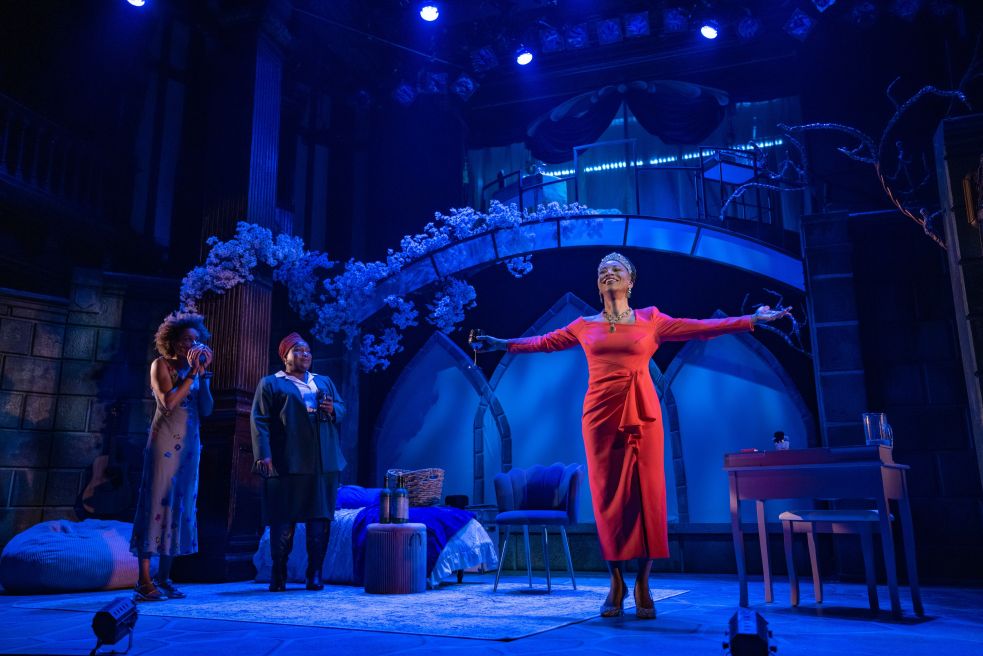
A Room in the Castle Dress Rehearsal 85:Sabrina Lynne Sawyer, Oneika Phillips, and Burgess Byrd in Folger Theatre’s world premiereof A Room in the Castle, written by Lauren M. Gunderson, directed by Kaja Dunn, co-produced with Cincinnati Shakespeare Company, on stage at the Folger Shakespeare Library, March4-April 6, 2025. Photo by Erika Nizborski
With only illusions to the narcissistic, gaslighting Hamlet of the original text, he is never seen. Not even the skull. Instead, we witness the story through the female perspective, exploring Ophelia as a motherless young woman navigating complex relationships and expectations. The production examines her circumstances: torn between her perceived love for Hamlet, her father and brother’s disapproval of him, Anna’s protective caution, and Queen Gertrude’s insistence on their marriage. Perhaps, it is “ . . .not to be.”
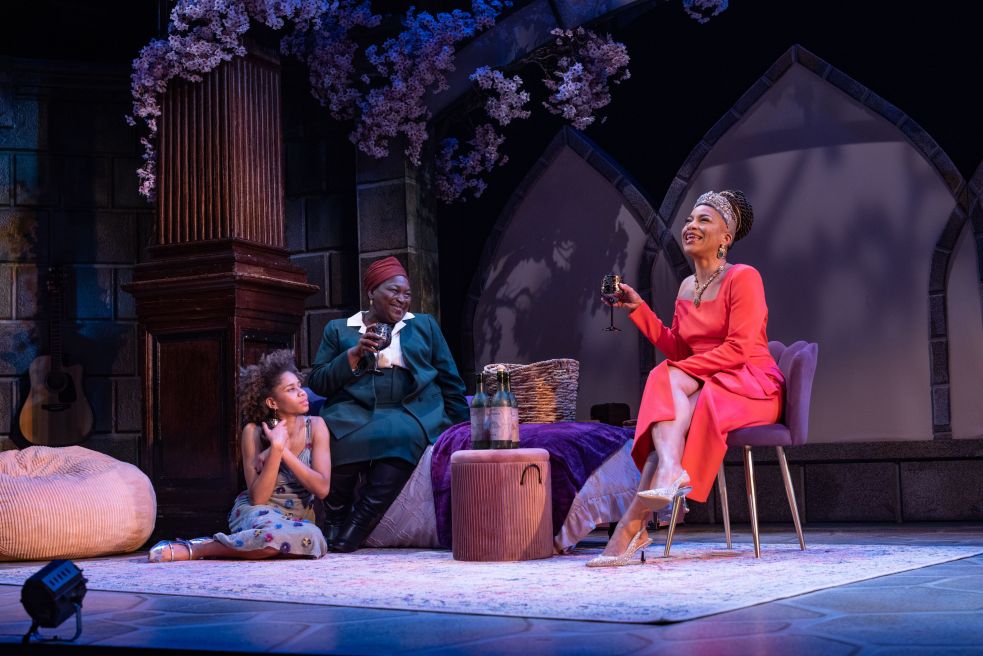
The all-female cast of three, delivers superb performances. Ophelia ( Sabrina Lynne Sawyer) emerges as a fully realized character – sometimes ambivalent, occasionally petulant, but ultimately autonomous. She is transformed from Shakespeare’s tragic figure into someone relatable in the 21st Century. Gertrude (Oneika Philips) commands the stage with regal confidence and impeccable dresses. Anna (Burgess Byrd) brings love and devotion to her role, having lost her own son and finding in Ophelia someone to mother and protect. Costume designer, Nicole Jescinth Smith’s costumes were visually stunning and spoke volumes about status and intent.
A Room in the Castle Dress Rehearsal 68: Oneika Phillips, Sabrina Lynne Sawyer, and Burgess Byrd in Folger Theatre’s world premiere of A Room in the Castle, written by Lauren M. Gunderson, directed by Kaja Dunn, co-produced with Cincinnati Shakespeare Company, on stage at the Folger Shakespeare Library, March4-April 6, 2025. Photo by Erika Nizborski
As we entered the Theater, I asked my guest and daughter, Tiffany, about her expectations of the play and to tell me her take on the original characters. Her immediate reply was that, “Hamlet was a madman, gaslighting Ophelia to her demise.” I shared that I found, “Both whiny and that she was needy and ‘a few cards short of a full deck.” Tiffany expected see a play about strength and perseverance over narcissistic dysfunction. I hoped that she was right and that after 425 years of waiting, Ophelia would find her voice.
The audience was greeted by the newly appointed director of the Folger Shakespeare Library, Dr. Farah Karim-Cooper, “I spent the last Twenty years of my life at Shakespeare’s Globe Theater in London. Over there, I was the resident scholar and director of education and research and it’s also where visceral performance informed all of my work, so I know something about theater. This is why I can say that I’m so inspired by the compelling and inclusive vision that’s emerging from the culture of this theater and our artistic leader Karen Ann Daniels.”
The intimate theater space enhances the experience, with its warm wood paneling, carved columns, and half-timbered walls – reminiscent of an Elizabethan setting. The set strikes an interesting juxtaposition between the now and then. When does this play take place? That really doesn’t matter.
A Room in the Castle Dress Rehearsal 93: Sabrina Lynne Sawyer, Oneika Phillips, and Burgess Byrd in Folger Theatre’s world premiere of A Room in the Castle, written by Lauren M. Gunderson, directed by Kaja Dunn, co-produced with Cincinnati Shakespeare Company, on stage at the Folger Shakespeare Library, March4-April 6, 2025. Photo by Erika Nizborsk
What makes this production special is that it honors Shakespeare’s world while boldly asking, “why not?” As Gunderson herself stated, “The play dances and duels with Shakespeare’s Hamlet, foregrounding the women in the play and re-imagining them with agency, vitality, and radical hearts eager for a new ending,… ripping a hole in the fabric of their suffocating story… because this play is anything but hopeless and tragic.”
There were frequent laughs and knowing sighs of recognition from the audience. While I won’t reveal the ending, I can say that it offers a satisfying conclusion to Ophelia’s journey. “A Room in the Castle” proves that sometimes the most interesting stories are found not with the titular character, but in the castle’s side chambers where the women speak their truths. “Obey, Agree, Assist?” How about “Rebel, Reject, Resist.”
A Room in the Castle Dress Rehearsal 91:Sabrina Lynne Sawyer, Burgess Byrd, and Oneika Phillips in Folger Theatre’s world premiere of A Room in the Castle, written by Lauren M. Gunderson, directed by Kaja Dunn, co-produced with Cincinnati Shakespeare Company, on stage at the Folger Shakespeare Library, March4-April 6, 2025. Photo by Erika Nizborski
A Room in the Castle Dress Rehearsal 87:Sabrina Lynne Sawyer, Burgess Byrd, and Oneika Phillips in Folger Theatre’s world premiere of A Room in the Castle, written by Lauren M. Gunderson, directed by Kaja Dunn, co-produced with Cincinnati Shakespeare Company, on stage at the Folger Shakespeare Library, March4-April 6, 2025. Photo by Erika Nizborski
Perhaps the most enduring power of Shakespeare lies not in the answers his works provide but in how each generation finds its own questions within them. Through my daughter’s unflinching modern lens, I watched not another classic Hamlet, but a study in how Ophelia finally gets the chance to exist beyond being defined by the men around her.
A Room in the Castle Dress Rehearsal 93: Sabrina Lynne Sawyer, Oneika Phillips, and Burgess Byrd in Folger Theatre’s world premiere of A Room in the Castle, written by Lauren M. Gunderson, directed by Kaja Dunn, co-produced with Cincinnati Shakespeare Company, on stage at the Folger Shakespeare Library, March4-April 6, 2025. Photo by Erika Nizborski
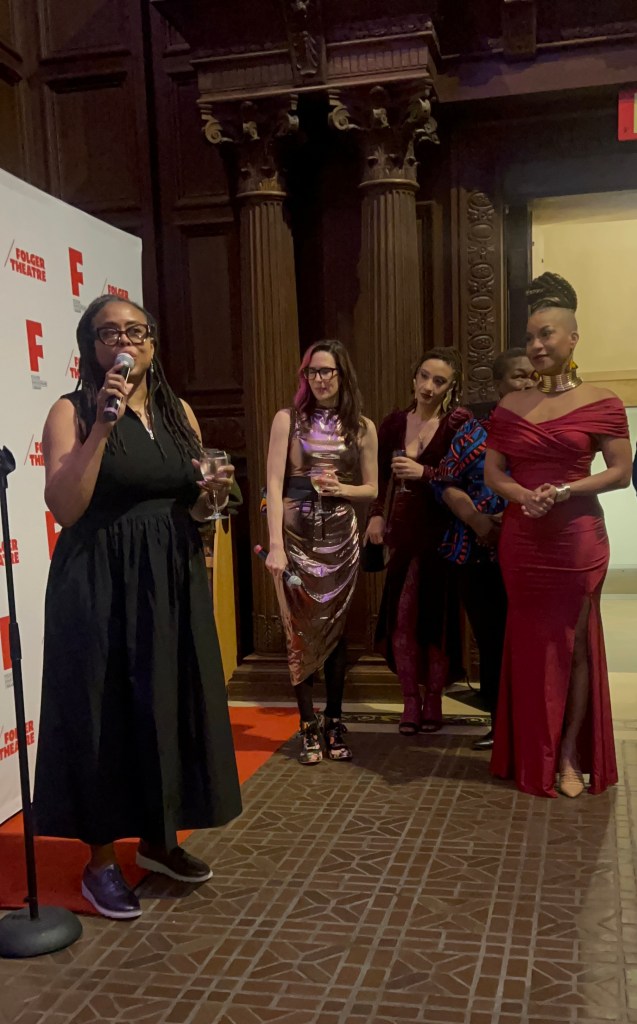
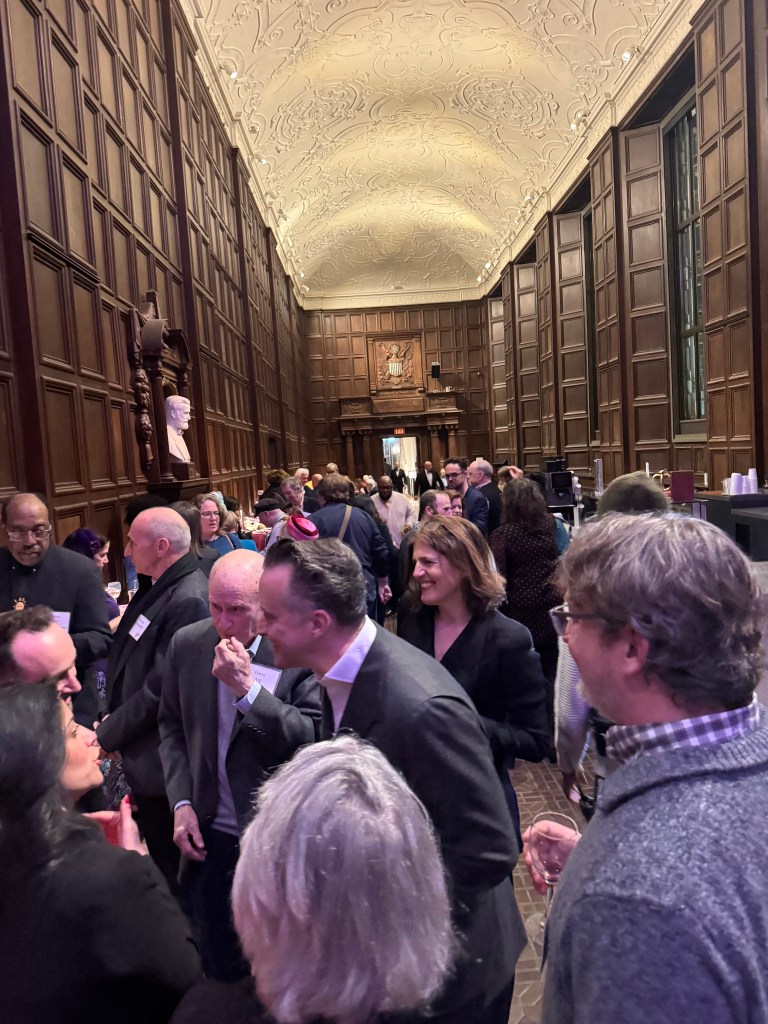
The cast, production team, and Folger staff greeted guests in the Great Hall for an elegant and enjoyable reception. Keeping with the woman theme, DJ, Miss H.E.R., provided invigorating music at the perfect volume for conversation. The reception gave us an opportunity to express our gratitude for the many levels of remarkable talent and work and to share snippets of insight and surprises. Meeting Dr. Karim-Cooper and Lauren Gunderson was an unexpected pleasure. Their generosity of spirit and depth of intellect and dedication to the Folger was inspiring.
The depth of intellect, knowledge, and commitment to both the production and the Folger Library Theater could have been overwhelming had not everyone been incredibly hospitable, responsive, and gracious.
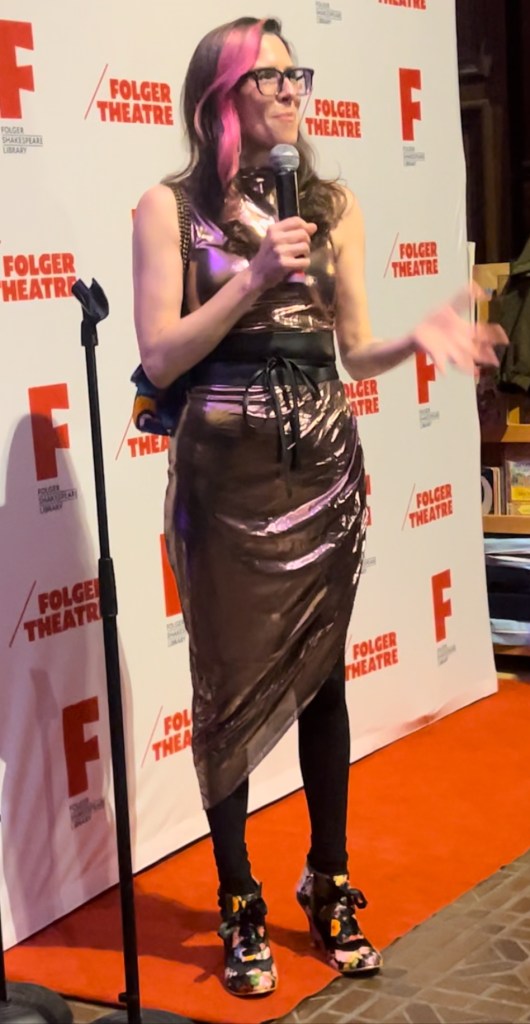
Playwright Lauren Gunderson shares her creative process PC: Henkel
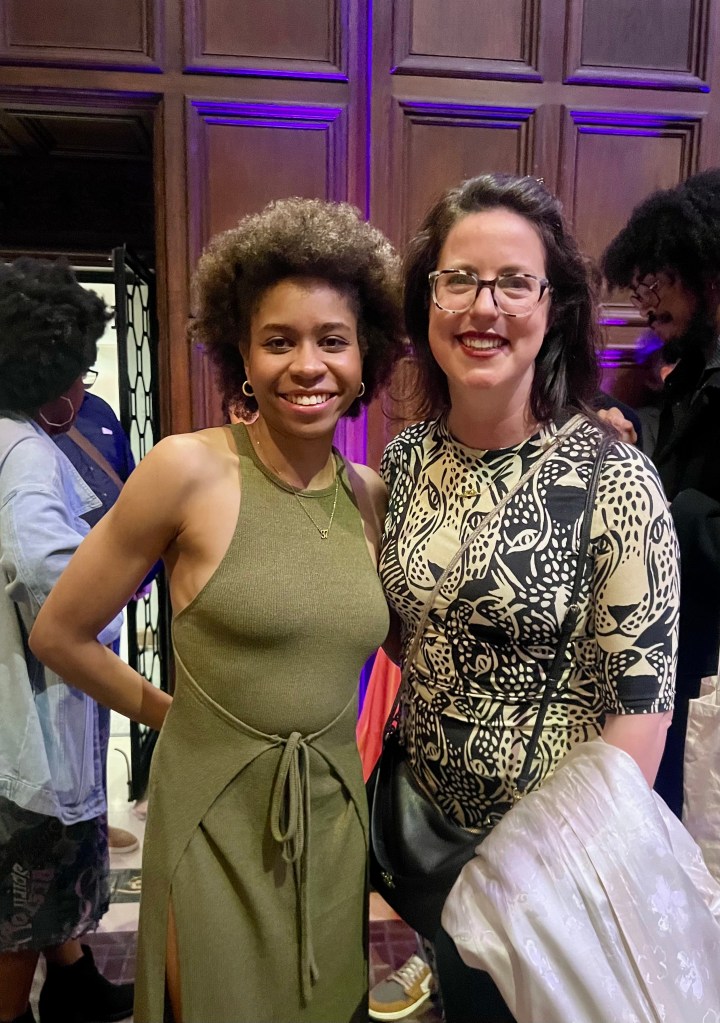
Meeting the cast, Sabrina Lynne Sawyer – Ophelia, and Oneika Philips – Gertrude gave additional focus to the characters. Sabrina is entirely invested in Ophelia. She wanted Ophelia to be liked and appreciated. When I shared my original opinion and how her representation changed my mind, she gave me a genuine hug and thanked me for being flexible and seeing the other side. Oneika, dressed in another stunning gown, this time in scarlet, carried herself as the regal queen that she portrayed. She was born to be the Queen. She complimented costumer, Nicole Jescinth Smith’s vision and impeccable attention to detail. Burgess Byrd and I managed to always be on opposite sides of the Hall – my compliments to her for bringing palpable warmth and love through her talent.
Top: Kaja Dunn, Lauren Gunderson, Nicole Jescinth Smith, Oneika Philips, Burgess Byrd Right: Lauren and Nicole Bottom Left: DJ MissH.E.R. Bottom Center: the Great Halls Bottom Right: Sabrina Lynn Sawyer and Tiffany Henkel PC: Henkel
I want to thank The Folger Press Secretary, Colleen Kennedy, for her generosity for allowing me to participate in this momentous event. I hope that this Blog will pique your interest to see this play. You will be glad that you did.
This delightful production plays until April 6 at the beautiful Folger Theater in Washington, DC. Tickets are limited. Don’t miss this chance to watch this modern production and see Ophelia in a new light. Click here for tickets
Colleen Kennedy, Right, with Krasi Henkel PC: Henkel
I dreamt that I told you about the love, Of Shakespeare and literature that you inspired. Oh, for another sleep, that I might thank you, For the minds you influenced and For the lives you changed.
Might we be different had you stayed? Your literary passion fueled our curiosity. To see through other’s eyes, To feel through other’s hearts, I would have stayed longer, for one more class with you.
With book in hand, you strode before us, A mischievous twinkle in your eye, Discussing symbolism from Freud’s or Socrates’ perspectives, You evoked the vivid colors of the verbal art, Challenging us to search for meaning.
From Alger to Albee, From Shakespeare to Beckett, From Eliot to Hemmingway and Poe, We read, we explored, and we wrote and wrote. Our assignments were remarkable.
We wrote plays and essays, Short stories and book reports, Verses, sonnets, ballads, limericks, and quatrains, Little nothings, and parodies. Your reactions were inspiring.
You challenged us to ask, “Why not?” Your questions gave space for discovery, Our discussions left us wanting more. You insisted on simplicity. Our rewrites became more elegant.
Your sense of humor was sublime, You were dignified and frank, Your generosity surprised and encouraged the sixteen-year-old me. You are yet my standard-bearer, For I question while I write, “What would Mr. Teunis think?”
There was so much more to glean. Our fledgling skills were just emerging. Your orders to “Condense and simplify,” Resonate a half century later. Alas, you left too soon.
In my dream, you would see that we turned out alright, That the seeds you planted are well tended, That your gifts of literary curiosity and challenging the status quo are well worn. Had you stayed, I see you an esteemed professor, writer, or producer, Subtly stretching and pushing limits.
WILLIAM TEUNIS
The Teunis Experience
Changed Lives
PC: John F. Kennedy Yearbook 1970
Subtle, eloquent, shy. He was a master of words. Words are all that remain with which to honor the all to short life of William Teunis, a man who quietly changed the lives of hundreds of his students. On this, the fiftieth anniversary of his drowning, I remember my remarkable teacher (really, a professor), with fondness, gratitude, and still with a bit of surprise. This endeavor is perhaps, the hardest of all of my writing assignments – one for which I volunteered. I believe that it would be the height of ingratitude not to share his contribution to our lives’ successes. It was his influence that gave me the love and confidence to write, hence this blog.
William Teunis was the chair of the English Department of John F. Kennedy High School in Montgomery County, Maryland. He was Harvard educated (BA and MA and MFA from the University of Iowa). He was a Shakespeare scholar. He was creative and demanding. How did we get so lucky? Why did he give a wit about kids when he could have been producing and staging Shakespeare plays?
Our education at John F. Kennedy High School (Kennedy) was extraordinary. The school opened in 1964 as an “experimental “school. There were no bells, no dress codes, no hall passes, and no honor roll. Students chose their classes each trimester and then decided whether to be graded, to pass/fail, or to audit the courses. Class attendance was optional; independent study was encouraged. The campus was “open.” We went out for breakfast or lunch. There were several smoking lounges. As in many Shakespeare plays, going into the woods to discover, contemplate, or play was standard procedure.
As You Like It October 1969 Production PC: John F. Kennedy Yearbook 1970
Many outsiders considered Kennedy a free-for-all. Yet, much learning took place and we turned out remarkably well. There, a young (not that we thought teachers could be young) English teacher, William Teunis, believed in pressing the limits and did not shy from controversy. He staged a Shakespeare play every autumn. The play of my sophomore year was As You Like It. It was his fourth such production, following, Hamlet, Richard III, and King Lear. I was astonished by its professionalism. While he officially taught 11th and 12th grade English and creative writing, I found myself in his class.
My schooling had been rigorous and traditional. I attended Kennedy under protest. My parents moved. Kennedy became my new school. My boyfriend, friends, horses, and everything I loved were left behind.
Although bright, I had limited motivation. My goal was to get out and get back to my friends. I completed assignments with minimal care and in minimum time. THEN, Mr. Teunis happened. Being somewhat “preppy,” I feared being censured by the liberal leanings of the Kennedy establishment. I was wrong. In Teunis’ class it was minimalism that was unacceptable. His passion for the English language and literature was contagious. He ignited our curiosity changing our lives forever.
On our first day of class studying Shakespeare’s As you Like It, we read roles around the class. Somewhere in the midst of an Act, he stopped. He clued us in to the fact that Shakespeare wrote plays. He wrote plays that would be performed within two to four hours. His audience was torn between attending public hangings, bear baiting, cockfighting, or watching a play. To survive, Shakespeare had to be competitive. He further pointed out that many in the audience were illiterate; while they knew oral histories and mythology, few delved deeply into the plays. There were no Shakespearean scholars then. Teunis tore the curtain from the mystery of Shakespeare and made us see that the plays were created (not written in books to be read) as entertainment, subject to political correctness and scrutiny of the time. There we were, in awe and relieved. Suddenly, Shakespeare became attainable. He shared that it was not rocket science and that one of the most enjoyable aspects of the Bard was the rhythm and energy of the language. He explained that every play contained multiple layers and levels and that at every reading or performance, there would be more revelations and more meanings.
During the 13 weeks that followed, we read plays, poems, and stories. We wrote complex assignments in iambic pentameter, we wrote sonnets, and we wrote plays. Overnight we would write an act of a play. We developed characters, wrote dialogue, and wrote summaries. Many of my topics dealt with loss and personal protest.
Protest. Kennedy students were proficient protesters. They protested the Vietnam War and the demise of the earth. The first Earth Day was observed that year. I had my own protest and wanted to simply finish my assignments and get on with my life. Mr. Teunis diplomatically returned my graded papers with instructions to “rewrite” a better product.
William Teunis respected his students. His low but bold voice urged us to question and reach for more. He gave examples of quality work. One student’s writing stood out. He often read her papers aloud as examples of a “well written paper.” Finally, I heard him, “Oh . . . that’s what he wants!” I thought. My competitiveness emerged, “I can do that.” Minimalism vanished; curiosity and determination took its place. My papers came back with A’s on first draft.
Reflecting upon the experience, I regret wasting his time with my marginal drivel. His kindness and patience remain constant reminders to be better. I am immensely grateful for every minute that I spent in his presence and for the world that he opened to our class and to me. Mr. Teunis changed my life. Fifty years later, I still ask myself while I write, “What will Mr. Teunis think?” then, I take more time and care.
At the age of 34, he was the English Department Chair. He built an English program unrivaled by any educational system that I have experienced either as a student or a parent. He challenged us to read, interpret, comprehend, and emulate literature uncommon for high schools. He challenged us with among others, T.S. Eliot, Hemingway, Poe, Beckett, Albee, and much Shakespeare. By my second trimester, I eagerly anticipated his class and wrote assignments from the heart; taking extra care. Our compelling discussions delved into the phycological, the Freudian, the personal, and the historical or contemporary. One classmate said, “He encouraged us to go beyond the story.”
PC: John F. Kennedy Yearbook 1970
One day, we found that our classroom was dark. There was lit candle on a small table beside his chair. Suddenly, Mr. Teunis appeared, wearing a dark cape and began reading Edgar Allan Poe’s “The Pit and the Pendulum.” So began our spring trimester. Our topics ranged from the journalistic approach of Hemingway, to the disillusionment of T.S. Eliot’s “The Wasteland,” to the tales of Poe, to the absurdity of Albee’s Who’s Afraid of Virginia Woolf? And Beckett’s Waiting for Gadot. I was spellbound. I remember writing and loving every moment. Every assignment was life-changing. Today, I cannot walk past the Café de Flore or Les Deux Magot on the left bank of the Seine without remembering Mr. Teunis’ stories of the heated conversations between Hemingway, Ezra Pound, Gertrude Stein, and other ex-pats of the time, over demitasse coffee.
The “Teunis Experience” has never left many of us. Regardless of the years, Teunis’ students remain grateful and devoted to his impact on their lives. While not all of us went on to study English, literature, or theater, the pull has remained strong to write everything carefully and clearly. Many, following successful careers elsewhere, are returning to their first love of writing, acting, and teaching. One student summarized it elegantly, “The Teunis-echoes became unbearably loud. Playwriting beckoned me.” Another, returned to community theater after fifty years.
PC:PHI DELTA KAPPA January 2008
The far-reaching experience has literally circumnavigated the globe. Former student, Richard Isenberg, took Shakespeare to Mongolia and taught 11-year-olds to perform Romeo and Juliet. In his article published in the January 2008 PHI DELTA KAPPAN Richard wrote, “My school experience was saved pretty much at the last minute, in large part because of a little bit of attention and encouragement that came my way from Mr. Teunis. Had it not been for that, I doubt that I would have mustered the confidence to continue my academic life. A few years later, when I entered upon my own teaching career, I was heavily in his debt.’
‘Mr. Teunis could never have imagined that one of the seeds he planted would bring his beloved Shakespeare to a stage in Inner Mongolia. We all have much to give and much to pay back. And we are all the richer for such a world of wonderfully improbable possibilities.’”
Attorney, Jeff Gorsky, who acted in the Teunis production, Richard III and in A Midsummer Night’s Dream later,in college, writes, “My favorite teacher. I took every class I could with him. Teunis was one of the best teachers of my life, maybe the most influential. Aside from the works he introduced me to—Shakespeare, T.S. Elliot, the essays of Orwell—he passed to me two ideas that shaped my intellectual development. The first was the idea of the canon, a core body of works that every educated person should know. He passed around a multipage mimeographed bibliography of the core works of American literature, and while I haven’t read everything on this list I used it heavily to shape my self-education in American literature. The other idea was the highbrow/middlebrow/lowbrow division, something he probably picked up from the writer Dwight MacDonald. The idea is that middlebrow—much of what used to be in the “Book of the Month Club” tends to be blandly conventional, while lowbrow pulp fiction has an imaginative power that can have important literary qualities as the highbrow. Like Feste, Teunis could sing both high and low. One of the books he assigned was Montana Rides, by Evans Evans, a pen name of Frederick Faust, who was best known as Max Brand. He was open to sci-fi and horror, and as a sci-fi/fantasy geek in high school who also was reading the classics, I found that idea very attractive. I’ve kept to that. While I’ve written high – my peer reviewed academic history Exiles in Sepharad: TheJewish Millennium in Spain (Univ. of Neb. Press/Jewish Publication Society), as well as the legal analysis I write for Law360 such as “An Alternative Legal Argument Against Trump’s Travel Ban,” I have self-published on Kindle a thriller, a Y.A. fantasy, and I am on my third draft of a Sci-fi novel called The Dark Forever, about dark matter and the Kabballah.”
Teunis student, Gail Robinson, said, “He was an amazing teacher. As a writer and occasional teacher of writing, I think of him often.”
John Diamond, Professor of Psychiatry at East Carolina University, remarked, “That man changed my life in many ways. His loss was such a tragedy.”
Julie Tyrrell wrote, “He was a remarkable teacher”
One classmate explained, “Our experience with Mr. Teunis gave us exposure to writers from the Western canon that I did not encounter again in the educational process, despite a liberal-arts education at a respectable college. That is important because a familiarity with those writers, and their style of writing, is helpful in appreciating the richness of the English language and in understanding literary references in later works. In a real sense, Mr. Teunis’ class was the first college course I took, and what he taught me was essentially English as a Second Language for someone who thought it was his first language.”
Images Courtesy of Sue-Ann Staake-Wayne
Sue-Ann Staake-Wayne, Class of 1968, was one of the Teunis Shakespeare performers. She shared, “The creative aspect never left me. He was a big influence for my love of theater.” She played Reagan in King Lear and Queen Elizabeth in Richard III. “Play preparations and rehearsals stared in the summer and performed the following October. Tickets were $1.00,” she recalled.
“That summer I will never forget. Who thought that a 15-year-old could memorize Shakespeare? It was intense. He [Teunis] was everybody’s understudy – he knew the entire play without a script! He would leave us performance notes in our cast mailboxes. In one note, he stressed the importance to make my scene emotionally and physically intense – ‘You are to be making out with Cornwall, not just touching hands. The handholding must be extremely sensual.’”
Image Courtesy of Sue-Ann Staake-Wayne
“He was a shy man. We worked to please him. It was hard to tell, but we learned that if he didn’t say anything, it was OK.”
Images Courtesy of Sue-Ann Staake-Wayne
“The following summer after classes ended, he took our cast to his Shenandoah retreat We swam and relaxed. It was the same place that he died two years later.”
Image Courtesy of Sue-Ann Staake-Wayne
Additional tributes claim, “Mr. Teunis significantly influenced the form of my life. I still look back in awe at all that he taught us. What a gifted teacher he was – he made us think and grow to do more than we ever thought we could.”
“Mr. Teunis’ intellectual challenges, his modesty, humor, and cartoons. still inspired me. He was a true hero and for me, a lifetime role model.”
“What genius, patience, generosity. What a man!”
Before coming to teach at Kennedy, Mr. Teunis taught at another Montgomery County high school. One of their alumni recalled his statement at the beginning of a school year, “I’ve reviewed the English syllabus and reading list prescribed by the Montgomery County Board of Education. And, after careful consideration, have decided to dispense with it.” Several weeks before the end of that school year, he told the class, “It has been brought to my attention that we’ve ignored the whole required course of study. I can’t understand how this happened. To remedy the oversight, I am posting a list of the books we should have covered over the past year. Please hand in a three-page report on any one of them by next week.” Classic Teunis.
He was with us just a short time before perishing at 34, in the Shenandoah River on June 20, 1970. His influence continues. Perhaps, that is the meaning of immortality.
Respectful yet irreverent, conservative yet liberal, generous yet demanding, quiet yet assertive, he disregarded convention, pushing limits out of bounds. William Teunis taught us so much more than reading and writing. He taught us to think, to question, to look beyond the story, and to never settle, but to be extraordinary. We are who we are because he was who he was when our lives met at just the right time. It was an honor to be his student. It is terrifying to write this tribute. We write in hopes of not disappointing him.









 Good News. Reviews. Events.