Conversations

An Art Exhibition by Tim Davis

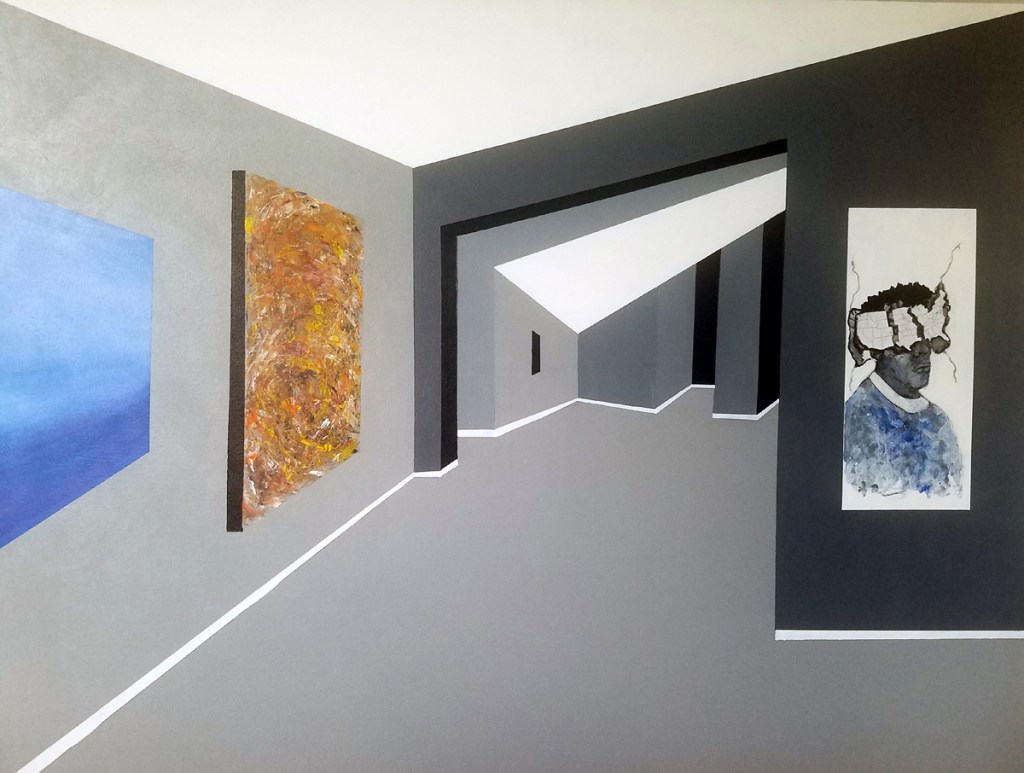
Tim Davis discusses his “Ashe” acrylic on plexiglass with a map of Virginia

Art exhibitions often ask questions of the visitors. If the artist is present, social conversations develop. However, silent conversations often take place while viewing a work of art. What is the artist’s message? How does the work inspire or inform?

Tim Davis’s exhibition, Conversations, at the Fred Schnider Gallery of Art in Arlington, Virginia opened with a gracious reception on January 10. Upon entering the gallery, the tone was set by presence. It was calm, intentional, and quietly confident.

Artist Tim Davis is the consummate host. Gracious, inviting, gentle, and generous, he was never too occupied to make introductions, whether to an ambassador and his wife or to a fellow artist. I felt among friends. There were no strangers.

Tim Davis introduced his friends – Left: David Young, the prominent retired U.S. Ambassador to Malawi, known for his extensive service and cultural integration Right: Krasi with Artvocate.us founder, Syahidah Osman and her son

Davis is a gentleman, an artist, a scholar, and a teacher. Those qualities quickly revealed themselves. Soft-spoken and attentive he was the ideal considerate host. He was generous with his time and friends, and sincerely curious about those in the room.

He engaged warmly with guests one-on-one, including my artist goddaughter, whom he met with kindness and interest. An aspiring 15-year-old artist and visual arts student at Duke Ellington School of the Arts, she felt comfortable to share her experience and ask substantive questions with Tim.  Art transcends age and their conversation was animated and inspiring. This spoke volumes about the man behind the work. His generosity is evident in the art itself.

Davis’s paintings invite lingering. They reward patience. The craftsmanship is intricate, layered, and deliberate. Sometimes gold ‘dust’ or subtle swirling elements add both depth and dimension. There is a conversational quality to the work – of endurance, hope, and transcendence. The paintings feel like thoughts recalled rather than scenes explained.

“The Golden Three” acrylic on canvas and plexiglass – inspired by a black and white photo

One painting, “The Golden Three,” tells a story of an old black and white photograph brought to life in color.  The image of the three boys standing at a wall captured this quality beautifully. The work carries a sense of intimacy and timelessness. One of the boys, the one with the red cap, is Davis’s son. The gold dusting and soft movement within the piece lend memory and delight. It is as though the moment exists somewhere between recollection and imagination. It does not insist on meaning. It allows it.

“Do You See US?” Acrylic on Plexiglass (reverse painting)

Another work, “Do You See Us?”, featuring figures set against the Chicago skyline and the lake, resonated deeply with several viewers. The piece acknowledges a universal human truth: the desire to be seen and heard. The struggle is real.  Davis addresses it with empathy.

“Dedicated to ‘Q’ ” – mixed media on plexiglass

Throughout the evening, the atmosphere mirrored the work: thoughtful, respectful, and engaged. The gallery provided a gracious setting for conversation, and the founders’ support of Davis’s work was evident in the care taken with both installation and hospitality. It was an experience designed to connect.

Gallery curator, David Carlson, added depth and context to the exhibition by introducing the gallery’s founder’s vision and mission: “The mission of the Fred Schnider Gallery of Art is to bring together artists of all mediums and styles to showcase their work to Arlington, Virginia and its surrounding communities. We celebrate the unique connection that art can create among friends and strangers alike.”

If the exhibition draws you in, the conversation continues. The exhibition is on display until February 28.

Tim Davis will present an ‘Artist Talk’ on February 7 at the Fred Schnider Gallery of Art. It promises to be an extension of what the exhibition offers: reflection, presence, and the opportunity to experience life through the artist’s eyes.

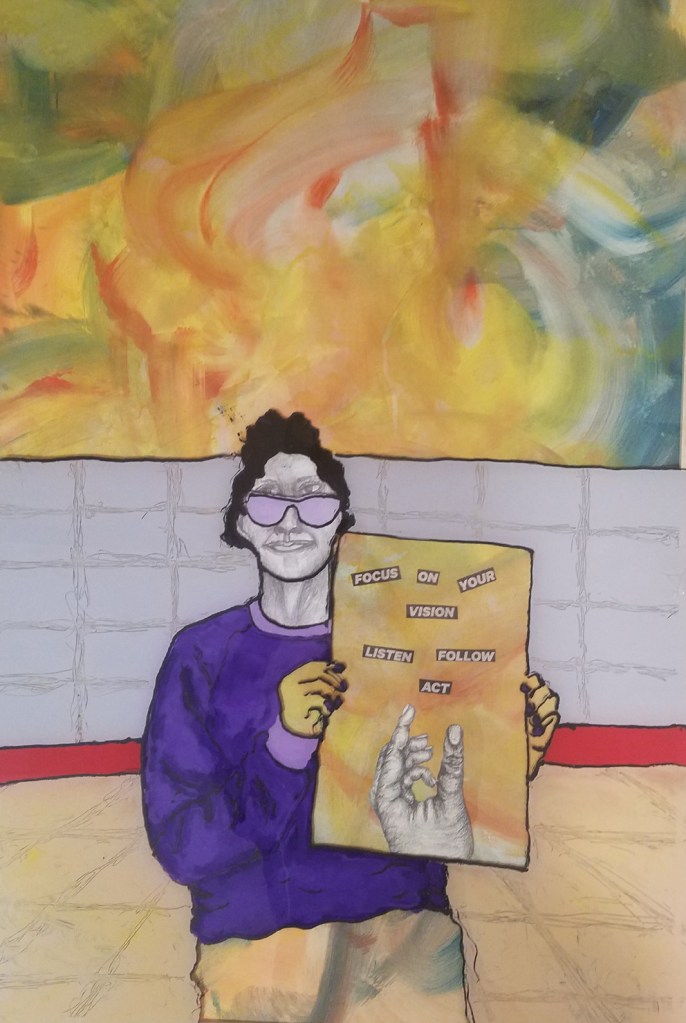
Left: “Lady in Yellow” mixed media acrylic on plexi and wood Center: (top) “Back to Africa” mixed media, acrylic on plexi on wood (bottom) “On the Front Line #2” acrylic on plexi. Left: “Waiting No. #2” Mixed media, acrylic on canvas and and plexi.

Photo Credits: Krasi Henkel

Art: Tim Davis at Fred Schnider Gallery of Art, Arlington, VA.

Just Spend a Little Time Here

Artist Tim Davis Shares His Art
Unlocking curiosity

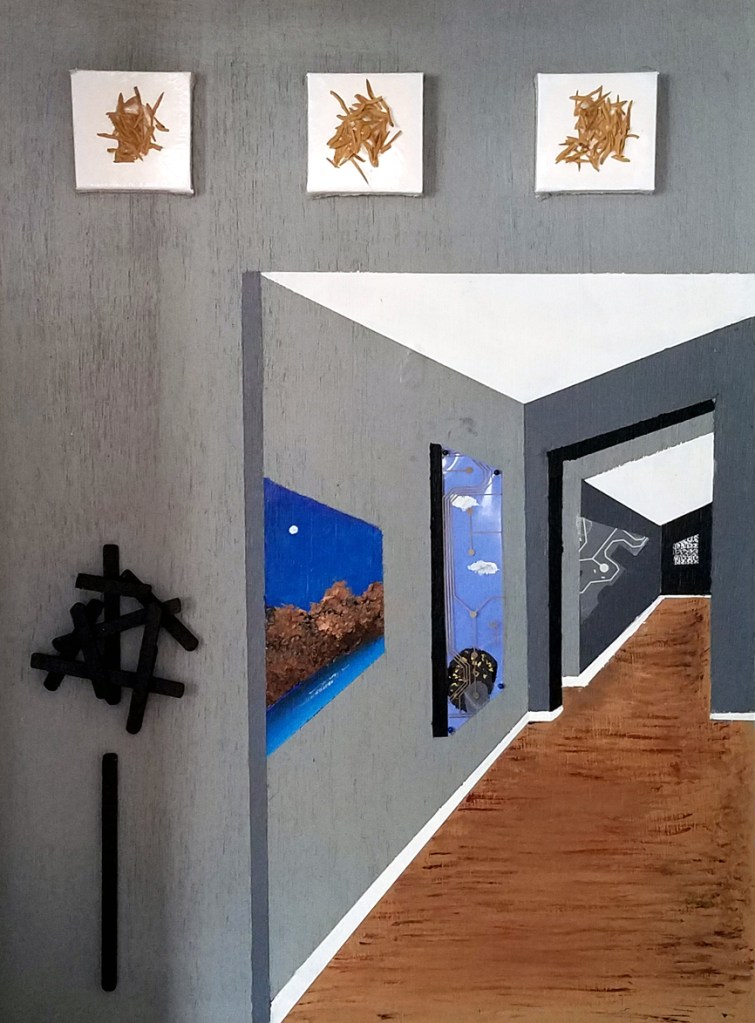
The gallery light reflected from a bright white line of the architectural painting on the right side of the gallery wall. I caught that light in the corner of my eye while walking past several closed galleries in the Torpedo Factory in Alexandria, Virginia. As if leading me into the studio, the light guided me to the real work of art where I was fortunate to meet the artist – Tim Davis.

Tim’s studio illuminated art. From fresh beginnings to fully completed pieces available for sale. The piece that brought me in was an architectural image with lines and perspective that guided the viewer down hallways and into rooms. Something about the piece spoke to me and encouraged my curiosity.
Versatility in medium combined with the curiosity of ‘why not,’ presents thoughtful innovation

Tim Davis welcomed me to his gallery and studio. More than even the paintings themselves, he exhibited a kindness, gentleness, and genuine hospitality that captured my spirit. We started a conversation that meandered throughout the studio. He showed me his creative works as well as some works in progress. I observed his brushes, paints, supplies, and a preparatory canvas. I felt as though I was viewing something sacred – the tools of creativity and a man’s spirit.

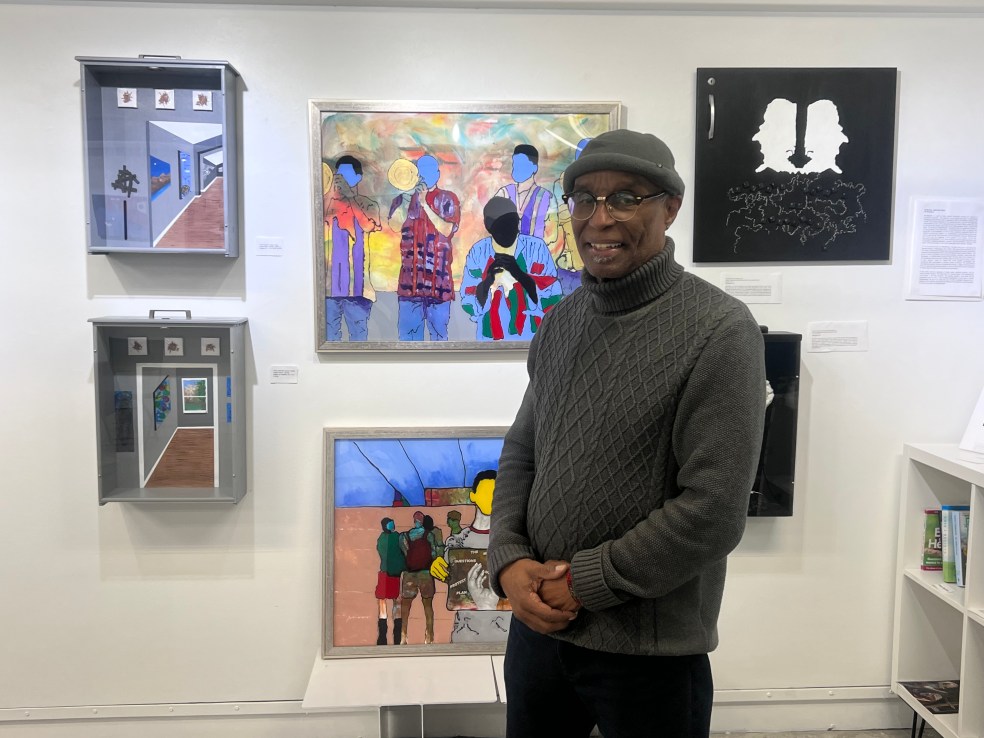
The more we spoke, the more I wanted to know. I took some photos which, in reflection, capture the ease with which the work and the man flowed. He shared how he repurposed drawers into works of art. He explained that his work is diverse and that he enjoys capturing and disclosing ideas.

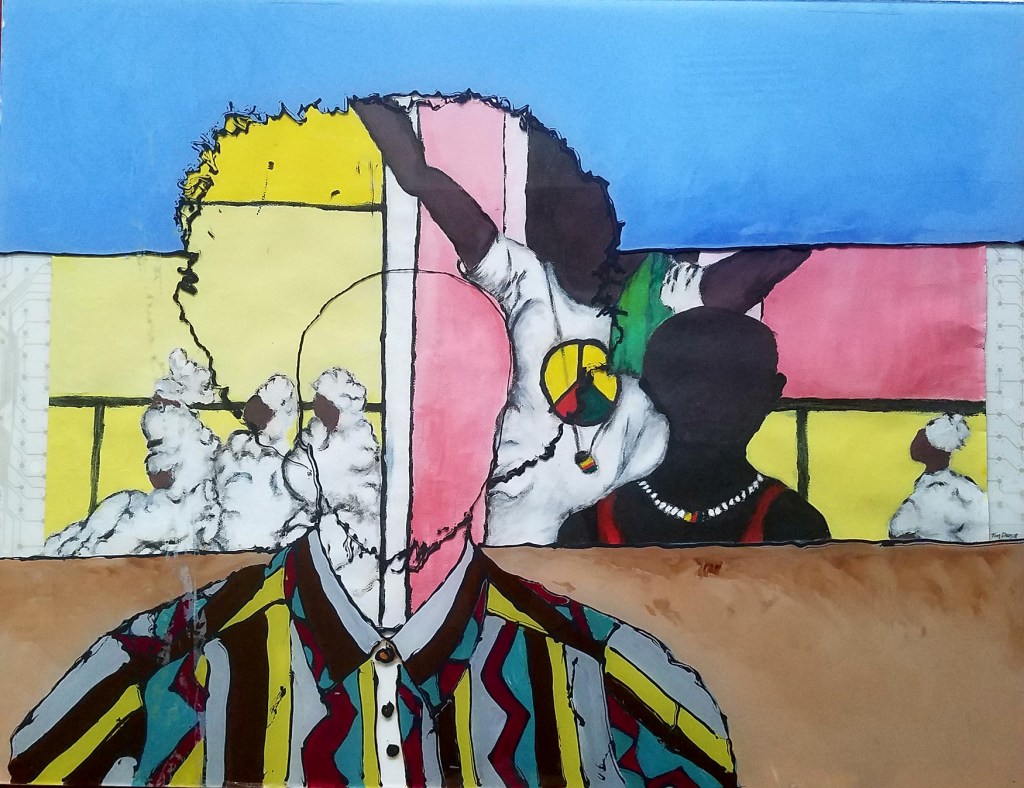
The prevailing theme of his work is space and statement. Or is that statement with space? His interiors paintings guide and lead. His paintings of people beckon friendship and collectiveness. While the humans are ‘faceless,’ their energy is palpable. I easily imagined hearing the trumpets, clarinet, and saxophone of the jazz players. They were in mid-measure and immersed in their music.
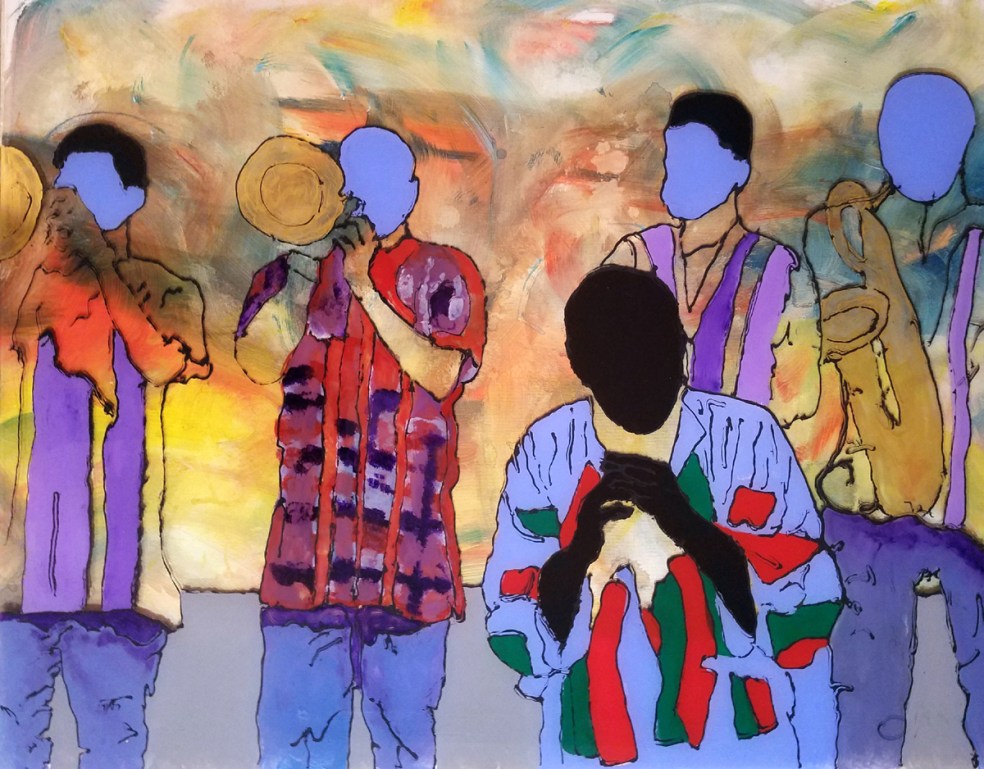
“In the pocket.” Musicians playing perfectly in time with a strong, locked-in groove.

Asked why he painted his subjects without faces, Tim explained that he wants to bring the soul and spirit of the subject to the viewer to discover the context of narrative. He allows the viewer to project and infer. He told me that, “Blue is hopeful, gold is royal, clear space brings openness and thoughtfulness.”

The artist and the man are one and the same. Tim’s persona is expression through art. He taught art for 38 years. The last school where he taught was Thomas Jefferson School in Alexandria, Virginia. He spent years teaching, inspiring, and giving back to future generations. He shared that his high school art teacher saw something in him and took him “in hand to develop.” Tim is the youngest in his family and the only one to go to college in his family.  His instructor saw promise. Tim told me that, “He pushed me to say what I needed to say,”
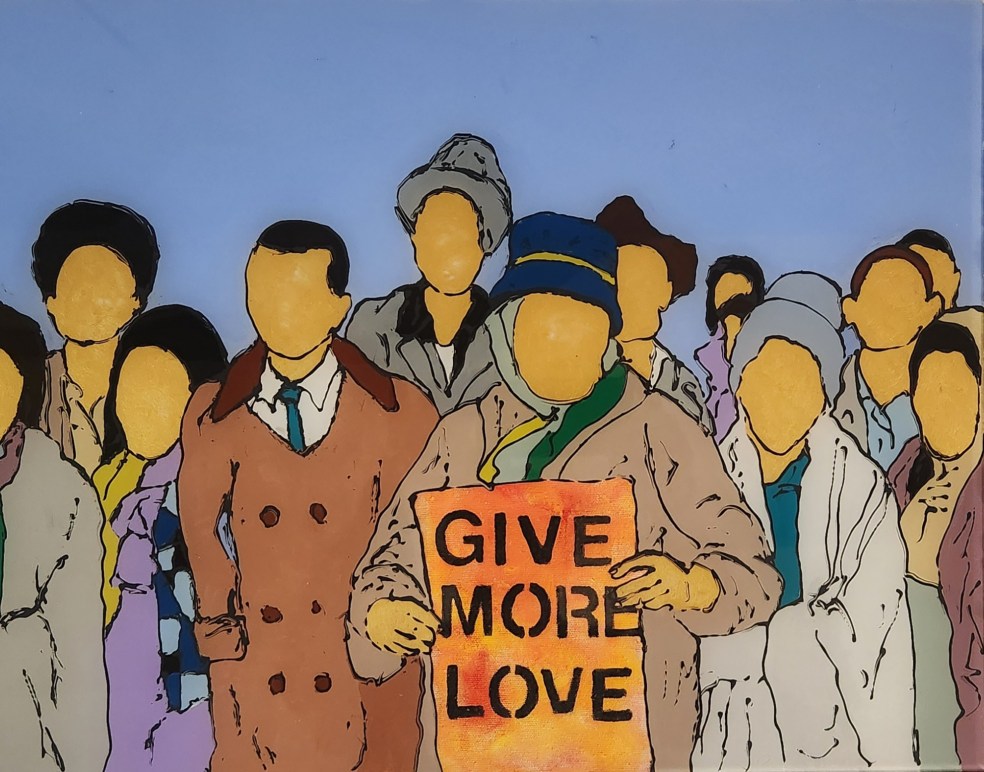
Golden Faces

Born in Chicago, Tim observed and endured division, separation, and segregation. He explained that Chicago was designed by Mayor Daley into communities – Italian, Polish, Black, Hispanic, and so forth. While very young, Tim instinctively knew, “This is wrong.” This shaped his beliefs and attitude about separation. His art ‘gives voice to the voiceless.’ His figures do not need faces to breathe – they allow their viewers to see with their hearts and experience unity of spirit.  His ambition for his art is to bring awareness to the Black community – to become a beacon of art in a large scope – to demonstrate that connectivity is a key to understanding.  He brings collectors together because art is important in place and space.

Tim Davis’ credentials are deep both academically and professionally. To capture the full breadth of his credentials, a visit to his website will be worth your time.  His exhibitions and accomplishments are extensive.  His art resides in collectors’ offices and homes and has been exhibited in prestigious galleries.

Tim Davis standing before his paintings of Oxen Hill Park for his commission for Cedar Hill Regional Medical Center, 2025 – Photo by: Roy Lewis

Davis began his art journey as a sculptor with intentions of working with bronze. He loved working with form and found it more important than realism. Sculpture’s demand for large spaces caused him to evolve to alternative media.

As an instructor, Tim regularly worked in varieties of media from clay to collage, from pastels to oils, from sketching to charcoals, and from 3-D to canvas. He loved the versatility of teaching alternate media to his students. Through this diversity, he has captured and inspired students in art to pursue their media passions.

With his main studio in the Torpedo Factory, he and his work are on constant exhibit to visitors. Asked how he feels about the steady stream of eyes and potential questions, Tim loves the engagement. He explained that some people walk by, others look in the window, and others step inside. He loves visitors to spend some time – whether they just look or engage with him. He told me, “As artists, we hope they just spend a little time here.” As a teacher, he relishes the opportunity to ‘teach and answer questions.”
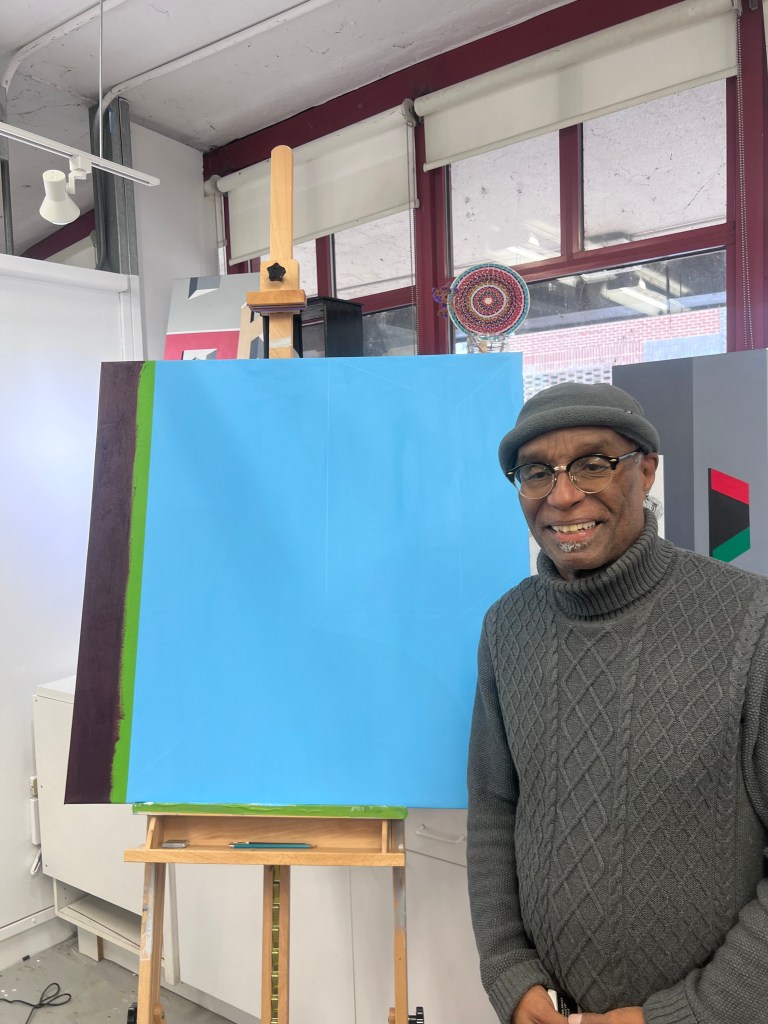
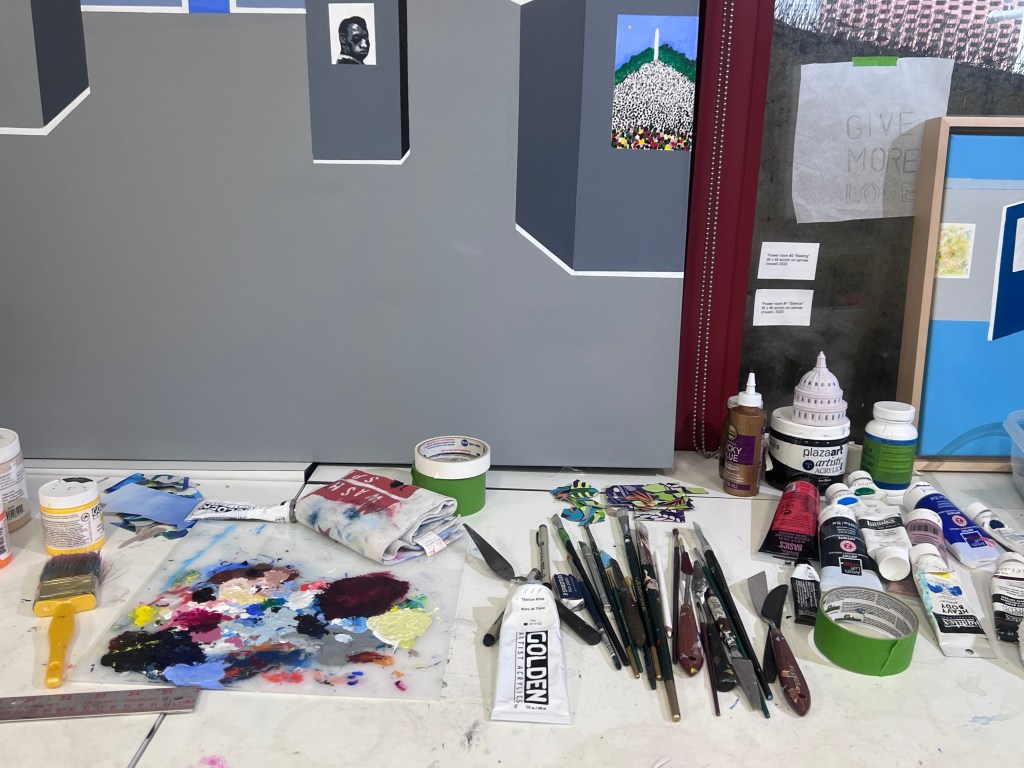
“The process” described by Tim Davis

Tim generously shared his artistic process with me. He told me that he can look at a blank canvas for days and weeks. He likes to work from photographs that he often captures while sitting in a park or walking along the Potomac River. He looks at colors and shapes. He sketches, then at a moment – he steps into his craft – and becomes enveloped into the flow of his work. He views his research to be key for his process. Trees, water, even people play important roles in his work.
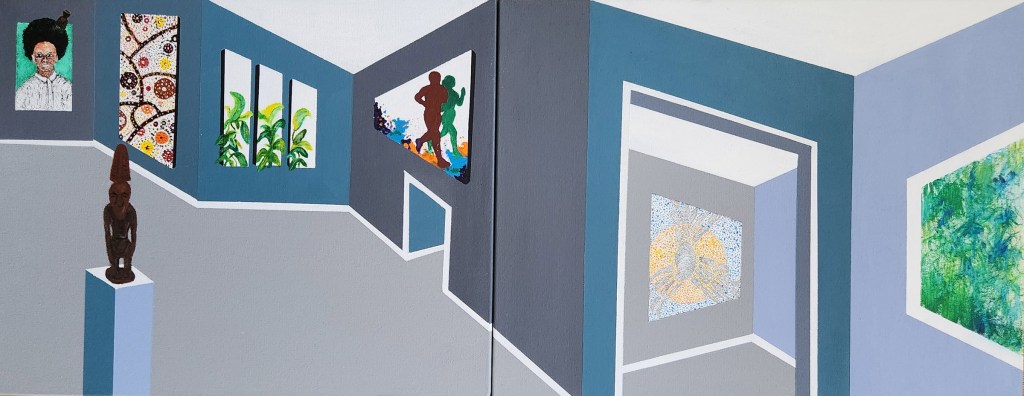
Architectural geometry flows to ideas and expression

The Torpedo Factory is in Old Town Alexandria. The area is rich in American history, and offers endless water, river, and city views. Tim loves to walk along the banks of the Potomac and enjoys many of the area’s good restaurants. He values his time in the environment as rich sources for ideas and inspiration.

Tim Davis is the featured artist at a new exhibition, ‘Conversations,’ at the Fred Schnider Gallery of Art in Arlington Virginia. The opening reception will be on January 10, 2026, from 5:00-8:00 PM. The exhibition runs through February 28.

Where Passion Meets Purpose: Inside the Duke Ellington School of the Arts Student Exhibition

Last Friday, I had the privilege of attending the Visual Arts Student Show 2025 at the Duke Ellington School of the Arts (DESA) in Washington, D.C. As I walked through the exhibition with my goddaughter, Nicoletta, a freshman in the Visual Arts Department, I witnessed firsthand how this extraordinary institution transforms artistic potential into polished expression.

“The Vienna Flood ’24” by Lucia Gonzalo Sebastian – 2D Concepts – New Yorker – Nikki explains, “This is difficult medium because of the many details involved in its creation – selection of just the right shades of color papers, assembling meticulously to smoothly apply each piece while keeping the surface clean of glue and staining. But it is so much fun to see the result.”

A Dream Realized

For Nicoletta, DESA represents the fulfillment of a lifelong passion. Even as a toddler, while other children played with dolls, she gravitated toward pencils, paints, and clay. Her journey to DESA wasn’t easy—the school’s rigorous admission process admits only 25 visual arts students annually from hundreds of applicants, requiring portfolio presentations and in-person drawing auditions. As her Godmother, her parents invited me to attend the “Family Meeting.”

“To have professional instruction, to be moving art forward, and be in the moment where ideas, vision, and expression move smoothly, is my ideal,” Nicoletta explained as she guided me through the exhibition. The school’s unique structure, dedicating three hours daily to arts education, has transformed her academic experience as well, leading to recognition for her outstanding GPA.

” I loved creating this collage where I incorporated photographs, textures, and graphics. I think I can say that I am happy that it was selected for the show.” Nikki Zapryanov

Team Building Creativity

“Sculpture Left Standing Work” Nikki – Arm, Eliana – Leg, Khepra – Torso, Luana – Head; Luana – Leg

The centerpiece of the exhibition featured four nearly life-size ballerina sculptures created by freshman student teams. Each sculpture represented a beautiful example of collaborative artistry—individual students crafted specific body parts that were later assembled into cohesive wholes under the guidance of their sculpture teacher, Mr. Wesley.

“I carried that leg around with me for months and worked on it at home and at school. I have grown accustomed to having its company,” shared Eliana, pointing to her beautifully extended ballet leg with its perfectly pointed foot.

What made these sculptures even more impressive was their construction material: cardboard. When asked about creating such fluid forms from such a rigid medium, one student explained, “We softened it by hand by repeatedly bending and smoothing until it yielded to our shapes.”

A Nurturing Environment

Beyond the impressive artwork, what is striking is the atmosphere of the school itself. The architecture, with its vast, inspiring spaces, creates an environment where creativity flourishes. But it’s the community that truly distinguishes DESA.

“I have made wonderful friends. We are a close community where everyone is supportive and lends help when needed. Criticism is constructive, kind, and very valuable,” Nicoletta shared as she introduced us to many of her classmates.

The faculty’s approach reflects this supportive philosophy. When asked about their teaching methods at a previous event, one visual arts teacher explained, “We teach the fundamentals and basics of art—technique, tools, media, and vision. We feel that this is the best way to help prepare our students for the rigors of their future education and ultimately, life.”

Growing Artistic Vision

As we explored intricate skull drawings that would inspire next year’s projects, Nicoletta reflected on her artistic development: “This year, my eye has become more developed. I calculate and observe better. I can see differences and note details, symbolism, and emotions.”

Drawings from Students in Drawing II

The exhibition culminated with award presentations, including a historic first—a sculpture titled “Right Standing Work” winning Best in Show. Department Chair Ms. Elana Casey recognized the excellence of the faculty while emphasizing, “We are so honored to be supporting our students’ vision.”

In a world that often undervalues artistic development,  DESA remind us that nurturing creative talent isn’t just about producing art—it’s about developing young people who see the world with greater depth, collaborate with genuine respect, and approach challenges with both technical skill and imaginative vision.

BEST IN SHOW – The first time that a sculpture has been awarded in this category – “Sculpture Sitting Right

Like many instructions in today’s economic environment, funding has been cut in many ways. The Visual Arts Department field trip to New York’s Metropolitan Museum of Art had to be cancelled due to cessation of funding. Instead of complaining, Department Chair,  Ms. Casey, said, “This is a wonderful opportunity for you guys to DONATE and support our mission.”

Walking back to our car through the rain, I hardly noticed the weather. My mind was still discovering details in the exceptional student creations I had  just witnessed- it was an highly engaging immersive experience—each piece a testament to the transformative power of dedicated arts education.