A Night with Macbeth at the Crossroads of Traditional and Modern
There’s something deliciously ironic about preparing to watch “The Scottish Play” through a screen. Armed with Marjorie Garber’s scholarly insights and Paul Cantor’s lectures queued on YouTube, I found myself straddling centuries – one foot in traditional academic preparation, the other in digital-age convenience. But nothing could have prepared me for the way that the filmed live Max Webster-directed production at London’s Donmar Warehouse; starring David Tennant and Cush Jumbo; would dissolve that careful distance between viewer and viewed.
The Seduction of Simplicity
In an era where productions often compete to outdo each other with elaborate sets and costumes, this Macbeth takes a boldly minimalist approach. The stark staging serves not as a constraint but as a canvas, allowing the raw power of Shakespeare’s language and the actors’ craft to paint vivid pictures in our minds. It’s a reminder that sometimes, less is more – especially with performers of exceptional caliber commanding the space.
The Intimacy of Technology
Things get interesting with the production’s use of binaural sound technology and the theater’s 5.1 surround sound transformed what could have been a mere filming of a stage play into something more visceral. Every whispered plotting, every sharp intake of breath, every moment of hesitation becomes startlingly intimate. This is psychological cinema at its finest. Using modern technology to achieve what Shakespeare himself must have dreamed of – the ability to place the audience not just in front of the action, but inside of it. Macbeth’s eye contact with the viewer is both thrilling and chilling.
Gender, Power, and the Space Between Desire and Action
At the heart of the play is an exploration of gender dynamics that feels startlingly relevant to contemporary discussions. Lady Macbeth emerges not simply as an ambitious woman, but as a complex figure trapped in a society that offers her “no chance of independent action and heroic achievement.” Her transformation of nouns into verbs – turning the Weird Sisters’ prophecies into calls for action – speaks to a deeper truth about power and agency.
The production masterfully highlights how Lady Macbeth’s infamous “unsex me here” speech resonates with modern conversations about gender constraints. Her willingness to “dash out the brains” of her nursing infant becomes not just an act of horror, but a violent rejection of prescribed feminine roles. In Jumbo’s portrayal, we see a woman who has internalized the brutal logic of a masculine world, turning it back on itself with devastating effect.
The Question of Responsibility
Perhaps the most unsettling aspect of this production is how it implicates its audience. Through the immersive sound design and intimate camera work, we become less spectators and more accomplices. Each choice, each action, each consequence feels personal in a way that traditional staging rarely achieves. The production asks us, in our era of influence and manipulation, whether we are ever truly responsible for our actions – a question that echoes far beyond the theater walls.
A New Kind of Shakespeare Experience
What makes this production remarkable is not just its technical achievements or stellar performances, but how it manages to honor both theatrical tradition and contemporary sensibilities. It’ is Shakespeare for our time: psychologically acute, technologically sophisticated, yet deeply rooted in the timeless power of language and performance.
For those planning to view the film: Yes, do your homework. Garber will guide you through the text and Cantor illuminates the themes. But, be prepared to have all that careful preparation wonderfully undermined by a production that refuses to let you remain a distant spectator. In bridging the gap between stage and screen, between past and present, this Macbeth creates something entirely new – and utterly compelling.
For optimal viewing, resist the urge to maintain analytical distance. This is one production where surrender yields the richest rewards. To whet your appetite take a little tour.
Love was in the air on Valentine’s Day when the curtain rose on the Virginia National Ballet’s “Snow White.” Their timing was perfect – what better way to celebrate the season of romance than with one of the most beloved fairytales of all time?
Snow White (Nicole Ramirez) and The Prince (Livan Gonzalez) surrounded by the Woodland Creatures performed by VNB Students
The audience came to engage and enjoy with much sparkle and finery. My party consisted of my friend and her young ballerina daughter. We arrived after battling Friday evening rush hour in full sparkle and pink regalia. I caught myself smiling throughout the performance.
Under the direction of award-winning choreographer, Rafik Hegab, the production transformed the classic Disney fairytale into an endearing ballet for audiences of all ages. The choreography presented seamless imagery while highlighting the talents of the dancers. The dancers brought to life themes of love’s victory over darkness, bonds between friends, and a pure heart’s ultimate success.
The sophisticated staging and beautiful costuming served as the perfect canvas for the company’s masterful artistry. They truly transported the viewer into an enchanted realm. The lush backdrops created a mysterious forest, a cold castle with a “live” mirror, and the dwarves‘ adorable cottage. The lyrical musical score of Bogdan Pavlovsky sounded familiar yet refined while featuring tunes from the movie. The multiple layers of nostalgic charm, eye-opening scenery, and excellent storytelling through professional ballet made this production sparkle. The inclusion of ballet school students as the woodland creatures gave the audience and the dancers a taste of preparation and performance. The stage of the Hylton Performing Arts Center in Manassas, Virginia made a perfect setting for the ballet.
The joyful Dwarves, each with unique choreography brought peels of laughter from the audience
The company’s international ensemble of twenty dancers brought elegant depth to this performance. The diverse cast represents talent from eight countries including the USA, Brazil, Cuba, Japan, Colombia, Uzbekistan, Nicaragua, and Canada. Each dancer imbued the production with a rich tapestry of artistic excellence. Their technical accuracy and emotional expressiveness brought each character beautifully to life – from Snow White’s impressive graceful innocence to the exquisitely menacing Evil Queen and her “Shadows,” to the mysterious Huntsman and the beguiling Prince, and of course, the Dwarves . . . pure joy! My favorite? The Queen.
The Evil Queen (Sierra Stipetich) and the Huntsman (Leonardo de Almeida)
The company’s decision to present “Snow White” during the Valentine’s season reflects their culture of bold programming. They have been voted the Best of Prince William County in Inside Nova’s Best Of for three years 2022-2024. The Virginia National Ballet pushes artistic boundaries while honoring classical traditions. Under the leadership of Managing Director Elysabeth Muscat and Artistic Director Rafik Hegab, the Company has earned their place among Virginia’s premier ballet institutions. The company performs a broad variety of ballet from “Led Zepllelin” last April to the holiday favorite, Nutcracker, at Christmastime. This is a company with a “two edged” sword. It is not surprising that almost every seat was taken.
For those seeking an affordable quality ballet experience, this one will put a smile on everyone’s face. There is one more chance to enjoy this production on March 1 at Capital One Hall. Visit the website for tickets. Here is a brief video from an earlier season https://www.youtube.com/watch?v=mF2mSJ_irlc.
As a first-time viewer and a bit of a ballet sceptic, I was delighted by the authenticity, technical accuracy, and charming emotional storytelling by the company. This production has made me eagerly anticipating the company’s April 27thBohemian Rhapsody , at the Hylton Performing Arts Center.
I wish Virginia National Ballet the best as they prepare for their exciting NYC debut of Bohemian Rhapsody in May at the Ailey Citigroup Theater in New York City.
*Photo Credit: Photos by Dave Pearson – courtesy of Virginia National Ballet Company
When rain is falling and an appointment reschedules, what is one to do? Window shop. This is a term my mother used to make adventures out of nothing. As immigrants on a very tight budget, shopping was a dream. Window shopping satisfied curiosities and gave us ideas for fashion and styles that we can imitate by sewing our own clothes and repurposing accessories in different ways.
Today, window shopping still satisfies my fashion curiosity, inspires my creativity, and lets me reminisce a bit about my past adventures with my most brilliant mother. Window shopping at a designer mall – perfect for the day. While I entered stores and physically inspected items, my goal was to see what is for sale, explore fabrics and textures, and see applications of the ideas.
I was greeted by a profusion of color, shapes, and textures. Flowers! Flowers permeate this spring’s fashions. There are large roses, small roses, daisies, and a plethora of bouquets on dresses, shirts, jackets, and pants. There are flowers that have been embroidered, appliqued, printed, and woven into the fabric. Color is in. Accents like buttons also echo the floral theme.
Soft silks, delicate cashmeres, polished cottons, and a variety of organza and gauze-like fabrics drape and gather for visual delight. The quality of fabrics has dramatically improved from past years. There is actual thread count in these fabrics. It was refreshing to see that care was taken to create a garment with detail, style, and innovation. Certainly, this is not fast fashion. It was less than 10 years ago that I tried on a pair of expensive Italian wool slacks with so little thread count that my skin color shone through on black! I was told then, “That is how it is made and the style of today.” Regardless of style, I did not consider such trousers acceptable for me.
The mall is a place where major designer boutiques display the latest styles and applications, from clothing, to jewelry, and many accessories. There are flowers in and on almost everything including handbags, shoes, and on stunning necklaces. This is the ideal window-shopping environment.
Not needing anything, I did not leave empty handed. I was almost out free but ducked into one more shop with an irresistible handbag and left with my lovely purchase carefully wrapped in its satin bag. Window shopping can induce impulse purchasing. Fortunately, it was closing time, and no more damage could be made.
It is all about the details. Mother of pearl buttons embellish a classic tweed jacket in an unexpected shade.Jackets and sweaters are adorned with embroidered flowersUnderstated details make a white shirt irresistableSubtle florals bring a powerful message
There is an art to window shopping. Operating hours do not dictate opportunity. The window lights illuminate treasures to admire. The window displays varied from stark and minimalist to opulently colorful. There are ruffles, flourishes, puff sleeves, mini to maxi lengths, skinny to ultra-wide leg pants, bolero jackets to maxi overcoats. This season promises a variety of opportunities to look chic and modern while enjoying items and garments already on hand. Adding one or two new items can update many existing items for fresh looks.
Today’s fabrics and textures are rich, supple, and flexible. They have a “hand” unlike previous versions. To that end, the saying, “What is old is new again,” is a bit of an exaggeration. Holding on to previously loved items in hopes that they come back in style does not work as we wish. There is always a twist on the style, a different texture, and the print, if any, is different as well. One thing I find important is that today’s fabrics is that they have some “give.” Bending elbows and knees and reaching with shoulders is not restricted as in earlier garments because the fabric has a little stretch. While I will always love certain items for the way I felt wearing them at certain occasions, I am happy to let them go now in favor of style with comfort.
Tone on tone flowers are ruffles on an “A-line” swing dressThere are hundreds of shades of white that pair beautifully togetherThere is something refined about monotones in fresh, yet understated tones
In addition to sensory creative stimulation, the exercise is great. It was easy to cover two miles of walking. Window shopping, although alone, I heard, in my head, my mother’s ongoing dialogue as I looked and admired.
Whether walking along a city street or in an enclosed mall, look in the windows and consider the styles, the designs, and even the window composition. It is a wonderful activity to do with children, friends, and even alone. Ducking into a cafe or restaurant for a little bite with a favorite beverage can be the “pièce de résistance.”
His beard and whiskers were snowy white. His red velvet suit showed wear, especially on his lap where thousands of children sat each year. His sleigh was lacquered red and quite comfortable for standing or sitting. He reminded each guest that the real meaning of Christmas was not “what” he will bring, but “who” came to earth on Christmas.
With supreme diplomacy, Santa suggested and never lectured about the true meaning of Christmas.
For years, we queued in long lines that took hours. Our first visit was when our daughter was one. She was tiny and was fascinated by the low windows where miniature toys depicted scenes of Christmas and the Christmas Story. The years rolled by and then she was five, ten, twelve, fifteen, and on. We always went, waited in those interminable lines, and he was always there.
There was a letter-writing station with pencils and papers in case someone had left their letter behind or that their dog ate it. Children as well as parents and grandparents wrote letters and Santa read most letters out loud.
Letter Reading
A visit to The Real Santa was always an adventure. He arrived at his “Santa’s House” the day after Thanksgiving and returned to the North Pole several days before Christmas. During his stay, he would meet, greet, hear, and consider every child. He would nod approval or express surprise and say, “Mom/ Dad . . . how would you feel if I delivered such a gift? Maybe I’ll bring you a blue scooter, instead.” I remember how he looked up at me when my daughter asked for the Dirty Dancing movie. I smiled and nodded.
Families lined up at Santa’s door hours before his arrival. There would be popcorn and hot chocolate to satisfy hungry youngsters. Santa’s house was a work in progress. Every year, something new would be added to the many display windows. There were albums with letters and photos with/to Santa from the parents (when they were children) of the children standing in line. At the entrance there was an empty space in which gently used and much loved toys could be left to be delivered to those in need.
Santa carefully unfolded every letter and listened to every whispered secret. His promises and instructions had to be followed exactly. “On Christmas Eve, I want you to place a small white plate on the kitchen table. On that plate place eight pieces of carrot for my reindeer and one cookie for me. In the morning, you will find a present wrapped in green tissue paper and tied with string. There will be a surprise for you from me,” Santa told one spellbound child while one parent was taking notes and the other photographed the visit. Before stepping away from the sleigh, Santa would smooth his beard, reach to his right, and produce a lollypop from his lollypop tree along with a beautiful small card depicting the Nativity . “Always remember the real reason for Christmas,” he would tell the child while handing them the card and candy.
Santa Transcended time and age and felt what was in the heart
Santa did not rush. He gave every child their due time. As his house became more crowded and the lines grew longer, Santa would take a break, go up to his rooftop, and address his guests. He might lead them in a Christmas song or read them a story or a poem. Sometimes he would speak to the adults and read them a poem. One very memorable poem by an anonymous author, goes like this:
Santa attended to his visitors with love and understanding. “He knew if you were bad or good” and would call actions out, much to the chagrin of the child. Several incidences that happened to our daughter still have us wondering – how did he know?
When my daughter was four years old, she loved to leap into our bed at the crack of dawn. It was great fun for her. When we visited Santa that year, just as she was about to step out of his sleigh, Santa called her back. Holding her tiny hand, he looked her in the eye and said, “Now, you must stop jumping in your parents’ bed and stay in your own bed. Promise me that you will try. I will bring you a special present wrapped in white ribbon and will put it in front of your bedroom door.” As of that moment, our early morning visits ended. Sure enough, there was a special present wrapped in white ribbon on the floor in front of her bedroom door. How did he know?
The year that my father passed away, my mother accompanied us on our visit. She stood near the sleigh to hear Santa’s instructions and reactions. He stopped, turned toward her and beckoned her into his sleigh. “Grandma, what you really want is peace. I wish I can bring you peace,” he told her. He gave her a lollypop and a card. How did he know??
Because time with Santa transcends age, we visited him even when our daughter grew up. She loved to introduce younger children to the Santa adventure. She loved when her younger cousin would visit. One year, her cousin was perplexed because she did not know if Santa would be able to find her at our house. As the girls were leaving the sleigh, Santa cleared his throat, looked into the little girl’s eyes and softly told her, “Don’t you worry about my finding you. I will always know where you are.” How did he know?
In a later year, again, with a younger friend, Santa listened and nodded to the younger child and to our daughter. Our daughter was a freshman in high school. As she was helping the young child out of the sleigh, Santa cleared his throat and tapped her on the shoulder saying, “You know, the things that hang on the rod of your closet are not mobiles. They are clothes hangers. You should use them. Hand up your clothes on those hangers and cleanup your room.” My husband and I were speechless as was she. How did he know?
The Real Santa In Action
In 2018, Santa took a break from the hustle and bustle of growing crowds and focus on his workshop. With internet access and mobile phones, he adapted to the age of technology. In his house there was a mailbox for real letters that children could write and mail to him. My Goddaughter drew him a beautiful picture as a gift to him and did not ask for a single present. We experienced the magic of Santa for 33 years and introduced many children and their families to him. The memories are priceless. Our Christmas traditions always included a visit to his house and marveled at his creativity as he added more displays. He never wavered from the true meaning of Christmas.
Santa gave everyone who stepped in his sleigh a card every time
I wish you and yours the merriest of Christmases and that the meaning of the season will be in your hearts throughout the New Year.
Born to a Jewish family in Germany, Mendelsohn was a child prodigy, much like Mozart had been 53 years earlier. Felix Mendelssohn was a composer, pianist, organist and conductor of the early Romantic period. His family converted from Judaism to Protestantism before his birth. The Mendelsohn family was in banking and left Hamburg in disguise in fear of French reprisal for the Mendelssohn bank‘s role in breaking Napoleon‘s Continental System blockade. While they moved to Berlin and lived there as Christians, antisemitic sentiment clouded his virtuosity. It was not until almost the mid-20th century that his music was reevaluated and finally appreciated.
When Felix was 12, he met the then over 70-year-old Johann Wolfgang von Goethe. Not one to be easily impressed, he declared “… but what your pupil already accomplishes, bears the same relation to the Mozart of that time that the cultivated talk of a grown-up person bears to the prattle of a child.”(Todd, R. Larry (2003). Mendelssohn – A Life in Music. Oxford; New York: Oxford University Press). Mendelssohn set a number of Goethe’s poems to music.
Felix Mendelssohn (PC: In the Public Domain)
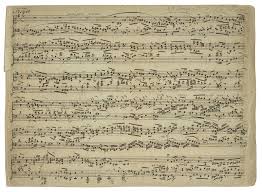
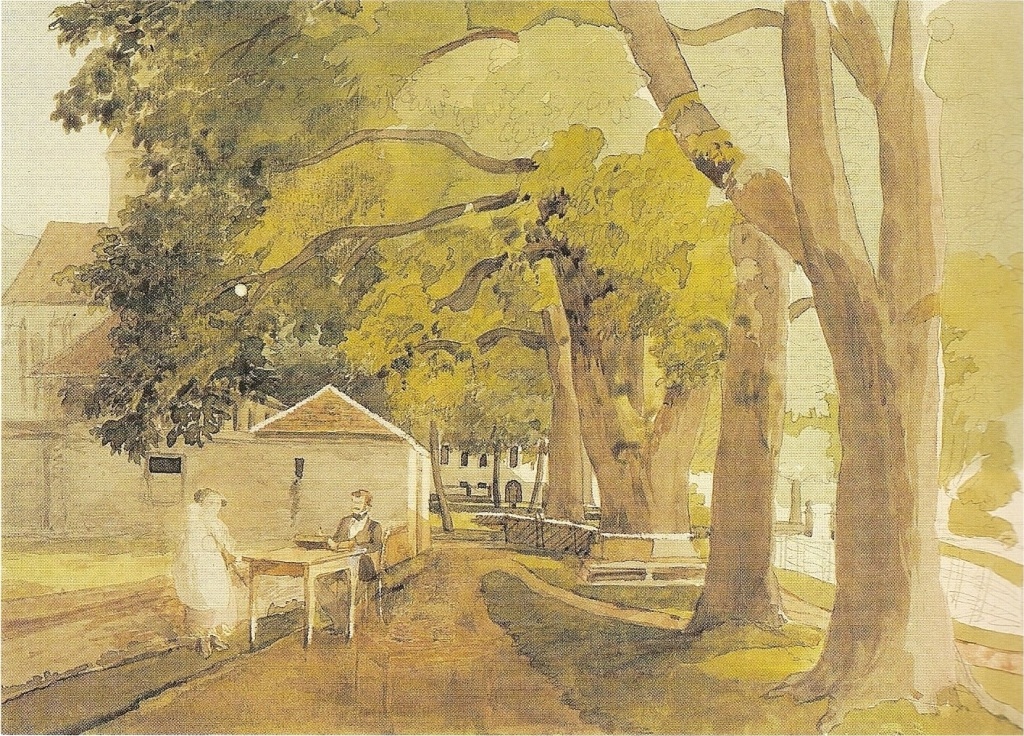
I remember vividly my first time hearing Mendelssohn’s Italian Symphony. I was spellbound and wanted to hear and rehear every note.My conscious awakened. Thereafter, I sought out his music at every opportunity. I discovered his music to A Midsummer Night’s Dream which took my breath away (until the over-played “Wedding March”). What a shame that the “Wedding March” has become cliché. Is it the desire for the “magic” or a couple’s lack of creativity in selecting wedding music? Aside from his awe-inspiring compositions, he was a prolific artist.
The musicologist Greg Vitercik considers that, while “Mendelssohn’s music only rarely aspires to provoke”, the stylistic innovations evident from his earliest works solve some of the contradictions between classical forms and the sentiments of Romanticism.
Watercolors by Mendelssohn (PC: Public Domain)
Perhaps it is Mendelssohn’s non-provocative conciliatory style that gives the listener space to hear and appreciate.
Like so many musical geniuses, Mendelssohn did not live to be 40. He died of several strokes at 38. In his short life, he created some of the most beautiful and poignant music that touches the core of one’s heart.
Conducting Tchaikovsky’s Fourth Symphony. The power is palpable. Photo Credit: Toby Marquez
From the moment Conductor, Nancia D’Alimonte, walks toward the podium, there is a spark that ignites the atmosphere. There is energy and joyfulness. Her sincerity to the audience and empathy for the musicians is unquestionable. A master storyteller, she involves the audience by revealing some hidden secrets and giving intriguing history about each piece.
What separates Nancia from many other conductors? Unity. There is a rare connection between conductor and orchestra. She brings the best out of the orchestra at the precise moment of every note of every score. They create each other- it is a sense where each makes the other. It seems as if she “sends” the music to the musicians and they return it to the audience. “When I step on the podium, something unique happens,” she said. The music comes through her.
A unique connection with the musicians – Photo Credit: Toby Marquez
Nancia D’Ailmonte is conductor of the Loudoun Symphony Orchestra (LSO). She is also founder (2006) and conductor of the NIH Philharmonia. At Christmastime, Nancia conducts the beloved Kennedy Center Messiah Sing-Along. She is a busy person of great depth, with exceptional talents, a delightful sense of humor, and a variety of interests.
Nancia Leadsthe Messiah Sing-Along at Kennedy Center – photo courtesy of Nancia D’Alimonte
Conductor positions are tightly held and highly coveted. With approximately 1250 symphony orchestras in the United States, with anywhere from 60 – 115 musicians; there are approximately 90,000 musicians. There are only about 1300 conductors. A 2014 survey discovered that of the top 150 orchestras, there were only five conductors who are women.
Meticulous details – Photo Credit: Toby Marquez
In the November 10, 2019, conversation about the arts and law at the Kennedy Center, the late Supreme Court Justice, Ruth Bader Ginsburg, shared, “In my growing up years, I never saw a woman in a symphony orchestra.” She recounted the advent of the “dropped curtain” after a New York Times critic was certain that he could tell the difference between a male and female pianist only to get “it all mixed up” after he was blindfolded.
French conductor and composer, Nadia Boulanger (1987 – 1979), was asked in 1947, about being a woman and a conductor. She said, “I’ve been a woman for a little over 50 years and have gotten over my initial astonishment. As for conducting an orchestra, that’s a job where I don’t think sex plays much part.”
Conductors have their own styles. Some are flamboyant making the performance all about themselves; some are timekeepers, and some are dreamers. Then, there is the rare conductor who brings music to life. Nancia is that conductor. Having been principal horn for 12 years, she says of conductors’ styles, “I know, I was a player.” Hence, her empathy and consideration for the musicians.
Knowing the scarcity and competitiveness of conducting positions, Nancia chose to follow this path. She tells her incredible story, “When I had been principal horn for 12 years with the Oshawa Symphony Orchestra (outside of Toronto, Canada), our beloved conductor was stepping down. I was on the search committee. We viewed endless video tapes of less than stellar conducting examples – all by men. After every video, I would think to myself, “I could do much better than that!” Then came the final guest conducting experiences… one conductor led more with his non-baton hand (left), being quite flamboyant, and kept shouting to the orchestra, ‘play with me, you’re behind, you’re behind!’ ‘
‘During that time, I was teaching high school music and art. A friend told me about a conducting workshop with John Paynter, guest clinician. I hadn’t a clue who he was, but I went anyway. During his talk, I was captivated by his demeanor, his gentleness, his every word, and his examples of conducting! I elbowed my friend and kept saying, ‘I do that… I do that… I do that too!’ At the break, I could barely contain myself… I had to introduce myself to Mr. Paynter. He was just as genuine in person. He gave me his full attention; I was honored.’
‘I began taking private conducting lessons with John Paynter. I would fly to Chicago about every six weeks for private lessons with him. John was Director of Bands at Northwestern University; only the second director in 100 years.’
‘A friend once posed a hypothetical scenario to me… ‘Supposed the Boston Symphony calls you and says their principal horn player is out sick, and they need you as a sub. The repertoire is an all-John Williams concert. You have 24 hours to let them know. Then, another person of the Boston Symphony organization calls you, and says their conductor is out sick, and they need you as a guest conductor. The repertoire is an all-John Williams concert. You have 24 hours to let them know. Which do you choose?” This hypothetical scenario made me look at my musical career. I was at the top of my game with horn playing but continuing that for the next 30+ years wasn’t too enticing. After watching the uninspiring conducting videos and then meeting John Paynter who saw something in me to give me a few precious moments of his time, I made the decision to conduct.’
‘One final thing about this story – once I entered the Eastman School of Music to work on my Doctorate in Orchestral Conducting, I had the absolute pleasure to meet John Williams when he guest conducted the Eastman Philharmonia in an all-John Williams concert. I was able to share my story of how I decided to go into conducting with him… talk about full circle!”
With Mendi Rodan, Nancia’s Teacher at Eastman School of Music – Image Courtesy of Nancia D’AlimonteAn Alumnus of ESM – Nancia D’Alimonte, D.M.A. – Image courtesy of Nancia D’Alimonte
About her goals for LSO, Nancia explained, “I want to grow the orchestra and I want to make them irresistible.” She loves the Orchestra because she says, “The beauty of the Loudoun Symphony Orchestra is that they have good bones, they are super players, and have a positive attitude.” What about classical music not being terribly popular? “If you build it good . . . they will come,” is Nancia’s solution. She is on a mission to make a great orchestra exceptional.
Nancia described her relationship with members of the orchestra as, “Always one of mutual respect. I do not follow the tradition of the dictator on the podium. Because I come from within the orchestra, the musicians know that I know their position, thus there is an appreciation from them.”
Among the roles of the conductor is designing the program. Nancia’s thoughtfulness and depth of musical knowledge give her the scope with which to make wise choices. Her goal is to please the audience and encourage and grow the musicians. Her musical selections and programming take into consideration the players’ strengths and the total number of players. She explained, “Some compositions work for 60-65 members while others like Mahler need over 100.” She explained that undertaking a composition designed for a very large orchestra and imposing it on a smaller one will not produce success of the composition or the musicians. She selects music to showcase the strengths of the performers which will ultimately please the audience and encourage the individual players.
Impeccable Style – Images courtesy of Nancia D’Alimmonte
Nancia has mastered her conducting image. She explained, “My conducting ‘costume’ is my own creation. After some experimenting, I decided on the tea-length skirt with satin stripes on the sides and a feminine slit, tails, and a beautiful brocade vest and matching bow tie. I want to be impeccable. Appearance is very important in this male-dominated environment.”
“The connection to my “instrument” (the orchestra) are my batons,” says Nancia. She has six custom-made batons by Tate Newland. Nancia says, “He is the best, in my opinion. I have been working with him for almost 30 years – I have known him for longer than I know my husband.” Nancia explained that the white shaft is made of maple wood. The handle must be large enough to fit in her hand and hers are of interesting and exotic woods including cocobolo, 100-year-old cherry, curly maple, rosewood, and even a champagne cork (for fun). The baton must be perfectly balanced at the joint where the shaft meets the handle. She always brings two batons with her.
Attention For Every Musician – Image courtesy of Nancia D’Alimonte
Asked whether she prefers to conduct with a score or from memory,” Nancia explained, “Conducting without a score… this phenomenon came about from Arturo Toscanini, famed Italian conductor (early-mid 20th C.) who conducted at La Scala in Milan, the NY Philharmonic, and later led the NBC radio orchestra. He had an impeccable ear and began as a cellist. One thing lacking for him was good eyesight… he was farsighted. In order for Toscanini to see a score, he had to be bent over, with his face about 6 inches from the score… that is no way to run a rehearsal! He could memorize really well, out of necessity, he studied and memorized all his scores. It’s an impressive feat, to be sure, and made for intimidating rehearsals (he knew every part and would stare down musicians when asking them to play a passage – nerve-racking). While some conductors memorize today, it’s not because they have bad vision, it’s a parlor trick… it is not a requirement.’
‘I use a score as I’m not sure I would have enough time to properly memorize my scores. I like to be able to immediately help a musician in the event they miss something.’
‘The next time you see a conductor not using a score, watch his/her face and see where their eyes are directed. Usually, there is no connection to the orchestra… and being disconnected is not a good thing… the musicians will actually lead the conductor through the performance.”
Aside from conducting, Nancia’s friends know her for her sublime “refreshments.” “My martinis are legendary. My Negroni is renowned, you should try one sometime” she said.
Taste, Presentation, and Artistry: Lemon Drop Martini; a proper Manhattan; just a simple spread; Making Limoncello – Images courtesy of Nancia D’Alimonte
A self-professed “foodie,” Nancia likes to keep her knives sharp even cooking at home. She once made butter from scratch for a special dinner. As in her orchestral conducting, she is precise. Her planning and presentation are meticulous.
Mouthwatering Creations by Nancia – Images courtesy of Nancia D’Alimonte
A woman of great passions, Nancia’s world is extensive. From her legendary Negroni martini, to her superb shrimp (and her knives are precisely sharp), to her underwater scuba adventures (where she says is her second favorite place on earth), to her world travels, and of course, to her music, Nancia is infinitely curious and devoted to impeccable excellence. She shares her life and passions with her husband, Giancarlo.
Travel Experiences and Adventures – Images courtesy of Nancia D’Alimonte
Nancia’s “second favorite place on earth” – Images courtesy of Nancia D’Alimonte
Nancia with her husband, Giancarlo D’Alimonte – images courtesy of Nancia D’Alimonte
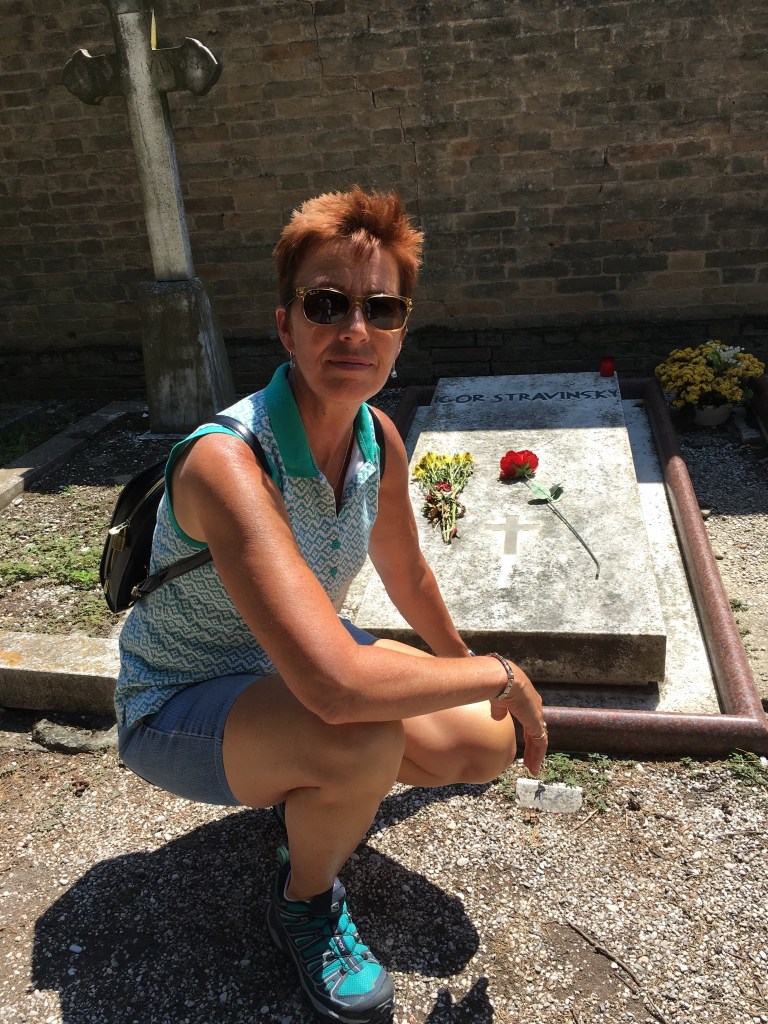
What kind of music does a conductor listen to when not working? “I love a wide variety of music. I love jazz, New Age, World Music, and of course the classics.” She enjoys Brahms, Bartok, and Mozart. The Rite of Spring by Igor Stravinsky and Mahler’s Symphony No. 1 are among her favorites.
Nancia – Authentic; Unstoppable.
“Humbled to be at the foot of Igor Stravinsky’s grave – Venice – Image courtesy of Nancia D’Alimonte
Celebrating 75 years of the Washington School of Ballet
Rising Star – Katherine Barkman PC: Screenshot of web production
Ballet lovers from around the world were invited to tune in for the first-ever LIVE online celebration of The Washington Ballet! Performances by The Washington Ballet artists and stories from students and faculty highlighted the event.
Ballet in Washington, D.C., under Artistic Director, Julie Kent, was beginning to soar and rival many American and international ballet companies. Their 2020 season promised to deliver breathtaking performances of classical ballets and repertoire. The season started with their exceptional production of Balanchine + Ashton in February to be followed by the full-length Swan Lake – music by Tchaikovsky. The classic ballet, Coppélia, to the music of Léo Delibes, was scheduled to premiere in May. Casting, choreography, costuming, and rehearsals were in progress. I planned to attend Coppélia and write a blog article about the performance.
PC: Screenshot
Producing a full length classical ballet is an very expensive and laborious process. The costuming alone, is extremely expensive with a single tutu potentially costing over $3000. The cost of costumes added to the salaries, overhead, and theater rental runs into the hundreds of thousands of dollars. Sold out productions, sponsors, grants, and patrons help cover these expenses. What happens when the curtain does not rise? The last Washington Ballet rehearsal was held on March 13 where snippets of a dress rehearsal of Act 3 were filmed.
The company staff and dancers are incredibly supportive, gracious, and optimistic for something wonderful to emerge from the current circumstances. Having been president of a pre-professional ballet company, I am aware of the magnificent cost involved in the production of every ballet.
Ballet Dancer Corey Landolt was honorary Mixologistfor the Gala PC: Screenshot
Tonight’s public virtual Gala was a wonderful way to bring the Washington Ballet to the City and to the world. The Gala were beautifully produced. There was a mix of executive, sponsor, and philanthropic recognitions along with a generous portion of stunning ballet performances. The 75th anniversary of the Washington School of Ballet begun by Mary Day and her mentor, Lisa Gardiner, was celebrated with joy and dignity.
Artistic Director, Julie Kent PC: Screenshot
The growth of The Washington Ballet under Julie Kent in just under four full years, has been remarkable. Like many Company patrons, I was eagarly anticipating the brilliance and excitement of the upcoming season. The Gala was elegant, classic, and was generously shared with the City and the world free of charge. The hope, being that donations would offset expenses and generate funds. During the event, donations came in ranging from just a few dollars to some with a several zeros at the end.
Monica Stephenson, Head of School, Southeast Campus. PC: Screenshot
In recognition of the 75th anniversary of the Washington School of Ballet, The Washington Ballet expressed their focus and goal of reaching city dancers and providing teaching and training opportunities regardless of dancers’ economic circumstances. Monica Stephenson, Head of School, Southeast Campus, The Washington Ballet, shared, “For our community of 1200 students, we kindle love, passion, interest and commitment. We encourage talent, creativity and integrity on all levels of the art stressing excellence in the classroom and on the stage. “ The interactive on-line ballet classes are helping students stay involved, active, and healthy. Ms. Stephenson emphasized the goal of, “Engaging in relevant dialogues in an unwavering commitment to our aspiration for the extraordinary. We work toward equitable excellence in artistic education and expanded diversity in classical ballet. It feels wonderful to be a part of dancers’ growth.”
“You can inspire the world with you dancing.” DC ballet student. PC: ScreenshotStudents ofThe WashingtonSchool of Ballet PC: Screenshot
Ms. Kent, in her mild, soft-spoken manner, introduced “An incredible evening of inspired performances.” Five performances, all very different and extremely engaging culminated with the final rehearsal of Act 3 of Swan Lake. At the end of each, I wished for “just a little more,” the mark of an exceptional artistic director.
Pas De Deux – Tamás Krizsa and Maki Onuki Performing “Together Apart” with “Backdrop of the Glorious National Cathedra,” JK PC: Screenshot Rench Soriano from the Philippines is a Washington Ballet Studio Company dancer performing 5 Variations on a theme by David Fernandez PC: Screenshot Women of the Company performing “Summer’s Heat” reliving the “Center Stage” movie experience. PC: Screenshot
Gil Delelio, Corey Landolt, Gian Carlo Perez, and Andile Ndlovu performing final scene from Somberisimo by Annabelle Lopez Ochoa TWB men representing Belgium, America, South Africa, and Cuba. PC: Screenshot
Katherine Barkman and Masanori Takiguchi in rehearsal of Act 3 Swan Lake PC:Screenshot
Ms. Kent closed the evening by saying, “At this time of tremendous loss and vulnerability, dance art is a celebration of humanity. We, at The Washington Ballet are ensuring artistic hopes and careers will live on and thrive. Thank you for your love and support.”
What can we do to support The Washington Ballet? Consider donating The art of dance transforms lives every contribution will help.
The Chamber Dance Project of Washington, D.C. Carries on Their Mission
When circumstances derail plans, creativity sets artists free to experiment with and present exceptional virtual opportunities to even more people than would have originally enjoyed performances. Such is the case for the Chamber Dance Project (CDP) in Washington, D.C.
Artistic Director and choreographer, Diane Coburn Bruning, founded the CDP because she believed that dance should be a collaborative process between dancers, musicians and the audience. That process, she says, “Deepens the audience’s experience.” They have grown to be Washington’s premier contemporary ballet company.
Their ballet season takes place in the summer when other companies and dancers are off. Because of this, CPD attracts and features exceptional dancers. Two such dancers are Austin Powers and his wife, Grace-Anne Powers. They are slated to dance in this summer’s CDP performances.
With theaters being dark now, this is an opportunity to expand creativity and communication with audience and patrons. CPD has moved their Open Rehearsals and Evenings with the Artist to on-line adventures via Zoom.
A recent Evening with the Artist featured Emmy Award – Winning ballerina, Grace-Anne Powers. She is a ballerina with Ohio’s BalletMet in the regular season. Grace-Anne met us from her living room in Ohio where she and her husband built a sprung wood floor upon which to rehearse. Typically, a dance floor is covered with a sheet of plastic called Marley which is both smooth and anti-slip for safe dancing. Resourcefully, the couple covered their floor with a fish pond liner instead. This decision was made based on economics and size of the floor.
The Shoe Must Fit – Grace-Anne Powers via Zoom
Pointe shoes are the quintessential piece of equipment for a ballerina. Pointe shoes are generally pink satin with pink ribbons that crisscross over the ankles. What else is there? Grace-Anne calls them, “The most beautiful and torturous item.” She spoke about the manufacturers, the construction, the fragility, and the importance of perfect fit of the beloved pointe shoe in a recent CDP Evening With An Artist.
Grace-Anne’s favorite pointe shoes are made by Freed of London. Every shoe is handmade by highly skilled craftsmen. The craftsmen each have their own mark that they place on the leather sole of the shoe. The “Butterfly” is the shoe that she finds most comfortable. The shoes are handmade just for her. “When I get a new pair of pointe shoes, I have to prepare them for dancing. The toe box is round. The first thing I do is flatten it so that it sits flat on top of my foot,” she demonstrated the process of putting the perfectly new shoe on the floor and unceremoniously stomps on it with her foot. The process continues with the insoles – tearing and cutting away until the arch is in the perfect place. Elastics and ribbons are sewed on and more maneuvering of the shoe continue until it fits like a glove. “It takes about two hours to prepare a pair of pointe shoes,” she told us.
A pair of shoes costs up to $125. Grace-Anne gets 40 pairs of pointe shoes form her home ballet company. “I have bendy feet that are stronger, so I tend to go through my shoes faster,” she explained. She tries to extend their lives with some unorthodox techniques involving jet glue.
pc: Austin Powers
Customizing The Custom Pointe Shoes Austin and Grace-Anne Powers
There is a fine line between being perfectly comfortable and “dead.” Dead shoes are not fit for dancing and can be harmful to the dancer. Did you know that the life of a pointe shoe is very short? Sometimes it is just a week and sometimes two weeks. Let’s see, they are satin, there is a leather outer sole, the sides are canvas with a satin outer shell. The “box” is made of fabric and cardboard and biodegradable materials like water soluble glue. Perspiration tends to dissolve the hardening materials of the box. For that reason, Grace-Anne has devised to coat inside of her well-fitting shoes with jet glue.
“There can be no movement in my shoe, so I double the elastics to keep them tight against my foot. Also, my ribbons are not just ribbons, I like my ribbons to give a little so they have some stretch and give. After the shoes have been flattened, potions cut out, and glued, Grace-Anne darns the pointe part of the shoe and creates a “box.” That also extends the life of the shoe and provides a flat space to “stand.” She uses a doubled macramé cord to create the rim then sews it onto the satin of the shoe. This further helps save the shoe in the contemporary repertoire when the angles become more exaggerated. “I wear a shoe that is a little larger than my foot to help me pad so that I keep corns and bunions from forming.”
The Life of the Pointe Shoe – from flat to “over-the-top”
Ill fitted shoes can cause blisters, bruised toe nails, bunions, even stress reactions. Properly fitted shoes are key to successful classes and performances. Grace-Anne experimented with different shoes, “Some had plastic in the toe. They lasted longer, but did not give me the correct fit and I could not fully articulate my foot. The Freed of London shoes give me the fit and articulation for artistry that I need. It is hard finding the right shoe. When you find the right shoe, it is no longer a foot inside a shoe, but it becomes a part of you.“
pc: Jennifer Zmuda
pc: Belimnda Carhartt
pc: Belimnda Carhartt
pc: Quinn B. Wharton
The Many Shapes of Grace-Anne Powers From Classical to Contemporary en pointe. Images courtesy of Grace-Anne Powers
A world-class ballerina, Grace-Anne, is comfortable with both the classical ballet repertoire and the contemporary realm. She is a perfect fit for CDP with her classical background and ability to extend into the extraordinary. “Contemporary ballet pushes you beyond the vertical and many times off-center. That is when pointe shoes deteriorate even faster since the contact with the floor changes dramatically and parts touch and wear faster,” she explained.
What does Grace-Anne find rewarding in dancing with CDP? “Working in smaller groups is very satisfying. Getting to know the people and the creativity is exciting,” she shared. She likes having the musicians on stage, “They help make dance spontaneous and interactive.” This season she and her husband, Austin, will have the opportunity to dance together. It will be a new experience for them to dance in a partnering capacity.
Grace-Anne Powers pc: Jennifer Zmuda Image courtesy of Grace-Anne Powers
Concluding the evening’s program, Grace-Anne and Austin demonstrated some partnering techniques and the resilience of their new floor. “With a partner, there is greater scope of movement, extension, and reach,” explained Grace-Anne and Austin. They are both able to stay in shape by working together, doing their own barre workouts, Austin works with weights, and there is lots of gardening for the both of them at their new home.
About the 2020 Season, Diane Coburn Bruning said, “I have utmost optimism for our season. For now, we will remain virtual. We are Nimble and creatively flexible.”
Powers’ presentation and Q&A is the first of four planned for May with dancer Julia Erickson discussed transitioning from classical to contemporary ballet roles on May 12. Luz San Miguel and Davit Hovhannisyan will demonstrate classical ballet partnering on May 19 and contemporary ballet partnering on May 26. For further scheduling, please visit the CDP website.
Imagine being greeted by a sophisticated musical composition by your children! That is exactly what happened when 13-year-old Sofia and 10-year-old Saul played their newly composed music for violin and cello.
World Premier Composition for S 8 Video Courtesy of Alan Saucedo
Of their first composition together, Sofia said, “We wanted to surprise our parents. I composed the melody and Saul helped arrange it for cello.” This is what the Saucedo children do in their spare time between school work, music lessons in violin, cello, and piano, and working toward their Second Degree Taekwondo Black Belts.
Their musical family thrives on love, beautiful music, tasty meals and delicious cakes. The Saucedos, father, Alan, is a PhD cellist, mother, Miho Sato, is a pianist and singer who works in music therapy and teaches voice and piano, the children, Saul and Sofia, study under their parents’ and aunt, Cynthia’s tutelage. Alan loves to prepare meals and bake amazing cakes.
What did their parents think about their composition? “I liked it very much! It was very touching and beautiful – look what they did for us,” said Miho. Dad, Alan said, “ I loved it! I encouraged the children to write it all down before it disappeared. I videoed it several times until they were happy with the video.”
I asked Saul to tell me about his arranging process. He told me, “I listened to Sophia’s melody. Then, I experimented with notes and phrases until we liked the sound.” And that is how the composition came to life!
1/4th Cello and full size cello – Sweet Music! Video Courtesy of Alan Saucedo
“Is it difficult learning from your parents?” I asked Saul and Sofia. “It’s fun! We understand each other and we like to learn,” Said Sofia. Dad, chimed in, “There have been some tears, but at this stage, they have the tools with which to problem solve and teaching is more guidance and skill honing. The lessons address specific things to make the music beautiful and expressive.”
Sofia and Saul both take piano in addition to their individual string instruments, they volunteered that while they love the piano as well as their strings, that strings are their favorites. Mom teaches them piano. Alan teaches cello. Their aunt, Alan’s sister, Cynthia, a concert violinist, teaches violin.
Saul plays a ¼ cello while Sofia plays a full sized violin. Saul started with a 1/10th cello at 4 years old and Sofia began with a 1/8th sized violin at four and a half years old.
The Entire Family – Pachelbel’s Cannon in D MIho on Piano, Cynthia on Violin, Sofia on Violin, Saul on Cello, Alan on Cello Video Courtesy of Alan Saucedo
The entire family creates beautiful music together. Alan, is always researching interesting music from around the world, and likes to introduce Mexican and Spanish classical works. Miho majored in voice from an oratorio perspective as well as piano. One of her favorite songs is Schumann’s “Lotus Flower.”
What are the children’s hobbies besides music and martial arts? Art – drawing and collages. They are precise in everything that they do. It goes without saying that they excel in their academics as much as they do in their other endeavors. They attend public school where Saul is in fourth grade and Sofia is in seventh grade. Their favorite subjects are science, math, history, and social studies.
Beautiful Birthday Cards Created by Saul (left) and Sofia (R) for Miho’s Birthday
The day that we spoke, was Miho’s birthday. Alan had a fun meal planned with barbecue ribs and a chocolate flan cake, “a Mexican chocolate cake.” Saul and Sofia like ice cream. Saul likes mango ice cream and chocolate mint chip. Sofia likes cookies and cream, vanilla, or strawberry. With so many wonderful flavors, it is hard to choose just one!
Saul, S and Alanin concertMiho in concertSofia Image Courtesy of Alan Saucedo
One parting question for Sofia and Saul – how much practicing do they do? They replied that they practice and study as much as is necessary to meet individual goals. Sometimes 20 minutes, other times, an one hour. They are goals centered and know what they want to accomplish.
Sofia and Saul call themselves, “S 8”
I hope that you love and enjoy their wonderful music!
Ballerina. She is as powerful as a panther and as graceful as a gazelle. She speaks not a word but can bring you to tears. She is beautiful, she is intuitive, she is a storyteller, and she is refined yet disciplined. She dances to delight the audience.
George Balanchine, choreographer and founder of the New York City Ballet said, “I don’t want people who dance. I want people who have to dance.” Ballerina, Dahlia Denicore has to dance.
Dahlia Photo by Chas Sumser Image Courtesy of Dahlia Denicore
“I want to bring my very best to the audience who has taken the time and spent their money to come see the performance. I love them and have been preparing all my life for this day,” says Dahlia, senior ballerina with the Loudoun Ballet Performing Arts Company. There are many virtuoso ballerinas, yet very few can connect on a level where they are dancing just for you. An exceptional ballerina transports the audience to the magical place and events of the story.
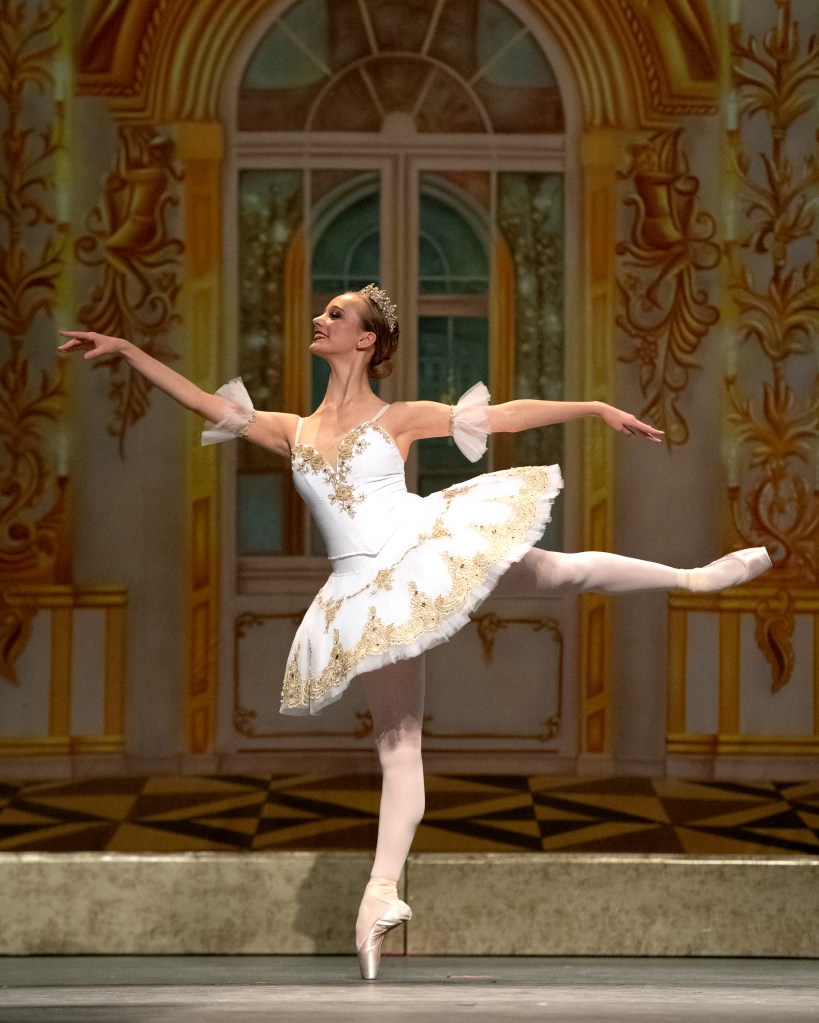
From Sleeping Beauty Photo by Chas Sumser Image Courtesy of Dahlia Denicore
Not yet 18, Dahlia, is a ballerina in every sense of the word. She says, “I love performing; telling the story and connecting with the audience on a personal level.” She bring a character to life through movement, expression, musicality, line, to the smallest tilt of her chin, glance of her eye, or reach of her finger.
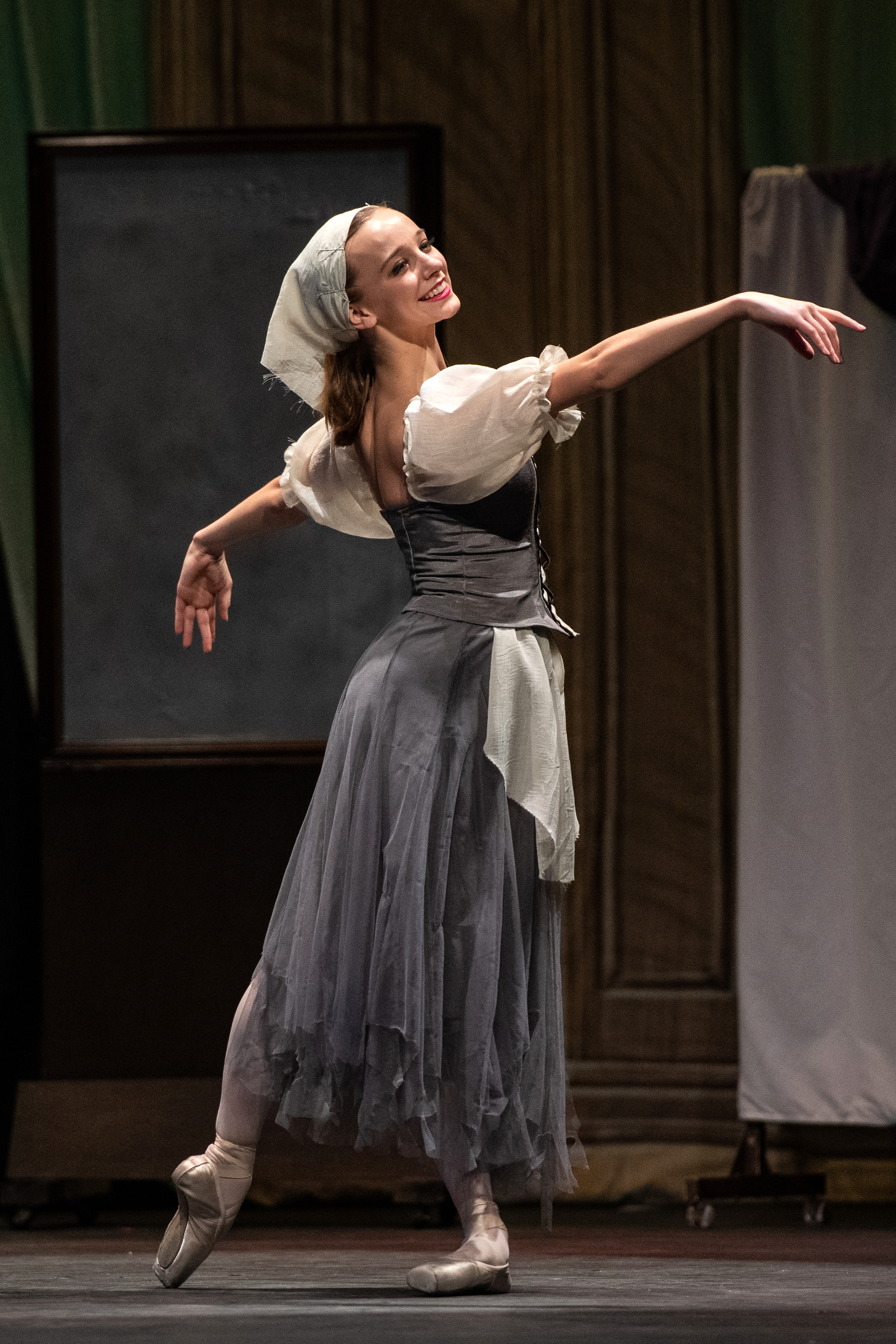
Cinderella photo credit: Chas Sumser Image Courtesy of Dahlia Denicore
Cinderella Photo by Chas Sumser Image Courtesy of Dahlia Denicore
Dahlia’s roles with the preprofessional ballet company have included most, if not all leading roles including Clara, the Sugar Plum Fairy, Cinderella, Alice, Snow Queen, Arabian Princess, and Odette. She has danced supporting and corps roles with the same enthusiasm and passion. She invests herself entirely.
Photo by Chas Sumser Image Courtesy of Dahlia Denicore
“What does it feel like on the day of a performance?” I asked Dahlia. She told me, “On show day, everything I do is for the show. I know that I am prepared. Yet, the excitement and the nerves are very real. I have a set pre-performance routine,” she told me. Interestingly, her warm-up and run through of choreography is not to the performance music, but to a completely different genre of music. “I love all music. I love jazz, pop, 80’s music. It inspires me,” she told me. “Before the performance, I go through barre and floor exercises. I work on my feet by rolling up and down and flexing and relaxing every joint and muscle. Then I put on my pointe shoes and again work my feet stretching, and rising and rolling, to get blood flowing. I keep practicing until the show.”
Staying focused is paramount for a successful and safe performance. In ballet, timing is everything. Pre-show, Dahlia relies on her ear buds to deliver music and keep her focused. Maintaining focus is a learned skill of ballet training. Dahlia explained that she listened to a phycology podcast about nerves, “I learned that people are nervous because they are afraid of being afraid. When I know that I am nervous, I accept it. I know that I will do what I love. Then, I feel my feet sink back into the ground. I visualize the performance and get lost in the story and the emotion of the moment.”
Before the curtain rises, “Roll-down sequences tell me it’s time to go. It wakes up my body,” she explained. Finally, positions and places and the music begins. “On stage, I am living it up! My nerves give way to my love and passion for the dance and pleasing the audience,” says Dahlia.
Asked about her character development, Dahlia explained, “I become that character. When I danced the Arabian Princess in Nutcracker, ‘I AM the Arabian Princess.’ I love to stay in the zone.”
Arabian Princess – The Nutcracker Photo Credit: Chas Sumser Image Courtesy of Dahlia Denicore
Staying focused is paramount for a successful and safe performance. In ballet, timing is everything. Pre-show, Dahlia relies on her ear buds to deliver music and keep her focused. Maintaining focus is a learned skill of ballet training. Dahlia explained that she listened to a phycology podcast about nerves, “I learned that people are nervous because they are afraid of being afraid. When I know that I am nervous, I accept it. I know that I will do what I love. Then, I feel my feet sink back into the ground. I visualize the performance and get lost in the story and the emotion of the moment.”
Snow Queen – Dahlia at age 15 Photo Credit: Chas Sumser
How do I know Dahlia? I am a crazy ballet girl who once danced with a burning passion and refused to settle for ‘good.’ Several years ago, my husband and I happened to be invited to fill stage space in a ballet production as ball guests. There was 14-year-old Dahlia, with the brightest genuine smile, the captivating eye contact, and the beautiful dancing. She caught my attention as someone going places. Because I happen to be friends with the company’s artistic director, I was pulled into way too much participation, but the result was developing a relationship with what the French would call, the “etoile,” Dahlia.
Dahlia repeatedly surprised me with her characters’ development, her emotional involvement, and her connection with the other dancers and the audience. There is a point where choreography ends and personal involvement takes over to reach to the back of the auditorium. How does one so young, accomplish something so difficult that many mature prima ballerinas lack? “I love acting. I have done some community theater. I love to tell the story,” she shared.
New York! Image Courtesy of Dahlia Denicore
In addition to performing with the preprofessional company, Dahlia has competed in the Youth America Grand Prix in Pittsburgh. She won the junior ballet division and competed in New York. This year she placed second in contemporary and in the top 12 in ballet. “I see myself more of a performer than a competitor,” said Dahlia. “In a performance, I tell the story. In a competition, there is very little time to develop the character. I have to bring the character with me and to bring it to life in the few minutes on stage.” She elaborated that competition is very helpful in developing her stage and dance skills . She loves the classes during the event.
In any given week, Dahlia will dance up to 40 hours. She takes class, has private coaching, and rehearsals every week. She is completing her first college year where she is earning top grades and excels in the sciences. While her time precludes her from acting in community theater, she stays involved by providing choreography for their shows.
In the Wings Photo Credit: Chas Sumser Image Courtesy of Dahlia Denicore
“How do you feel when a performance ends?” I asked her. Dahlia told me, “The most special part of a performance is the curtsey and audience appreciation. That day is high adrenaline and joyful. The following day feels like something is missing and somewhat sad. Yet, I try to stay hopeful and happy for the next performance.”
A Break From a Masterclass at Kennedy Center Image Courtesy of Dahlia Denicore
Dahlia has been studying ballet since she was two years old. In addition to her regular ballet and contemporary classes, she takes masterclasses with most of the major ballet companies that come to the Kennedy Center. She stands on the threshold of her professional career. She has received a number of offers from amazing ballet companies. In the summer she will be attending the San Francisco Ballet’s Summer Intensive program. She is evaluating opportunities for the coming year.
The “Dancing Denicores“ Images Courtesy of Dahlia Denicore
Dahlia is the oldest of three exceptional dancing children. She and her family live in the historic village of Waterford, Virginia where they have a fluffy dog, named Toby, a cat, a rabbit, and several chickens. Her younger sister, Daisy, is a beautiful ballerina, her brother, Tucker is an incredible singer and dancer who loves baseball and theater, although he has been “Fritz” in the Nutcracker for many years. Their mother, Amy, helps support the ballet company by sewing costumes, writing for grants, and getting the family fed. Their father, Mark, an attorney, is co-founder of Changing Latitudes, a non-profit organization focusing on education in Haiti where Dahlia has also worked during summer and spring break vacations.
Applause! “The most special part of a performance is the curtsey and audience appreciation. with Norbert Nirewicz Photo Credit: Chas Sumser Image Courtesy of Dahlia Denicore
Gumdo, is a long Samurai-like sword. J (just J) Douglas earned his first black belt in that martial art. For 17 years J owned and operated an Olympic World Taekwondo martial arts school. How does a martial arts master change careers? By picking up a paint brush.
J Image Courtesy of J Douglas
J delivers power with his paint brush. His “disruptive representationalism” blends powerful energy with classical realism. Yet, as a high school student in Texas, his representational realistic style was deemed mere “photography” by his abstract-loving art teacher. “So, I got into drama instead,” said J. “I went through phases of art forms from dance to drama to commercial art until 2008. Then, I was inspired to pursue my passion of oil painting.”
“In 2008, I watched Henry Asencio paint in person. I was inspired to return to my fine art roots. I bought my paints and supplies and haven’t looked back,” said J.
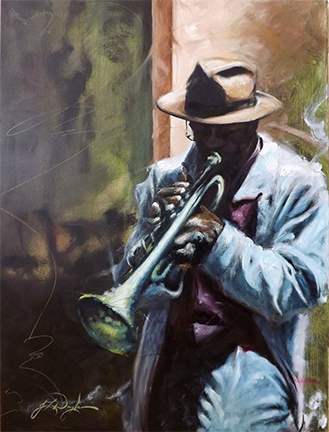
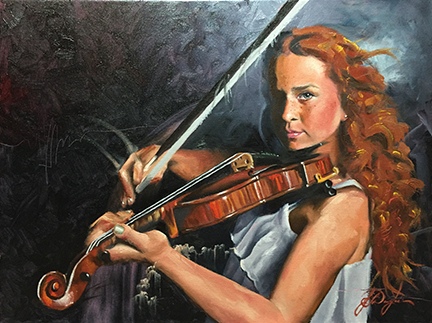
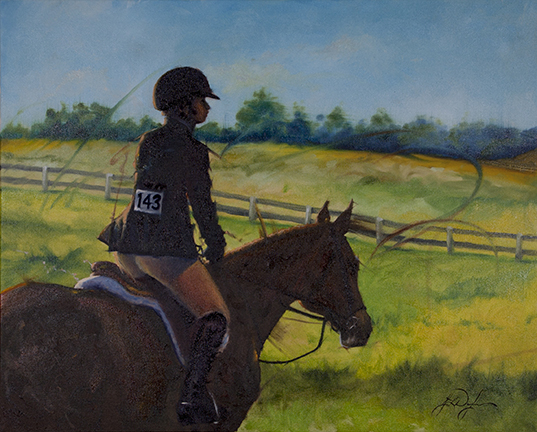
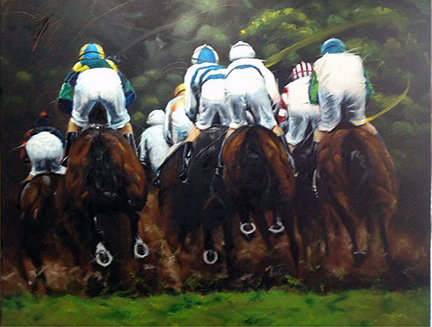
The emotions are palpable Paintings by J Images courtesy of J Douglas
“I feel that I am a lifetime student of the arts. Study and grow or get stagnant and die. I love where I am now with my art,” he says. His journey from disheartened, but seeking student; to dance and ballet; to the martial arts; and back to painting has taken interesting turns throughout his life. The constant has been his passion for painting.
On Pointe by J Image courtesy of J Douglas
I met J at the Salamander Resort’s Gold Cup Wine Bar a number of years ago. He was my server. Immediately, I sensed something intriguing about him. I had to ask questions. I learned that his name was simply, J. He joked, “When you’re as famous as me, just your first letter will do.” From our brief conversation, I learned that he was an artist. I also learned that his prints were for sale in the resort gift shop. That day, I bought my first J print, On Pointe. Today, we like to say that he is “an artist costumed as a server.”
Companions
Commission
Commission
Bottoms Up
Into the Sunset
Original Oil Paintings by J Images courtesy of
Salamander Resort (Middleburg, Virginia) owner, Sheila Johnson, has a keen eye for art. Beautiful paintings of pastoral scenes and powerful horses grace the walls of “Middleburg’s living room” and hallways leading to the spa and ballrooms of the Salamander Resort. Among those stunning oil paintings is a 5’ X 7’ painting titled, Destiny, by J. The Salamander Resort is his gallery. “Sheila Johnson made me an international artist. Thanks to her, I have been able to get commissions and patrons.”
Destiny by J is prominently displayed at Salamander Resort Image courtesy of J Douglas
Destiny is not only very large, but very powerful as well. Looking at the painting, I can hear the horse breathing, the sand spraying on the jump standards upon takeoff, and I can tell where the next jump is from the focused look in the eye of the rider. It is a work of balance, understanding, appreciation, and respect for animal, sport, and rider. It fits beautifully into the quiet atmosphere of excellence of Ms. Johnson’s vision for the resort.
Self Portrait by Rembrandt Image from Public Domain
Rembrandt is J’s favorite artist. J explained, “He was a master of the face and color. There are hundreds of colors in the faces of his subjects, although we see flesh tones.” Surely, a closer look at Rembrandt’s Self Portrait reveals multiple pallets of colors masterfully applied to beguile the eye. “The bodies of humans and horses, are captivating,” says J. “Their eyes, their strength, agility, textures, colors, and moods keep me asking and delving deeper,” he explained.
When asked about his materials, he said thatoil paint is his favorite medium and that he stretches his own canvas. “Oil paints are the most forgiving medium,” he explained. He shared that there are hundreds of colors and qualities of paints. He uses only about eight colors that he mixes to achieve the exact color. His works mostly with a brush but a pallet knife has occasionally come in handy.
The Wet Wall
Portraits – J captures “the souls of his subjects through their eyes” the painting top left and bottom left is a work in progress. The reflections in the sunglasses tells a story.
He works on commissions first. For his personal projects, he has a “wet wall” that he turns to when time permits. The flexibility of oil paints allows him the privilege to let some pieces “rest.” On social media, J features many time lapse videos of his work. Take a look at one for Destiny:
Watch Tine Lapse Video of the creation of this painting Courtesy of J Douglas
J gives much back to his community. He has supported the local ballet company with his On Pointe print, created a Salamander Fox for the Middleburg Garden Club’s biennial “Foxes on the Fence fundraiser,” and consults for the greater good of the area.
The Salamander Fox for Middleburg Garden Club’s BiennialFoxes on the Fence Fundraiser Image courtesy of J Douglas
Always growing and trying different approaches, his artistic includes graphic an commercial art. A popular and still available image is the “Parrotheads” (of Jimmy Buffet fame) “License to Chill” license plate that he created for the Virginia Department of Motor Vehicles.
“License to Chill” by J Image courtesy of J Douglas
As an avid horse enthusiast and a fan of J’s equestrian paintings, I had to ask, “Do you ride horses?” “I am learning and loving it. My wife wants me to stay safe so I take riding lessons,” he replied. Being from Texas does not automatically bestow equestrian prowess. He is a horse-studier and horse lover. He naturally understands the power, spirit, movement, and essence of the horse. His paintings seem to get it just right.
Best Friendsby J Image courtesy of J Douglas
J wants people to love the art they acquire and commission. He understands that it can be an economic extravagance. To help more people be able to enjoy his art, “We are now teaming up with Patreon. Patreon is a site that allows people to support the arts. Almost like an internet tip jar. But, we don’t want to just ask for support. We created a system to spread your payments out over 12 easy payments. You decide the level of support, choose the subject of your painting and then in one year you have your original piece of art.”
J, the man, exemplifies the “polymath,” the Renaissance man. The power of his brushes tell mesmerizing stories.
Pansies, Henri Fantin-Latour, 1874, National Gallery of Art, Washington DC
“The world will surprise you with its grace,” is a line from a movie that I have watched many times. In today’s environment, this line has been brought to fruition in the most generous ways. We are all affected in how we move about, how we work, how we interact with friends and family, and how we entertain ourselves.
Detail of Frederick Edwin Church El Rio de Luz National Gallery of Art, Washington, D.C.
As in Sleeping Beauty, theater, music, art, dance, intellectually stimulating courses, and much of our in-person physical activities have ceased for the moment. However, the outpouring of generosity on the part of performers, museums, theaters, educators, and trainers have amazed me over and over. Sometimes I have blinked to be sure that what I was reading is true. And, so it is. We need grace and must exercise generosity now. We need the arts now more than ever. What better way to experience grace and generosity now?
Washington, DC
Westminster, London
Palais Garnier Paris
Louvre Paris
Royal Opera House London
Royal Opera House London
From Paris to Seoul, from London to Washington, DC , Florence to New York City, and from Harvard to Yale, and Princeton, along with many others, the best and greatest are sharing with us their best and greatest. We can nourish our souls (this is not a theological article) profoundly by a click on our computers . We can regroup. Perhaps this is our opportunity to explore, learn, reinforce, and discover the beauty of the arts. Our souls will be better for it.
Tea . . . Fortnum and Mason
Fortnum and Mason
Through my love for the arts, I feel like a kid in a candy store – where to go first – what to watch first?? Actually, I am feeling like I did on my first visit to Fortnum and Mason, “Must focus. Time is fleeting.”
Oliver Lee Jackson exhibition 2019 at NGA East Wing
The Lacemaker Johannes Vermeer
Allies Day, May 1917 Childe Hassah
A Young Girl Reading by Jean-Honoré Fragonard
To help make the most of our situation, I have compiled links to complimentary (some are pay what you can) videos from some of the world’s greatest resources. To these generous and gracious people and organizations, I give heartfelt thanks. Please remember them when times change and support them by become patrons, buying tickets, attending exhibitions, and buying future streaming services. They have gone above and beyond our expectations to feed our souls with beauty, creativity, adventure, and grace.
12 Museums offer virtual tours – from the Guggenheim and the Washington National Gallery of Art to the Uffizi, to the British Museum, London, and so many repositories of treasured art throughout the world
HBO provides movies, programs, and documentaries free to stream
Amazon Prime SXSW 2020 Film Festival – ““Prime Video presents the SXSW 2020 Film Festival Collection” offers filmmakers in the 2020 SXSW Film Festival lineup an invitation to opt in to take part in this online film festival, which will play exclusively on Prime Video in the U.S. for 10-days. The one-time event will be available in front of the Prime Video paywall and free to all audiences around the country, with or without an Amazon Prime membership, all that is needed is a free Amazon account.”
Hanukkah – the celebration of light and thanksgiving for the miracle of the oil. In the year 139 BC, the Macabees’ victory over the Syrian-Greek occupiers liberated Jerusalem. This event was recognized by the lighting of the Menorah but the oil supply was sufficient for barely one day. Miraculously, the oil lasted for eight days. Therefore, the eight days of prayers and thanksgiving at Hanukkah. This event is historical and not biblical, therefore is not a major holiday, according to my Jewish sources. The thanksgiving is for God’s provision and extending the tiny bit of oil from barely one day to eight, reminding the Israelites that He is with them.
Friends from many parts of the world shared some beautiful memories and traditions of their Hanukkah celebrations.
Jam-filled Hole-less doughnuts – sufganiot
Jonathan – Ra’anana – a suburb of Tel Aviv Israel
Jonathan spent much of his childhood and youth in Canada and the United States. He told me. “You can see lit menorah candles in peoples’ windows. Israelis love to eat hole-less doughnuts called “sufganiot” filled with various creams and jams. We ate fried potato pancakes, latkes, with apple sauce,” he said.
Recalling his childhood, he told me that his family followed the German-Jewish custom, “My parents would buy gifts, set them on the table, and cover them with a sheet. After we lit the candles and sang the religious prayers, we would head to the dining room and they would remove the sheet. My sister and I would get our gifts on the first night. I would play with my new toys and we would play games together. I remember getting a toy plane with lights. It was fantastic!”
Jonathan shared one particular memory of holiday times as a five-year-old kindergartner in Canada – “The teacher asked us to sit in a circle cross-legged and sing Christmas songs. My non-Jewish neighbor and friend (his father had served in the Wermacht) was also in the circle. When I couldn’t sing any of the songs, the teacher was quite cross. She asked me angrily why I wasn’t singing the Christmas songs with the other children. I told her that I was Jewish and was not familiar with the songs. She told me to leave the circle and to sit by myself. A few minutes passed and my friend, also five years old, realized the unfairness of it all. He stood up and stated angrily, ‘If my friend, Jonathan, will not be allowed to sit with us in the circle, then I’d prefer to sit outside the circle with my friend!”
Also in Canada, Jonathan and his friend visited Santa. He remembers, “When it was my turn to sit on Santa’s lap, I was hesitant but curious. When he asked me what I wanted for Christmas, I whispered in his ear that I was Jewish. He told me, ‘That’s OK, so am I!’”
Danielle – Leesburg, VA
Family Time Photo Credit – Marc Sirinsky
“When I was a child, Hanukkah was not commercial and there were not many holiday decorations in the stores. My sister and I would make paper chains and decorate our house. One year at school, I noticed that there were Christmas decoration but nothing for Hanukkah. There were not many Jewish children in my school. I asked my teacher if we could have some Hanukkah decorations. She told my sister and me that we could make some and they would be put up. My sister and I made decorations and they were installed along with the other ones,” recalled Danielle.
Pot Roast
Latkes
Photo Credit – Marc Sirinsky
“Hanukkah is not a high holiday. It is a celebration. So, we usually stay close to home with immediate family. My sister is a cantor in a synagogue so we will go there on the first night. We eat latkes – fried potato pancakes and there is a bakery that makes the hole-less doughnuts,” explained Danielle. On the first night, the first candle in the menorah is lit and three prayers are said/sung. On the subsequent seven nights, two prayers are said as each night one more candle is lit.
“We give one large gift and then smaller gifts during the celebration. Our first night is bigger so we have a larger meal, usually a pot roast, and give and receive the largest present,” explained Danielle. The fried foods represents the miraculous oil, she told me. Danielle’s husband and two daughters enjoy family time during the celebration.
Dreidel Game
Joan – Purcellville, Virginia; originally from Brooklyn, New York
“We are a multicultural family today so we celebrate Hanukkah as well as Christmas. Typically, we don’t put up the Christmas tree until after Hanukkah. This year we put up the tree early because Hanukkah falls at Christmastime,” explained Joan. “I grew up in Brooklyn. On Christmas Eve, we were always at our neighbor’s Chinese restaurant. They were good friends. I never sat with my parents, I sat with the owner’s children and we ate authentic Chinese food,” said Joan.
In her family, the first day of Hanukkah is the day that has the biggest present and the one the recipient wants. On the second day, the gift is major but is what the parents believe the child needs – “Typically shoes. On the third day, it will be socks, the pajamas, and on down the list of importance. This can be called the festival of feet,” said Joan.
‘We played dreidel with pennies. Some people use gold chocolate coins,” explained Joan. The dreidel is a four-sided spinning top. On each of the four sides a Hebrew character is inscribed. The meaning of the each of the characters – none (you win nothing); half (you win half the pot), All (you win the entire pot), and sorry, you have to put in another coin. The game ends when the latkes are gone or the sun comes up, or the players lose interest.
From Canada to Israel, from Chicago to Leesburg and from Brooklyn to Purcellville, the prevailing tradition of Hanukkah is one of thanksgiving and family. Wishing all of my Jewish friends a happy Hanukkah!










































 Good News. Reviews. Events.