For my birthday, my daughter gave me a ticket to see Lady Gaga’s Mayhem Ball Concert at Madison Square Garden. I immediately began mentally making excuses not to go—too much work, too far to travel, too complicated. Then I bit the bullet and went to New York for the show.
What would I have missed had I stayed home working? A transformative cultural experience. That would have been my loss, despite whatever tasks I might have accomplished at my desk.
I have been attending concerts since the Who opened for Herman’s Hermits (yes, I was young once). After countless shows in theaters, stadiums, and arenas, I grew jaded. I thought having seen some of the best, I was done.
Not so fast.
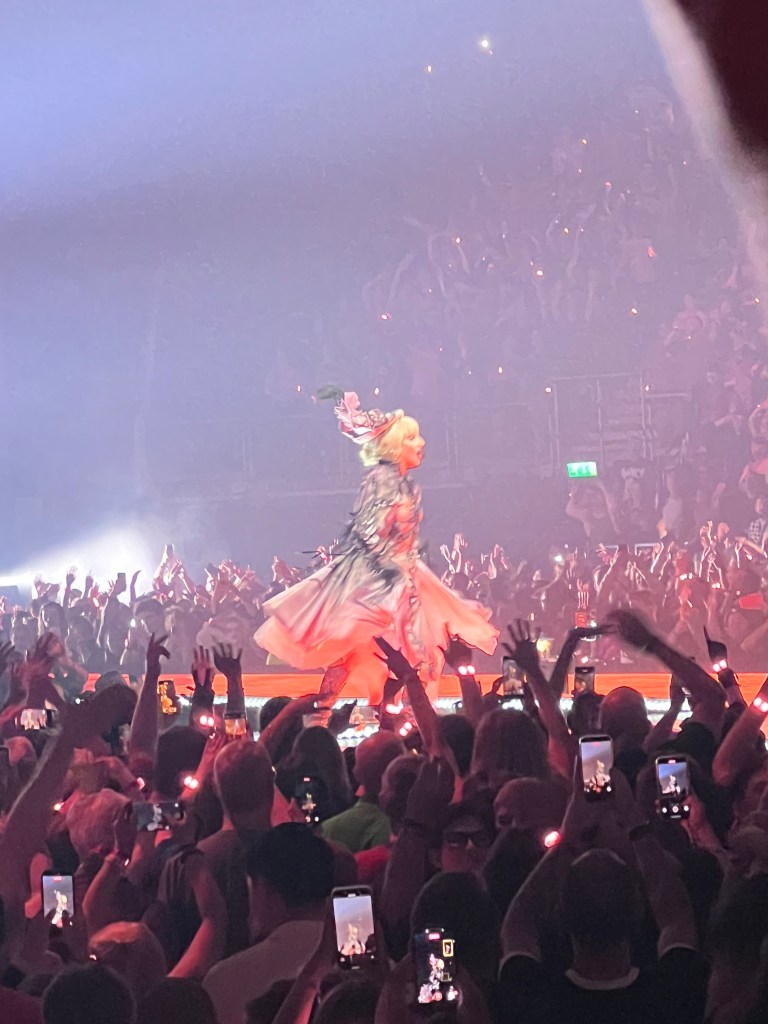
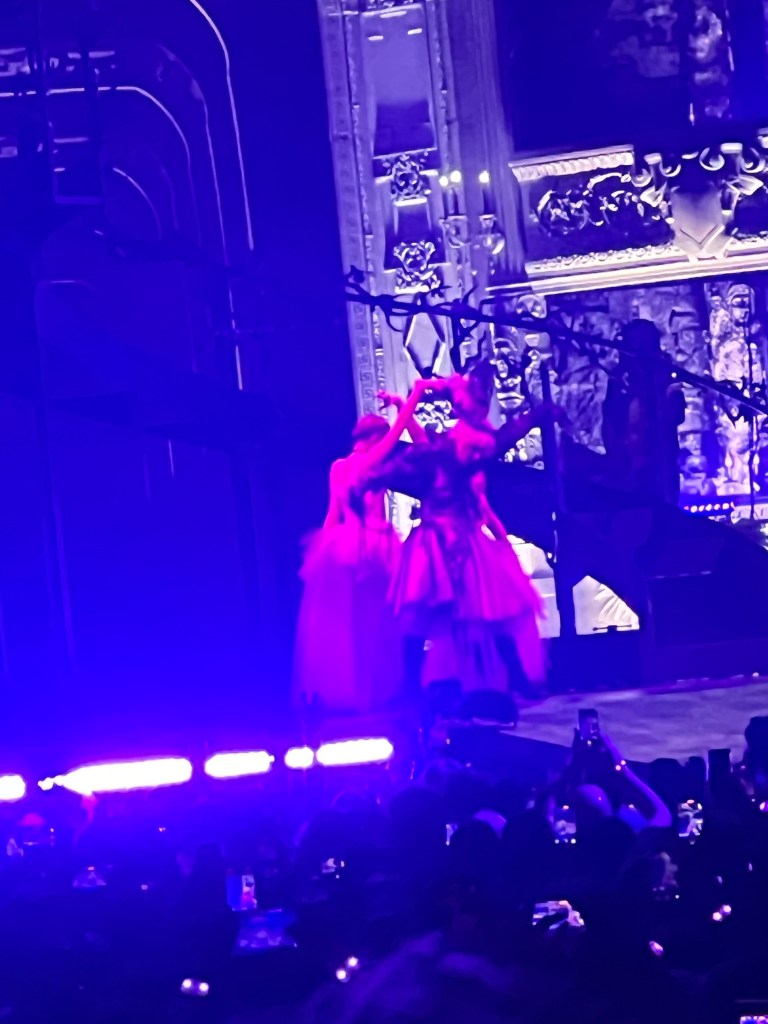
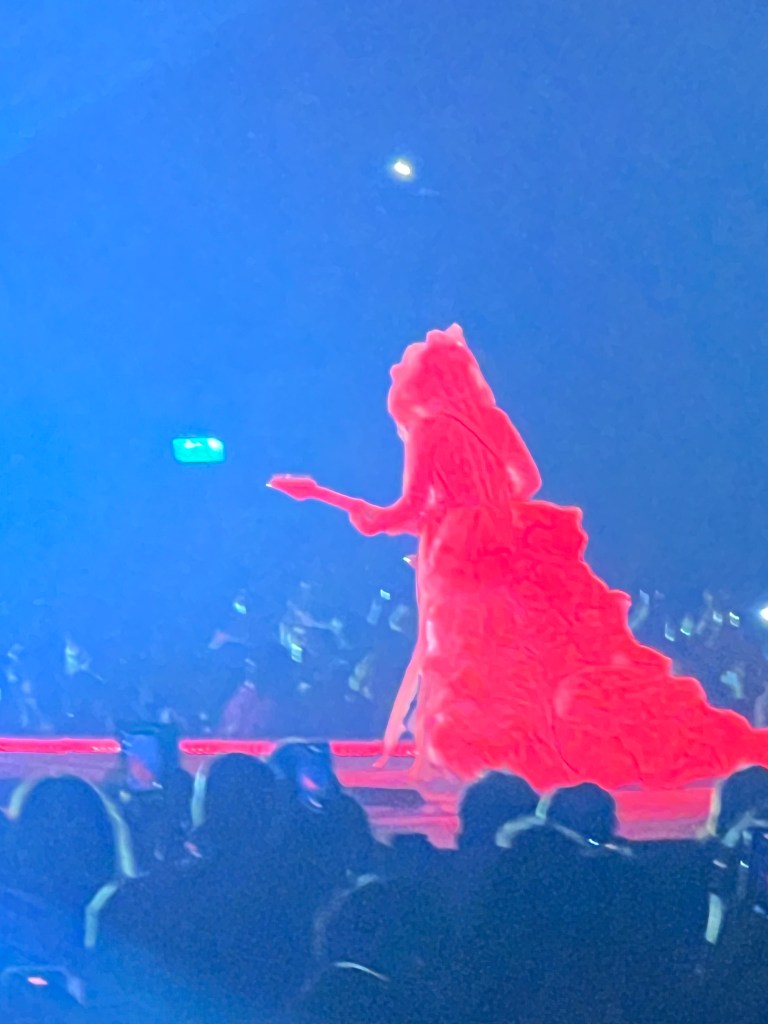
These concerts are not merely performers singing their songs loudly while audiences cheer. This is an experience like none other: music, costumes, dance, theater, sociology, spectacular lighting, elaborate sets, powerful themes, and above all—generosity of spirit.
The Artist Who Delivers
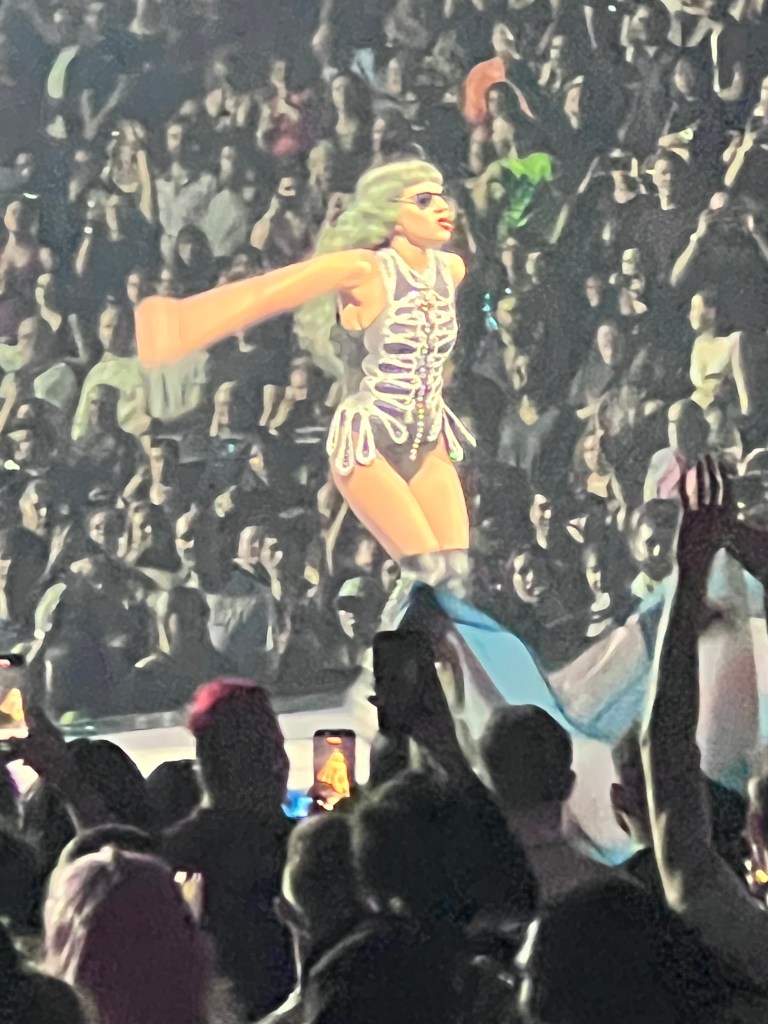
We have all read about difficult performers who show up angry, battling group dynamics and technical problems. The performance I witnessed had none of those issues and all of the magic. Gaga delayed the concert start by several hours to accept the 2025 MTV Video Music Awards, including Artist of the Year. Then she arrived and gave us her heart. She had already put in a whole day’s work, then performed an electrifying two-and-a-half-hour concert. And yes, she incorporated her award statues into one of the acts.
The later start gave us time to enjoy a leisurely dinner and a relaxed entry into Madison Square Garden. The music and performance were exceptional—but you don’t need me to review an exceptional artist’s performance. Of course it was off-the-charts wonderful. What captivated me was the audience and the atmosphere they created with the performer.
London!
The Magic of the Crowd
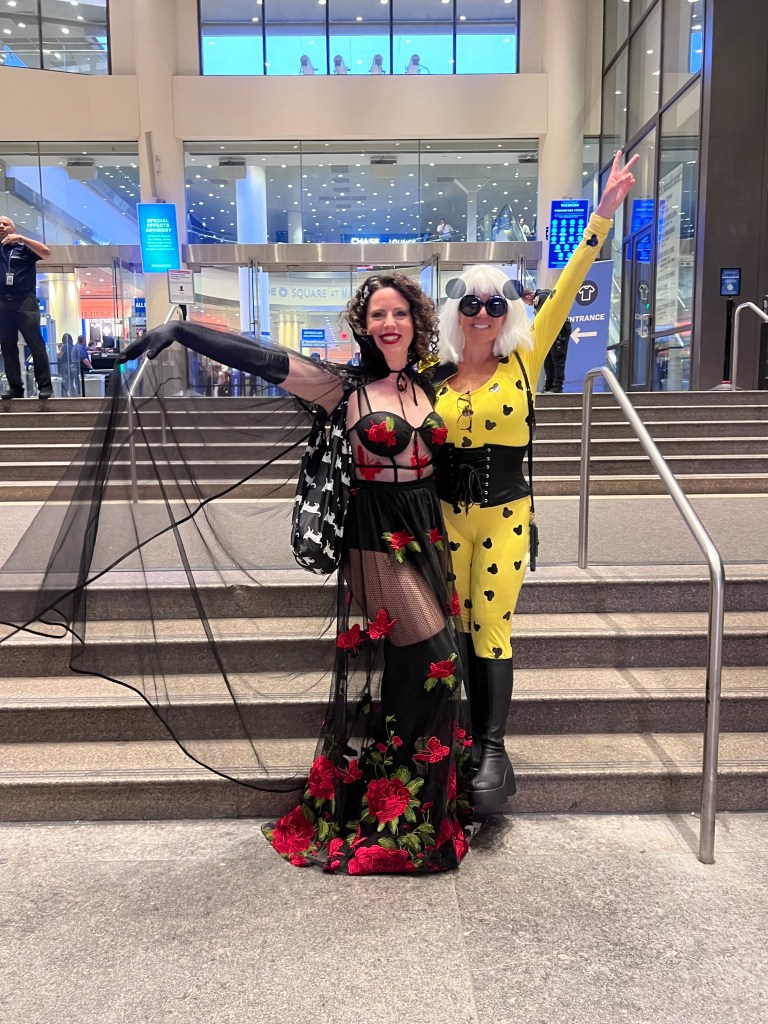
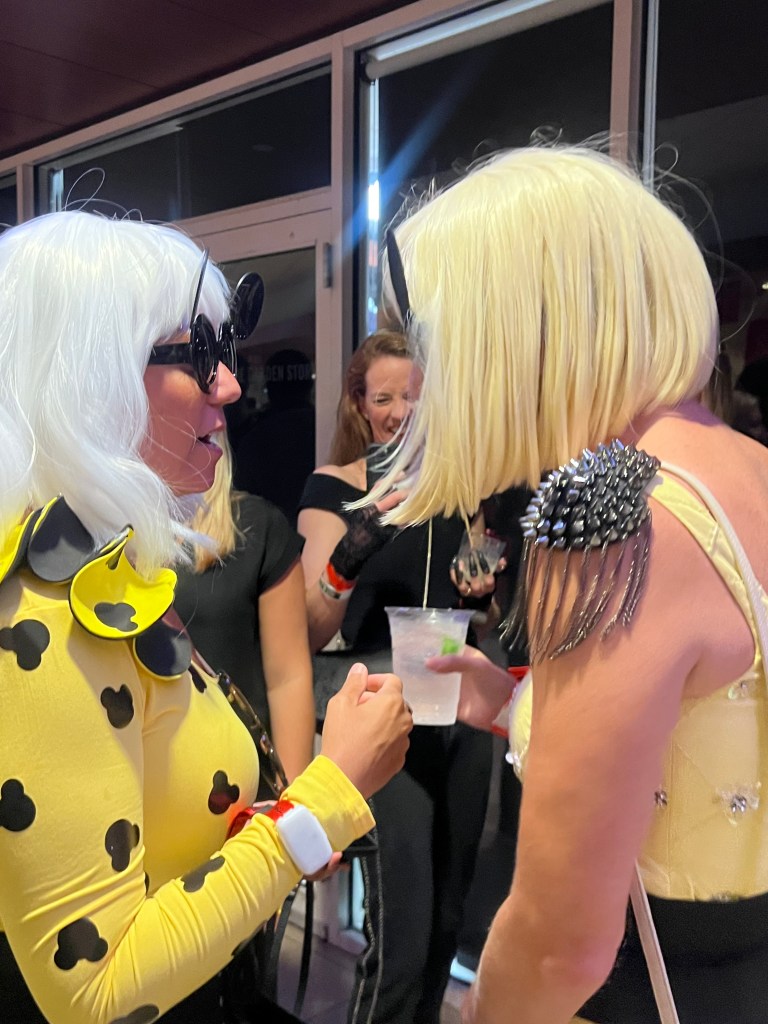
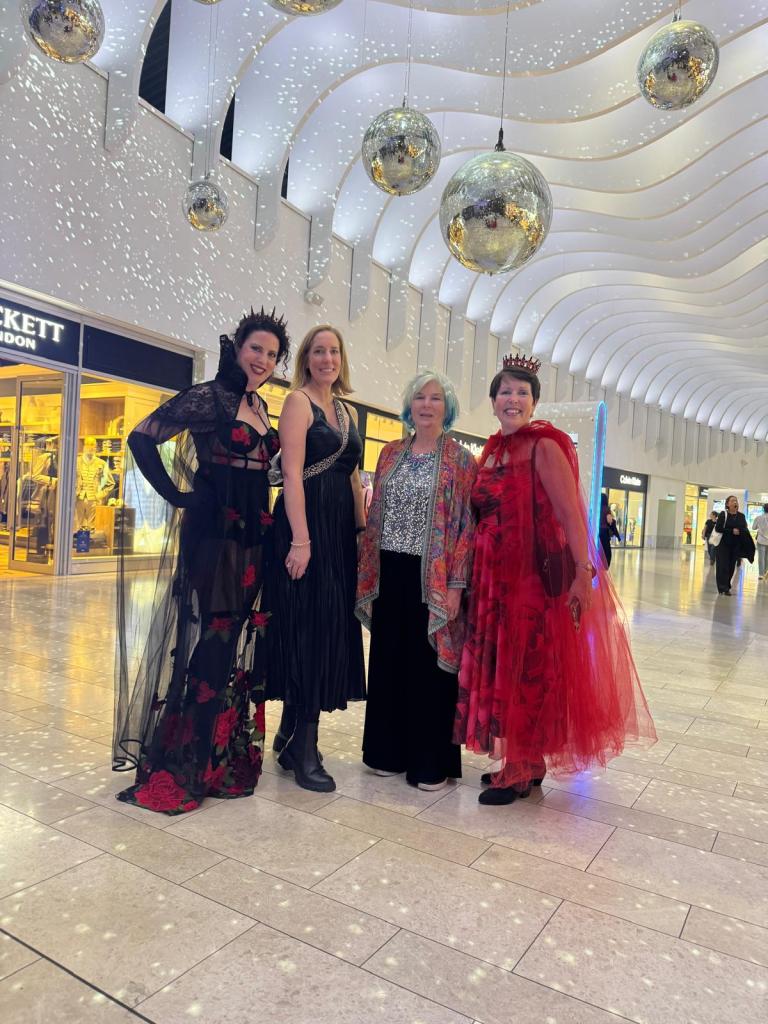
So many people came dressed as Mayhem characters. There was me in a nice colorful cocktail dress, all the way to the full Lady Mayhem complete with lace mask, crown, and red costume. In my party, the costumes were breathtaking. I felt a bit underdressed, but the show went on.
The audience was gracious and kind. It was delightful to meet so many enthusiastic fans who came to enjoy both the performance and the camaraderie. People stopped to admire costumes and introduce themselves. The atmosphere was electric.
I spotted Gaga’s parents in the audience. They must have been over the moon—awards and adulation: proof that those voice and piano lessons paid off.
Breaking My Own Rules
I loved the NYC concert so much that I made a rash decision: I would see it again in London. I broke my promise not to travel in 2025 and booked a flight. While the NYC concert was out of this world, somehow the London performance exceeded my expectations. The audience’s appreciation and Gaga’s acknowledgment and gratitude were palpable.
The London performance was at O2 Arena, where 20,000 people entered, reached their seats, experienced the magic of the performance, and then miraculously filed out onto the Tube without pushing, shoving, or even loud words. They were gentle and patient—even in the very crowded, shoulder-to-shoulder train cars. Twenty thousand people, some dressed in their finest Mayhem costumes, made their way home peacefully. We were a bit less conspicuous on the return trip than we had been heading to the venue.
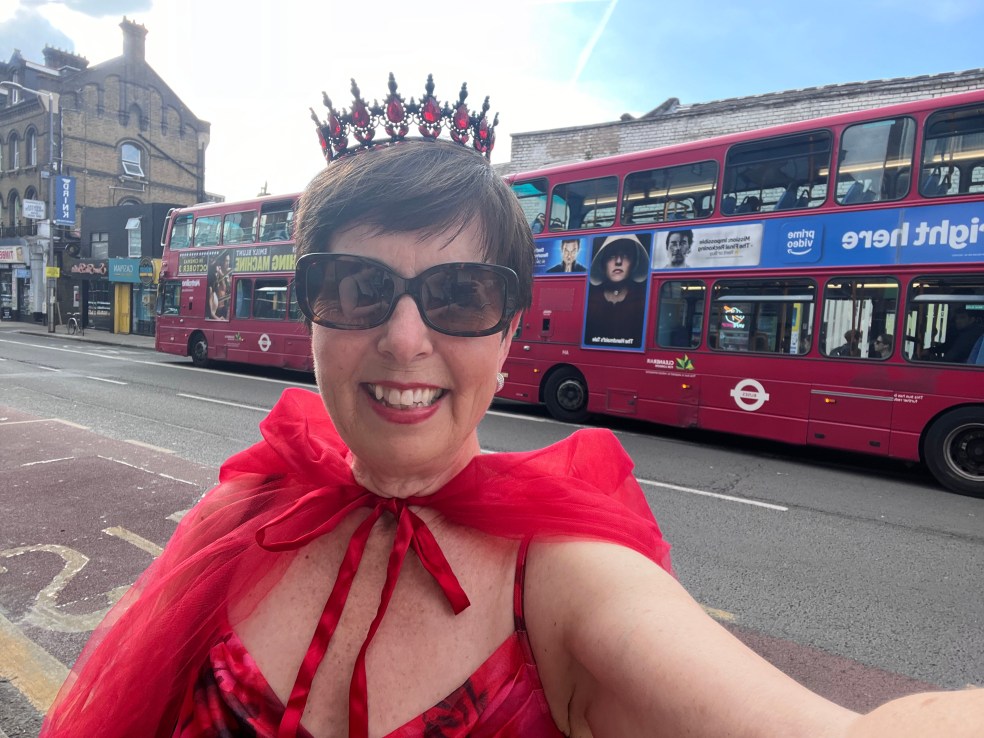
Before the concert, I worried about wearing our regalia on the Tube and causing other riders consternation. But Londoners are tactful and uninvolved with the strangers with whom they share the evening commute. A few Gaga fans even cheered us on.
Having just seen the NYC show, I was prepared for excellence. But I wasn’t prepared for excellence multiplied. How can perfection improve? The London audience’s energy was supercharged. They cheered, sang, and hugged their neighbors. The costumes weren’t as over-the-top as in NYC, but some were incredible. This time, I made better plans and packed a crown, cape, and dress in my suitcase. I WAS Lady Mayhem! Although, looking at the pictures – maybe more like Little Red Riding Hood?
The Real Gift
After the performance ended and we returned to my friend’s house in London, I pondered what I’d just experienced. This was more than entertainment—it was an entire sensory event that spoke not only to my musical and dramatic interests but to my soul. To my sense of joy and gratitude.
To those of us who have seen many concerts: go to the new ones. To those who haven’t experienced such events: this is a cultural phenomenon worthy of the cost—even if you don’t dress up and look silly on the Tube or Metro.
I thank Lady Gaga for her generosity in sharing her talents with us and creating an impeccable experience worthy of causing me to break my travel moratorium. I thank my lovely and incredible daughter for inviting me and for such a memorable birthday gift.
The Virginia National Ballet delivered a spectacular trio of performances at their recent “Bohemian Rhapsody” show, showcasing their remarkable versatility and technical prowess through three distinct repertoire pieces.
The evening began with “Tango Nights,” set to the passionate music of Astor Piazzolla. The atmospheric stage design evoked an Argentine nightclub where dancers explored the complex emotional landscape of pursuit, betrayal, and romance. The choreography captured tango’s sultry essence while maintaining the company’s signature balletic precision; a captivating introduction that immediately drew the audience into the performance’s emotional world.
“Moonlight Sonata,” a new world premier by Rafik Hegab, and choreographed to Beethoven’s timeless composition cooled the atmosphere with three phases of the moon.. This piece displayed ballet in its most powerful form, with over fifteen dancers executing intricate patterns across the intimate stage. What struck me most was the remarkable juxtaposition of strength and gracefulness – forceful movements executed with extraordinary finesse. The dancers’ stamina and control were evident as they embodied the music’s emotional journey, with visual elements representing lunar phases complementing the crescendos of both music and movement. Sierra Stipetich delivered a particularly breathtaking performance with her fearless pas de trois featuring gravity-defying lifts and seamless transitions between her male counterparts.
The culminating piece, “Bohemian Rhapsody,” was nothing short of transformative. Choreographer Rafik Hegab, brilliantly fused classical ballet techniques with the electric energy of Queen’s iconic music, creating a synthesis that honored both traditions while creating something entirely new. Six Queen compositions flowed together in a performance that had me repeatedly smiling with sheer delight. The dancers embodied Freddie Mercury’s theatrical spirit while maintaining their classical foundation; a combination that felt organic rather than forced.
Throughout the evening, the company demonstrated remarkable emotional range, transitioning from the moody intensity of tango to the structural elegance of Beethoven, and finally to the bold theatricality of Queen. This versatility speaks to the vision of company founder and managing director, Elysabeth Muscat, and the choreographic genius of Rafik Hegab, who have clearly created an environment where technical excellence and artistic expression flourish equally.
For those who missed this extraordinary performance, there’s one more opportunity to experience it on May 17, 2025, at the Ailey Citigroup Theater in Manhattan. This is a production that deserves to be seen – repeatedly, if possible. It showcases ballet’s timeless ability to evolve while honoring its classical foundations.
The Virginia National Ballet has proven once again that they are a company worth watching, not just for their technical precision, but for their willingness to push the boundaries of what ballet can express.
Photo Credits:Photos by David Pearson, Compliments of Elysabeth Muscat, Managing Director, Virginia National Ballet
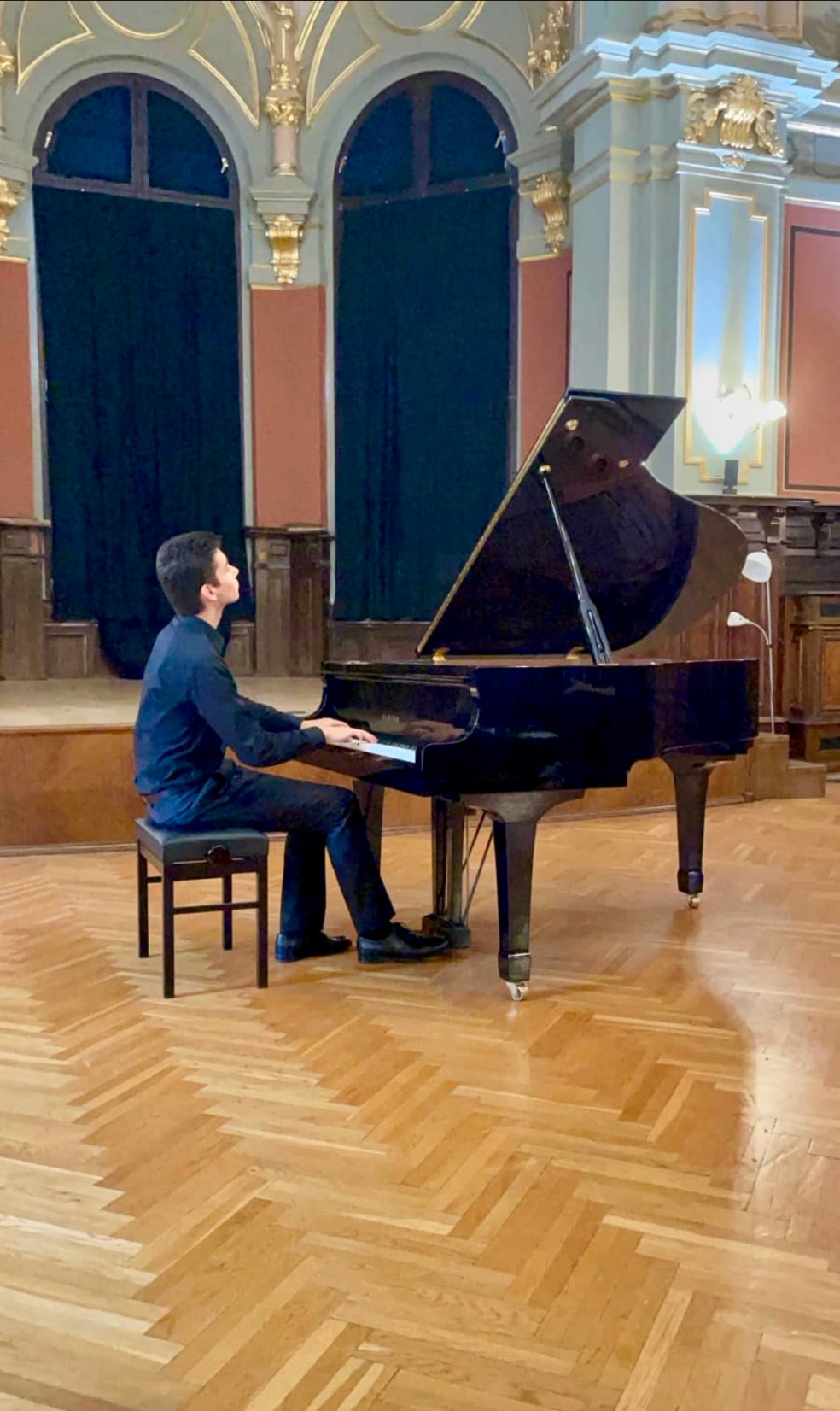
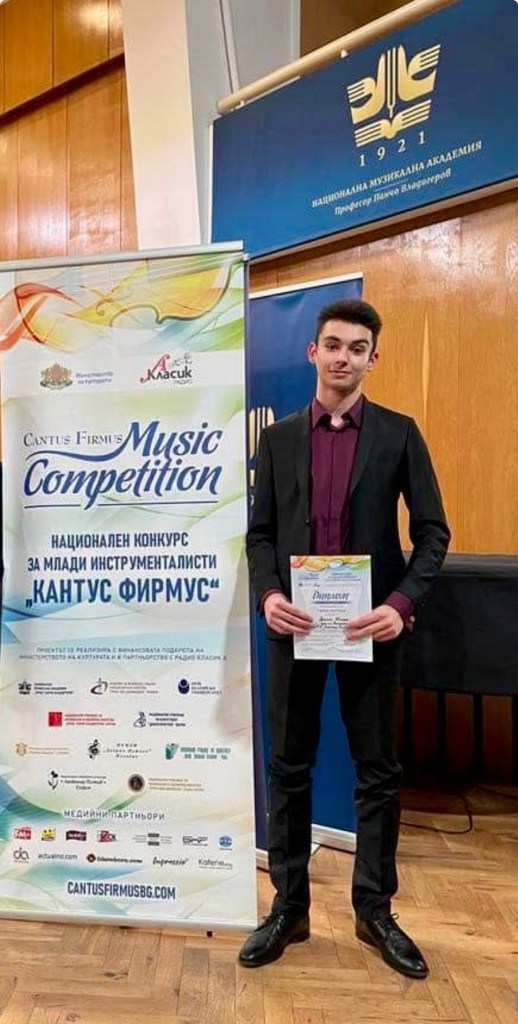
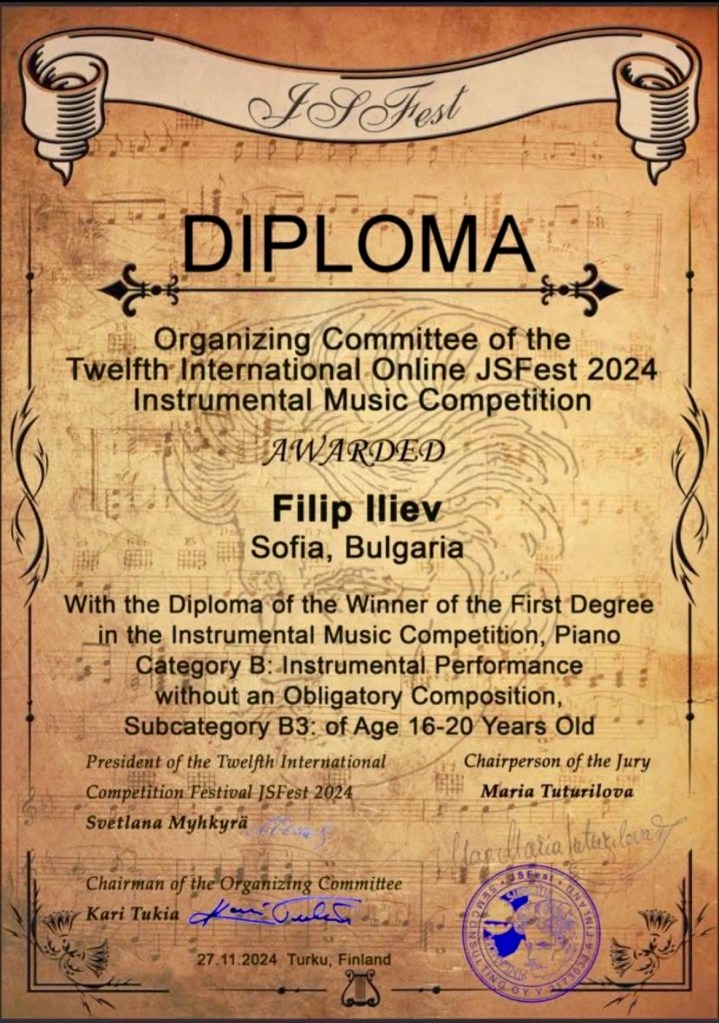
In the heart of Sofia, Bulgaria, a remarkable musical talent is blooming. At just 17 years old, Philip Iliev stands out as a classical pianist whose journey began with a simple moment of childhood curiosity – catching a glimpse of a piano on children’s television at age five. He has won over 30 national and international prizes for his virtuosity.
A Natural Calling
Unlike many prodigies pushed into music from infancy, Philip’s path to piano excellence was organic. His mother, Elena Kostova, waited to see genuine motivation before arranging his first lesson. That patience led to a serendipitous encounter with a top piano pedagogue, Angela Tosheva, in an unexpected setting – a garage studio workshop. By 2016, what started as childhood curiosity had crystallized into an unwavering calling.
Aviation Meets Artistry
Perhaps the most intriguing aspect of Philip’s background is his unique family heritage. Born to parents working in air traffic control, he inherited their exceptional attention to detail and capacity for total focus – crucial attributes for a classical pianist. While his father’s passion lies in aviation and the air, Philip found his calling in the grounded precision of piano keys. Though neither parent is a professional musician, their home resonated with the sounds of Italian opera and Mozart, creating a rich musical environment that nurtured his developing talent.
Technical Mastery
One cannot discuss Philip’s abilities without mentioning his remarkable physical gift – hands that can span 12 tones, reminiscent of Rachmaninov himself. While he’s quick to acknowledge that smaller hands can achieve excellence, these natural attributes give him additional versatility at the keyboard. His approach to practice is uncompromising and holistic – when tackling Chopin’s etudes, he aims to master all 24 (the entirety of the original 2 Opuses), elevating each composition to its highest potential. Of the Chopin etudes, his favorites are opus 25 no. 10 in B minor and opus 25 no. 12 in C minor. Philip stresses that “Music is a tapestry of tones, emotions, intentions, and mathematics. To create a pleasing, technically correct, and moving performance, every aspect of a composition must be assessed, studied, then played slowly at first, gaining momentum as confidence and understanding grow.”
Musical Philosophy
What sets Philip apart is not just his technical prowess but his mature approach to interpretation. He raises the spirit and soul of the music. He holds a particular fascination with Rachmaninov, noting how the composer’s relatively recent place in musical history allows for a more immediate connection to his intentions. “We can hear him,” Philip explains, suggesting a direct line of artistic interpretation that bridges the temporal gap. He also mentions that his hands have been compared to the composer.
His repertoire choices reflect a sophisticated understanding of classical music’s breadth. Rather than claiming a favorite composer, he allows his mood to guide him through the works of Brahms, Chopin, Liszt, and Bach. This emotional intelligence in his musical choices speaks to a maturity beyond his years.
He Studies at a High Level
Philip is a student at an immersive musical arts school in Sofia where academics blend with his art. “Truth be told, I prefer the music,” he shared. His school, National Music School, Lyubomir Pipkov , believes that “Music Comes First.” He currently stuies with Professor Alexander Vassilenko. In addition to academics and his school Philip takes masterclasses at almost every opportunity. In addition to his school, his motivation and curiosity has taken him on three occasions to Salzburg, Austria, where he attended the Mozarteum University, ClavoCologne Master Class, then returned to follow up classes with a particular professor that he found most inspiring.
The Competition Circuit
Since his first professional competition at age ten, Philip has been making waves in the classical music world. His competition preparations are methodical and thorough.He often performs in venues including the concert halls of the National School of Music and National Academy of Music in Sofia, and the Plovdiv School of Music’s concert hall. His recent recognition for interpreting the works of Lyubomir Pipkov, a leading Bulgarian composer, demonstrates his ability to master both traditional repertoire and more contemporary pieces. Listen to his latest competition performance of Liszt-Paganini Etude No 6
Looking Forward
As Philip continues to develop his artistry, his goals remain ambitious yet focused. He has immersed himself in the complete works of the great composers, having listened to thousands of hours of Chopin, alone. His systematic approach to mastering entire collections – from ballads and scherzos to sonatas and concertos – suggests a promising future in the international classical music scene. His goal for the 2025 season is to prepare for the Bulgarian competition circuit in the fall with future goals for international opportunities.
In an era where classical music sometimes struggles to find its place among younger generations, Philip Iliev represents a bright hope for the future. His combination of technical excellence, emotional maturity, and unwavering dedication marks him as a rising star in the classical piano world, one whose journey has only just begun.
Conducting Tchaikovsky’s Fourth Symphony. The power is palpable. Photo Credit: Toby Marquez
From the moment Conductor, Nancia D’Alimonte, walks toward the podium, there is a spark that ignites the atmosphere. There is energy and joyfulness. Her sincerity to the audience and empathy for the musicians is unquestionable. A master storyteller, she involves the audience by revealing some hidden secrets and giving intriguing history about each piece.
What separates Nancia from many other conductors? Unity. There is a rare connection between conductor and orchestra. She brings the best out of the orchestra at the precise moment of every note of every score. They create each other- it is a sense where each makes the other. It seems as if she “sends” the music to the musicians and they return it to the audience. “When I step on the podium, something unique happens,” she said. The music comes through her.
A unique connection with the musicians – Photo Credit: Toby Marquez
Nancia D’Ailmonte is conductor of the Loudoun Symphony Orchestra (LSO). She is also founder (2006) and conductor of the NIH Philharmonia. At Christmastime, Nancia conducts the beloved Kennedy Center Messiah Sing-Along. She is a busy person of great depth, with exceptional talents, a delightful sense of humor, and a variety of interests.
Nancia Leadsthe Messiah Sing-Along at Kennedy Center – photo courtesy of Nancia D’Alimonte
Conductor positions are tightly held and highly coveted. With approximately 1250 symphony orchestras in the United States, with anywhere from 60 – 115 musicians; there are approximately 90,000 musicians. There are only about 1300 conductors. A 2014 survey discovered that of the top 150 orchestras, there were only five conductors who are women.
Meticulous details – Photo Credit: Toby Marquez
In the November 10, 2019, conversation about the arts and law at the Kennedy Center, the late Supreme Court Justice, Ruth Bader Ginsburg, shared, “In my growing up years, I never saw a woman in a symphony orchestra.” She recounted the advent of the “dropped curtain” after a New York Times critic was certain that he could tell the difference between a male and female pianist only to get “it all mixed up” after he was blindfolded.
French conductor and composer, Nadia Boulanger (1987 – 1979), was asked in 1947, about being a woman and a conductor. She said, “I’ve been a woman for a little over 50 years and have gotten over my initial astonishment. As for conducting an orchestra, that’s a job where I don’t think sex plays much part.”
Conductors have their own styles. Some are flamboyant making the performance all about themselves; some are timekeepers, and some are dreamers. Then, there is the rare conductor who brings music to life. Nancia is that conductor. Having been principal horn for 12 years, she says of conductors’ styles, “I know, I was a player.” Hence, her empathy and consideration for the musicians.
Knowing the scarcity and competitiveness of conducting positions, Nancia chose to follow this path. She tells her incredible story, “When I had been principal horn for 12 years with the Oshawa Symphony Orchestra (outside of Toronto, Canada), our beloved conductor was stepping down. I was on the search committee. We viewed endless video tapes of less than stellar conducting examples – all by men. After every video, I would think to myself, “I could do much better than that!” Then came the final guest conducting experiences… one conductor led more with his non-baton hand (left), being quite flamboyant, and kept shouting to the orchestra, ‘play with me, you’re behind, you’re behind!’ ‘
‘During that time, I was teaching high school music and art. A friend told me about a conducting workshop with John Paynter, guest clinician. I hadn’t a clue who he was, but I went anyway. During his talk, I was captivated by his demeanor, his gentleness, his every word, and his examples of conducting! I elbowed my friend and kept saying, ‘I do that… I do that… I do that too!’ At the break, I could barely contain myself… I had to introduce myself to Mr. Paynter. He was just as genuine in person. He gave me his full attention; I was honored.’
‘I began taking private conducting lessons with John Paynter. I would fly to Chicago about every six weeks for private lessons with him. John was Director of Bands at Northwestern University; only the second director in 100 years.’
‘A friend once posed a hypothetical scenario to me… ‘Supposed the Boston Symphony calls you and says their principal horn player is out sick, and they need you as a sub. The repertoire is an all-John Williams concert. You have 24 hours to let them know. Then, another person of the Boston Symphony organization calls you, and says their conductor is out sick, and they need you as a guest conductor. The repertoire is an all-John Williams concert. You have 24 hours to let them know. Which do you choose?” This hypothetical scenario made me look at my musical career. I was at the top of my game with horn playing but continuing that for the next 30+ years wasn’t too enticing. After watching the uninspiring conducting videos and then meeting John Paynter who saw something in me to give me a few precious moments of his time, I made the decision to conduct.’
‘One final thing about this story – once I entered the Eastman School of Music to work on my Doctorate in Orchestral Conducting, I had the absolute pleasure to meet John Williams when he guest conducted the Eastman Philharmonia in an all-John Williams concert. I was able to share my story of how I decided to go into conducting with him… talk about full circle!”
With Mendi Rodan, Nancia’s Teacher at Eastman School of Music – Image Courtesy of Nancia D’AlimonteAn Alumnus of ESM – Nancia D’Alimonte, D.M.A. – Image courtesy of Nancia D’Alimonte
About her goals for LSO, Nancia explained, “I want to grow the orchestra and I want to make them irresistible.” She loves the Orchestra because she says, “The beauty of the Loudoun Symphony Orchestra is that they have good bones, they are super players, and have a positive attitude.” What about classical music not being terribly popular? “If you build it good . . . they will come,” is Nancia’s solution. She is on a mission to make a great orchestra exceptional.
Nancia described her relationship with members of the orchestra as, “Always one of mutual respect. I do not follow the tradition of the dictator on the podium. Because I come from within the orchestra, the musicians know that I know their position, thus there is an appreciation from them.”
Among the roles of the conductor is designing the program. Nancia’s thoughtfulness and depth of musical knowledge give her the scope with which to make wise choices. Her goal is to please the audience and encourage and grow the musicians. Her musical selections and programming take into consideration the players’ strengths and the total number of players. She explained, “Some compositions work for 60-65 members while others like Mahler need over 100.” She explained that undertaking a composition designed for a very large orchestra and imposing it on a smaller one will not produce success of the composition or the musicians. She selects music to showcase the strengths of the performers which will ultimately please the audience and encourage the individual players.
Impeccable Style – Images courtesy of Nancia D’Alimmonte
Nancia has mastered her conducting image. She explained, “My conducting ‘costume’ is my own creation. After some experimenting, I decided on the tea-length skirt with satin stripes on the sides and a feminine slit, tails, and a beautiful brocade vest and matching bow tie. I want to be impeccable. Appearance is very important in this male-dominated environment.”
“The connection to my “instrument” (the orchestra) are my batons,” says Nancia. She has six custom-made batons by Tate Newland. Nancia says, “He is the best, in my opinion. I have been working with him for almost 30 years – I have known him for longer than I know my husband.” Nancia explained that the white shaft is made of maple wood. The handle must be large enough to fit in her hand and hers are of interesting and exotic woods including cocobolo, 100-year-old cherry, curly maple, rosewood, and even a champagne cork (for fun). The baton must be perfectly balanced at the joint where the shaft meets the handle. She always brings two batons with her.
Attention For Every Musician – Image courtesy of Nancia D’Alimonte
Asked whether she prefers to conduct with a score or from memory,” Nancia explained, “Conducting without a score… this phenomenon came about from Arturo Toscanini, famed Italian conductor (early-mid 20th C.) who conducted at La Scala in Milan, the NY Philharmonic, and later led the NBC radio orchestra. He had an impeccable ear and began as a cellist. One thing lacking for him was good eyesight… he was farsighted. In order for Toscanini to see a score, he had to be bent over, with his face about 6 inches from the score… that is no way to run a rehearsal! He could memorize really well, out of necessity, he studied and memorized all his scores. It’s an impressive feat, to be sure, and made for intimidating rehearsals (he knew every part and would stare down musicians when asking them to play a passage – nerve-racking). While some conductors memorize today, it’s not because they have bad vision, it’s a parlor trick… it is not a requirement.’
‘I use a score as I’m not sure I would have enough time to properly memorize my scores. I like to be able to immediately help a musician in the event they miss something.’
‘The next time you see a conductor not using a score, watch his/her face and see where their eyes are directed. Usually, there is no connection to the orchestra… and being disconnected is not a good thing… the musicians will actually lead the conductor through the performance.”
Aside from conducting, Nancia’s friends know her for her sublime “refreshments.” “My martinis are legendary. My Negroni is renowned, you should try one sometime” she said.
Taste, Presentation, and Artistry: Lemon Drop Martini; a proper Manhattan; just a simple spread; Making Limoncello – Images courtesy of Nancia D’Alimonte
A self-professed “foodie,” Nancia likes to keep her knives sharp even cooking at home. She once made butter from scratch for a special dinner. As in her orchestral conducting, she is precise. Her planning and presentation are meticulous.
Mouthwatering Creations by Nancia – Images courtesy of Nancia D’Alimonte
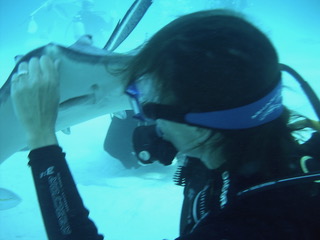
A woman of great passions, Nancia’s world is extensive. From her legendary Negroni martini, to her superb shrimp (and her knives are precisely sharp), to her underwater scuba adventures (where she says is her second favorite place on earth), to her world travels, and of course, to her music, Nancia is infinitely curious and devoted to impeccable excellence. She shares her life and passions with her husband, Giancarlo.
Travel Experiences and Adventures – Images courtesy of Nancia D’Alimonte
Nancia’s “second favorite place on earth” – Images courtesy of Nancia D’Alimonte
Nancia with her husband, Giancarlo D’Alimonte – images courtesy of Nancia D’Alimonte
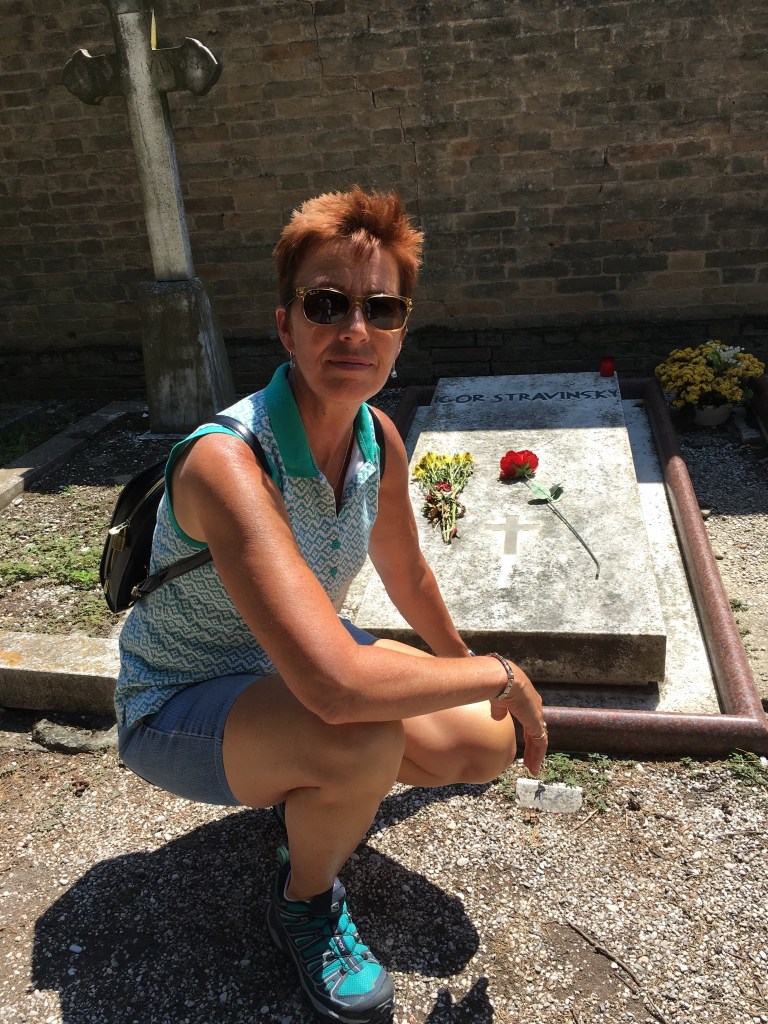
What kind of music does a conductor listen to when not working? “I love a wide variety of music. I love jazz, New Age, World Music, and of course the classics.” She enjoys Brahms, Bartok, and Mozart. The Rite of Spring by Igor Stravinsky and Mahler’s Symphony No. 1 are among her favorites.
Nancia – Authentic; Unstoppable.
“Humbled to be at the foot of Igor Stravinsky’s grave – Venice – Image courtesy of Nancia D’Alimonte
Celebrating 75 years of the Washington School of Ballet
Rising Star – Katherine Barkman PC: Screenshot of web production
Ballet lovers from around the world were invited to tune in for the first-ever LIVE online celebration of The Washington Ballet! Performances by The Washington Ballet artists and stories from students and faculty highlighted the event.
Ballet in Washington, D.C., under Artistic Director, Julie Kent, was beginning to soar and rival many American and international ballet companies. Their 2020 season promised to deliver breathtaking performances of classical ballets and repertoire. The season started with their exceptional production of Balanchine + Ashton in February to be followed by the full-length Swan Lake – music by Tchaikovsky. The classic ballet, Coppélia, to the music of Léo Delibes, was scheduled to premiere in May. Casting, choreography, costuming, and rehearsals were in progress. I planned to attend Coppélia and write a blog article about the performance.
PC: Screenshot
Producing a full length classical ballet is an very expensive and laborious process. The costuming alone, is extremely expensive with a single tutu potentially costing over $3000. The cost of costumes added to the salaries, overhead, and theater rental runs into the hundreds of thousands of dollars. Sold out productions, sponsors, grants, and patrons help cover these expenses. What happens when the curtain does not rise? The last Washington Ballet rehearsal was held on March 13 where snippets of a dress rehearsal of Act 3 were filmed.
The company staff and dancers are incredibly supportive, gracious, and optimistic for something wonderful to emerge from the current circumstances. Having been president of a pre-professional ballet company, I am aware of the magnificent cost involved in the production of every ballet.
Ballet Dancer Corey Landolt was honorary Mixologistfor the Gala PC: Screenshot
Tonight’s public virtual Gala was a wonderful way to bring the Washington Ballet to the City and to the world. The Gala were beautifully produced. There was a mix of executive, sponsor, and philanthropic recognitions along with a generous portion of stunning ballet performances. The 75th anniversary of the Washington School of Ballet begun by Mary Day and her mentor, Lisa Gardiner, was celebrated with joy and dignity.
Artistic Director, Julie Kent PC: Screenshot
The growth of The Washington Ballet under Julie Kent in just under four full years, has been remarkable. Like many Company patrons, I was eagarly anticipating the brilliance and excitement of the upcoming season. The Gala was elegant, classic, and was generously shared with the City and the world free of charge. The hope, being that donations would offset expenses and generate funds. During the event, donations came in ranging from just a few dollars to some with a several zeros at the end.
Monica Stephenson, Head of School, Southeast Campus. PC: Screenshot
In recognition of the 75th anniversary of the Washington School of Ballet, The Washington Ballet expressed their focus and goal of reaching city dancers and providing teaching and training opportunities regardless of dancers’ economic circumstances. Monica Stephenson, Head of School, Southeast Campus, The Washington Ballet, shared, “For our community of 1200 students, we kindle love, passion, interest and commitment. We encourage talent, creativity and integrity on all levels of the art stressing excellence in the classroom and on the stage. “ The interactive on-line ballet classes are helping students stay involved, active, and healthy. Ms. Stephenson emphasized the goal of, “Engaging in relevant dialogues in an unwavering commitment to our aspiration for the extraordinary. We work toward equitable excellence in artistic education and expanded diversity in classical ballet. It feels wonderful to be a part of dancers’ growth.”
“You can inspire the world with you dancing.” DC ballet student. PC: ScreenshotStudents ofThe WashingtonSchool of Ballet PC: Screenshot
Ms. Kent, in her mild, soft-spoken manner, introduced “An incredible evening of inspired performances.” Five performances, all very different and extremely engaging culminated with the final rehearsal of Act 3 of Swan Lake. At the end of each, I wished for “just a little more,” the mark of an exceptional artistic director.
Pas De Deux – Tamás Krizsa and Maki Onuki Performing “Together Apart” with “Backdrop of the Glorious National Cathedra,” JK PC: Screenshot Rench Soriano from the Philippines is a Washington Ballet Studio Company dancer performing 5 Variations on a theme by David Fernandez PC: Screenshot Women of the Company performing “Summer’s Heat” reliving the “Center Stage” movie experience. PC: Screenshot
Gil Delelio, Corey Landolt, Gian Carlo Perez, and Andile Ndlovu performing final scene from Somberisimo by Annabelle Lopez Ochoa TWB men representing Belgium, America, South Africa, and Cuba. PC: Screenshot
Katherine Barkman and Masanori Takiguchi in rehearsal of Act 3 Swan Lake PC:Screenshot
Ms. Kent closed the evening by saying, “At this time of tremendous loss and vulnerability, dance art is a celebration of humanity. We, at The Washington Ballet are ensuring artistic hopes and careers will live on and thrive. Thank you for your love and support.”
What can we do to support The Washington Ballet? Consider donating The art of dance transforms lives every contribution will help.
The Chamber Dance Project of Washington, D.C. Carries on Their Mission
When circumstances derail plans, creativity sets artists free to experiment with and present exceptional virtual opportunities to even more people than would have originally enjoyed performances. Such is the case for the Chamber Dance Project (CDP) in Washington, D.C.
Artistic Director and choreographer, Diane Coburn Bruning, founded the CDP because she believed that dance should be a collaborative process between dancers, musicians and the audience. That process, she says, “Deepens the audience’s experience.” They have grown to be Washington’s premier contemporary ballet company.
Their ballet season takes place in the summer when other companies and dancers are off. Because of this, CPD attracts and features exceptional dancers. Two such dancers are Austin Powers and his wife, Grace-Anne Powers. They are slated to dance in this summer’s CDP performances.
With theaters being dark now, this is an opportunity to expand creativity and communication with audience and patrons. CPD has moved their Open Rehearsals and Evenings with the Artist to on-line adventures via Zoom.
A recent Evening with the Artist featured Emmy Award – Winning ballerina, Grace-Anne Powers. She is a ballerina with Ohio’s BalletMet in the regular season. Grace-Anne met us from her living room in Ohio where she and her husband built a sprung wood floor upon which to rehearse. Typically, a dance floor is covered with a sheet of plastic called Marley which is both smooth and anti-slip for safe dancing. Resourcefully, the couple covered their floor with a fish pond liner instead. This decision was made based on economics and size of the floor.
The Shoe Must Fit – Grace-Anne Powers via Zoom
Pointe shoes are the quintessential piece of equipment for a ballerina. Pointe shoes are generally pink satin with pink ribbons that crisscross over the ankles. What else is there? Grace-Anne calls them, “The most beautiful and torturous item.” She spoke about the manufacturers, the construction, the fragility, and the importance of perfect fit of the beloved pointe shoe in a recent CDP Evening With An Artist.
Grace-Anne’s favorite pointe shoes are made by Freed of London. Every shoe is handmade by highly skilled craftsmen. The craftsmen each have their own mark that they place on the leather sole of the shoe. The “Butterfly” is the shoe that she finds most comfortable. The shoes are handmade just for her. “When I get a new pair of pointe shoes, I have to prepare them for dancing. The toe box is round. The first thing I do is flatten it so that it sits flat on top of my foot,” she demonstrated the process of putting the perfectly new shoe on the floor and unceremoniously stomps on it with her foot. The process continues with the insoles – tearing and cutting away until the arch is in the perfect place. Elastics and ribbons are sewed on and more maneuvering of the shoe continue until it fits like a glove. “It takes about two hours to prepare a pair of pointe shoes,” she told us.
A pair of shoes costs up to $125. Grace-Anne gets 40 pairs of pointe shoes form her home ballet company. “I have bendy feet that are stronger, so I tend to go through my shoes faster,” she explained. She tries to extend their lives with some unorthodox techniques involving jet glue.
pc: Austin Powers
Customizing The Custom Pointe Shoes Austin and Grace-Anne Powers
There is a fine line between being perfectly comfortable and “dead.” Dead shoes are not fit for dancing and can be harmful to the dancer. Did you know that the life of a pointe shoe is very short? Sometimes it is just a week and sometimes two weeks. Let’s see, they are satin, there is a leather outer sole, the sides are canvas with a satin outer shell. The “box” is made of fabric and cardboard and biodegradable materials like water soluble glue. Perspiration tends to dissolve the hardening materials of the box. For that reason, Grace-Anne has devised to coat inside of her well-fitting shoes with jet glue.
“There can be no movement in my shoe, so I double the elastics to keep them tight against my foot. Also, my ribbons are not just ribbons, I like my ribbons to give a little so they have some stretch and give. After the shoes have been flattened, potions cut out, and glued, Grace-Anne darns the pointe part of the shoe and creates a “box.” That also extends the life of the shoe and provides a flat space to “stand.” She uses a doubled macramé cord to create the rim then sews it onto the satin of the shoe. This further helps save the shoe in the contemporary repertoire when the angles become more exaggerated. “I wear a shoe that is a little larger than my foot to help me pad so that I keep corns and bunions from forming.”
The Life of the Pointe Shoe – from flat to “over-the-top”
Ill fitted shoes can cause blisters, bruised toe nails, bunions, even stress reactions. Properly fitted shoes are key to successful classes and performances. Grace-Anne experimented with different shoes, “Some had plastic in the toe. They lasted longer, but did not give me the correct fit and I could not fully articulate my foot. The Freed of London shoes give me the fit and articulation for artistry that I need. It is hard finding the right shoe. When you find the right shoe, it is no longer a foot inside a shoe, but it becomes a part of you.“
pc: Jennifer Zmuda
pc: Belimnda Carhartt
pc: Belimnda Carhartt
pc: Quinn B. Wharton
The Many Shapes of Grace-Anne Powers From Classical to Contemporary en pointe. Images courtesy of Grace-Anne Powers
A world-class ballerina, Grace-Anne, is comfortable with both the classical ballet repertoire and the contemporary realm. She is a perfect fit for CDP with her classical background and ability to extend into the extraordinary. “Contemporary ballet pushes you beyond the vertical and many times off-center. That is when pointe shoes deteriorate even faster since the contact with the floor changes dramatically and parts touch and wear faster,” she explained.
What does Grace-Anne find rewarding in dancing with CDP? “Working in smaller groups is very satisfying. Getting to know the people and the creativity is exciting,” she shared. She likes having the musicians on stage, “They help make dance spontaneous and interactive.” This season she and her husband, Austin, will have the opportunity to dance together. It will be a new experience for them to dance in a partnering capacity.
Grace-Anne Powers pc: Jennifer Zmuda Image courtesy of Grace-Anne Powers
Concluding the evening’s program, Grace-Anne and Austin demonstrated some partnering techniques and the resilience of their new floor. “With a partner, there is greater scope of movement, extension, and reach,” explained Grace-Anne and Austin. They are both able to stay in shape by working together, doing their own barre workouts, Austin works with weights, and there is lots of gardening for the both of them at their new home.
About the 2020 Season, Diane Coburn Bruning said, “I have utmost optimism for our season. For now, we will remain virtual. We are Nimble and creatively flexible.”
Powers’ presentation and Q&A is the first of four planned for May with dancer Julia Erickson discussed transitioning from classical to contemporary ballet roles on May 12. Luz San Miguel and Davit Hovhannisyan will demonstrate classical ballet partnering on May 19 and contemporary ballet partnering on May 26. For further scheduling, please visit the CDP website.
Imagine being greeted by a sophisticated musical composition by your children! That is exactly what happened when 13-year-old Sofia and 10-year-old Saul played their newly composed music for violin and cello.
World Premier Composition for S 8 Video Courtesy of Alan Saucedo
Of their first composition together, Sofia said, “We wanted to surprise our parents. I composed the melody and Saul helped arrange it for cello.” This is what the Saucedo children do in their spare time between school work, music lessons in violin, cello, and piano, and working toward their Second Degree Taekwondo Black Belts.
Their musical family thrives on love, beautiful music, tasty meals and delicious cakes. The Saucedos, father, Alan, is a PhD cellist, mother, Miho Sato, is a pianist and singer who works in music therapy and teaches voice and piano, the children, Saul and Sofia, study under their parents’ and aunt, Cynthia’s tutelage. Alan loves to prepare meals and bake amazing cakes.
What did their parents think about their composition? “I liked it very much! It was very touching and beautiful – look what they did for us,” said Miho. Dad, Alan said, “ I loved it! I encouraged the children to write it all down before it disappeared. I videoed it several times until they were happy with the video.”
I asked Saul to tell me about his arranging process. He told me, “I listened to Sophia’s melody. Then, I experimented with notes and phrases until we liked the sound.” And that is how the composition came to life!
1/4th Cello and full size cello – Sweet Music! Video Courtesy of Alan Saucedo
“Is it difficult learning from your parents?” I asked Saul and Sofia. “It’s fun! We understand each other and we like to learn,” Said Sofia. Dad, chimed in, “There have been some tears, but at this stage, they have the tools with which to problem solve and teaching is more guidance and skill honing. The lessons address specific things to make the music beautiful and expressive.”
Sofia and Saul both take piano in addition to their individual string instruments, they volunteered that while they love the piano as well as their strings, that strings are their favorites. Mom teaches them piano. Alan teaches cello. Their aunt, Alan’s sister, Cynthia, a concert violinist, teaches violin.
Saul plays a ¼ cello while Sofia plays a full sized violin. Saul started with a 1/10th cello at 4 years old and Sofia began with a 1/8th sized violin at four and a half years old.
The Entire Family – Pachelbel’s Cannon in D MIho on Piano, Cynthia on Violin, Sofia on Violin, Saul on Cello, Alan on Cello Video Courtesy of Alan Saucedo
The entire family creates beautiful music together. Alan, is always researching interesting music from around the world, and likes to introduce Mexican and Spanish classical works. Miho majored in voice from an oratorio perspective as well as piano. One of her favorite songs is Schumann’s “Lotus Flower.”
What are the children’s hobbies besides music and martial arts? Art – drawing and collages. They are precise in everything that they do. It goes without saying that they excel in their academics as much as they do in their other endeavors. They attend public school where Saul is in fourth grade and Sofia is in seventh grade. Their favorite subjects are science, math, history, and social studies.
Beautiful Birthday Cards Created by Saul (left) and Sofia (R) for Miho’s Birthday
The day that we spoke, was Miho’s birthday. Alan had a fun meal planned with barbecue ribs and a chocolate flan cake, “a Mexican chocolate cake.” Saul and Sofia like ice cream. Saul likes mango ice cream and chocolate mint chip. Sofia likes cookies and cream, vanilla, or strawberry. With so many wonderful flavors, it is hard to choose just one!
Saul, S and Alanin concertMiho in concertSofia Image Courtesy of Alan Saucedo
One parting question for Sofia and Saul – how much practicing do they do? They replied that they practice and study as much as is necessary to meet individual goals. Sometimes 20 minutes, other times, an one hour. They are goals centered and know what they want to accomplish.
Sofia and Saul call themselves, “S 8”
I hope that you love and enjoy their wonderful music!
Ballerina. She is as powerful as a panther and as graceful as a gazelle. She speaks not a word but can bring you to tears. She is beautiful, she is intuitive, she is a storyteller, and she is refined yet disciplined. She dances to delight the audience.
George Balanchine, choreographer and founder of the New York City Ballet said, “I don’t want people who dance. I want people who have to dance.” Ballerina, Dahlia Denicore has to dance.
Dahlia Photo by Chas Sumser Image Courtesy of Dahlia Denicore
“I want to bring my very best to the audience who has taken the time and spent their money to come see the performance. I love them and have been preparing all my life for this day,” says Dahlia, senior ballerina with the Loudoun Ballet Performing Arts Company. There are many virtuoso ballerinas, yet very few can connect on a level where they are dancing just for you. An exceptional ballerina transports the audience to the magical place and events of the story.
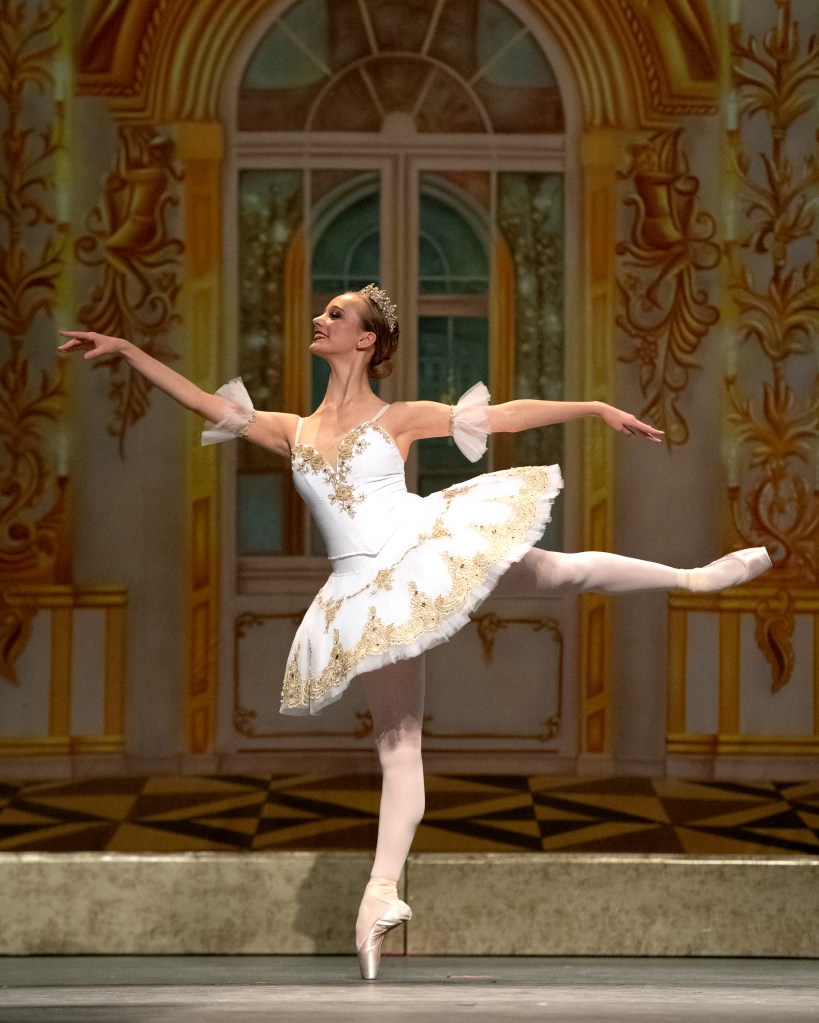
From Sleeping Beauty Photo by Chas Sumser Image Courtesy of Dahlia Denicore
Not yet 18, Dahlia, is a ballerina in every sense of the word. She says, “I love performing; telling the story and connecting with the audience on a personal level.” She bring a character to life through movement, expression, musicality, line, to the smallest tilt of her chin, glance of her eye, or reach of her finger.
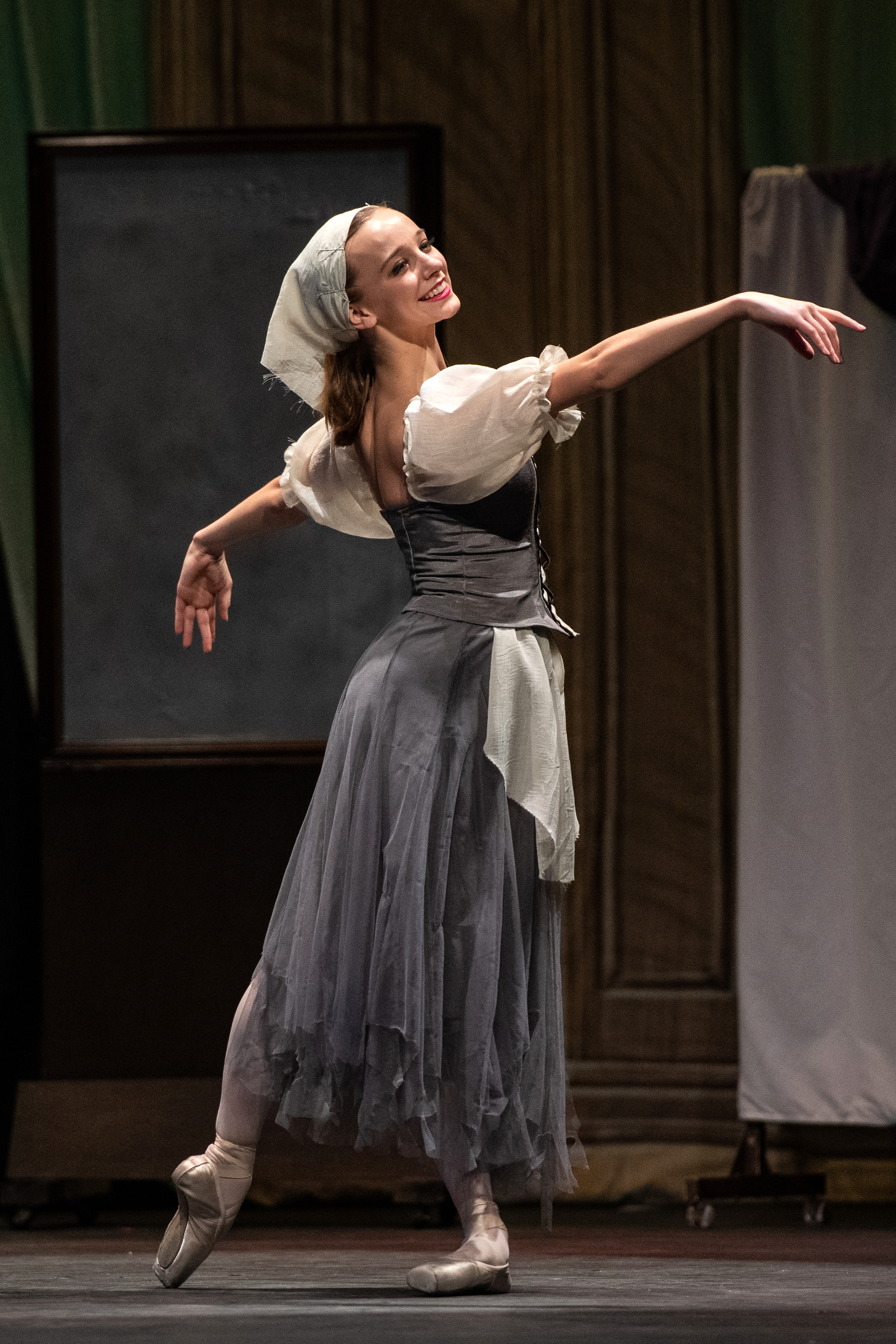
Cinderella photo credit: Chas Sumser Image Courtesy of Dahlia Denicore
Cinderella Photo by Chas Sumser Image Courtesy of Dahlia Denicore
Dahlia’s roles with the preprofessional ballet company have included most, if not all leading roles including Clara, the Sugar Plum Fairy, Cinderella, Alice, Snow Queen, Arabian Princess, and Odette. She has danced supporting and corps roles with the same enthusiasm and passion. She invests herself entirely.
Photo by Chas Sumser Image Courtesy of Dahlia Denicore
“What does it feel like on the day of a performance?” I asked Dahlia. She told me, “On show day, everything I do is for the show. I know that I am prepared. Yet, the excitement and the nerves are very real. I have a set pre-performance routine,” she told me. Interestingly, her warm-up and run through of choreography is not to the performance music, but to a completely different genre of music. “I love all music. I love jazz, pop, 80’s music. It inspires me,” she told me. “Before the performance, I go through barre and floor exercises. I work on my feet by rolling up and down and flexing and relaxing every joint and muscle. Then I put on my pointe shoes and again work my feet stretching, and rising and rolling, to get blood flowing. I keep practicing until the show.”
Staying focused is paramount for a successful and safe performance. In ballet, timing is everything. Pre-show, Dahlia relies on her ear buds to deliver music and keep her focused. Maintaining focus is a learned skill of ballet training. Dahlia explained that she listened to a phycology podcast about nerves, “I learned that people are nervous because they are afraid of being afraid. When I know that I am nervous, I accept it. I know that I will do what I love. Then, I feel my feet sink back into the ground. I visualize the performance and get lost in the story and the emotion of the moment.”
Before the curtain rises, “Roll-down sequences tell me it’s time to go. It wakes up my body,” she explained. Finally, positions and places and the music begins. “On stage, I am living it up! My nerves give way to my love and passion for the dance and pleasing the audience,” says Dahlia.
Asked about her character development, Dahlia explained, “I become that character. When I danced the Arabian Princess in Nutcracker, ‘I AM the Arabian Princess.’ I love to stay in the zone.”
Arabian Princess – The Nutcracker Photo Credit: Chas Sumser Image Courtesy of Dahlia Denicore
Staying focused is paramount for a successful and safe performance. In ballet, timing is everything. Pre-show, Dahlia relies on her ear buds to deliver music and keep her focused. Maintaining focus is a learned skill of ballet training. Dahlia explained that she listened to a phycology podcast about nerves, “I learned that people are nervous because they are afraid of being afraid. When I know that I am nervous, I accept it. I know that I will do what I love. Then, I feel my feet sink back into the ground. I visualize the performance and get lost in the story and the emotion of the moment.”
Snow Queen – Dahlia at age 15 Photo Credit: Chas Sumser
How do I know Dahlia? I am a crazy ballet girl who once danced with a burning passion and refused to settle for ‘good.’ Several years ago, my husband and I happened to be invited to fill stage space in a ballet production as ball guests. There was 14-year-old Dahlia, with the brightest genuine smile, the captivating eye contact, and the beautiful dancing. She caught my attention as someone going places. Because I happen to be friends with the company’s artistic director, I was pulled into way too much participation, but the result was developing a relationship with what the French would call, the “etoile,” Dahlia.
Dahlia repeatedly surprised me with her characters’ development, her emotional involvement, and her connection with the other dancers and the audience. There is a point where choreography ends and personal involvement takes over to reach to the back of the auditorium. How does one so young, accomplish something so difficult that many mature prima ballerinas lack? “I love acting. I have done some community theater. I love to tell the story,” she shared.
New York! Image Courtesy of Dahlia Denicore
In addition to performing with the preprofessional company, Dahlia has competed in the Youth America Grand Prix in Pittsburgh. She won the junior ballet division and competed in New York. This year she placed second in contemporary and in the top 12 in ballet. “I see myself more of a performer than a competitor,” said Dahlia. “In a performance, I tell the story. In a competition, there is very little time to develop the character. I have to bring the character with me and to bring it to life in the few minutes on stage.” She elaborated that competition is very helpful in developing her stage and dance skills . She loves the classes during the event.
In any given week, Dahlia will dance up to 40 hours. She takes class, has private coaching, and rehearsals every week. She is completing her first college year where she is earning top grades and excels in the sciences. While her time precludes her from acting in community theater, she stays involved by providing choreography for their shows.
In the Wings Photo Credit: Chas Sumser Image Courtesy of Dahlia Denicore
“How do you feel when a performance ends?” I asked her. Dahlia told me, “The most special part of a performance is the curtsey and audience appreciation. That day is high adrenaline and joyful. The following day feels like something is missing and somewhat sad. Yet, I try to stay hopeful and happy for the next performance.”
A Break From a Masterclass at Kennedy Center Image Courtesy of Dahlia Denicore
Dahlia has been studying ballet since she was two years old. In addition to her regular ballet and contemporary classes, she takes masterclasses with most of the major ballet companies that come to the Kennedy Center. She stands on the threshold of her professional career. She has received a number of offers from amazing ballet companies. In the summer she will be attending the San Francisco Ballet’s Summer Intensive program. She is evaluating opportunities for the coming year.
The “Dancing Denicores“ Images Courtesy of Dahlia Denicore
Dahlia is the oldest of three exceptional dancing children. She and her family live in the historic village of Waterford, Virginia where they have a fluffy dog, named Toby, a cat, a rabbit, and several chickens. Her younger sister, Daisy, is a beautiful ballerina, her brother, Tucker is an incredible singer and dancer who loves baseball and theater, although he has been “Fritz” in the Nutcracker for many years. Their mother, Amy, helps support the ballet company by sewing costumes, writing for grants, and getting the family fed. Their father, Mark, an attorney, is co-founder of Changing Latitudes, a non-profit organization focusing on education in Haiti where Dahlia has also worked during summer and spring break vacations.
Applause! “The most special part of a performance is the curtsey and audience appreciation. with Norbert Nirewicz Photo Credit: Chas Sumser Image Courtesy of Dahlia Denicore
Pansies, Henri Fantin-Latour, 1874, National Gallery of Art, Washington DC
“The world will surprise you with its grace,” is a line from a movie that I have watched many times. In today’s environment, this line has been brought to fruition in the most generous ways. We are all affected in how we move about, how we work, how we interact with friends and family, and how we entertain ourselves.
Detail of Frederick Edwin Church El Rio de Luz National Gallery of Art, Washington, D.C.
As in Sleeping Beauty, theater, music, art, dance, intellectually stimulating courses, and much of our in-person physical activities have ceased for the moment. However, the outpouring of generosity on the part of performers, museums, theaters, educators, and trainers have amazed me over and over. Sometimes I have blinked to be sure that what I was reading is true. And, so it is. We need grace and must exercise generosity now. We need the arts now more than ever. What better way to experience grace and generosity now?
Washington, DC
Westminster, London
Palais Garnier Paris
Louvre Paris
Royal Opera House London
Royal Opera House London
From Paris to Seoul, from London to Washington, DC , Florence to New York City, and from Harvard to Yale, and Princeton, along with many others, the best and greatest are sharing with us their best and greatest. We can nourish our souls (this is not a theological article) profoundly by a click on our computers . We can regroup. Perhaps this is our opportunity to explore, learn, reinforce, and discover the beauty of the arts. Our souls will be better for it.
Tea . . . Fortnum and Mason
Fortnum and Mason
Through my love for the arts, I feel like a kid in a candy store – where to go first – what to watch first?? Actually, I am feeling like I did on my first visit to Fortnum and Mason, “Must focus. Time is fleeting.”
Oliver Lee Jackson exhibition 2019 at NGA East Wing
The Lacemaker Johannes Vermeer
Allies Day, May 1917 Childe Hassah
A Young Girl Reading by Jean-Honoré Fragonard
To help make the most of our situation, I have compiled links to complimentary (some are pay what you can) videos from some of the world’s greatest resources. To these generous and gracious people and organizations, I give heartfelt thanks. Please remember them when times change and support them by become patrons, buying tickets, attending exhibitions, and buying future streaming services. They have gone above and beyond our expectations to feed our souls with beauty, creativity, adventure, and grace.
12 Museums offer virtual tours – from the Guggenheim and the Washington National Gallery of Art to the Uffizi, to the British Museum, London, and so many repositories of treasured art throughout the world
HBO provides movies, programs, and documentaries free to stream
Amazon Prime SXSW 2020 Film Festival – ““Prime Video presents the SXSW 2020 Film Festival Collection” offers filmmakers in the 2020 SXSW Film Festival lineup an invitation to opt in to take part in this online film festival, which will play exclusively on Prime Video in the U.S. for 10-days. The one-time event will be available in front of the Prime Video paywall and free to all audiences around the country, with or without an Amazon Prime membership, all that is needed is a free Amazon account.”











































 Good News. Reviews. Events.